

 Hong Kong



 Singapore



 UAE
UAE



 Malaysia


 Turkey


 UK
UK
 EU
EU
 US
US
 Switzerland
 Bahamas Bank Account
 Cayman Islands Bank Account
 Mauritius Bank Account
 BVI
BVI
 Seychelles

Imagine this: you're on the verge of closing a game-changing merger, but a key director suddenly goes off-grid. The entire deal grinds to a halt. Contracts hang in the balance, and a golden opportunity starts to fade. This is precisely the kind of chaos a Power of Attorney (POA) is built to prevent. Governed by Hong Kong's legal framework, a POA isn't just another dense legal document; it's one of the most vital business continuity tools in your arsenal. The Power of Attorney Ordinance lays down the rules for this essential safeguard, making sure your business can keep moving forward, even when key people can't.
Why a Power of Attorney Ordinance Should Matter to You
As an entrepreneur, you're the engine of your company. But what happens if you’re unexpectedly hospitalised, stranded abroad, or simply unable to sign a time-sensitive contract? Without a contingency plan, your operations could be completely paralysed. The power of attorney ordinance in Hong Kong provides the legal rails to keep your business running smoothly through exactly this kind of crisis.
Think of a POA as giving someone a spare key to your business controls, but with very specific instructions on when and how they can use it. It's a legal instrument where you (the "donor") appoint a trusted person or institution (the "attorney") to handle your financial and business affairs. This isn't just about disaster planning; it's a smart, strategic move for maintaining operational agility.
The Two Flavours of POA: General vs. Enduring
Hong Kong law splits the Power of Attorney into two distinct types, and for a business owner, knowing the difference is vital.
Here's a quick comparison to see how they stack up for business use.
General POA vs Enduring POA for Business Owners
| Feature | General Power of Attorney (GPA) | Enduring Power of Attorney (EPA) |
|---|---|---|
| When It's Valid | Only while the donor is mentally capable. | Remains valid even if the donor loses mental capacity. |
| Primary Use Case | Short-term absences (e.g., travel, temporary illness). | Long-term planning, protecting against unforeseen incapacity. |
| Business Application | Authorising someone to sign contracts or manage banking while you are on a month-long trip overseas. | Ensuring the business continues to run if the founder has a serious accident or develops a degenerative illness. |
| Legal Basis | Powers of Attorney Ordinance (Cap. 31) | Enduring Powers of Attorney Ordinance (Cap. 501) |
The introduction of the Enduring Powers of Attorney Ordinance (Cap. 501) back on 1 July 1997 was a landmark moment for asset protection in Hong Kong. It created the EPA, a special tool allowing an attorney to manage financial affairs even after the donor becomes mentally incapacitated—something a standard POA could never do. You can dig into the history on the Hong Kong Department of Justice's website.
For any small or medium-sized business, an EPA is a powerful safety net. It means if a sole director is incapacitated, an appointed attorney can still pay salaries, manage bank accounts, and make critical decisions, preventing the business from collapsing.
This distinction is absolutely crucial for your business continuity planning. A GPA is perfect for short-term, predictable absences. An EPA, on the other hand, is your long-term shield against personal tragedy, protecting not just your personal wealth but the future of the company you've built.
Putting these legal safeguards in place can feel complex, which is why working with a professional who provides a comprehensive company secretary service is often the best first step. They can help integrate the right type of POA directly into your corporate governance structure.
How Legal Reforms Forged Today’s Power of Attorney
A law is only as strong as its real-world application. The history of Hong Kong's power of attorney ordinance, particularly when it comes to Enduring Powers of Attorney (EPAs), is a perfect case study of a legal framework adapting to meet genuine business needs. It’s a classic tale of great intentions hitting practical roadblocks, followed by crucial reforms that finally made the law work for entrepreneurs like you.
When the Enduring Powers of Attorney Ordinance (Cap. 501) first came on the scene in 1997, it aimed to solve a massive problem: how do you manage someone's financial affairs after they’ve lost mental capacity? For a business founder, this was about protecting their company if they were suddenly unable to call the shots. The problem was, the original rules were so clunky and restrictive that almost no one used them.
Think about it. The original law required you to get a solicitor and a medical doctor in the same room, at the exact same time, just to watch you sign the EPA. For any busy professional, that kind of logistical nightmare made the whole process a non-starter. The law was sound in principle, but in practice, it just wasn't working.
The Turning Point: The 2011 Amendments
The incredibly low adoption rate sent a clear message: something had to give. For a full decade after the ordinance was introduced, its impact was virtually non-existent.
In fact, research from the Law Reform Commission showed just how badly the law was failing. Between 1997 and 2007, the number of registered EPAs was shockingly low—only a "handful" were ever recorded, which was miles behind international standards. The main culprit? Those impossible witnessing requirements. Acting on recommendations from a March 2008 report, the government passed the 2011 Amendment Ordinance to streamline the entire system. You can dive deeper into the full history by reading the Law Reform Commission's detailed report.
This reform was a complete game-changer. The two most important changes were:
- Scrapping the Medical Witness Rule: The requirement for a doctor’s presence was eliminated, which instantly made the EPA far more accessible.
- Clarifying the Solicitor's Role: The duty was now squarely on the solicitor to ensure the person signing the EPA fully understood what they were agreeing to.
This wasn't just a minor administrative update. It was a fundamental shift that turned the EPA from a theoretical legal concept into a genuinely practical tool for business continuity.
Why This History Matters for Your Business Today
Knowing how we got here is crucial because it highlights why the EPA has become such a powerful and easy-to-use safeguard. The reforms were a direct acknowledgement that for a power of attorney ordinance to be effective, it needs to be simple enough for busy business owners to actually put in place.
The 2011 amendments effectively democratised the EPA. It became a viable succession and protection tool not just for the super-wealthy, but for every SME founder in Hong Kong who needs a solid plan for the unexpected.
Today, you don’t have to jump through the bureaucratic hoops that once made creating an EPA a logistical headache. The modern, streamlined process means you can efficiently set up a plan to ensure your business keeps running—paying bills, signing contracts, and managing staff—even if you're medically unable to do so yourself. This history isn't just a legal footnote; it’s the very reason you now have a reliable way to protect everything you've built.
Will Your Hong Kong POA Work Abroad?
So you’ve sorted out a Power of Attorney under Hong Kong's ordinance. That’s a great first step, but it’s only the beginning if your business has any kind of global footprint. The real test is when your attorney needs to finalise a deal in Singapore, get into a corporate account in London, or handle an asset over in the UAE.
Will your Hong Kong POA actually work there? The honest answer is: it depends.
A Hong Kong POA isn’t some magic, universal key that unlocks every international door. Every country has its own legal system, its own rules, and its own expectations. If you just show up with your standard Hong Kong document at a foreign bank or government office, you’re likely to be met with confusion, which quickly turns into frustrating—and expensive—delays. This is where you run into the maze of cross-border legal validation.
The whole issue boils down to one thing: proving to a foreign entity that your Hong Kong document is authentic and legally sound. Without that proof, they have no way to know if the signature is real, the notary is legitimate, or that the whole thing was done correctly according to Hong Kong law.
The Two Roads to International Recognition
To get your Hong Kong POA recognised overseas, you'll generally follow one of two paths, and the one you take depends entirely on the destination country.
-
Apostille: This is the simpler route. If the country is a member of the 1961 Hague Convention, you just need an "apostille". Think of it as a special certificate that Hong Kong’s High Court staples to your POA. It acts like an internationally recognised seal of approval, confirming the document is legit.
-
Legalisation: For countries not in the Hague Convention, things get more complicated. Legalisation is a chain of verifications. It usually starts with a Hong Kong notary, then gets authenticated by the High Court, and finally, it has to be validated by the destination country's own embassy or consulate here in Hong Kong.
An apostille is like an international passport for your document—it's good in over 120 countries. Legalisation is more like getting a specific visa for every single country you want to visit. It's a bespoke process, and it almost always takes more time and effort.
We often see Hong Kong entrepreneurs hit a wall when trying to manage an overseas bank account with a POA. The foreign bank, buried under its own anti-money laundering rules, will reject a document flat out if it hasn't been apostilled or legalised. Suddenly, critical business funds are frozen, and it’s always at the worst possible moment.
Cross-Border POA Recognition Checklist
Getting this right isn’t just about ticking a box; it’s about strategic planning. A mistake in one country can bring your entire international operation to a grinding halt, especially when it comes to money. For instance, if you need to open a business bank account remotely, a properly authenticated POA can be the make-or-break factor.
To give you a clearer picture, here are some key considerations for ensuring your Hong Kong Power of Attorney is effective in major business hubs.
| Jurisdiction | Key Recognition Requirement | Common Pitfall for Businesses |
|---|---|---|
| United Kingdom | Apostille (Hague Convention Member) | Foreign banks often scrutinise the specific powers granted, rejecting POAs that are too general. |
| Singapore | Apostille (Hague Convention Member) | Real estate transactions have very strict rules; the POA must precisely match Singapore's property law terminology. |
| UAE (Dubai) | Legalisation | The document often needs to be translated into Arabic by a sworn translator, and the legalisation chain is complex. |
| Mainland China | Legalisation via a specific attesting officer recognised by Mainland authorities. | Using a standard notary public is not sufficient; the process is unique and must be followed exactly. |
In the end, drafting a document under the power of attorney ordinance is only half the battle. If you want the authority you grant to actually travel with your business, you have to think ahead. Figure out where the POA will be used and get the apostille or legalisation process started early. That foresight is what stops your strategic safeguard from becoming a useless piece of paper right when you need it most.
Drafting a Rock-Solid Power of Attorney for Your Company
A vague or poorly drafted Power of Attorney is a ticking time bomb. It can invite legal challenges, create operational chaos, and ultimately fail you right when your business needs it most. Let's forget the dense legal jargon for a moment and treat this as a practical workshop for forging a POA that acts as an ironclad shield for your company.
Think of it like programming a robot to run the business in your absence. If your instructions are ambiguous—"make good decisions"—the robot might just sell off your most valuable asset. But if you give it precise, clear commands—"pay salaries up to HK$500,000, sign contracts pre-approved by the board, but never sell company real estate"—it will execute your wishes perfectly. The devil is truly in the details.
The goal here is to create a document so clear that it leaves zero room for misinterpretation. That very precision is what separates a useful legal tool from a future courtroom battle.
Defining the Scope of Authority with Surgical Precision
The single most critical part of any POA is defining the exact powers you are granting. Generic phrases like "to manage my business affairs" are an open invitation for trouble. What you need is to be specific and intentional, clearly outlining what your attorney can and, just as importantly, cannot do.
Let's look at a few key areas and how to nail down the specifics:
- Financial Management: Instead of a vague "manage bank accounts," specify which accounts (by number and institution) and what actions are permitted. For example: "Authority to draw cheques, make electronic transfers, and pay invoices from ABC Bank Account #123-456, but with a single transaction limit of HK$100,000."
- Contractual Powers: Rather than a blanket "sign contracts," detail the types and values of agreements. A much better clause would be: "Power to execute service agreements with vendors up to a total value of HK$250,000 per quarter. Any contract exceeding this amount requires written approval from a non-executive director."
- Asset Management: Avoid loose permissions like "handle property." Be explicit: "Authority to manage the rental of the commercial property at [Address] but expressly forbidden from selling, mortgaging, or otherwise encumbering this asset."
This level of detail gives your attorney the flexibility to act on your behalf without handing over the unchecked power to make decisions that could harm the company. When you are incorporating a company in Hong Kong, thinking about these contingency plans from day one is a hallmark of a mature and resilient business strategy.
Building Safeguards into Your POA
A strong POA doesn't just grant power; it builds in checks and balances to prevent misuse. These safeguards are what protect your business and ensure the attorney remains accountable. The real-world effectiveness of your POA hinges on these protective clauses, which are a core part of any well-drafted document under a power of attorney ordinance.
The real strength of a Power of Attorney lies not just in the authority it delegates, but in the limitations it imposes. Smart entrepreneurs grant power with one hand and install guardrails with the other to ensure their vision is protected, no matter what.
Here are a few essential safeguards to build in:
- Reporting Requirements: Mandate regular updates. A clause could state, "The Attorney must provide a detailed monthly report of all financial transactions and decisions made under this Power of Attorney to the company's designated accountant."
- Activation Triggers: For an Enduring Power of Attorney, be precise about what kicks it into gear. For instance, "This EPA becomes effective only upon the written certification of two independent medical practitioners that the donor has lost mental capacity."
- Conflict of Interest Clauses: Explicitly prohibit the attorney from self-dealing. You need wording like, "The Attorney is forbidden from entering into any transaction on behalf of the company in which the Attorney or their immediate family has a personal financial interest."
This flowchart shows the high-level process for getting a POA recognised internationally, which always starts with a well-drafted document.
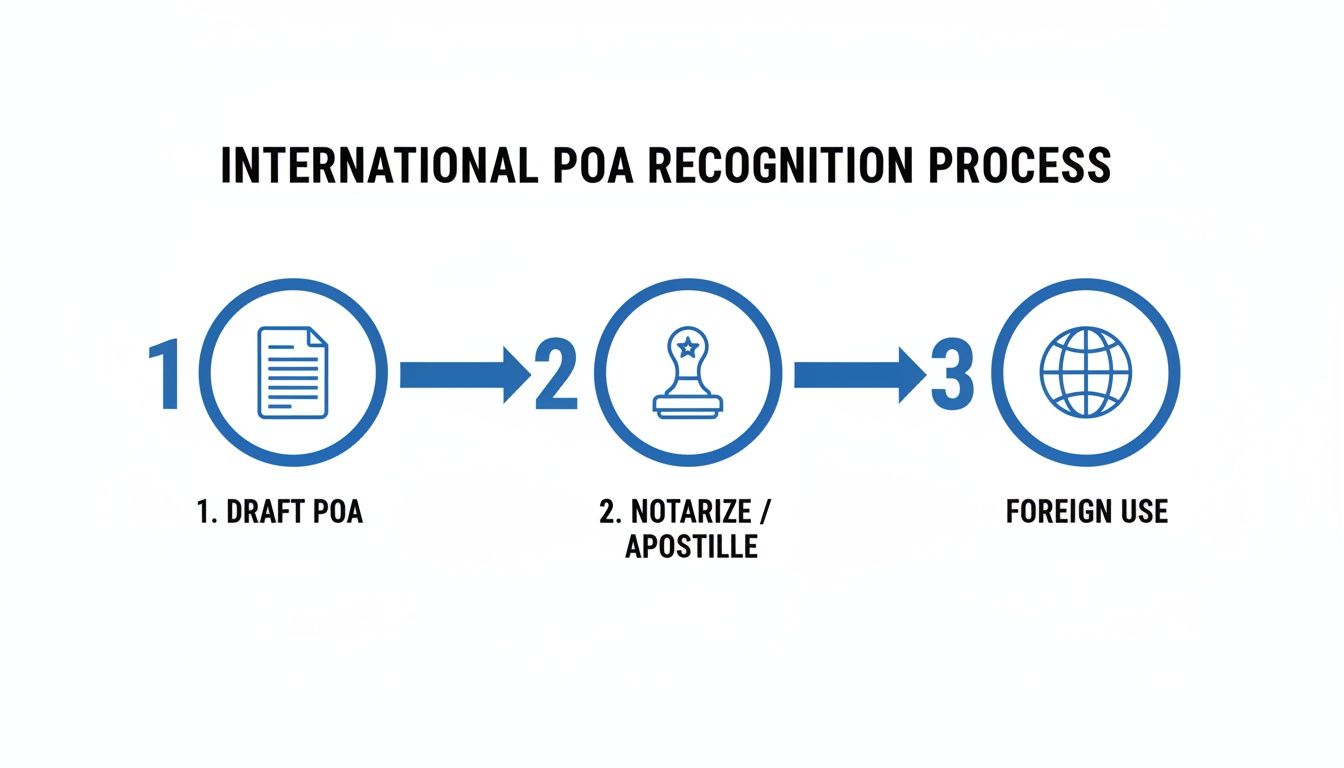
As you can see, drafting the document correctly is the foundational step. Before any international validation like notarisation or an apostille can even begin, the POA itself must be solid.
New technologies can certainly help get the ball rolling; you might explore resources on AI tools for drafting Power of Attorney) to streamline the initial process. But remember, these tools should supplement, not replace, professional legal advice tailored to your specific business and jurisdiction. Crafting a rock-solid POA is a direct investment in your company’s stability and future.
Managing Risks and Preventing Misuse

Handing over the keys to your business is an act of immense trust. A Power of Attorney is a powerful tool for ensuring things keep running, but it’s not without its dangers. Unauthorised deals, poor judgement calls, or even outright fraud by an attorney can have devastating consequences. Facing these risks head-on isn’t about being paranoid; it's about smart, proactive governance.
The entire framework of the power of attorney ordinance rests on the idea of delegated authority, but that delegation has to be managed with incredible care. Your first line of defence is always the person you choose.
Selecting a Trustworthy Attorney
The choice of attorney is the single most critical decision in this entire process. This goes far beyond just picking a close friend or a family member. You need someone with unimpeachable integrity, sound business sense, and the ability to handle complex financial matters under real pressure.
Think of it like choosing a co-pilot for your business jet. You wouldn't just pick someone you like; you’d want a skilled aviator who knows how to navigate storms and will always prioritise the safety of the aircraft and its passengers. Your attorney has to be someone who will act in your company’s best interest, even when it’s difficult.
A dramatic surge in Enduring Power of Attorney registrations in Hong Kong shows just how seriously people are taking these decisions. High Court Registry data reveals registrations almost doubled from 560 in 2020 to 1,109 in 2021. This trend is driven by a greater awareness of the risks of incapacity. As Hong Kong's population ages, with a median age of 46.3 in 2021, more business owners are using the Enduring Powers of Attorney Ordinance to secure their futures, making the selection of a trustworthy attorney more crucial than ever.
Structural Safeguards to Build In
Beyond picking the right person, you can build safeguards directly into the POA document itself. These are the legal guardrails that guide your attorney's actions and create a system of checks and balances.
A well-drafted POA should never be a blank cheque. By embedding clear limitations and accountability mechanisms, you can grant the authority needed while closing the door on potential misuse.
Here are a few practical strategies to consider:
- Appoint Joint Attorneys: Instead of one person, you can appoint two or more attorneys who must act together ("jointly"). This creates an immediate layer of oversight, as no single individual can make a unilateral decision.
- Require Dual Signatures: For significant transactions, like selling company property or authorising payments over a certain amount, you can mandate that two attorneys (or an attorney and a designated third party) must sign off.
- Mandate Regular Reporting: Include a clause requiring your attorney to provide regular, detailed financial reports to a trusted third party, such as your company's accountant or a non-executive director. This ensures transparency and accountability.
- Set Clear Financial Limits: Explicitly state the maximum value for transactions the attorney can authorise without needing additional approval. This is a simple way to prevent large-scale misuse of company funds.
A Power of Attorney with built-in checks and balances is like a corporate governance policy for one. It establishes clear rules of engagement, defines accountability, and ensures that delegated power never goes unchecked.
To really get a handle on the risks, businesses should also establish effective conflict of interest policies for their agents. By combining a carefully vetted attorney with robust structural safeguards, you can use a POA with confidence, knowing it's a shield for your business, not a vulnerability.
Your Power of Attorney Action Plan
Knowing the theory behind a power of attorney ordinance is one thing, but actually putting that knowledge into practice is what will safeguard your business. It's time to move from understanding the concepts to taking decisive action. This is the final, critical step.
Think of this as your roadmap. It’s a straightforward, actionable plan designed to help you secure your company's future and build a more resilient operation, ready for whatever comes next.
Step 1: Pinpoint Your Key Dependencies
Before a single word of a legal document is written, you need a clear-eyed view of your vulnerabilities. Who in your company holds the keys to the kingdom? If they were suddenly out of the picture, even for a short time, what would grind to a halt?
Run through a few "what if" scenarios:
- Banking: Who is the sole signatory on your main corporate account? What happens if they can't approve a crucial payment?
- Contracts: Who has the authority to sign a game-changing client agreement or greenlight a major purchase from a supplier?
- Operations: Who pushes the button on payroll each month or makes those critical, on-the-ground decisions during an emergency?
Laying out these dependencies shows you exactly where you're exposed and where a POA is most urgently needed.
A business continuity plan without a Power of Attorney is like a fire escape with a locked door. It looks good on paper but fails completely in a real emergency. Identifying your key-person risks is how you find that lock and get the right key.
Step 2: Get Ready for Your Legal Consultation
Once you've mapped out your risks, it's time to talk to a legal expert. To get the most out of that meeting (and your legal fees), you need to walk in prepared. A good lawyer will certainly guide the conversation, but having your own list of questions ensures you cover all the bases that matter to your specific business.
This preparation transforms a general legal chat into a focused, strategic session.
Questions to Ask Your Legal Counsel
Here are a few essential questions to have in your back pocket for that meeting:
- Given our business structure and key people, would a General or an Enduring Power of Attorney be a better fit?
- What specific powers should we grant to keep the lights on without handing over complete control? Let's talk about limitations.
- Can we appoint joint attorneys to create a system of checks and balances, especially for significant financial moves?
- In Hong Kong, what are the precise legal triggers that would activate an Enduring POA? How is incapacity proven?
- We do business internationally. What do we need to do—like getting an apostille or legalisation—to make sure our POA is actually recognised in our main overseas markets?
- How can we define and document potential conflicts of interest for the person we appoint as our attorney?
Taking these concrete steps turns the power of attorney ordinance from an abstract legal idea into a practical, powerful tool that protects the business you've worked so hard to build.
Frequently Asked Questions
For any busy entrepreneur, the legalities around a power of attorney ordinance can feel a bit overwhelming. To cut through the noise, we've put together answers to some of the questions we hear most often from business owners in Hong Kong who are looking to put this crucial safeguard in place.
Can I Just Appoint My Business Partner as My Attorney?
Absolutely, and it's a very popular choice for good reason. Your partner already has their finger on the pulse of the business—they know the operations, the financials, and where the company is headed. This existing knowledge can make for a smooth transition if they ever need to step in.
The key, however, is to think through potential conflicts of interest beforehand. A well-drafted Power of Attorney will set clear boundaries and limitations. This isn’t about mistrust; it’s about protecting both your personal interests and the company, ensuring everyone is on the same page and avoiding messy disputes later on.
What’s the Worst That Could Happen If I Don't Have a POA?
If you’re suddenly incapacitated or simply out of reach and you don’t have a POA, your business could grind to a halt. Think about it: without legal authority, no one can sign that urgent contract, access the company bank account to make payroll, or make critical decisions that can't wait.
This kind of operational paralysis can be a death sentence for a small or medium-sized business. Your family or partners would have to go to court to get someone appointed to manage your affairs. That process is notoriously slow, costly, and public—laying your business's vulnerabilities bare for all to see.
A POA is your contingency plan. It lets you pre-authorise a trusted person to take the reins immediately, keeping the business running without any costly legal drama.
Does My POA Need to Be Registered?
That really depends on what kind of POA it is and what you need it to do. In Hong Kong, if you set up an Enduring Power of Attorney (EPA)—the type that stays valid even if you lose mental capacity—it must be registered with the High Court before it can be used. This registration is what officially activates it.
On the other hand, a General Power of Attorney usually doesn't need to be registered. The main exception is if it’s going to be used for property transactions. In that case, it will need to be registered with the Land Registry to be valid for buying or selling real estate.
What's the Ballpark Cost to Get a POA Set Up?
The cost can swing quite a bit depending on how complex your business and personal life are. A simple General Power of Attorney for a single, straightforward task will naturally cost less than a comprehensive Enduring Power of Attorney designed to manage multiple business assets and international bank accounts.
The main things that will affect the price are:
- The lawyer's fees for their time and expertise.
- How detailed you get with the powers and limitations you want to include.
- Whether you need it recognised internationally, which might involve an apostille or legalisation.
Yes, there's an upfront cost, but it's best to think of it as a vital investment in your company's stability. It's a small price for the peace of mind that comes from knowing your business is protected from a crisis that could otherwise cause immense financial and operational damage.
Conclusion
At Lion Business Consultancy Limited, we do more than just draft documents; we build resilient legal and financial frameworks designed to protect entrepreneurs and their global interests. We see ourselves as your strategic partner, making sure your business is ready for whatever comes its way.