
 Hong Kong

 Singapore
 UAE
UAE

 Malaysia
 Turkey


 UK
UK
 EU
EU
 US
US
 Switzerland
 Bahamas Bank Account
 Cayman Islands Bank Account
 Mauritius Bank Account
 BVI
BVI
 Seychelles

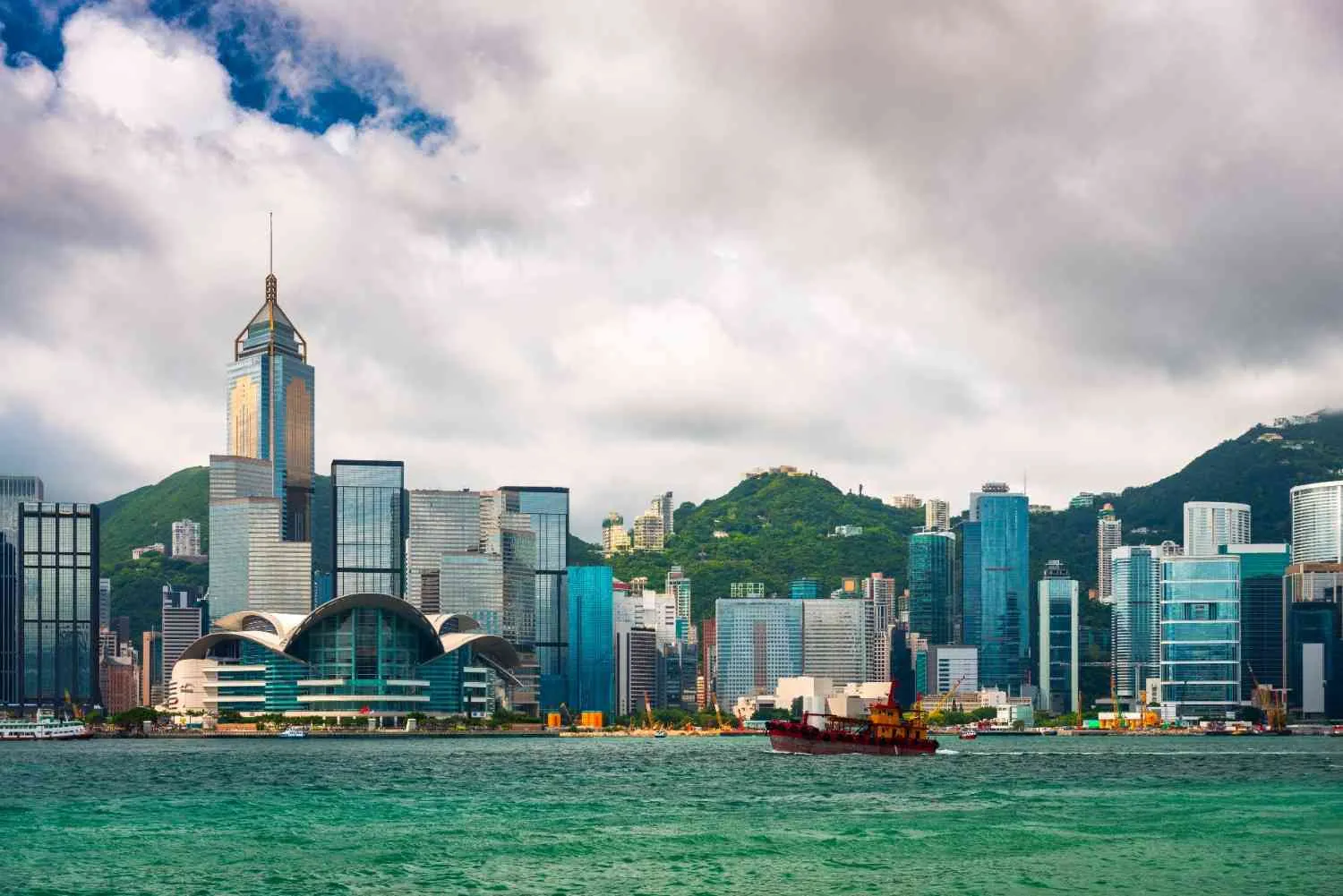
So, you're thinking about incorporating a company in Hong Kong. Smart move. It's famous for being incredibly fast—seriously, you can often get everything done online in just 24 to 48 hours. Imagine having your business legally up and running in Asia before the week is out. That speed, combined with a refreshingly simple tax system and a world-class location, is why countless founders see it as the perfect launchpad.
Why Hong Kong Is a Top Choice for Global Founders
When entrepreneurs look towards Asia, Hong Kong almost always makes the shortlist. It's more than just a strategic dot on the map; it’s a living, breathing ecosystem built for business. For a startup or a growing SME, the city offers a unique blend of Eastern and Western business cultures, creating an environment that feels both familiar and bursting with opportunity.
But the appeal goes deeper than just geography. The entire system is designed to help businesses thrive. The legal framework, built on English common law, gives international founders the stability and predictability they crave. You can operate with confidence, knowing that contracts will be honoured, your intellectual property will be protected, and any disputes will be handled within a world-class judicial system.
A Gateway with Global Reach
Let's be real: Hong Kong's biggest superpower is its location. It's the ultimate bridge to Mainland China's massive market, especially with agreements like the Closer Economic Partnership Arrangement (CEPA). This gives Hong Kong-based businesses a preferential "fast pass" to the mainland—a huge advantage for companies in trade, logistics, and professional services.
At the same time, it’s a major international finance centre that connects capital flowing between Asia and the rest of the world. This gives you direct access to:
- Venture capital and private equity: There's a deep pool of investors here actively hunting for the next big thing.
- A rock-solid banking infrastructure: You're dealing with world-class banks that genuinely understand the complexities of international trade.
- Free port status: With zero customs tariffs on imports or exports, it's a massive cost-saver for any business that moves goods across borders.
The Beauty of Its Simple Tax System
One of the most compelling reasons for incorporating a company in Hong Kong is its famously simple and low-rate tax regime. The system is built on a territorial basis, which is a fancy way of saying you’re only taxed on profits that are actually generated in Hong Kong.
For many international businesses, this is a game-changer. Let's say you're a UK-based consultant who sets up a Hong Kong company to serve clients in Singapore and Australia. If your profits are sourced from outside Hong Kong, you could be eligible for a 100% tax exemption on those offshore earnings. This isn’t some obscure loophole; it’s a core feature of the city’s pro-business tax policy.
The corporate tax rate itself is incredibly competitive. It’s capped at 16.5%, and the first HK$2 million of assessable profits are taxed at just 8.25%. Plus, there’s no sales tax (VAT/GST), no capital gains tax, and no tax on dividends. This clarity lets you forecast your finances with confidence and reinvest more of your earnings back into growth.
To see the benefits at a glance, here’s a quick summary of what makes Hong Kong so attractive.
Key Advantages of Incorporating a Company in Hong Kong
| Advantage | What It Means for Your Business |
|---|---|
| Strategic Location | Unrivalled access to Mainland China and key Asian markets. |
| Low & Simple Tax | Only pay tax on HK-sourced profits. Offshore profits can be 100% tax-free. |
| Pro-Business Environment | A world-class legal system, strong IP protection, and minimal red tape. |
| Global Financial Hub | Easy access to international banking, capital, and investment opportunities. |
| Free Port | No customs duties on imports or exports, making it ideal for trading businesses. |
These benefits create a powerful incentive for entrepreneurs worldwide. The numbers tell the same story: in the first half of 2023 alone, the Companies Registry saw an incredible 56,231 new local companies get started, pushing the total number to a record high of nearly 1.4 million. The fact that over 99% of these were private companies shows just how well the structure works for agile SMEs. This lasting confidence from the global business community cements Hong Kong’s status as a premier destination for incorporation.
If you’re keen to dive deeper, our guide explains why Hong Kong company incorporation is a great option for expanding your business.
Choosing the Right Business Structure in Hong Kong
Picking the right legal entity for your business is one of the most critical decisions you'll make. Think of it like this: a freelance photographer needs a different setup than a tech start-up planning to raise venture capital. Getting this right from day one saves an incredible amount of time, money, and administrative headaches down the road.
When you're incorporating a company in Hong Kong, you’ll find that over 99% of entrepreneurs register as a Private Company Limited by Shares. There are solid reasons for its popularity. This structure creates a clear legal wall between you (the owner) and the business itself, giving the company its own distinct identity.
This separation is the magic behind limited liability. What it means in practice is that if your business hits a rough patch or faces a lawsuit, your personal assets—your house, your savings, your car—are kept safe. The company’s debts belong to the company, not you. For any founder taking a calculated risk, this layer of protection is non-negotiable.
The Main Contenders: A Breakdown
While the Private Limited Company is the undisputed favourite, it’s worth understanding the other options to see exactly why it’s the go-to choice for most serious businesses. The other common structures, particularly for smaller operations, are the Sole Proprietorship and the Partnership.
A Sole Proprietorship is the most straightforward setup. It's just you, operating as the business. There's no legal distinction between your personal and business finances, which is both a blessing and a curse. All the profits are yours, but so are all the debts and liabilities, with zero protection.
A Partnership is what it sounds like: two or more people teaming up to run a business. Like a Sole Proprietorship, it's simple to start, but it also carries the burden of unlimited liability. In a tough spot, you could be held personally responsible not just for your share of the business debts, but for your partner's as well.
Key Takeaway: The number one reason founders opt for a Private Limited Company is for the robust shield of limited liability. It lets you chase ambitious goals without risking your personal financial security.
To really see the differences, let’s lay them out side-by-side. Seeing how each structure stacks up on liability, compliance, and growth potential will make your decision much clearer.
Comparing Hong Kong Business Entities
This table breaks down the crucial differences every founder should consider before deciding on a structure for their Hong Kong venture.
| Feature | Private Limited Company | Sole Proprietorship | Partnership |
|---|---|---|---|
| Legal Identity | A separate legal entity from its owners. Can own assets and sue or be sued in its own name. | Not a separate legal entity. The owner and the business are legally the same. | Not a separate legal entity. The partners are personally liable for the business. |
| Liability | Limited. Shareholders are only liable up to the amount of their unpaid shares. Personal assets are protected. | Unlimited. The owner is personally responsible for all business debts and liabilities. | Unlimited. All partners are personally, jointly, and severally liable for all business debts. |
| Scalability | High. Easy to raise capital by issuing new shares to investors. Ownership is easily transferable. | Low. Difficult to raise external capital. Business ends if the owner retires or passes away. | Moderate. Can bring in new partners, but ownership changes can be complex and require a new agreement. |
| Compliance | Higher. Requires an appointed Company Secretary, annual audits, and filing of Annual Returns. | Minimal. No formal annual filings with the Companies Registry, just business registration renewal. | Minimal. Similar to a Sole Proprietorship, with simpler compliance than a limited company. |
| Perception | Professional. Viewed by banks, investors, and clients as a more stable and credible business structure. | Less Formal. Often perceived as a small, one-person operation. | Varies. Credibility can depend on the reputation of the partners involved. |
Ultimately, the best choice boils down to your long-term vision. If you’re just freelancing or testing a small side hustle, a Sole Proprietorship might do the job. But for any serious entrepreneur with plans for growth, funding, and real security, setting up a Private Limited Company in Hong Kong is the most strategic and protective move you can make.
Laying the Groundwork for Your Hong Kong Company
Alright, this is where your business idea starts to become a real, legal entity. Before you jump into the official registration, you need to get a few foundational pieces sorted out. Nailing these details now is the key to a smooth incorporation process and will save you from the headache of having your application kicked back by the Companies Registry.
Think of it like building a house. You need a solid blueprint and foundation before you even think about putting up the walls. Let's get that groundwork right.
Choosing a Company Name That Sticks
Your company name is more than just a label; it's your identity. In Hong Kong, it has to be unique and not clash with any other name already registered. A classic rookie mistake is picking a name that's just a little too similar to an existing one—that's a fast track to rejection.
Before you get too attached to a name, do your homework. Use the Companies Registry’s free Cyber Search Centre to run a thorough check. It's an essential first step. Keep in mind, your name can be in English, traditional Chinese, or both, but you can't mix languages within the same name. And don't forget the final touch: it must end with the word "Limited" to signal its legal structure.
Defining Who's Who in Your Company
Every limited company in Hong Kong needs a clear structure with specific roles. These aren't just fancy titles; they're legal appointments with real responsibilities.
Here’s a quick rundown of the key players you'll need:
- Director: You must have at least one director who is an actual person, not another company. They’re the ones steering the ship, handling daily management and big-picture strategy. The good news is, they can be of any nationality and don't have to live in Hong Kong.
- Shareholder: You also need at least one shareholder, and yes, this can be the same person as the director. Shareholders own the company through their shares. They can be individuals or corporate bodies from anywhere in the world.
- Company Secretary: This is a non-negotiable role and is crucial for keeping your company in good legal standing. Your Company Secretary must be a Hong Kong resident or a Hong Kong-based corporation. Their job is to manage your official records and ensure all government filings are done correctly and on time.
Expert Tip: If you're an overseas founder, the easiest solution is to hire a professional corporate services firm to act as your Company Secretary. This instantly satisfies the residency requirement and puts an expert in charge of your compliance from day one.
Establishing Your Hong Kong Address
Even if you’re running your business from a laptop on a beach halfway across the world, your Hong Kong company needs a physical, registered address in the city.
This can't be a simple P.O. Box. It has to be a legitimate physical location where the government can send official mail. This address is where all legal notices from the Companies Registry and the Inland Revenue Department will land. For most international founders, this is where a professional service comes in handy. Our guide on how to get a virtual office in Hong Kong breaks down how you can meet this legal requirement without breaking the bank.
Finally, you’ll need to prepare your Articles of Association. This is basically the rulebook for your company. It sets out how things will be run internally—covering everything from shareholder rights and director appointments to how meetings are held. Most startups and SMEs just adopt the standard model Articles, which works perfectly well.
Bringing Your Hong Kong Company to Life: The Registration Process
With your company name reserved, key people in place, and a registered address secured, you're at the final hurdle: the official registration. This is where your business formally comes into existence in the eyes of the Hong Kong government. It might sound daunting, but the system here is built for efficiency.
You have two main paths to get this done. Think of one as the express, digital route and the other as the traditional, paper trail. Both lead to the same result.
This simple flowchart lays out the foundational steps you’ll have already completed to get to this point.
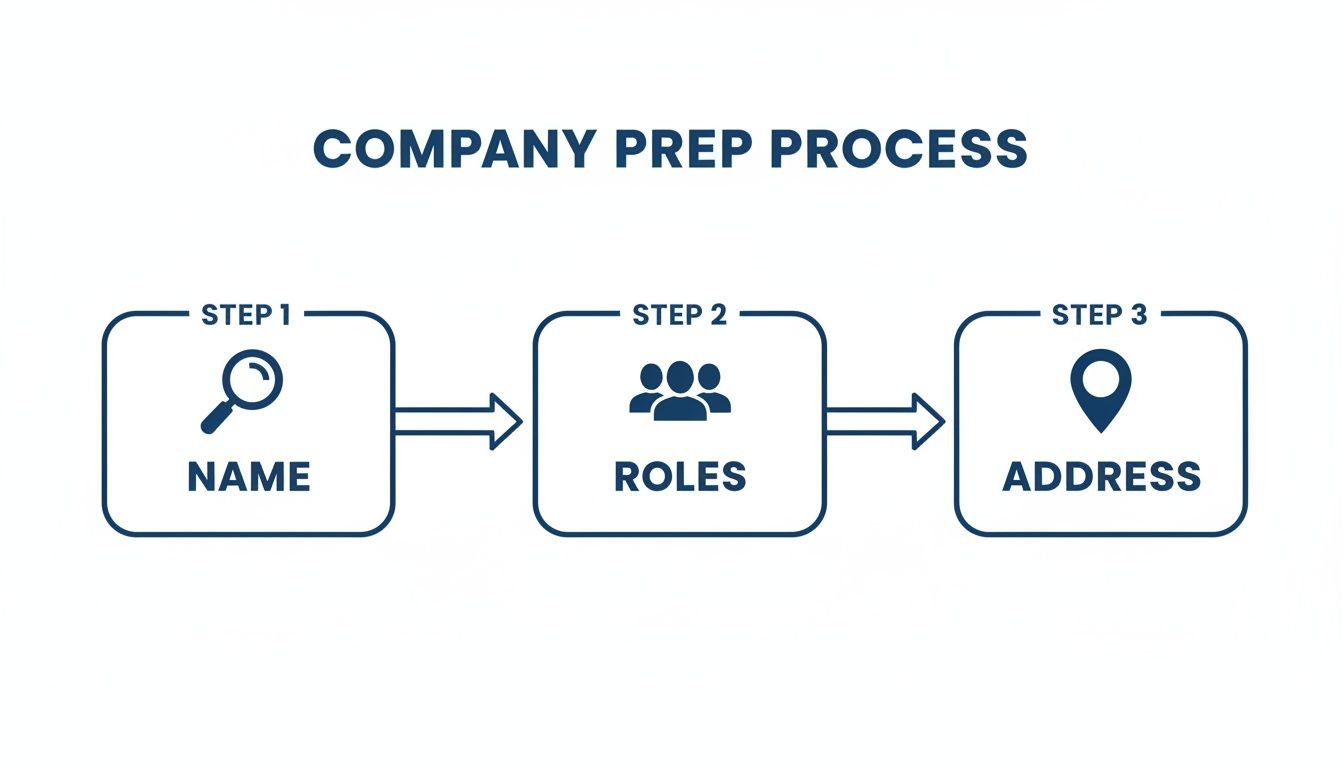
Nailing these three elements—name, roles, and address—makes the actual registration remarkably smooth.
The Fast Lane: Using the Online e-Registry
If you need to get up and running yesterday, the Companies Registry's e-Registry is your best bet. It's a fully online, 24/7 platform that handles the application and fee payments in one go.
Assuming all your paperwork is correct and your name is clear, you can get your electronic Certificate of Incorporation and Business Registration Certificate in as little as one hour. It’s an incredibly powerful tool for founders on a tight timeline.
A Real-World Example: We once helped a fintech founder from Europe who urgently needed to form a Hong Kong company to sign a major partnership deal. Using the e-Registry, we had their entire company incorporated in a single afternoon. They signed the contract the next day. That’s the kind of speed Hong Kong's system makes possible.
The main requirement for this digital route is that directors and shareholders must sign the forms using digital signatures or have their physical signatures verified by a registered professional. It’s incredibly fast, but it demands absolute accuracy—one small mistake can lead to a rejection, and you'll have to start over.
The Traditional Route: Hard-Copy Filings
The alternative is the tried-and-true method: submitting physical, signed documents to the Companies Registry. This path is often preferred for more complex setups or when stakeholders aren't set up for digital signatures.
While this method is perfectly reliable, it's just not as fast. You’ll need to physically prepare and sign the incorporation form (Form NNC1), a copy of the company's Articles of Association, and a notice for the Business Registration Office. After you've delivered them, expect a turnaround time of about four to seven working days.
Your Company Is Official—Now What?
Whichever path you take, the end goal is the same. The Companies Registry will issue two crucial documents.
First is the Certificate of Incorporation. This is your company's birth certificate, the official proof that it’s a legal entity under the Hong Kong Companies Ordinance.
At the same time, you'll get your Business Registration Certificate from the Inland Revenue Department. This is effectively your licence to do business, and you’re legally required to display it at your registered office.
These two certificates are the keys that unlock everything else. You'll need them to open a corporate bank account, sign an office lease, and hire staff. With these documents in hand, your idea is no longer just an idea—it's a real, operational Hong Kong company, ready for business.
Managing Your Business After Incorporation

Getting your Hong Kong Certificate of Incorporation is a fantastic milestone, but the real work starts now. Think of it less as crossing the finish line and more as the starting gun for the actual race. Your focus has to pivot from setup paperwork to building a compliant and sustainable business.
It’s a bit like buying a high-performance car. The thrill is in the purchase, but ownership is all about ongoing maintenance. If you skip the regular servicing, you're heading for a breakdown. The same is true for your new Hong Kong company; neglecting the fundamentals now will lead to much bigger headaches later.
Your Core Compliance Obligations
First things first: you must stay on the right side of Hong Kong’s authorities. The rules are clear, but missing a deadline is an easy way to rack up fines and unnecessary legal stress.
You have a few non-negotiable annual tasks to keep on your radar:
- Annual Return (Form NAR1): This is your company’s yearly health check for the Companies Registry, confirming your directors, shareholders, and address. You have a strict 42-day window after your company's incorporation anniversary to file it.
- Business Registration Certificate Renewal: This is your official licence to operate. The Inland Revenue Department will send you a renewal notice about a month before it’s due, so keep an eye out for it.
- Annual General Meeting (AGM): While most small businesses can skip the formal meeting by getting a unanimous written resolution from shareholders, it’s still a procedural box you need to tick.
Your Company Secretary will handle most of this, which is precisely why choosing the right one is so important. They are your first line of defence against compliance slip-ups.
Understanding Hong Kong's Tax Landscape
Let's be honest, Hong Kong's simple, low-tax system is a huge reason why people incorporate here. Every year, you'll need to file a Profits Tax Return with the Inland Revenue Department (IRD).
The key concept to get your head around is Hong Kong's territorial tax basis. This means you only pay tax on profits earned in or from Hong Kong. If your business profits are genuinely sourced offshore, you can apply for a tax exemption. This is a game-changer for many international businesses.
The headline profits tax rate is 16.5%, but it gets better for SMEs. Thanks to a two-tiered system, your first HK$2 million in profits is taxed at just 8.25%. Getting this right is crucial for your financial planning. To really get into the details, you can explore the nuances of the Hong Kong corporation tax rate in our dedicated guide.
The Big Hurdle: Opening a Corporate Bank Account
For non-resident founders, this is often the single most frustrating part of the whole process. Don't underestimate it. Hong Kong banks have become incredibly strict with their Know Your Customer (KYC) checks, making account approval anything but a sure thing.
A Word of Caution: A Certificate of Incorporation does not grant you an automatic right to a bank account. You have to prove you are a legitimate, active business with a solid rationale for banking in Hong Kong.
To have a real chance of success, you need to be over-prepared for the in-person meeting that nearly every bank will demand.
Your Bank Meeting Checklist:
- A Solid Business Plan: Show them your model, target customers, and realistic cash flow projections. They want to see you've thought this through.
- Proof of Business Activity: Bring contracts, supplier invoices, or even letters of intent from potential clients. Anything that proves you're a real business.
- Director & Shareholder KYC: Have passports, recent proof of address, and professional CVs ready. They want to know who they're dealing with.
- Source of Funds Documentation: Be prepared to show exactly where your initial capital is coming from.
Banks are trying to screen out shell companies. You need to confidently explain your operations and why a Hong Kong bank account is essential. For businesses dealing with frequent international payments, it's also worth looking into modern financial platforms. For example, a good Wise integration can be a powerful tool to manage cross-border transactions efficiently, either alongside or as an alternative to a traditional bank.
Common Questions About Setting Up in Hong Kong
We've covered a lot of ground, but I find that entrepreneurs, especially those based outside Hong Kong, often have a few specific questions that pop up time and again. Let’s tackle those so you can move forward with total confidence.
Can a foreigner own 100% of a Hong Kong company?
Absolutely. This is one of Hong Kong's biggest draws for international business. You can be the sole director and the only shareholder of your Private Limited Company, with no requirement for a local partner. It's your business, completely.
The one rule you can't get around, however, is the need for a Company Secretary. This isn't just an administrative role; it's a legal requirement. The person or corporate body you appoint must be a resident of Hong Kong.
What are the ongoing annual costs I should expect?
Setting up is just the first step. To keep your company compliant and in good legal standing, you'll need to budget for a few recurring annual costs. Think of it as essential maintenance.
Here’s a quick rundown of what you’ll be paying for each year:
- Business Registration Certificate Renewal: The yearly fee to the Inland Revenue Department to keep your business licence valid.
- Companies Registry Annual Return: A standard filing fee to update the government on your company's official details.
- Company Secretary and Registered Office Fees: You’ll pay an annual retainer for these required professional services.
- Accounting and Audit: This is a big one. Every Hong Kong company—even one that's not trading—must have its accounts audited. The cost here really depends on how many transactions you have.
Do I physically need to be in Hong Kong to set up the company?
No, you don't need to fly in just to register the company. The entire incorporation process can be managed remotely by a good corporate services firm, which is a huge advantage for global founders.
But—and this is a big one—opening the bank account is a different story. Almost every major bank in Hong Kong will insist on an in-person meeting with the company directors. It’s part of their standard due diligence, so plan for a trip to Hong Kong for this crucial step.
What's the minimum share capital required?
Technically, there's no minimum. You could start a company with just HK$1 in share capital, which offers incredible flexibility.
In reality, most startups begin with a more standard, though still nominal, amount like HK$1,000 or HK$10,000. It’s simple to increase this figure down the line as your business scales, so there’s no need to tie up a large amount of capital right at the start.
Conclusion
Navigating the complexities of global business requires more than just a registration certificate—it demands a strategic partner. At Lion Business Consultancy Limited, we act as your private financial manager, ensuring your structure is built for security, low-tax efficiency, and long-term growth. If you’re ready for personalised, expert guidance for your next move, visit us at Lion Business Co. to learn how we can protect and prepare your business for tomorrow.