

 Hong Kong

 Singapore

 UAE
UAE



 Malaysia


 Turkey
 UK
UK
 EU
EU
 US
US
 Switzerland
 Bahamas Bank Account
 Cayman Islands Bank Account
 Mauritius Bank Account
 BVI
BVI
 Seychelles

A virtual office in Hong Kong is your key to a prestigious business address and essential corporate services, but without the crippling expense of a physical lease. For entrepreneurs and small businesses, it's a strategic move to build a credible local footprint, meet all legal requirements, and run your company from anywhere on the globe.
Launching Your Business in Hong Kong the Smart Way
Picture this. You've just perfected a brilliant fintech app and you know Hong Kong is the perfect launchpad into Asia. You've got the plan, the passion, and a small, dedicated team. But then you hit a wall: the astronomical cost of commercial rent in Central, where even a tiny office can easily set you back six figures a year.

This isn't just a hypothetical. It’s the exact challenge a startup founder we recently consulted was facing. Potential investors were cautious, and big clients were on the fence. Seeing a home address on business filings simply didn't project the stability they needed to get those crucial first deals signed. They had to look professional and established with a prime Hong Kong address and a local phone number, but a physical office was completely off the table financially.
A Strategic Launchpad for Market Entry
This is precisely where a virtual office in Hong Kong becomes a game-changer. It’s so much more than a P.O. box; it’s a foundational tool that gives you the infrastructure you need to get off the ground successfully. Think of it as your business’s digital command centre—the practical solution that connects your ambition to the reality of the market.
A virtual office offers the instant credibility and operational backbone of an established company, but for a tiny fraction of the cost and without the long-term headaches of a traditional lease.
For that founder, getting a virtual office was the turning point. Almost overnight, their business had an address in a well-regarded commercial building, a dedicated phone line handled by a professional receptionist, and a seamless mail-handling service. It was the missing piece that helped them land their first major client. This one move wasn't just about getting a place to send letters; it delivered tangible results:
- Immediate Credibility: A premium address builds trust with clients, banks, and potential partners right from the start.
- Cost-Efficiency: It slashes what is often the biggest overhead for a new business—rent—freeing up precious capital you can pour back into growth.
- Operational Agility: You can manage your company from anywhere in the world while still maintaining a polished, professional presence in a global financial hub.
- Legal Compliance: Having a proper commercial address is a must-have for company formation. You can get into the specifics in our guide on the incorporation of a company in Hong Kong.
In the end, this isn't about being cheap; it's about being smart. A virtual office is a strategic investment that provides the essential framework for entering the market, staying compliant, and operating with flexibility, paving the way for real growth in one of Asia's most exciting markets.
What Is a Virtual Office, Really?
Forget the old idea of a simple PO Box. A virtual office in Hong Kong is best thought of as your company’s professional command centre, just without the physical four walls. It’s a smart package of services that gives your business a prestigious commercial address, a dedicated local phone number, and professional mail handling—all the essentials you need, but without the crippling overhead of a long-term lease.
This isn't about faking an office; it's about having the functional framework of one. You get the credibility and the operational tools to compete in one of the world's top financial hubs, all while having the freedom to work from anywhere on the planet. It’s a complete support system designed to meet strict local regulations and give your clients total confidence.
Breaking Down the Core Services
A solid virtual office package is built on a few key pillars, each playing a vital role in your day-to-day operations. When you understand how these pieces fit together, you see the real value is far more than just an address for your business cards.
To help illustrate, here’s a breakdown of the essential services you should expect in a standard Hong Kong virtual office package.
| Service Component | What It Provides | Key Benefit for Your Business |
|---|---|---|
| Registered Commercial Address | A legitimate, physical address in a commercial building. | This is non-negotiable. It satisfies the legal requirements of the Hong Kong Companies Registry for company incorporation and official government correspondence. |
| Professional Mail Handling | A team that receives all your business mail—from bank statements and government notices to client invoices—and forwards it to you. | You never miss a critical document. Mail can be scanned and emailed to you instantly or physically forwarded anywhere in the world, keeping your business moving. |
| Dedicated HK Phone Number | A unique Hong Kong telephone number for your business. | This immediately establishes a local presence. Calls can be forwarded to your mobile, or a professional receptionist can answer and take messages, adding a layer of trust and professionalism. |
As you can see, these components work in tandem to create a seamless professional front for your business, ensuring you stay compliant and operationally efficient no matter where you are.
For instance, the registered address is what keeps you in good standing with the Companies Registry. To dig deeper into the legal nuances, you can learn more about what constitutes a valid correspondence address in our detailed guide.
It's a Growth Engine, Not Just a Mailbox
This isn't just a niche trend—it's a major shift in how modern businesses are built. The demand for virtual offices in Hong Kong is exploding, driven by tech startups, global consultants, and e-commerce entrepreneurs who need a flexible, low-cost way to enter the market.
In fact, the Hong Kong virtual office market is on track to hit a value of around USD 400 million by 2025. That number says it all: flexible work isn't just a perk anymore; it's a core business strategy.
The real power of a virtual office is how it separates your business presence from your physical location. It gives you a foothold in a premium market without demanding that you be there in person, freeing up precious capital for what actually drives your business forward: growth.
This model fundamentally changes how you can approach new markets. It provides the credibility you need to open a local bank account, sign contracts, and build trust with partners and clients—laying the groundwork for everything that follows. If you're weighing your options, diving into resources on choosing between virtual and traditional office setups can offer a broader perspective on what makes the most sense for your specific goals.
Navigating Hong Kong's Legal and Banking Rules
This is where the true value of a virtual office in Hong Kong comes into sharp focus. It’s not just about getting a prestigious address for your business cards; it's about clearing the two biggest hurdles for any new business here: staying compliant and opening a corporate bank account. These aren't just boxes to tick—they're the very foundation of your company's legal and operational life in the city.

Many entrepreneurs make the mistake of thinking any old address will do. To save a bit of cash, they might try using a P.O. box or even their home address. This is a critical error. The Hong Kong Companies Registry is unambiguous: every company must have both a registered office address and a business address physically located in Hong Kong.
Crucially, these can't just be any addresses. They have to be actual commercial locations where official government mail can be physically received and signed for. A P.O. box is an instant non-starter, and using a residential address immediately raises red flags for both regulators and banks, damaging your professional credibility before you've even started.
The Non-Negotiable Role in Company Formation
This is the problem a proper virtual office from a licensed provider solves so elegantly. It gives you a legitimate, commercial address that ticks all the boxes for the Companies Registry, making your company setup smooth and compliant from day one.
Think of it like building a house. Your company’s legal structure is the foundation, and the registered address is the plot of land it’s built on. If that plot isn't properly zoned for commercial use, the whole structure is legally shaky.
A professional virtual office address isn't an optional extra; it is the prerequisite for a compliant business structure in Hong Kong. It’s the key that unlocks the door to legal incorporation and, subsequently, the banking system.
Opening the Door to Hong Kong Banking
Let's play out a common scenario. An e-commerce founder, we'll call her Sofia, has just incorporated her business in Hong Kong to expand into the Asian market. Her next mission is to open a corporate bank account to manage transactions. She books her appointment, pulls together her business plan, and presents her documents with confidence.
The bank manager scans her incorporation papers and spots the problem: she's used a residential address. The application is immediately put on ice. To the bank, this signals a messy overlap between personal and business affairs, raising doubts about the seriousness and stability of her company.
This story is all too familiar. Hong Kong banks are incredibly diligent. They need to see evidence of a credible business presence, and a proper commercial address is the first, most basic test. For Sofia, the fix was to sign up for a virtual office hong kong package. With a legitimate commercial address on her updated documents, her second attempt to open an account sailed through.
If you're serious about setting up your financial footing here, getting the application process right is vital. Our complete guide on Hong Kong bank account opening details every step, from the required paperwork to the in-person meeting.
Demystifying KYC and AML Compliance
So, why are providers and banks so strict about all this? It boils down to two critical regulatory frameworks: Know Your Customer (KYC) and Anti-Money Laundering (AML). These aren't just bits of jargon; they are legal obligations that exist to prevent financial crime.
- Know Your Customer (KYC): This is the process where banks and service providers verify who you are. They need to confirm your identity, understand your business model, and know the source of your funds.
- Anti-Money Laundering (AML): This is the broader set of rules that forces institutions to monitor for and report any suspicious financial activity. It's how authorities combat everything from tax evasion to terrorism financing.
When you register for a virtual office with a reputable provider, they will ask for your ID and details about your business. They aren't being nosy; they are fulfilling their legal duties as a licensed Trust or Company Service Provider (TCSP).
This vetting process actually works in your favour. By choosing a provider that takes compliance seriously, you align your company with a regulated, legitimate partner. This sends a strong message to banks and regulators that your business is transparent and operates with integrity, safeguarding your reputation and ensuring your long-term success in a world-class financial hub.
How to Choose the Right Virtual Office Provider
Picking a provider for your virtual office in Hong Kong is a much bigger deal than just choosing an address off a list. Think of it as bringing on a strategic partner. This one decision directly impacts your business's credibility, its legal standing, and how smoothly things run day-to-day.
Get it right, and you've got a silent partner backing your growth. Get it wrong, and you could be facing compliance headaches and a damaged reputation before you've even made your first sale.

The market is crowded with options, but they are far from equal. Your job is to find a provider that not only ticks your immediate boxes but also aligns with your long-term ambitions, ensuring your business is built on a solid, respectable foundation.
Location Still Matters—A Lot
Even in our digital world, the physical location of your registered address sends a powerful signal. An address in a prime commercial hub like Central, Admiralty, or Tsim Sha Tsui instantly projects authority and professionalism. It tells potential clients, banks, and investors that you’re a serious player right in the heart of Hong Kong’s business scene.
On the other hand, an address in a remote industrial area might save you a few dollars, but it could seriously undermine your credibility. It’s the difference between showing up to a major pitch meeting in a tailored suit versus a tracksuit. Both are clothes, but only one makes the right impression.
Your virtual address is often the very first impression your business makes. Choose a location that reflects the calibre of your brand and the clients you want to attract.
Verify Their Legal Credentials (This is Non-Negotiable)
Let's be clear: this is the most critical check you'll make. In Hong Kong, any company offering secretarial services—including registered addresses—is required to hold a Trust or Company Service Provider (TCSP) licence.
This licence, issued by the Companies Registry, is your proof that the provider follows strict regulatory standards, especially those concerning Anti-Money Laundering (AML) and Counter-Terrorist Financing (CTF).
Before you even think about signing a contract, ask for their TCSP licence number. Then, head straight to the official public register on the Companies Registry website and verify it yourself.
A provider who can't show you a valid licence is operating illegally. Partnering with them puts your entire business at risk. We're talking fines, operational shutdowns, and a world of trouble when you try to open a bank account.
Assess the Quality of Their Services
Beyond the address and the licence, you need to dig into the practical side of what they offer. How will they actually support your business day in and day out?
Here’s what to look into:
- Mail Handling: How quickly will they let you know when post arrives? Do they offer a scan-to-email service, or just physical forwarding? Ask them straight up about their turnaround times.
- Communication Professionalism: If you add a phone service, who is answering the calls? Is it a well-trained, professional receptionist, or a generic, impersonal call centre? The difference is huge.
- Customer Support: When you have a question or an urgent request, can you actually reach a real person? Give their customer service a test run before you commit.
Remember, a virtual office is meant to make remote operations seamless, and solid communication is key. As you weigh providers, think about how your business will handle calls. It’s worth exploring the top VoIP services for small businesses to ensure you have a reliable system in place.
This whole trend is part of a bigger picture. The demand for virtual offices in Hong Kong has shot up alongside the rise of hybrid work. Businesses need that blend of a prestigious physical address and the flexibility of remote operations. In fact, the use of virtual offices in key Hong Kong commercial districts has grown by over 25% since 2022, showing just how much companies value this agility. You can dig deeper into this growth in the tech and finance sectors.
Watch Out for These Red Flags
Finally, being smart about this is as much about spotting the bad signs as it is about finding the good ones. Keep your eyes peeled for these warning signals:
- Vague or "Too Good to Be True" Pricing: Unbelievably cheap offers almost always come with hidden fees, terrible service, or—worst of all—no proper licence. A good provider will have a clear, transparent price list.
- Lax Onboarding Checks: If a provider isn't asking you for proper ID and business details (what's known as KYC, or "Know Your Customer"), they are not following TCSP rules. This is a massive red flag.
- No Physical Office to Visit: A legitimate provider must have a real, physical office at the address they’re selling you. If they seem to be completely virtual themselves, it raises serious questions about their entire operation.
Putting It All Together: Real-World Scenarios
It’s one thing to read about mail forwarding and business addresses, but it’s another thing entirely to see how a virtual office in Hong Kong actually solves real problems for growing businesses. Theory is great, but stories make it stick.
Let's move past the features and benefits and look at three very different business owners. Each faced a common roadblock when trying to get a foothold in Hong Kong, and in each case, a virtual office was the key that unlocked the door.
Case Study 1: The European Tech Startup
Imagine a small, ambitious tech company in Berlin. They've got a fantastic product and see huge potential in the Asian market, but the idea of leasing an office in Central is financially terrifying. They needed a legitimate Hong Kong presence to even get in the room with investors and partners, but couldn't justify paying six figures in annual rent for a space they’d barely use.
The Solution:
They signed up for a premium virtual office package. This gave them:
- A prestigious business address in a landmark commercial building.
- A mail handling service that scanned and emailed all their post, so they saw everything instantly.
- The ability to book meeting rooms by the hour whenever their team flew into town.
This was a total game-changer. The A-grade address gave them instant credibility, helping them secure meetings that might have otherwise been impossible. They ran all their correspondence from Germany and had a slick, professional space ready for those make-or-break negotiations—all for less than what one month's rent on a traditional office would have cost.
Case Study 2: The Local Freelance Consultant
Now, let's think about Michael, a talented freelance consultant living in the New Territories. He had the skills to win big corporate contracts, but his residential address on invoices and proposals was a problem. It screamed "small-timer," which created a credibility gap when he was pitching to MNCs.
The Solution:
Michael got a basic virtual office in Hong Kong. It provided a proper commercial address and a dedicated local phone number handled by a professional answering service.
For a solo operator, a virtual office is often the single best investment you can make in your professional image. It immediately lifts you from a one-person-show to a serious, established business in the eyes of potential clients.
The difference was night and day. His proposals suddenly had the professional edge they were missing, thanks to the new address in a prime business district. The call answering service meant he never missed an important call while deep in client work, making him look organised and reliable. This small tweak helped him land two major corporate clients in just three months.
Case Study 3: The Global E-commerce Seller
Finally, consider an e-commerce entrepreneur based in Canada. Her business selling artisan goods across Asia was booming. To make her operations more efficient and register her company for regional tax benefits, she needed a proper business address in Hong Kong. Her biggest worries were getting official mail reliably and having a compliant address for company registration.
The Solution:
She found a virtual office provider that specialised in e-commerce. Her package included:
- A registered address that satisfied all government and legal requirements.
- A secure mail and parcel forwarding service to handle everything from supplier invoices to tax notices.
This gave her a solid, compliant foundation to build her Asian business. She successfully incorporated her company and opened a local bank account, which made payment processing a breeze and boosted her profit margins. The mail forwarding was so reliable that she could run the entire admin side of her business from the other side of the world, never worrying that something important would slip through the cracks.
These examples aren't just one-offs; they show how flexible workspace solutions are becoming a core part of modern business strategy. The rise of the virtual office in Hong Kong is tied to a massive global trend. The coworking space market is forecast to jump from USD 22.44 billion in 2024 to USD 26.2 billion in 2025, growing at a compound annual rate of 16.8%. You can learn more about the significant expansion of the flexible workspace market and see what it signals for the future of how we work.
So, What's Your Next Move?
You've got the theory, you've seen the regulations, and you've looked at how real businesses are making it work. Now it’s time to put all that knowledge into practice. Setting up shop in Hong Kong doesn't have to mean signing an eye-wateringly expensive lease for an office you don't really need.
There’s a much smarter, more capital-efficient way to get started: a virtual office in Hong Kong.
This is more than just a clever workaround; it's a strategic first step. It gives you the credibility and compliance you need to operate legally, and the agility to hit the ground running. When you secure a virtual office, you’re not just renting a mailbox. You're getting the key that unlocks everything else—legal incorporation, a business bank account, and the trust of clients in one of the world's top financial hubs.
Your Market Entry Checklist
Let's turn this from a plan into reality. Here’s a straightforward checklist to get your Hong Kong presence set up the right way.
-
Pinpoint Your Must-Haves: First, figure out what you actually need. Is a registered address for the Companies Registry enough? Or do you need a professional to answer your calls and forward your mail so you never miss an important client message?
-
Find Licensed Providers: Do your homework. Find three or four providers that hold a valid Trust or Company Service Provider (TCSP) licence. To give your business an extra layer of prestige, look for providers with addresses in prime locations like Central or Tsim Sha Tsui.
-
Interview Your Shortlist: Get on the phone or send some emails. Ask pointed questions. How quickly do they process mail? What are their support hours? Are there any hidden costs? You can tell a lot about a company by how they handle these simple queries.
-
Get Your Paperwork in Order: Have your Know Your Customer (KYC) documents ready to go. This usually means a copy of your passport, a recent utility bill as proof of address, and a short summary of what your business does. Being prepared makes the sign-up process a breeze.
The infographic below shows how different types of businesses, from SaaS startups to solo consultants, use virtual offices to hit their specific goals.
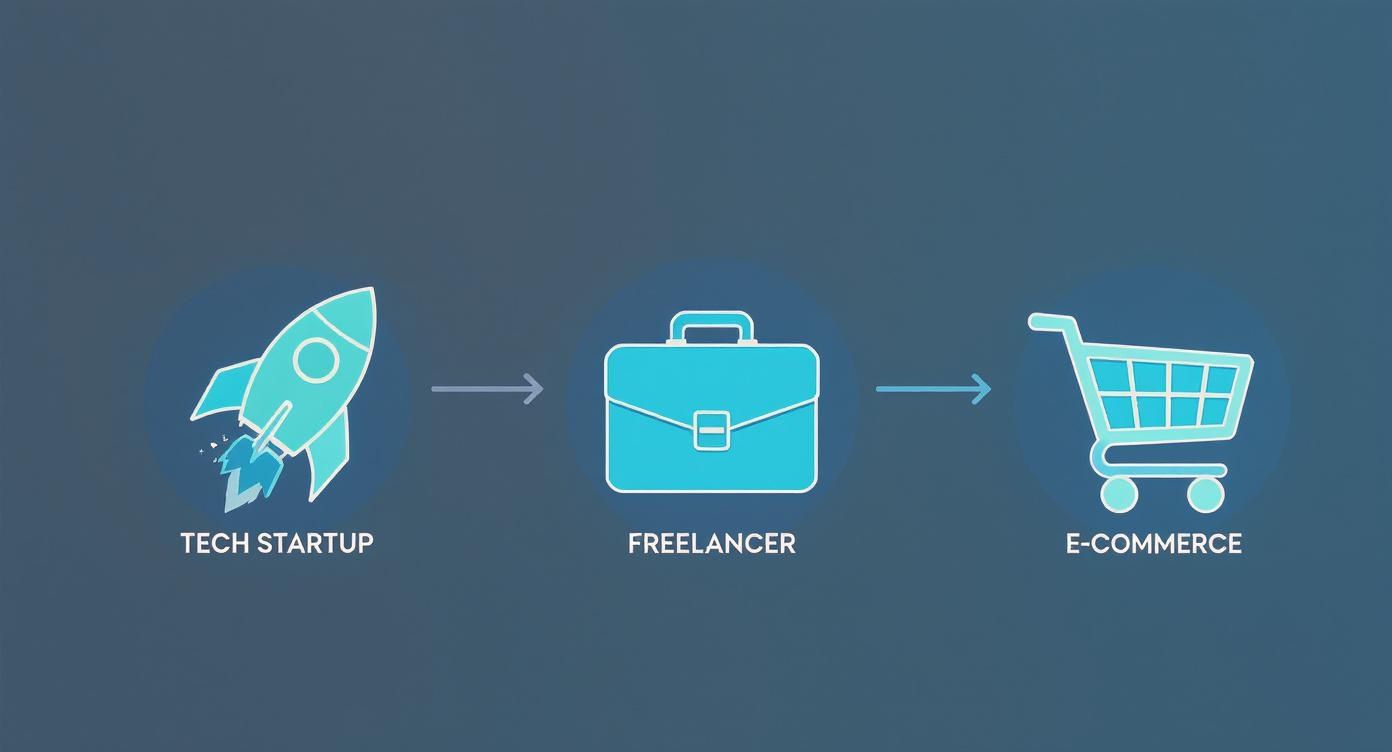
As you can see, a virtual office isn't a one-size-fits-all product. It's a flexible tool that you can adapt for market entry, building a professional brand, or simply running your operations more efficiently.
If you remember just one thing, make it this: A virtual office is the cornerstone. It’s what makes the rest possible—the company registration, the bank account, and a credible presence in the market—all without the massive overhead of a physical lease.
Ready to make your move? The next step is finding a package that fits your ambition. You can explore our verified virtual office hong kong solutions or book a private chat with our team. We're here to help you cut through the noise and build your business on a solid foundation.
Frequently Asked Questions
Even with a solid plan, a few questions are probably still bouncing around in your head. That's completely normal. Getting the small details right is often what makes the difference between a smooth launch and a frustrating one, so let's clear up some of the most common queries about using a virtual office in Hong Kong.
Is a Virtual Address Actually Legal for Company Registration?
Yes, it is 100% legal and completely standard practice. The key is to use a legitimate commercial address from a provider licensed as a Trust or Company Service Provider (TCSP). The Hong Kong Companies Registry simply requires a physical, non-residential address to incorporate your company, and a proper virtual office service ticks that box perfectly. Just remember, a P.O. Box or your home address won't cut it.
Can I Really Open a Business Bank Account With a Virtual Office?
You can, and in reality, you must. Having a compliant commercial address from a virtual office is a prerequisite for opening a corporate bank account in Hong Kong. Banks see it as a sign that you've structured your business correctly and are serious about operating here. Trying to use a residential address is one of the fastest ways to get your application flagged or flat-out rejected.
Think of your virtual office address as the foundation of your business's credibility. It's the first thing a bank looks at to see if you meet their strict KYC (Know Your Customer) and AML (Anti-Money Laundering) standards. Without it, you can't even get in the door.
So, What Actually Happens to My Mail and Parcels?
Think of your provider as your professional front desk. Whenever anything arrives for your company—whether it’s a critical letter from the government or an invoice from a supplier—their team signs for it.
From there, depending on your plan, they’ll:
- Notify You Instantly: You'll usually get an email alert the same day your mail lands.
- Scan and Send: For anything urgent, they can open, scan, and email the documents straight to your inbox.
- Forward the Originals: They'll bundle up your physical post and forward it to any address in the world, on a schedule you decide (like weekly or monthly).
How Hard Is It to Switch Virtual Office Providers if I Need To?
Switching is a fairly simple administrative task, but it does need to be handled carefully. The main step is filing a Change of Registered Office Address form (known as an NR1) with the Companies Registry. More importantly, you have to update your bank, clients, and suppliers with the new address to ensure you don't miss any critical mail during the changeover. A good new provider will usually help you manage this process to keep things running smoothly.
Conclusion
Ready to build your presence in one of Asia's top business hubs? At Lion Business Consultancy Limited, we don’t just rent you an address; we provide a strategic foundation for your growth. We specialise in creating secure, compliant, and tax-efficient structures that protect your business and set you up for global expansion.