
 Hong Kong

 Singapore


 UAE
UAE



 Malaysia

 Turkey


 UK
UK
 EU
EU
 US
US
 Switzerland
 Bahamas Bank Account
 Cayman Islands Bank Account
 Mauritius Bank Account

 BVI
BVI
 Seychelles

If you're running a business in Hong Kong, the term MPF maximum contribution is one you can't afford to ignore. It’s the upper limit on mandatory retirement savings, and for the current period, it's capped at HK$1,500 per month from both you and your employee. This cap applies once monthly earnings hit HK$30,000, meaning any income above this level doesn't require further mandatory contributions.
Understanding this cap is foundational to managing payroll and planning for your team's future—and your own.
How the MPF Maximum Contribution Cap Works
Imagine your monthly MPF contributions as a bucket you and your employer are filling together. The law requires both of you to pour in 5% of your employee's relevant income. But this bucket has a fill line—the "maximum relevant income level." Once your earnings surpass this line, the mandatory pouring stops.
This cap is a core feature of the MPF system's design. It strikes a balance, ensuring everyone builds a retirement nest egg without placing an excessive burden on high-income earners. For you as an employer, it introduces a welcome dose of predictability, making it far simpler to forecast and manage your labour costs.
So, whether your top sales manager earns HK$40,000 a month or your lead developer brings in HK$80,000, their mandatory contribution stays locked at HK$1,500. You, as the employer, match that amount. This perfectly illustrates the MPF’s intended role: it’s the solid foundation for retirement savings, not the entire skyscraper.
Why Is There a Cap?
At its heart, the MPF maximum contribution exists to establish a basic retirement safety net for everyone working in Hong Kong. It was never designed to be the only savings vehicle someone would need, but rather a compulsory system to get the ball rolling on long-term financial planning.
This structured approach brings a few clear benefits to the table:
- Fairness and Consistency: It establishes a clear, consistent rule for every employee and employer, regardless of their industry or size.
- Encourages Extra Savings: The cap acts as a subtle nudge, particularly for higher earners, to look beyond the basics and explore other savings avenues, like making Voluntary Contributions.
- Keeps Things Simple: A fixed maximum simplifies payroll calculations and reduces administrative headaches, which is a huge plus for busy SMEs.
Getting your head around how this cap works is the first real step to mastering your retirement planning obligations. It defines what's required and sets the stage for you to decide how to build on this mandatory foundation for a more secure financial future.
The Story Behind MPF Contribution Limits
To really appreciate the MPF system today, it helps to understand its journey. The contribution limits we follow weren't just picked out of thin air; they've been carefully adjusted over time. This isn't just a story about numbers changing—it's about a system evolving to keep pace with Hong Kong's dynamic economy and its people's rising incomes.
When the MPF first launched, the economic landscape was very different. The initial rules were a product of their time, creating a foundational retirement safety net. But as Hong Kong's economy flourished and salaries grew, it became clear that the original caps needed a refresh to remain meaningful.
This adaptability is a core strength of the MPF. It signals that the system is built for the long haul, ensuring contributions don't get eroded by inflation and can still build a respectable nest egg. For business owners, these periodic updates are a clear sign that the government is committed to maintaining a stable and relevant retirement framework.
Key Moments in MPF Adjustments
The changes over the years have been deliberate, each one aiming to keep the mpf maximum contribution aligned with average wages. One of the most significant updates happened back on 1 June 2012. Before that date, the maximum relevant income was capped at HK$20,000 a month, meaning the most you and your employer contributed was HK$1,000 each.
Recognising that wages had grown, the government lifted the maximum relevant income level to HK$25,000. This pushed the maximum monthly contribution up to HK$1,250 each, giving retirement funds a much-needed boost. It was a direct response to ensure the MPF was still fulfilling its mission. You can read up on the history of these MPF changes and what they meant for savers here.
This forward-thinking approach is what keeps the MPF relevant. It ensures the system doesn’t just stagnate, but actively works to secure people's financial futures by mirroring economic growth in their retirement pots.
How This Affects Your Financial Planning
Knowing this history isn't just trivia; it's genuinely useful for smart financial planning. The government periodically reviews these income levels based on economic trends, and those decisions directly impact your payroll costs and your team's savings potential.
If you're running a business, understanding that the MPF system is designed to evolve helps you forecast your finances more accurately. It also highlights why you must stay on top of regulatory updates that can affect both your liabilities and your team's take-home pay. These adjustments are often aligned with the fiscal calendar, so understanding the tax year in Hong Kong is crucial for staying ahead.
Ultimately, this history shows the MPF isn't a static policy but a living tool, designed to grow with your career and your business.
Getting Your Mandatory Contributions Right
Nailing your MPF calculations isn't about complex algebra; it all boils down to one core concept: relevant income. This is the figure that determines everything. Think of it as an employee's total cash compensation—it includes their basic salary, commissions, bonuses, and allowances.
Equally important is knowing what doesn't count. For instance, severance payments and long service payments are specifically excluded from the MPF calculation. For you, the employer, getting this right is the key to running a compliant and accurate payroll. For your employees, it’s how they can be confident they're saving the right amount for their future.
The MPF system has evolved to keep pace with Hong Kong's economy. This infographic shows how the contribution cap has adapted over the years.
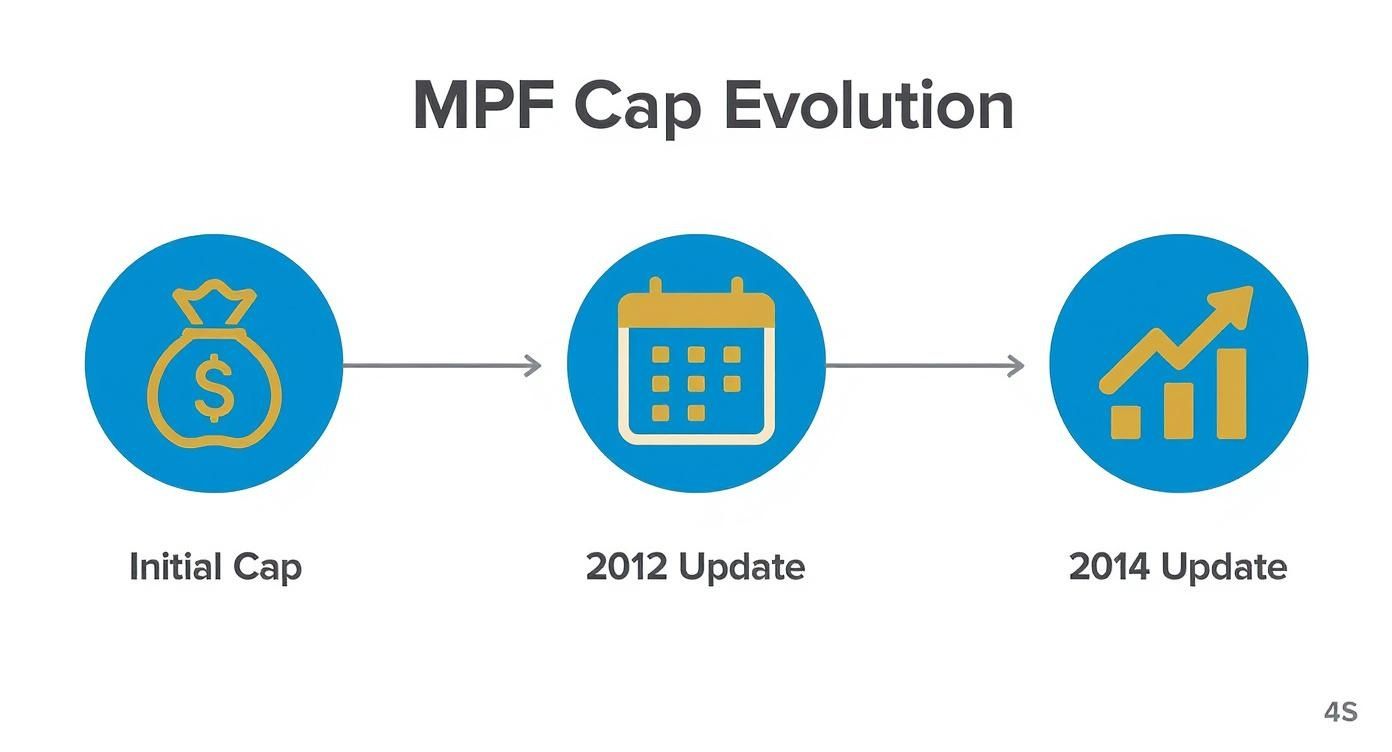
As you can see, the system isn't static. Key adjustments in 2012 and 2014 were made to reflect the city's rising income levels, strengthening retirement savings for everyone.
Putting the Calculation into Practice
So, how does the 5% contribution rate actually play out for different team members? The percentage is constant, but the final dollar amount can vary significantly based on their earnings. Let's walk through a few real-world examples you might encounter in your own business.
-
The Salaried Manager: An operations manager is on a fixed salary of HK$45,000 a month. Her income is well above the HK$30,000 maximum relevant income level, so her contribution is capped. She pays HK$1,500, and your company matches it with another HK$1,500.
-
The Commission-Based Sales Professional: A salesperson has a base salary of HK$15,000. After a great quarter, he earns HK$20,000 in commission, bringing his total income that month to HK$35,000. His contribution hits the HK$1,500 cap. The next month is slower, and he only earns his base salary. His contribution then drops to 5% of HK$15,000, which is HK$750.
-
The Part-Time Intern: A student intern working part-time earns HK$6,500 in a month. Because her income is below the HK$7,100 minimum threshold, she doesn't have to contribute anything. Your company, however, is still required to contribute 5% of her salary (HK$325) to her MPF account.
The 5% contribution rate from both employee and employer is the bedrock of the MPF scheme. It ensures a consistent and shared responsibility for retirement savings. The system is designed with fairness in mind, exempting those who earn the least while capping contributions for the highest earners.
For business owners, getting these calculations right is a fundamental part of payroll management. It’s not just about compliance; it’s about building trust with your team. If you find yourself needing support with the numbers, our guide to accounting services in Hong Kong can provide more detailed insights on managing these financial obligations.
Going Beyond the Cap with Voluntary Contributions
Hitting the MPF maximum contribution of HK$1,500 each month is a solid start, but it's important to see it for what it is: the foundation, not the entire retirement plan. For savvy professionals and business owners, this cap is just the starting line. The real opportunity to build serious wealth for the future lies in making Voluntary Contributions (VCs).
Think of an MPF account like a garden. The mandatory contributions are the seeds you're required to plant each season. They'll certainly grow, but what if you could add a powerful fertiliser to accelerate that growth? That’s what VCs do. They supercharge the growth potential of a retirement fund, putting the powerful force of compounding returns firmly on your side.

Unlocking Different Types of Voluntary Contributions
Not all voluntary contributions are created equal. The MPF system offers a few different pathways, each with its own set of rules and advantages. Figuring out which one aligns with your financial goals is key to building a robust strategy.
Here are the two main options you'll come across:
-
Special Voluntary Contributions (SVCs): This is the most flexible route. You can set up an SVC account directly with any MPF provider—it doesn't even have to be the one your company uses. You can contribute as much as you like, whenever you like, and the withdrawal rules are generally more lenient than with the mandatory portion of your MPF.
-
Tax Deductible Voluntary Contributions (TVCs): Introduced in 2019, TVCs were specifically designed to incentivise extra saving with an immediate tax break. Contributions up to HK$60,000 per year are tax-deductible, which directly reduces your annual tax bill while simultaneously boosting your retirement nest egg. It's a genuine win-win.
The trend is clear: people are taking more control. In the first three quarters of 2024, voluntary contributions made up 24% of all MPF contributions. That's a huge jump from just 13% a decade ago, showing a real shift towards proactive retirement planning among Hong Kong's workforce.
The Real-World Impact of Going the Extra Mile
Let's put this into perspective with a tangible example. Imagine a marketing director who already maxes out her mandatory contributions every month. She decides to open a TVC account and puts in an extra HK$5,000 each month.
Not only does this extra HK$60,000 a year begin growing within her MPF, but she also gets to deduct the full amount from her taxable income. This single move could save her thousands of dollars in taxes annually.
This transforms her MPF from a simple obligation into a powerful tool for both wealth-building and tax planning. Of course, for anyone considering this path, it's wise to understand the implications of excessive pension contributions to ensure the strategy is sound. By looking beyond the mandatory cap, you take control of your financial future and make your money work that much harder for you over the long run.
Strategic Planning for High-Income Earners
If you're consistently hitting the MPF maximum contribution limit, that’s your cue to think bigger about your retirement strategy. For high-income earners and the self-employed, the mandatory MPF is just the starting point, not the destination. Relying solely on that capped amount is like trying to build a house with only a foundation—it’s a necessary start, but it won’t give you the shelter you need down the road.
The real goal is to build a diversified, resilient portfolio where your MPF is just one piece of the puzzle. Think of your retirement savings as a complete financial ecosystem, not a single pot of money. Your MPF provides the stable, tax-advantaged base, but your real growth and future financial freedom will come from what you build on top of it.
Building a Multi-Faceted Retirement Portfolio
For entrepreneurs and top earners, the name of the game is making your money work harder. This means layering different asset classes to strike the right balance between risk and long-term returns. A well-rounded approach often includes a mix of these:
- Stocks and Equities: This is where you'll find higher growth potential, though it comes with more market volatility.
- Real Estate: Property can be a great way to generate steady rental income while also benefiting from long-term capital appreciation.
- Private Annuities and Insurance: These products are designed to provide guaranteed income streams in retirement, adding a valuable layer of security.
- Voluntary Contributions (VCs): As we've discussed, topping up your MPF with VCs—especially the tax-deductible kind—remains one of the smartest and most efficient ways to boost your savings.
Remember, the MPF system itself has evolved. A significant change happened in June 2014 when the maximum relevant income level was lifted to HK$30,000 a month. That’s what established the current HK$1,500 monthly contribution cap for both employers and employees.
Case Study: Picture an entrepreneur with a thriving e-commerce business. She maxes out her mandatory MPF contributions without a second thought. But she doesn't stop there. She also funnels a set percentage of her profits into a diversified stock portfolio and a separate TVC account. This multi-pronged strategy means she isn’t putting all her retirement eggs in one basket.
Integrating Tax Efficiency into Your Plan
When you have a substantial investment portfolio, smart tax planning can make a huge difference to your overall returns. It's worth exploring specific methods like tax loss harvesting strategies, which can help you offset gains and reduce your tax bill.
Beyond that, how you structure your business and personal finances plays a massive role. Proper management of your company's books isn't just for compliance; it's about optimising your take-home value. Getting a firm grip on the nuances of the Hong Kong profits tax system is essential for any high earner serious about building a strong financial future. A proactive and strategic approach ensures every dollar is working as hard as possible to get you to your retirement goals.
Answering Your Top MPF Contribution Questions
Let's be honest, the rules around the MPF maximum contribution can feel a bit tangled, especially when real-world payroll scenarios don't fit neatly into a textbook example. To tie everything together, I've rounded up the most common questions I hear from business owners and their teams.
Think of this as your practical cheat sheet for those tricky "what if" moments that inevitably crop up during a payroll run. Getting these details right not only keeps you compliant but also gives your staff peace of mind that their retirement savings are being handled correctly. Let's clear up the confusion.
What Happens If My Income Fluctuates Above the Maximum Level?
This is a classic question, especially for anyone in sales, on commission, or with freelance income that can feel like a rollercoaster. The key takeaway is that MPF contributions are calculated strictly on a month-by-month basis. The system doesn't average your earnings over the year.
Here’s a simple illustration. Let's say one of your sales reps earns HK$40,000 in March but only HK$25,000 in April.
- In March, their income is over the HK$30,000 threshold. Their contribution is capped at HK$1,500.
- In April, their income falls below the cap. Their contribution is simply 5% of HK$25,000, which is HK$1,250.
This monthly approach ensures fairness and consistency, making sure contributions directly reflect what was earned in that specific pay period.
Are Year-End Bonuses Included in MPF Calculations?
Yes, they absolutely are. Bonuses, commissions, and other one-off payments are all considered 'relevant income' for MPF purposes. But here's the crucial detail: the monthly contribution cap still applies.
Let's break it down. If an employee's regular salary is already HK$30,000 or more, they've already hit the MPF maximum contribution for that month. When their bonus is paid, it's added to their income for that pay period, but their mandatory MPF contribution for the month stays locked at HK$1,500. The bonus doesn't trigger an additional contribution on top of the cap.
How Do I Handle MPF for Part-Time Staff with Irregular Hours?
Managing MPF for part-time staff comes down to meticulous tracking of their earnings each pay period. If a team member earns less than HK$7,100 in a month, they are not required to contribute, but you, as the employer, must still contribute your 5%.
If their earnings for the month fall between HK$7,100 and HK$30,000, then both you and the employee contribute 5% each. And if they have a great month and earn over HK$30,000, both of your contributions are capped at HK$1,500 for that period. This really highlights how vital accurate and timely payroll management is.
This granular, period-by-period approach to contributions is what makes the MPF system adaptable to different work arrangements, from full-time salaried roles to flexible, part-time positions.
Can I Choose Where My Voluntary Contributions Are Invested?
For the most part, the answer is a resounding yes. Voluntary contributions—especially Special Voluntary Contributions (SVCs) and Tax Deductible Voluntary Contributions (TVCs)—give you the same freedom to choose your investments as your mandatory funds.
This means you can select from the entire menu of funds your MPF provider offers, from conservative bond funds to more aggressive equity funds. It's a fantastic way to build a cohesive investment strategy across your entire MPF portfolio, ensuring both your mandatory and voluntary savings are working towards your personal financial goals and are aligned with your risk appetite. This control truly empowers you to take the driver’s seat in shaping your retirement.
Navigating the complexities of MPF contributions, tax structures, and international banking is what we do best. At Lion Business Consultancy Limited, we act as your private financial manager, ensuring your business is compliant, protected, and structured for growth. If you need expert guidance to simplify your global operations, we’re here to help.