
 Hong Kong

 Singapore


 UAE
UAE



 Malaysia

 Turkey


 UK
UK
 EU
EU
 US
US
 Switzerland
 Bahamas Bank Account
 Cayman Islands Bank Account
 Mauritius Bank Account

 BVI
BVI
 Seychelles
If you're an entrepreneur scanning the globe for the best place to set up shop, Hong Kong’s corporate tax rate is likely the first thing that jumps out. So let's cut to the chase: the city runs on a beautifully simple and highly competitive two-tiered system.
For most small and medium-sized businesses, this means you’ll enjoy a remarkably low rate of just 8.25% on your first HKD 2 million of profit. The standard 16.5% rate only applies to profits above that mark. This isn't just a tax break; it's a strategic advantage designed to give growing companies a powerful financial leg up.
Related Reading: Hong Kong Corporate Tax Calculator
Decoding Hong Kong’s Tax Advantage
When you start exploring Hong Kong as a business base, you quickly learn its reputation for a simple, low-tax environment isn't just marketing hype. It’s a core philosophy that makes the city a world-class business hub. But what does this actually feel like for a business on the ground?
Imagine it as a "starter pack" for entrepreneurs. Instead of slapping every business with a high, flat tax rate from day one, Hong Kong’s system offers a gentler on-ramp. It’s a policy built on the understanding that cash flow is the lifeblood of any young company.
The Two-Tiered System Explained
This modern framework, officially called the two-tiered profits tax regime, was created specifically to give SMEs some much-needed breathing room. Before its introduction, a single flat rate applied to every company, big or small. The current structure is far more supportive of growth.
Here’s the breakdown for corporations in a nutshell:
- Tier 1: Your first HKD 2 million in assessable profits is taxed at 8.25%.
- Tier 2: Any profit above HKD 2 million is taxed at the standard rate of 16.5%.
This progressive approach means a new startup or a scaling SME gets to keep more of its initial earnings. That’s precious capital you can reinvest directly into hiring your next key team member, developing a new product, or expanding into a new market. It's a deliberate strategy to nurture growth from the ground up.
Think of it this way: The Hong Kong tax system doesn't just collect revenue; it actively invests in the success of its business community by giving smaller companies a crucial financial head start.
To paint a clearer picture, here’s a quick look at how the rates apply across different business structures.
Hong Kong's Two-Tiered Profits Tax Rates
| Business Type | Tax Rate on First HKD 2 Million | Tax Rate on Profits Above HKD 2 Million |
|---|---|---|
| Corporations | 8.25% | 16.5% |
| Unincorporated Businesses | 7.5% | 15.0% |
This table illustrates how the system provides relief not only to limited companies but also to partnerships and sole proprietorships, making it a true cornerstone of Hong Kong's business-friendly ecosystem.
A Foundation Of Stability
This attractive tax system isn't some new, temporary gimmick. It’s built on a foundation of predictability. Hong Kong’s standard corporate tax rate has held steady at 16.5% since the 2008/09 tax year, creating a stable and reliable environment for businesses to plan their future. For a deeper historical dive, you can find the official details on the government’s page for Hong Kong profits tax rates.
For any entrepreneur trying to map out a five-year plan, this stability is priceless. It removes the guesswork and policy flip-flopping that plague so many other jurisdictions, letting you build financial forecasts with genuine confidence. This predictability, combined with the low rates, is why truly understanding the Hong Kong corporation tax rate is the first step toward building a powerful and sustainable global business.
How the Two-Tiered System Really Works for Your Business
The real magic of Hong Kong’s tax system isn't just the low number on the page; it’s how it practically empowers startups and SMEs. The two-tiered system is the perfect example of this philosophy in action.
Let's say you're running a new e-commerce business. In your second year, you're starting to see real traction. The standard 16.5% corporate tax rate already sounds appealing, but the real power lies in how your first block of profit is treated.
For a company in its growth phase, that lower 8.25% rate on the first HKD 2 million of profit is more than just a tax discount. It's tangible cash that stays in your bank account, ready to be deployed. Suddenly, you have the capital to hire that developer you've been dreaming of, or to launch a bold marketing campaign that could unlock a whole new audience. This is what tax policy designed to fuel growth looks like.
This game-changing structure kicked in from the 2018/19 assessment year. Under this system, the first HKD 2 million of a company's assessable profits is taxed at 8.25%, with the remainder taxed at the standard 16.5%. For a more technical breakdown of the rules, you can find further insights on this corporate income tax structure on PWC.com.
A Real-World Example: A Thriving E-commerce Startup
Let’s put some real numbers behind this with a story. Meet "Urban Oasis," our fictional e-commerce startup. They’ve just closed a fantastic year.
- Year 2 Assessable Profits: HKD 2,500,000
Under the old, single-rate system, their tax bill would have been simple but painful: HKD 2,500,000 x 16.5% = HKD 412,500.
Now, watch how the two-tiered system completely changes their financial picture:
- First HKD 2,000,000 is taxed at 8.25% = HKD 165,000
- The remaining HKD 500,000 is taxed at 16.5% = HKD 82,500
Their total tax bill is just HKD 247,500. That’s a direct saving of HKD 165,000—a massive boost for a young company. That's cash the founders can now use to invest in new inventory, upgrade their tech, or expand their team.
Of course, the strategic advantages of incorporation go far beyond this one rule. To get a broader perspective on making your company structure work for you, it's worth exploring other limited company tax benefits. Understanding the bigger picture is key to financial efficiency.
One Critical Rule: The "Connected Entities" Clause
Now, there’s one important rule you need to know, especially if you're a serial entrepreneur. To ensure fairness, the Inland Revenue Department (IRD) introduced a provision about 'connected entities'.
Think of it like a family phone plan that only offers the premium data discount on one line. If you have a group of "connected" companies, you can only nominate one of them each year to benefit from the lower 8.25% tax rate.
The Bottom Line: The two-tiered tax break is applied once per group, not once per company. If you control several businesses, you have to nominate just one to receive the lower rate in any given tax year.
This rule prevents business owners from splitting a single large company into multiple smaller ones just to claim the 8.25% rate on each.
So, what makes a company 'connected'? The IRD’s definition generally includes:
- A parent company that controls a subsidiary.
- Two or more companies controlled by the same person.
- A company where a single individual holds over 50% of the voting rights.
Understanding this rule from day one is vital for smart tax planning. It helps you structure your ventures correctly and make a strategic choice about which company gets the tax concession, maximising the benefit across your entire portfolio. It’s this kind of foresight that helps you truly harness the Hong Kong tax system for long-term success.
Understanding Hong Kong's Territorial Tax Principle
The low Hong Kong corporation tax rate is a huge draw, but it’s only half the story. The city’s real secret weapon—the feature that truly makes it a global powerhouse—is its territorial source principle of taxation. For international entrepreneurs, this concept is often the biggest game-changer.
Let's break it down with a simple analogy. Imagine you own a bustling coffee shop in Central, Hong Kong. Naturally, you'll pay Hong Kong profits tax on every latte and pastry you sell. But what if you also own a successful café in London? Thanks to the territorial principle, Hong Kong's tax authorities are only interested in your Hong Kong-sourced profits. The income from your London café stays completely off their radar.
This straightforward yet powerful rule—taxing only profits that arise in or are derived from Hong Kong—is what makes the city a premier hub for businesses with global operations. It means your foreign-sourced income generally isn't touched by Hong Kong profits tax, freeing you up to reinvest and grow your international ventures more effectively.
What Does "Sourcing Profits" Actually Mean?
The entire territorial principle hangs on one critical question: where did your profits really come from? Decades ago, this was easy to answer. If a factory in Kwun Tong made toys and sold them to a local retailer, the source of profit was clearly Hong Kong. Simple.
Today, especially for service-based and digital businesses, the lines are much blurrier. The Inland Revenue Department (IRD) has become incredibly savvy at looking past superficial details to find the true origin of your profits. They want to know what you did to earn that money and, crucially, where you did it.
This isn't about where your clients are based or what address is on your invoice. The IRD applies an "operations test," which means they pinpoint the specific, core activities that generated the income and the physical location where those activities happened.
For a much deeper dive into how this works in practice, this comprehensive guide on Hong Kong profits tax breaks down the specifics for different business models. I'd consider it essential reading for anyone thinking about making an offshore income claim.
Practical Examples for SMEs
To really get a feel for this, let's walk through a couple of common scenarios for small and medium-sized businesses.
1. The International Consulting Firm
Picture a Hong Kong-based consultancy that provides marketing strategy for a client in Singapore. The key question for the IRD is: where were the services performed?
- Hong Kong Sourced: If the consultants did all their research, held strategy sessions, and built the marketing plans from their office in Hong Kong, that profit is sourced locally. It’s taxable.
- Offshore Sourced: But, if those same consultants flew to Singapore, conducted on-the-ground market research, and delivered the entire project from the client's office there, the profit would very likely be considered offshore. That means no Hong Kong tax.
2. The Global Trading Company
For companies that buy and sell goods, the source of profit is usually determined by where the contracts of purchase and sale are effected. This really means looking at where the important negotiations, decisions, and formal agreements took place.
If your Hong Kong company negotiates and closes a deal to buy goods from Vietnam and sell them to a customer in Germany—and all this is managed from your Hong Kong office—the profits are taxable here. The physical location of the goods themselves is far less important than where the profitable business activity actually happened.
Key Factors the IRD Considers
When the IRD reviews a case, they don't just look at one thing. They assess the "totality of the facts" to decide if your profits are sourced in Hong Kong.
Here are some of the main things they'll look at:
- Location of Employees: Where are the key people who actually generate the profits based?
- Decision-Making Hub: Where are the big strategic and day-to-day operational decisions made?
- Service Performance Location: Where is the actual work that earns the income being done?
- Contract Negotiation & Conclusion: Where are legally binding agreements hammered out and signed?
- Asset Location: Where are your main business assets, like your office or important equipment?
This decision tree gives you a quick visual of how your assessable profits feed into the two-tiered tax system.
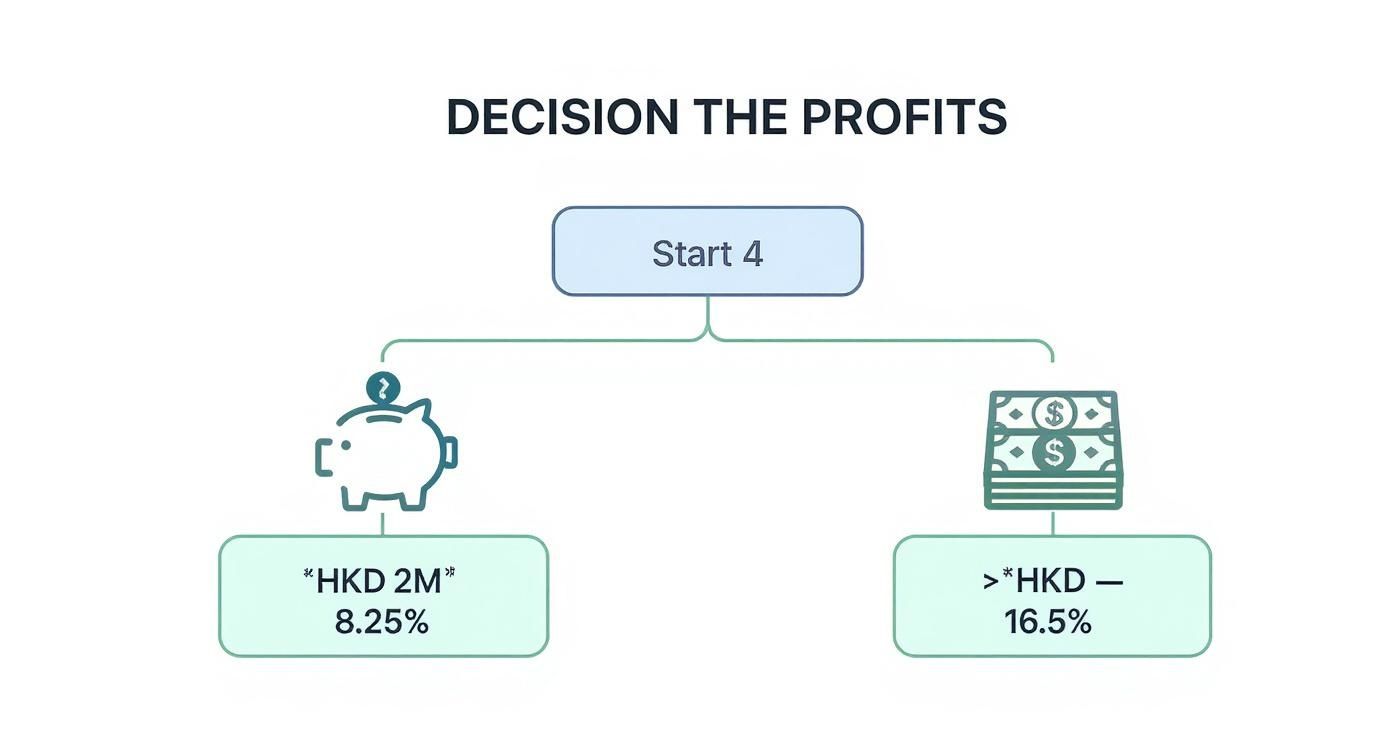
Ultimately, this all reinforces a simple truth: once you’ve figured out which of your profits are sourced in Hong Kong, the next step is just applying the right tax rate based on how much you earned.
A Practical Walkthrough of Your Tax Calculation
Theory is one thing, but seeing the numbers in action is where it all clicks. Let's make the Hong Kong corporation tax rate feel less abstract by walking through a real-world calculation. It’s the best way to turn a potentially daunting task into something clear and manageable.
For this, we'll follow "Pixel Perfect," a fictional creative agency in Hong Kong that's just wrapped up a great year. Like most SMEs, their path from gross revenue to the final tax bill involves a few key stages, starting with figuring out their 'assessable profits'.
Step 1: From Gross Revenue to Assessable Profits
Your assessable profits are the foundation of the entire calculation. It's not your total sales; it's what's left after you've subtracted all your legitimate, tax-deductible business expenses. Think of it as your company's true, taxable earnings.
Let's imagine Pixel Perfect brought in an annual revenue of HKD 3,000,000. To find their assessable profits, they first need to tally up all the costs they incurred purely to generate that income.
Common deductible expenses include things like:
- Staff Costs: Salaries, mandatory provident fund (MPF) contributions, and employee benefits.
- Office & Utilities: Rent for their co-working space, electricity, and high-speed internet.
- Professional Tools: Monthly subscriptions for design software, project management platforms, and cloud storage.
- Marketing & Client Costs: Digital advertising spend, client entertainment, and travel for project meetings.
After a careful accounting, Pixel Perfect’s total deductible expenses for the year came to HKD 500,000.
So, the calculation is straightforward: HKD 3,000,000 (Revenue) – HKD 500,000 (Expenses) = HKD 2,500,000 (Assessable Profits). This is the magic number the Inland Revenue Department (IRD) will be looking at.
Step 2: Applying the Two-Tiered Tax Rates
Now that we have their assessable profits of HKD 2,500,000, we can apply Hong Kong's two-tiered tax system. This is where the benefits for small and medium-sized businesses really come to life.
The first HKD 2,000,000 of their profit is taxed at the reduced rate of 8.25%. Only the remaining profit—in this case, HKD 500,000—is taxed at the standard 16.5% rate.
This structure is a powerful incentive for growth. It ensures that as your business scales, your tax liability grows in a manageable, predictable way, rather than hitting you with a high rate from your very first dollar of profit.
Let's see how that breaks down into their final tax bill.
Sample Profits Tax Calculation for an SME
To make this crystal clear, here’s a step-by-step look at Pixel Perfect's calculation, from their assessable profits all the way to their final tax bill.
| Calculation Step | Amount (HKD) | Notes |
|---|---|---|
| Assessable Profits | 2,500,000 | This is the starting point for our tax calculation. |
| First Tier (at 8.25%) | 2,000,000 | The first HKD 2 million of profit. |
| Tax on First Tier | 165,000 | Calculated as HKD 2,000,000 x 8.25%. |
| Second Tier (at 16.5%) | 500,000 | The remaining portion of the profit (2.5M – 2M). |
| Tax on Second Tier | 82,500 | Calculated as HKD 500,000 x 16.5%. |
| Total Tax Liability | 247,500 | The sum of the tax from both tiers (165,000 + 82,500). |
This table clearly shows how the two rates work together to determine the company's total tax obligation for the year.
The Final Tax Bill
By adding the two figures, we can see that the total profits tax payable by Pixel Perfect is HKD 247,500. Of course, knowing your obligations is tied to understanding timelines, which you can learn more about in our guide to the tax year in Hong Kong.
This walkthrough proves that calculating your tax is much more than just applying a percentage. It’s a process of accurately identifying your true profits by diligently tracking every legitimate expense. For SMEs, smart tax preparation isn't just a compliance headache—it's a core financial strategy.
To make this process even smoother, many businesses look into tools like Drake Tax Hosting to ensure accuracy and save valuable time that can be put back into growing the business.
Beyond the Basics: Special Tax Regimes and Industry Incentives
While Hong Kong's two-tiered system is a huge plus for most small and medium-sized businesses, the city's tax strategy doesn't stop there. The government gets very specific, rolling out the red carpet for certain high-growth industries it wants to see flourish. This is where concessionary tax regimes come into play.
Think of these as targeted tax breaks designed to sharpen Hong Kong's competitive edge as a top-tier global hub for finance, aviation, and trade. If you operate in one of these sectors, getting to know these regimes is essential. They can unlock a Hong Kong corporation tax rate that's a world away from even the attractive 8.25% small-profits rate.
How Do These Concessionary Rates Work?
These special rates aren't a free-for-all; they’re designed for companies carrying out very specific, qualifying activities. The government strategically identifies industries vital to Hong Kong's economic future and creates powerful incentives to draw in investment and talent.
This focused approach has resulted in some seriously attractive tax concessions. For example, qualifying profits earned by a corporate treasury centre are taxed at a concessionary rate of just 8.25%—exactly half the standard 16.5% rate. It’s a clear signal of where the government wants to encourage growth. You can explore more of these specialised CIT rates on PWC.com.
Key Industries on the Priority List
The list of qualifying activities is precise and directly reflects Hong Kong’s economic playbook. While it's always evolving, some of the most prominent sectors that can benefit from these lower tax rates include:
- Corporate Treasury Centres: As we've seen, businesses managing treasury functions for their group can have their qualifying profits taxed at 8.25%.
- Aircraft Leasing: To cement its status as a global aviation hub, Hong Kong offers a significantly reduced rate for qualifying aircraft lessors and managers.
- Fund Management: In a massive draw for the financial services industry, carried interest for eligible private equity funds can be taxed at 0%.
- Insurance Businesses: Specific activities, particularly in marine and captive insurance, also enjoy preferential tax treatment.
These incentives are more than just tax breaks; they're a clear message from the government about which industries are central to Hong Kong’s future. For businesses in these fields, it’s a competitive advantage baked right into the system.
Figuring out if your business might qualify for one of these special rates—or perhaps for a full offshore exemption—is a cornerstone of smart tax planning. For a closer look at one of the most powerful tools in the Hong Kong tax system, our guide on understanding Hong Kong’s offshore profits exemption claim is a must-read. This is how you ensure you aren't leaving money on the table.
Got Questions About Hong Kong's Tax System? We’ve Got Answers.
Once you’ve grasped the basics of Hong Kong's tax rates, the practical questions start to surface. The day-to-day realities and "what-if" scenarios are where the rubber meets the road. Let's tackle some of the most common questions we hear from entrepreneurs just like you.
Think of this as your quick-start guide to staying compliant and making smart decisions. We'll cut through the jargon and get straight to the point on deadlines, offshore claims, and knowing when it's time to call in a professional.
What Are the Key Tax Filing Deadlines I Need to Know?
This is probably the number one question on every business owner's mind, and for good reason—nobody wants to face penalties for a late filing. The good news is that Hong Kong's tax schedule is predictable once you learn its rhythm, which is tied to your company's financial year-end date.
The Inland Revenue Department (IRD) typically sends out Profits Tax Returns on the first working day of April. While the standard deadline is one month from that date, most companies receive an automatic extension through the Block Extension Scheme.
Here’s a quick cheat sheet based on your accounting year-end:
- 1 Jan to 31 Mar (N Code): Your deadline is usually around mid-November.
- 1 Apr to 30 Nov (D Code): You’ll typically need to file by late April of the following year.
- 1 Dec to 31 Dec (M Code): Your due date is often mid-August of the following year.
A special note for new businesses: your first profits tax return operates on a different timeline. The IRD generally issues it about 18 months after you incorporate, giving you plenty of time to get your first set of audited accounts in order.
What Happens if I Claim Offshore Income?
Claiming your profits are sourced offshore is one of the most powerful features of Hong Kong's tax system, but it’s not a simple box-ticking exercise. When you make an offshore claim, you are essentially inviting the IRD to take a closer look at your business operations.
You can’t just make the claim and hope for the best. Think of it as building a legal case—you need to present clear, compelling evidence to support your position.
The IRD will likely send you a detailed questionnaire. They'll want proof of where the real work happens, asking for specifics on:
- Where your key team members are physically located.
- Where major strategic decisions are made.
- Where you negotiate and sign client contracts.
- The physical or digital journey of your goods and services.
If you can't provide solid evidence, the IRD will reject the claim, and those profits will be subject to Hong Kong tax. This is one area where meticulous record-keeping isn't just a good habit; it's absolutely essential.
What Is the Difference Between Tax Avoidance and Evasion?
This is a critical distinction that every business owner must understand. While the terms might sound similar, legally, they are worlds apart.
Tax Avoidance is about playing by the rules. It's the art of legally arranging your business affairs to minimise your tax liability. A classic example is structuring your operations to legitimately qualify for the offshore profits exemption. You're using the tax code as it was intended.
Tax Evasion, on the other hand, is breaking the law. It’s the deliberate act of deception to pay less tax. This includes hiding income, inventing fake expenses, or simply failing to file a tax return. The penalties for evasion are severe, including hefty fines and even imprisonment.
In short, avoidance is smart financial planning; evasion is a crime. Your tax strategy must always be built on a solid, legal foundation.
When Should I Absolutely Seek Professional Tax Advice?
While Hong Kong’s tax system is refreshingly straightforward, some situations are a clear signal that it's time to bring in an expert. Trying to DIY your taxes when things get complex is a recipe for costly mistakes.
It's time to call a professional if you're:
- Making an offshore profits claim: The burden of proof is high, and an advisor can help you build a rock-solid case from the start.
- Setting up a group of companies: The "connected entities" rules for the two-tiered rate can be tricky, and you'll want to maximise the benefit legally.
- Doing business across borders: Issues like double taxation agreements and transfer pricing require specialist knowledge.
- Planning a major restructure, sale, or acquisition: The tax implications are significant and need careful management to avoid costly surprises.
- Facing an inquiry or audit from the IRD: You need an expert in your corner to navigate the process and protect your interests.
Don't think of a tax advisor as a cost. See them as an investment in your company's financial health and your own peace of mind.
At Lion Business Consultancy Limited, we know that understanding the Hong Kong corporation tax rate is just one step in your journey. We’re here to be your private financial manager, helping you build compliant, tax-efficient structures and secure banking solutions that set you up for long-term global growth. If you’re ready for personalised, 1:1 guidance, let's start building your international framework together. https://lionbusinessco.com