

 Hong Kong

 Singapore

 UAE
UAE


 Malaysia
 Turkey


 UK
UK
 EU
EU
 US
US
 Switzerland
 Bahamas Bank Account
 Cayman Islands Bank Account
 Mauritius Bank Account
 BVI
BVI
 Seychelles

Thinking about setting up shop in Hong Kong? Let’s talk about what that really means. To “incorporate a Hong Kong company” isn’t just about paperwork; it’s about creating a distinct legal entity for your business in one of the world’s premier financial hubs. The journey ends with you holding a Certificate of Incorporation and a Business Registration Certificate from the Hong Kong Companies Registry, officially breathing life into your venture.
Why Hong Kong Is Your Strategic Gateway to Asia

Choosing where to anchor your business in Asia is a monumental decision. You aren’t just picking a legal jurisdiction; you’re selecting a launchpad for growth, a financial ecosystem, and a home base for your global ambitions. It has to feel right.
Many entrepreneurs I speak with are first drawn to Hong Kong for its legendary simple and low-tax system. And while that’s a massive perk, it’s really just the tip of the iceberg. The true magic of Hong Kong lies in its unique position as a bridge between the East and the West.
Imagine you’re running an e-commerce brand in Europe and want to tap into the enormous consumer market in mainland China. Navigating China’s regulations directly can feel like a minefield of complexity. But when you incorporate a Hong Kong company, you instantly gain credibility. You’re operating within a stable, internationally respected legal framework that makes cross-border trade exponentially smoother.
This strategic advantage is precisely why so many international businesses choose this path. For a deeper look at how this plays out in practice, explore our guide on Hong Kong as your gateway to China for trading. It’s about making a smart, calculated move for your future.
Hong Kong Company Incorporation at a Glance
Here’s a quick breakdown of the core requirements and benefits for entrepreneurs.
| Feature | Requirement or Benefit | What This Means for You |
|---|---|---|
| Legal System | Common Law | A familiar, predictable, and transparent legal environment for international business. |
| Tax Regime | Low, simple two-tier profits tax | Significant tax savings and straightforward compliance, boosting your bottom line. |
| Shareholder | Minimum 1 (any nationality) | Complete ownership flexibility, whether you’re a solo founder or have global partners. |
| Director | Minimum 1 natural person (any nationality) | You can appoint directors from anywhere in the world, without residency requirements. |
| Company Secretary | Must be a HK resident or HK-based firm | Ensures you have local representation to handle official communications and filings. |
| Registered Address | Must be a physical HK address | Provides a formal presence and a place for official mail (P.O. boxes aren’t allowed). |
| Strategic Location | Gateway to mainland China and Asia | Unrivalled access to one of the world’s largest markets and supply chains. |
This table illustrates just how accessible and pro-business Hong Kong’s framework truly is, designed specifically to attract global talent and investment.
A World-Class Legal and Financial Hub
Hong Kong’s common law system gives international businesses a welcome sense of familiarity and predictability. This framework provides rock-solid protection for contracts, intellectual property, and shareholder rights—all non-negotiables for any serious enterprise.
The city’s reputation for stability isn’t just marketing fluff. It’s built on decades of sound governance and a pro-business attitude that genuinely cuts through red tape, making the process to incorporate a Hong Kong company remarkably efficient.
This supportive environment is reflected in the sheer number of new businesses set up here every year. Hong Kong consistently sees a high rate of new company incorporations, cementing its status as one of the world’s most business-friendly cities.
For instance, in the first half of 2025 alone, the Companies Registry reported 84,293 new local companies were registered. That pushed the total number of live companies to a record 1,494,806 by the end of June 2025. The vast majority are private companies, which really highlights the city’s magnetic appeal for entrepreneurs and SMEs.
Ultimately, choosing Hong Kong is about more than just registering a name. It’s about plugging your business into a powerful global network and leveraging world-class infrastructure to scale your vision.
Laying the Groundwork: Pre-Registration Essentials
Before diving into the paperwork, let’s pause for a moment. The choices you make right now will form the very foundation of your business. Getting these initial details right is the secret to avoiding frustrating delays and costly fixes down the line.
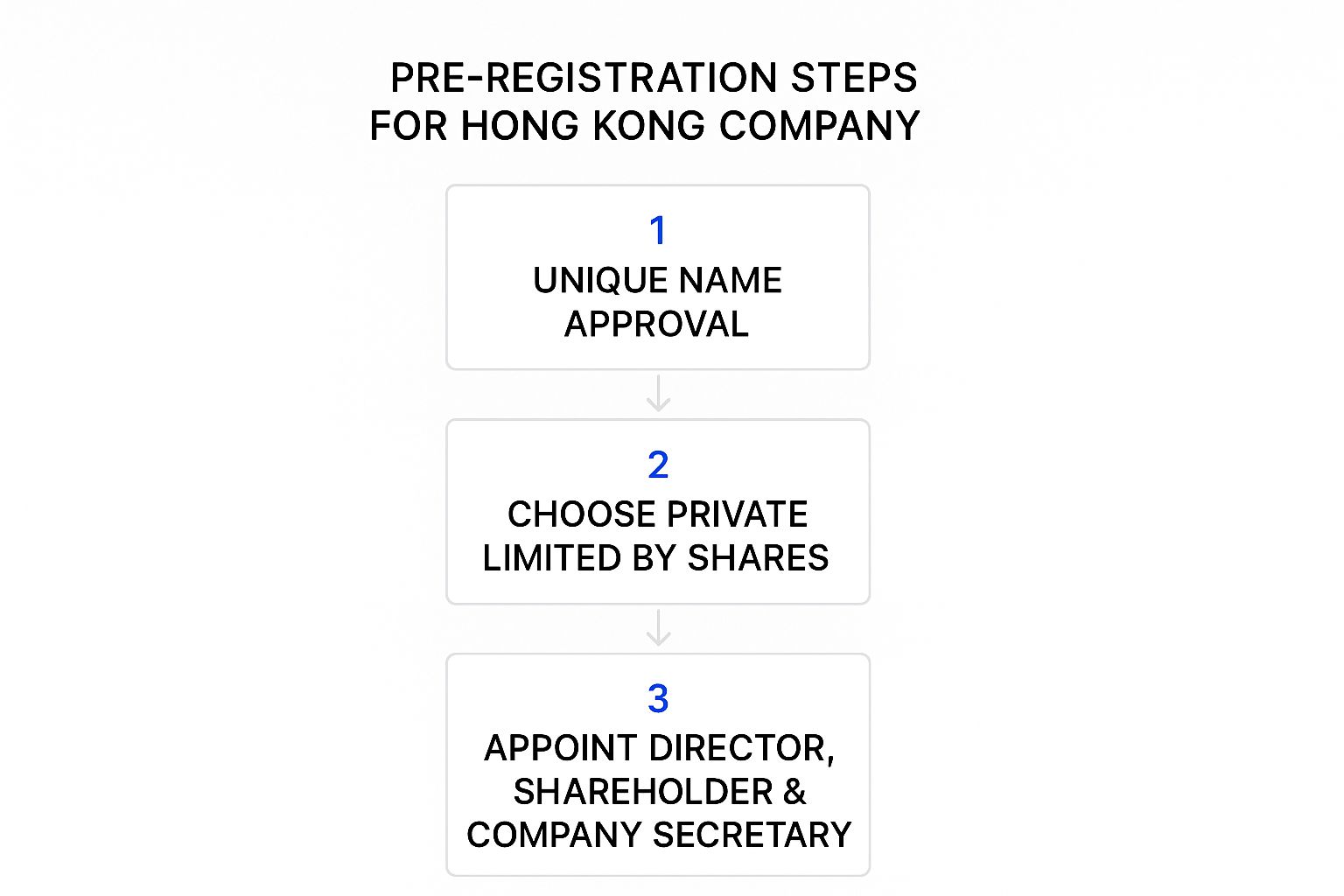
Think of it like drafting the blueprint for a house before laying a single brick—you need a solid plan. Your first job is to lock down a company name that’s not only unique but also plays by the rules set by the Hong Kong Companies Registry.
A classic rookie mistake is choosing a name that’s too similar to one already on the books, which guarantees a swift rejection. Your name also can’t be misleading or use restricted terms without proper justification. It’s essential to check for availability and understand the naming conventions before you commit. For a deep dive, check out this excellent guide on how to register business names.
Choosing the Right Company Structure
With a name picked, your next critical decision is the company structure. While Hong Kong offers a few different types, for most founders and entrepreneurs, the choice is pretty clear.
The numbers speak for themselves. In 2025, private companies made up over 99% of all new incorporations in Hong Kong. This overwhelming preference highlights just how well-suited the private limited company model is for the small and medium-sized businesses that fuel the city’s economy.
So, why is it so popular? The main draw is limited liability. This structure creates a legal firewall between the business and your personal finances, meaning your personal assets are shielded if the company runs into debt. For any entrepreneur, that peace of mind is invaluable.
This simple workflow shows how these initial decisions create a clear roadmap before you even start the formal application.
Assembling Your Core Team and Address
Once you’ve settled on the structure, it’s time to put the key players and pieces in place. Every Hong Kong company has a few non-negotiable requirements to stay compliant.
You’ll need at least one director—they can be of any nationality and live anywhere. You also need a minimum of one shareholder, and yes, the same person can be both director and shareholder.
However, two roles must be based in Hong Kong:
- A Hong Kong Registered Address: This must be a physical, local address, not a P.O. Box. All official government mail will be sent here.
- A Hong Kong Company Secretary: This isn’t just an administrative role. Your company secretary, who must be a Hong Kong resident (or a HK-based corporate body), is your official liaison with the government, ensuring all statutory duties are met on time.
Getting these foundational elements right isn’t just about ticking boxes. It’s about building a credible, compliant business from day one, which makes the entire process to incorporate a Hong Kong company much smoother.
Getting It Done: The Incorporation Process From Paperwork to Launch
With your groundwork sorted, it’s time to make your company official. This isn’t just form-filling; it’s the moment your business idea becomes a legal reality. Think of it as the final step before you can open your doors and start trading.
Thankfully, the journey to incorporate a Hong Kong company is built for speed. You have two paths: the modern digital route or the traditional paper one. Both work, but one is clearly designed for entrepreneurs who value their time.
Digital vs. Traditional Filing
Most founders I work with go straight for the online e-Registry. It just makes sense. It’s faster, slightly cheaper, and you can submit everything from anywhere in the world. With all your documents ready, you can have your official certificates in hand in as little as 24 hours.
The alternative is filing hard copies in person at the Companies Registry. It’s a valid option, but it naturally takes longer—usually a few working days. For anyone eager to hit the ground running, the digital path is the obvious choice.
Your Core Incorporation Documents
No matter which method you choose, the required documents are the same. These aren’t just bureaucracy; they’re the legal DNA of your new company.
- Incorporation Form (NNC1): This is the main application, pulling together all the key details: your company name, registered address, and the specifics of your directors, shareholders, and company secretary.
- Articles of Association: This is your company’s internal rulebook. It lays out how the company will be managed, from shareholder rights to director powers. Most new companies start with a standard, reliable template.
- Notice to the Business Registration Office (IRBR1): This is submitted alongside your main application, a great example of Hong Kong’s efficiency.
Getting these details right the first time is critical. A simple typo in a director’s name or an incorrect address can cause frustrating delays and throw a wrench in your launch plans.
The Two Certificates That Make It Official
Once your application is approved, you’ll receive two key documents. This often confuses new entrepreneurs, as they come from two different government bodies but are processed together.
The Companies Registry issues your Certificate of Incorporation, which legally establishes your company as its own entity. Simultaneously, the Inland Revenue Department issues your Business Registration Certificate, which gives you the license to conduct business. You need both to be fully operational.
This two-in-one system is a prime example of Hong Kong’s efficiency. You don’t have to bounce between departments; it’s all handled in a single, coordinated process.
Receiving these certificates is a huge milestone, but it also signals your next immediate task: opening a corporate bank account. Banks require these documents as proof of your company’s legal existence. To get a head start, our guide on how to open a business bank account in Hong Kong walks you through what banks look for and how to prepare.
What’s the Real Cost to Start a Hong Kong Company?
Let’s get down to the brass tacks: what’s the actual investment? When you decide to incorporate a Hong Kong company, it’s easy to focus on the low government fees and miss the bigger picture. To get a realistic sense of the cost, you need to account for both the initial setup and the essential annual upkeep.
Many first-time founders are pleasantly surprised by the official registration costs but often forget the legally required services needed to operate. These aren’t fancy extras; they’re the bedrock of a compliant Hong Kong company.
For example, you absolutely must have a local registered address and a Hong Kong-based company secretary. If you don’t live here, you’ll need to hire a professional firm to provide these services. This is typically where a significant portion of your initial setup costs will lie.
Don’t Forget the Annual Costs
Remember, setting up your company is not a one-time event. There are recurring annual costs to keep your business in good standing. This means budgeting for the renewal of your Business Registration Certificate, filing your annual return, and paying for your company secretary and registered address services year after year.
Think of these recurring fees like basic maintenance for your business. Neglecting them is a surefire way to rack up fines, jeopardize your company’s legal standing, and create major operational headaches down the road.
Planning for these costs from day one gives you a much clearer financial runway. For a deeper dive into taxation, our guide on the Hong Kong profits tax system is an excellent resource.
Typical Costs: DIY vs. Professional Service
So, what does this all look like in Hong Kong dollars? Let’s compare what you might expect to pay if you handle it yourself versus hiring a professional to guide you.
| Cost Item | DIY Approach (Approx. HKD) | Using a Service Provider (Approx. HKD) |
|---|---|---|
| Govt. Incorporation Fee | HK$1,720 | Included in package |
| Business Registration Fee | HK$2,250 (varies) | Included in package |
| Company Secretary | N/A (requires HK resident) | HK$1,500 – HK$4,000 annually |
| Registered Address | N/A (requires physical HK address) | HK$1,500 – HK$3,500 annually |
| Bank Account Assistance | N/A (handle on your own) | HK$4,000 – HK$8,000 (one-time) |
| Total Estimated First Year | HK$3,970* | HK$7,000 – HK$15,000+ |
*Note: The DIY cost assumes you’re a Hong Kong resident who can serve as your own company secretary and use your own local address. For most overseas entrepreneurs, this simply isn’t a practical option.
As you can see, the DIY path only looks cheaper on the surface and is rarely viable for international founders. A good service provider doesn’t just check boxes; they bundle these essentials, providing the expertise and peace of mind that comes from knowing everything is set up correctly from day one.
Life After Incorporation: Staying Compliant
Congratulations, your Hong Kong company is live! The papers are filed, and the certificates are in your hands. It’s a huge achievement, but this is where the real work begins: building a sustainable business.
One of the first, and often most challenging, hurdles is opening a Hong Kong business bank account. A few years ago, this was a simple walk-in process. Today, it’s a different story. Banks have significantly tightened their due diligence to combat money laundering and meet global compliance standards.
Showing up at a bank unprepared is an almost guaranteed rejection. They want to see more than your incorporation documents; they need a credible business plan, solid proof of your professional background, and ideally, some evidence of business ties to Hong Kong or Asia. Getting organized is non-negotiable.
Navigating the Banking World
To give yourself the best shot at a quick approval, prepare your documents with military precision. Put yourself in the shoes of the bank’s compliance officer—their job is to build a complete, risk-free picture of your business.
Here’s what most banks will ask for:
- Certified True Copies: Your Certificate of Incorporation, Business Registration Certificate, and Articles of Association, all certified by a professional.
- Proof of Business: This is crucial. It could be supplier contracts, initial client invoices, or a detailed business plan with realistic cash flow projections.
- Director & Shareholder Details: Be ready with passports, proof of residential addresses, and sometimes even a personal banking reference letter for every key person involved.
Having everything perfectly in order shows you’re a serious, professional entrepreneur. This simple act of preparation can make a world of difference, potentially shaving weeks off the approval process.
Your Ongoing Compliance Checklist
With your bank account running, your focus must turn to ongoing compliance. Think of it as regular maintenance on a high-performance car—if you neglect it, you’re heading for a breakdown. For your company, this “maintenance” boils down to a few key annual tasks.
Staying compliant isn’t just about avoiding penalties. It’s about protecting your company’s good standing, which is vital for securing loans, attracting investors, and building trust with partners. It’s the foundation of your long-term success.
Your main responsibilities will be:
- Annual Return (Form NAR1): An annual snapshot of your company’s details—directors, shareholders, registered address—which you must file with the Companies Registry.
- Business Registration Certificate Renewal: Think of this as your license to operate. It needs to be renewed every year with the Inland Revenue Department (IRD).
- Profits Tax Return: The IRD will send you this form. You’re required to report your company’s profits (or losses) and, if your revenue hits a certain level, have your accounts audited by a registered Hong Kong CPA.
Juggling these obligations, especially across multiple jurisdictions, can get tricky fast. To understand managing cross-border rules, it’s worth learning how PEOs help companies stay compliant across multiple countries. Keeping meticulous records isn’t just a good habit; it’s a legal requirement that will make yearly filings far less stressful.
Common Questions About Hong Kong Incorporation
When you’re looking to incorporate a Hong Kong company, you’re bound to have questions. I’ve guided hundreds of entrepreneurs through this journey, so let’s clear up some of the most common queries.
One of the first things people ask is if they need to fly to Hong Kong to get set up. The short answer is a definitive no. The entire incorporation process can be managed from anywhere in the world, a massive plus for international founders. From document submission to receiving the final certificates, it’s all handled online.
Another big one is about money. How much do you need for share capital? Hong Kong is incredibly flexible here—there’s no minimum share capital requirement. You could literally register your company with just HK$1. It’s a perfect example of the city’s pro-business attitude.
Foreign Ownership and Director Rules
For entrepreneurs outside of Hong Kong, ownership is a top concern. Can a foreigner own 100% of a Hong Kong company? Yes, absolutely. Hong Kong imposes no restrictions on foreign ownership, so you maintain complete control.
And what about directors? Do they need to live in Hong Kong? Again, no. Your directors can be of any nationality and reside anywhere on the globe. The only local requirement is the Company Secretary, who must be a Hong Kong resident or a registered local corporate body.
The big picture is that Hong Kong’s corporate framework is built for global business. The rules are designed to attract international investment by removing common roadblocks like residency requirements or limits on foreign ownership.
Timeframes and Taxation
“How fast can I get this done?” is a question I hear all the time. If you use the government’s online e-Registry and have your paperwork sorted, the process is incredibly quick—often within 24-48 hours. This speed means you can take your business from idea to operational entity in no time.
Finally, let’s talk tax. Does setting up in Hong Kong mean you pay zero tax? Not exactly, but it has a very attractive territorial tax system. This means you only pay profits tax on income generated within Hong Kong. Money you earn from business activities outside the city is generally not subject to Hong Kong tax, a huge advantage for global operations.
Conclusion
Getting these details right from the start is where professional guidance truly pays off. At Lion Business Consultancy Limited, we do more than just file paperwork. We help you build a compliant, tax-efficient structure that’s perfectly aligned with your international goals. Let us handle the complexities so you can focus on what you do best: growing your business.