

 Hong Kong


 Singapore


 UAE
UAE



 Malaysia


 Turkey



 UK
UK
 EU
EU
 US
US
 Switzerland
 Bahamas Bank Account
 Cayman Islands Bank Account
 Mauritius Bank Account

 BVI
BVI
 Seychelles

A professional company secretary service is the engine room of your business's legal and administrative compliance. It’s far more than just shuffling paperwork. Think of this service as your company's chief governance officer, a silent partner ensuring every statutory obligation is met on time, every time. From filing annual returns to meticulously maintaining official records and advising your board on correct corporate procedures, they've got it covered.
The Guardian of Your Company's Compliance

Launching a business is exhilarating. Amidst the rush of product development and market entry, it's easy to push aside the less glamorous legal duties. But there's one that many entrepreneurs accidentally overlook: appointing a company secretary. In Hong Kong, this isn't optional—it's a mandatory appointment under the Companies Ordinance.
Imagine an air traffic controller for your business. They safely guide all your corporate maneuvers, helping you avoid collisions with complex regulations and preventing costly compliance mistakes. This person or firm is your first line of defense against hefty fines, crippling penalties, and even legal action against your directors. They free you up to focus on what you do best—growing the business.
More Than Just a Name on a Form
The company secretary is the true guardian of your company’s governance. Their responsibilities run much deeper than just filing documents. They are tasked with maintaining the company's statutory books and records, which act as the official, legal chronicle of your business’s entire life.
Essentially, they are the keepers of your company’s core legal identity. These records include things like:
- The register of members (your shareholders).
- The register of directors and the company secretary themselves.
- Minutes of all board meetings and shareholder resolutions.
Getting this wrong can be painful. For instance, failing to maintain these registers accurately can lead to fines of up to HK$50,000. We often see entrepreneurs who've just completed their company registration in Hong Kong underestimate this crucial step, only to get tangled in compliance headaches down the road. The right professional service turns this legal burden into a strategic asset that bolsters your company’s stability and reputation.
Protecting Your Leadership and Your Business
A quiet but vital part of the company secretary’s job is to protect your directors. By making sure every decision, meeting, and filing is procedurally sound, they create a protective layer that shields the board from personal liability.
Your company secretary is the silent partner who keeps your business legally sound. They manage the procedural details that, if ignored, can create significant risks for directors and the company itself.
This protective function is absolutely crucial. When a company's leadership is protected, it can make bold decisions with confidence. It's also worth noting that good governance, managed by the secretary, works hand-in-hand with protections like Directors and Officers (D&O) insurance. At its heart, a company secretary service is all about smart risk mitigation, ensuring your business is built on a solid, compliant foundation from the very beginning.
So, What Does a Company Secretary Actually Do?
Let's cut through the jargon. What does a professional company secretary service really do for your business day-to-day? It isn't just about filing paperwork. Think of them as the guardian of your company's legal health, expertly navigating Hong Kong’s Companies Ordinance to shield you and your directors from some serious liabilities.
They are the architects of your company's good governance. They ensure the very foundation of your business is solid, compliant, and ready for whatever growth comes your way. This isn't just a legal box-ticking exercise; it's a strategic function that adds real value.
The Three Pillars of Their Role
A company secretary's work really boils down to three core responsibilities. Each one is crucial for keeping your company in good standing and running smoothly. Drop the ball on any of them, and you could be looking at fines, operational headaches, or a black mark on your reputation.
- Keeping the Government Happy (Statutory Compliance): This is the bread and butter. It means preparing and filing vital documents like the Annual Return on time. It also means making sure any company changes—a new director, a different address—are reported to the Companies Registry within strict legal deadlines.
- Running the Boardroom (Board & Governance Support): They are the right hand of the board of directors. Their job is to ensure board meetings are properly called, run, and recorded. This involves preparing agendas, taking minutes that stand up to scrutiny, and advising on correct procedures so every decision is legally sound.
- Managing the Owners (Shareholder Management): The company secretary is the official link between the company and its shareholders. This means everything from organising general meetings and handling communications to maintaining the register of members—the definitive legal record of who owns the company.
More Than Just Paperwork: A Strategic Edge
It's easy to look at these tasks and think they're just admin. But that's missing the bigger picture.
Let's say you're trying to raise a new round of funding. Any serious investor will perform due diligence, and you can bet one of the first things they'll dig into are your company's official records.
A clean, professionally managed set of company records sends a powerful signal. It tells potential investors, lenders, and partners that you run a tight ship. It builds trust and shows that your business is a serious, well-managed operation worth their time and money.
On the flip side, messy or missing records are a huge red flag. It can kill a deal before you've even had a chance to talk numbers. This is where a great company secretary proves their worth—by keeping your corporate house in perfect order, they directly add to your company's credibility and value. For example, they make sure crucial details like your Business Registration Number are correctly filed and consistent across all official documents.
A Real-World Example: Why Proactive Matters
Think about a common business move: appointing a new director. In Hong Kong, this isn't just an internal decision. It’s a legal event that has to be reported to the Companies Registry by filing a Form ND2A within 15 days.
A proactive company secretary doesn't sit back and wait for you to remember this. They're on the front foot, guiding you through the steps, preparing the board resolutions to make the appointment official, and handling the filing for you. This simple, professional act stops you from breaching the Companies Ordinance and avoids fines for both the company and its directors. You can get a broader sense of these obligations by reviewing the full list of Company Secretary Duties and Responsibilities to see how this works in other common law jurisdictions.
This is what separates a mere filing service from a genuine governance partner. They turn compliance from a reactive chore you dread into a smooth, seamless part of how you do business.
When you're building a business across borders, it's easy to assume what works in one country will work in another. This is a classic mistake, and nowhere is it more apparent than with the role of the company secretary.
The job isn't a simple copy-paste function. Its duties are tied directly to local laws, and the compliance framework in London is worlds apart from the one in Hong Kong or Singapore. A one-size-fits-all approach to corporate governance isn't just inefficient; it's a direct route to compliance headaches.
Hong Kong's Unmissable Residency Rule
Let's start with Hong Kong. The local Companies Ordinance (Cap. 622) is crystal clear and leaves no room for interpretation. A Hong Kong company must have a company secretary who is either an individual living in Hong Kong or a corporate body with a registered office here.
This isn't just red tape. It's a fundamental safeguard to ensure someone is physically present and accountable for the company's legal duties. For international entrepreneurs, this local residency rule is often the first major hurdle. It's precisely why partnering with a professional Hong Kong company secretary service is less of a choice and more of a legal necessity.
The core responsibilities of a company secretary—compliance, board support, and shareholder relations—are universal in principle, but how they're carried out varies dramatically by location.
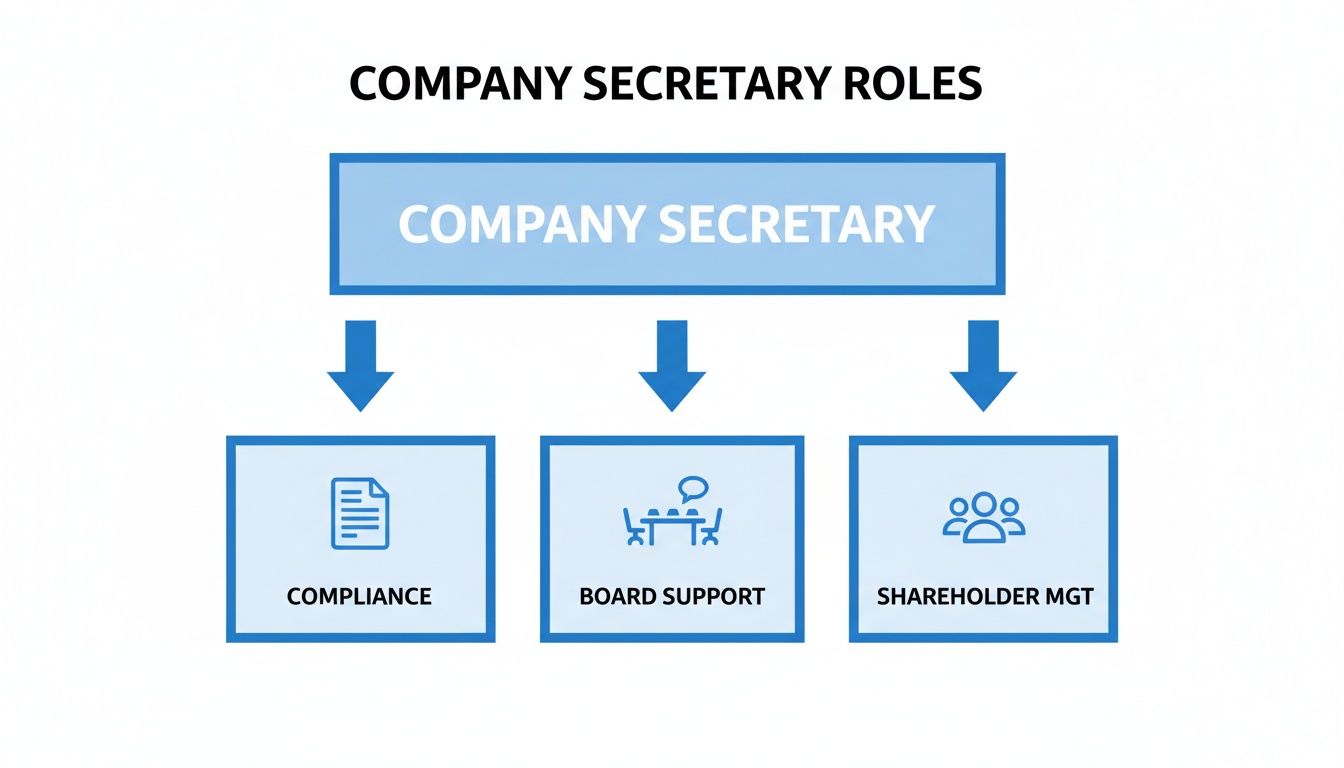
As this shows, each pillar of the role demands deep-seated local knowledge to navigate correctly.
Comparing Company Secretary Requirements
To really drive this point home, let's look at how these rules stack up in other major business hubs.
Company Secretary Requirements Hong Kong vs Other Jurisdictions
| Requirement | Hong Kong (Cap. 622) | Singapore | United Kingdom |
|---|---|---|---|
| Mandatory Appointment | Yes, for all private limited companies. | Yes, must be appointed within 6 months of incorporation. | No, for private limited companies (unless articles require it). |
| Residency Rule | Strictly enforced. Must be a Hong Kong resident (individual) or a HK-registered company. | Strictly enforced. Must be a "natural person who is resident in Singapore." | No residency requirement. |
| Governing Law | Companies Ordinance (Cap. 622). | Companies Act (Cap. 50). | Companies Act 2006. |
| Key Responsibility | The duties fall on the appointed secretary. | The duties fall on the appointed secretary. | If no secretary is appointed, the duties legally fall to the directors. |
| Regulatory Oversight | Oversight by the Companies Registry. | Oversight by the Accounting and Corporate Regulatory Authority (ACRA). | Oversight by Companies House, with new ACSP rules from 2025. |
This table quickly reveals just how different the legal DNA of each jurisdiction is. What's mandatory in Asia might be optional in the UK, but that "flexibility" comes with its own set of responsibilities.
The UK's Shift Towards Accountability
The United Kingdom offers a really interesting contrast. Under the Companies Act 2006, private companies are no longer legally required to appoint a company secretary. It sounds simpler, but don't be fooled—the work doesn't vanish. Instead, all those statutory duties land squarely on the directors' shoulders.
What's more, the UK is actively tightening its grip on corporate governance. From 2025, agents filing on behalf of companies must register as an Authorised Corporate Service Provider (ACSP). It's a clear move to weed out bad actors and ensure accountability, echoing the same spirit behind Hong Kong's residency rule, just with a different mechanism.
Singapore: A Mirror Image of Hong Kong's Rules
Fly over to Singapore, and the picture looks much more familiar. Its Companies Act is just as strict as Hong Kong's, mandating that every company appoint a secretary within six months of incorporation.
And here’s the key similarity: the company secretary in Singapore must be a "natural person who is resident in Singapore." This shared principle underscores a non-negotiable expectation in Asia's top financial hubs—there has to be a local, accountable officer on the ground.
Ignoring this in either city can lead to steep fines and put your company in immediate default. It’s a perfect example of why you can't just assume your UK or US corporate structure will work here.
These subtle but critical differences are exactly why local expertise is not just a "nice-to-have." It's everything. A good Hong Kong company secretary service does more than just file paperwork; they act as your guide, helping you master the local rules of the game so your business can thrive.
In-House Hire vs Outsourced Service
Sooner or later, every growing business hits a crossroads: do we hire a company secretary full-time, or do we bring in an expert service provider? This isn't just about ticking a box on your budget; it's a strategic call that directly impacts your company's agility, costs, and access to critical expertise.
The right answer really depends on where your business is today and where you plan to take it tomorrow. A nimble tech start-up has a completely different set of needs compared to a well-established international trading firm. Let's break down the practical realities and the hard numbers behind the decision.
The True Cost of an In-House Hire
Bringing a full-time company secretary onto your payroll in Hong Kong is a serious financial undertaking. It’s not just about the monthly salary. You've also got to factor in MPF contributions, annual leave, medical benefits, potential bonuses, and the overheads that come with another desk in the office.
A quick look at recent market data shows just how big that commitment is. These are highly valued professional roles, and the salaries reflect that. For 2025, recruitment data shows the median monthly salary for a Company Secretary in Hong Kong is around HK$70,000. That's an annual base salary north of HK$840,000—before you even add the on-costs. If you dig into the salary benchmarks, you’ll see this is a significant, fixed expense.
This is precisely why so many small to medium-sized enterprises (SMEs) and international firms opt for a company secretary service. Outsourcing lets you turn that hefty fixed cost into a predictable, manageable operating expense.
Comparing the Two Paths
To make this feel more real, let's look at two different types of businesses and see how this choice would play out for them.
Scenario 1: The Lean Tech Start-up
- Who they are: A newly funded tech company with 10 people, all-in on product development and getting to market. Their corporate structure is simple, and they don’t have board meetings every five minutes.
- Hiring In-House: Shelling out HK$840,000+ a year for one role would be a huge drain on capital—money that could be funding another engineer or a marketing campaign. On top of that, a full-time person would likely be sitting idle for much of the time.
- Outsourcing: For a clear annual fee, they get an expert on call to handle all their statutory filings, manage the company registers, and offer advice when they need it. It’s top-tier expertise without the crippling overhead.
Scenario 2: The Established Trading Firm
- Who they are: A 15-year-old trading business with 75 employees, dealing with complex international transactions and multiple subsidiaries. Their board meetings are formal and frequent.
- Hiring In-House: At this scale, an in-house hire might seem like the obvious choice. They’d be embedded in the day-to-day operations and really get the company. But even for a larger firm, the cost is still a major consideration.
- Outsourcing: A specialised provider offers not just one person, but a whole team with diverse skills. This becomes incredibly valuable when you’re dealing with complex cross-border compliance or a corporate restructuring. They get access to a department’s worth of knowledge for less than the price of a single senior hire.
Key Factors to Guide Your Decision
Your choice really comes down to weighing four key factors against what your company needs right now.
| Factor | In-House Hire | Outsourced Service |
|---|---|---|
| Cost Structure | High fixed cost. A full package of salary, benefits, training, and overheads. | Predictable variable cost. You pay for exactly the services you need, usually as a clear annual fee. |
| Expertise | Deep but narrow. You're limited to the knowledge and experience of one person. | Broad and deep. You tap into a team with specialists in law, finance, and corporate governance. |
| Scalability | Difficult to scale. Hiring and training takes time and money. | Highly scalable. Easily add services as you grow or expand into new markets. |
| Risk Management | Single point of failure. All your compliance knowledge rests on one person's shoulders. | Reduced risk. Professional firms have backup and quality control systems built in. |
For most SMEs and start-ups, the math is compelling. Outsourcing provides a level of expertise and flexibility that is simply unaffordable with a direct hire. It’s about paying for the function, not the full-time position.
This approach lets you put your cash where it will have the biggest impact—on growth. It also fits perfectly with a modern, asset-light business model, where you bring in specialist external teams for vital functions. This isn't just true for company secretarial work; many growing businesses see the same value in outsourcing other key areas, often looking for one provider to handle both. You can see how this works by checking out our guide on outsourced accounting services in Hong Kong.
Ultimately, choosing a company secretary service is a strategic move to de-risk your operations and buy back your most valuable asset: your time.
How to Choose the Right Service Provider

Choosing an outsourced company secretary service feels less like hiring a vendor and more like bringing a long-term partner into your business. This decision will directly impact your company's legal and financial well-being for years. Make the right choice, and you gain stability and peace of mind. Get it wrong, and you could be facing fines, missed deadlines, and a mountain of compliance headaches.
Many entrepreneurs fall into the trap of just picking the cheapest option on the market. This is almost always a mistake. A bargain-basement price often hides extra fees, slow service, and a complete lack of proactive advice. Your focus shouldn't be on cost, but on finding a partner who delivers real value and earns your trust.
Your Due Diligence Checklist
Before you sign on the dotted line, you have to do your homework. Treat this like you're vetting a key member of your senior team. Here’s a practical checklist to help you size up potential providers.
- Verify Their Licence First: In Hong Kong, any firm offering these services must hold a Trust or Company Service Provider (TCSP) licence. This is absolutely non-negotiable. Ask for their licence number right away and check it yourself on the Companies Registry’s official register. This one simple step will instantly filter out any unqualified operators.
- Scrutinise the Fee Structure: Never settle for a vague quote. Insist on seeing a detailed fee schedule that clearly outlines what’s included in the annual retainer and what counts as extra, non-routine work. Ask pointed questions: "What is the exact cost for filing a change of director?" or "Are there separate charges for preparing standard board resolutions?" A transparent provider won't hesitate to give you clear answers.
- Assess Their Technology and Security: How are they going to handle your sensitive corporate data? A modern, reputable firm will use a secure client portal for sharing documents and communicating—not just standard email. You should ask about their data protection policies and digital workflows to make sure your company’s information is properly protected.
- Evaluate Their Communication Style: Do they respond promptly? Are their answers clear and easy to understand? A great partner is proactive. They should be sending you reminders for key deadlines and explaining complex rules in plain English. If they're slow or confusing before you’ve even hired them, that’s a massive red flag.
A Tale of Two Companies
Think about this scenario, which plays out all the time. One startup, desperate to save every dollar, goes with the cheapest online service they can find. They quickly learn that the low price only covers the absolute basics. Every filing, every question, and every bit of advice triggers another unexpected invoice. To make matters worse, their provider misses a critical deadline for the Annual Return, landing the company an easily avoidable penalty.
Now, consider a second startup. They did things differently. They interviewed three providers, focusing on their expertise and how responsive they were. They ended up choosing a firm that wasn't the cheapest but offered a clear, all-inclusive package and actually took the time to understand their business. This partner didn't just file forms; they offered strategic advice on how to structure the company for a future funding round. They became a genuine asset on the startup's growth journey.
The lesson is clear: A good company secretary service isn't a cost centre; it's an investment in your company's stability and future success. It’s the difference between reactive problem-solving and proactive risk prevention.
The Growing Market for Expertise
The demand for reliable, licensed providers in Hong Kong is huge. To meet this need, the Registry issued 350 new TCSP licences in the first half of 2025 alone, pushing the total number of licensees to nearly 7,000. These firms are the backbone of the city’s corporate world, handling crucial compliance for thousands of local and international businesses. You can explore more data on Hong Kong's corporate services landscape to see just how vital these licensed providers are.
Finding a high-value partner among these thousands of options means looking beyond the price tag. It’s about finding a firm with the expertise, technology, and proactive mindset to become a true guardian of your company’s compliance.
Your Questions Answered: Company Secretary Services
Getting to grips with corporate compliance can feel like learning a new language. You've seen that having a company secretary in Hong Kong isn't just a box-ticking exercise—it's the law. But what does that mean for you day-to-day?
To help you connect the dots, we've gathered the most common questions we hear from entrepreneurs about professional company secretary services. Think of this as your final briefing before making a foundational decision for your business.
Can a Director Also Be the Company Secretary in Hong Kong?
This is easily one of the most frequent questions we get, and the answer gets right to the heart of Hong Kong's focus on good governance. In short: no. If your company has only one director, that same person cannot also wear the company secretary hat.
The law demands a clear separation of duties. This is a deliberate safeguard to ensure there’s at least one other party involved in the company's core governance, preventing a single individual from having total, unchecked control.
There is one exception, though. If your company has two or more directors, one of them can be appointed as the secretary. However, they must meet Hong Kong's residency requirement, meaning they ordinarily live here.
What Happens If My Company Fails to Appoint a Company Secretary?
Ignoring this rule isn't an option. It's a direct breach of the Hong Kong Companies Ordinance, and the consequences are serious. Failing to appoint a company secretary can lead to hefty fines for both the company and its directors personally.
But the real pain goes beyond the financial hit—it leads to immediate operational paralysis. Without a named secretary, you can't legally file critical documents like your Annual Return. This triggers further penalties for late filing and, in the worst-case scenario, could lead to the Companies Registry striking your company off the register entirely. A professional company secretary service is your insurance policy, keeping this crucial role filled and your company in good legal standing.
A vacant company secretary role is like leaving the driver's seat of your compliance empty while the car is still running. It’s not a question of if you’ll run into trouble, but when. Keeping a qualified professional in that seat is fundamental to keeping your business on the road.
What Is the Typical Cost of an Outsourced Company Secretary Service?
There's no single price tag, as costs vary based on the provider and exactly what you need. However, the pricing structure is usually quite clear.
A basic annual package for a standard private limited company in Hong Kong generally ranges from a few thousand to several thousand Hong Kong dollars. This retainer typically covers the essentials:
- Acting as your named company secretary on the public record.
- Maintaining the company’s statutory books and records.
- Preparing and filing your mandatory Annual Return.
The key is to ask what isn't included. Non-routine work—things like drafting detailed board minutes for a special resolution, processing a share transfer, or changing your company's structure—will almost always be billed as extra. Always ask for a detailed fee schedule upfront so you have a transparent view of all potential costs.
How Do I Change My Company Secretary?
Switching your company secretary service is a formal legal process, but it's very straightforward. You can't just part ways with your old provider and sign up with a new one; specific steps must be followed to stay compliant.
It all starts with your board of directors. They need to pass a formal resolution that officially terminates the appointment of your current secretary and confirms the appointment of the new one.
Once that resolution is passed, the change has to be reported to the government by filing a Form ND2A (Notice of Change of Company Secretary and Director) with the Hong Kong Companies Registry. This must be done within 15 days of the change taking place.
The good news? Your new provider will almost always manage this entire process for you. They’ll prepare the resolutions, fill out the Form ND2A correctly, and make sure it’s filed on time. This ensures a seamless and fully compliant handover, letting you switch partners without any disruption.
Conclusion
Navigating global compliance, banking, and tax requires more than just a service provider—it demands a private advisor. At Lion Business Consultancy Limited, we act as your strategic partner, designing the compliant, low-tax, and secure financial structures your business needs to expand with confidence.