

 Hong Kong
 Singapore


 UAE
UAE


 Malaysia
 Turkey
 UK
UK
 EU
EU
 US
US
 Switzerland
 Bahamas Bank Account
 Cayman Islands Bank Account
 Mauritius Bank Account
 BVI
BVI
 Seychelles

Imagine you’re about to open a crucial international bank account for your new BVI company. You've polished your business plan, gathered your personal documents, but the banker asks for something you’ve probably never heard of – a Certificate of Incumbency BVI. What felt like a simple administrative task suddenly becomes a major hurdle.
So, what exactly is this document, and why does it matter so much? Think of it as your company's official, verified team sheet. It's a formal document that confirms exactly who the current directors, officers, and sometimes shareholders are at a specific moment in time. It’s the definitive "who's who" that proves who has the legal power to act on your company's behalf.
This piece of paper isn't just bureaucracy; it's a vital key for unlocking business functions like opening bank accounts or proving who can legally sign contracts.
Your Company's Official Roster Explained
Let's unpack what this document really is. It isn't some complex legal scroll designed to confuse you. Instead, it’s a simple, clear snapshot of your company’s leadership at a single point in time. Its whole purpose is to provide undeniable, third-party proof that the people running your company are exactly who they say they are.
A Certificate of Incumbency BVI is essentially your company's official team roster. Just like a sports team's lineup lists every player and their position for the current season, this certificate lists all the key people in your business—the directors, officers, and shareholders—and confirms their designated roles. It definitively answers the question: "Who has the authority to sign contracts, open bank accounts, and make decisions for this business?"
To give you a clearer picture, here’s a quick breakdown of what this certificate means for your day-to-day operations.
BVI Certificate of Incumbency at a Glance
| Key Aspect | Why It Matters for Your Business |
|---|---|
| Official Verification | Confirms the identities of your company's directors, officers, and key shareholders. |
| Authority Proof | Acts as conclusive evidence of who has the legal right to sign documents and bind the company. |
| Third-Party Credibility | Issued by your BVI Registered Agent, giving it official weight with banks and regulators. |
| Time-Sensitive Snapshot | Reflects your company's structure on the exact date it was issued, ensuring information is current. |
This table shows that the certificate is less about internal record-keeping and more about proving your company's legitimacy to the outside world.
Why It's More Than Just Paperwork
For any entrepreneur or SME operating in the global marketplace, credibility is everything. When you’re engaging with banks, investors, or legal partners in different countries, they need solid assurance that you are who you say you are. A handshake won't cut it; they require official documentation verifying that your company’s internal structure is legitimate and current.
This document acts as a key that unlocks critical business functions. Without it, your company's growth can stall before it even begins, as essential steps like securing financing or finalising partnerships become impossible.
The certificate gains its authority because it’s issued by your company's Registered Agent in the British Virgin Islands. This isn't a document you can just type up yourself. It’s a formal declaration from a regulated professional who maintains your official company records, which is precisely why financial institutions and other authorities trust it.
Understanding the Registered Agent’s role is fundamental to managing BVI business companies, as they are your official link to staying compliant and obtaining essential documents like this one. In short, the certificate of incumbency bvi elevates your company from just a name on a registration form to a verifiable entity with a clearly defined leadership team, ready to do business on the world stage.
When Do You Actually Need a Certificate of Incumbency?
It’s easy to dismiss a Certificate of Incumbency BVI as just another piece of corporate paperwork. But in the real world, its value pops up in the moments that truly matter for your company's growth and legitimacy. This isn't about ticking a compliance box; it's a vital key that proves your company is who it says it is, especially when the stakes are high.
Let's step away from the technical definitions and walk through the practical scenarios where this certificate becomes indispensable.
Opening a Corporate Bank Account
Picture this: you’ve just landed a major client in Europe. To handle the new income efficiently, you decide to open a business account with an international bank in a hub like Hong Kong or Singapore. You've filled out all the forms, submitted your passport copies and business plan, and you're feeling confident.
Then, an email from the bank’s compliance department lands in your inbox. Your application is on hold until you provide a Certificate of Incumbency BVI issued within the last three months.
This is, by far, the most common reason you'll need one. Banks operate on a zero-trust basis. They need absolute, undeniable proof of who controls the company and has the legal authority to manage its finances. They won’t take your word for it or accept an internal company resolution. The certificate, issued by your BVI Registered Agent, is their official, third-party verification—their shield against fraud and money laundering.
Securing Loans or Attracting Investors
Here’s another common situation. Let's say your tech startup, registered as a BVI company for its global flexibility, is ready for its next big leap. You're in talks with a venture capital firm for your Series A funding round and are also applying for a business loan to scale up your team.
During the due diligence process, both the investors and the bank will ask for the same thing: a full set of corporate records, headlined by a recently issued Certificate of Incumbency.
Why is it so crucial for them? They need to confirm two fundamental facts:
- Who is in charge? Investors won’t wire a single dollar until they know precisely who is on the board of directors and has the power to make key decisions.
- Who owns the company? Lenders and investors must verify the shareholder structure to understand who ultimately controls the business and benefits from its success.
For any financial partner, the certificate is a cornerstone of their risk assessment. It confirms they are dealing with the real, authorised people, ensuring that any investment or loan agreement they sign is legally sound and enforceable.
Entering Major Corporate Deals
Imagine your BVI holding company is about to sign a joint venture agreement with a large multinational. The deal is complex, involving asset transfers, shared intellectual property, and significant financial commitments. Lawyers on both sides are poring over every clause.
In a high-stakes scenario like this, the other party’s legal team will demand a Certificate of Incumbency—often one that has been notarised and apostilled to give it legal standing across borders. This is particularly true for entities engaged in complex activities like family office wealth management, where verifying officers and shareholders is critical for international compliance.
This certificate provides irrefutable proof that the director signing the multi-million-dollar contract has the legal authority to do so. Without it, the entire deal could be challenged or even voided down the line, exposing everyone to massive legal and financial fallout. It’s what gives real legal power to the signatures on the agreement.
Anatomy of a BVI Certificate of Incumbency
So, what are you actually looking at when you hold a BVI Certificate of Incumbency? Think of it less like a complicated legal scroll and more like your company's official passport. Every detail on it is scrutinized by banks and business partners to verify who you are and that you’re in good standing.
This document is more than just a list of names; it's a formal declaration from your Registered Agent, confirming the "who's who" of your company at a specific moment. Understanding its parts is key to navigating any due diligence process smoothly.
Core Components Translated
When you receive your certificate, you'll see it’s laid out quite clearly. Each section provides a vital piece of the puzzle that third parties, like a bank in Hong Kong or a potential investor, need to see.
Here's a simple breakdown of the essentials:
- Company Name and Registration Number: This is your company’s legal name and the unique ID number issued by the BVI Registrar of Corporate Affairs. No ambiguity here.
- Registered Office Address: This confirms your official BVI address, which is the office of your Registered Agent. It’s your company’s legal home.
- Current Directors and Officers: You’ll find a complete roster of who is currently running the show – the directors and any other officers, along with their titles (e.g., Director, President, Secretary).
- Shareholder Details (Optional but Common): Often, the certificate will also name the current shareholders and how much of the company they own, giving a full picture of the ownership structure.
These details are essentially a snapshot drawn from your official records. For a complete historical record of decisions and changes, this information aligns with what's kept in your corporate minute book.
The All-Important Issuance Date
Pay close attention to the date on the certificate. It’s probably the most important—and most often overlooked—detail. Ever had a bank demand a "fresh" certificate, one that's no older than three or six months? There's a very good reason for that.
Think of it like a newspaper. The information is only guaranteed to be accurate on the day it was printed. A company can change fast. Directors resign, new shareholders join, or the company might even be facing being struck off.
A recent issuance date tells banks and partners they are dealing with the current reality of your company. An old certificate is a massive red flag because the information could be completely out of date.
This isn't just a quirky BVI rule; it’s standard practice for financial institutions everywhere, especially in places with strict compliance like Hong Kong. It's a fundamental part of their anti-money laundering (AML) and know-your-customer (KYC) checks. The fee, usually around USD 200–300, isn't just for the paper—it’s for the real-time verification from your Registered Agent.
Spotting Red Flags and Ensuring Accuracy
When you get your certificate, you need to be meticulous. Any error, no matter how small, can cause serious headaches, from delayed transactions to flat-out rejections.
Keep an eye out for these common slip-ups:
- Mismatched Names: Do the names of the directors and shareholders match their passports and IDs exactly? "Close enough" isn't good enough.
- Outdated Information: The certificate must show the absolute latest company structure. If you appointed a new director last week, they need to be on it.
- Missing Signatures or Seals: A valid certificate must be properly signed and stamped by your authorised Registered Agent. Without that, it's worthless.
A single typo can halt a multi-million-dollar deal in its tracks or get your bank account application thrown out. Treat this document with the respect it deserves; it’s a direct reflection of your company's professionalism and good governance.
How to Get Your BVI Certificate of Incumbency
Alright, we've covered what a Certificate of Incumbency BVI is and why it's so critical. Now for the practical part: how do you actually get your hands on one? The good news is that it's a very clear process, but it all hinges on one critical relationship: the one you have with your Registered Agent.
This isn't a document you can just whip up in-house. It’s an official declaration that can only come from one source – your company's Registered Agent in the British Virgin Islands.
Why Your Registered Agent is the Gatekeeper
Think of your Registered Agent as the official guardian of your company's core legal files. They are responsible for maintaining the statutory registers, which are the definitive records of who your directors and shareholders are, along with other crucial company details.
Because they are legally mandated to keep these records up to date, they are the only party authorized to issue a certificate that formally verifies this information. A bank or business partner receiving it knows the details have been confirmed by a licensed, regulated professional who holds the original records. It’s this independent validation that gives the certificate its credibility.
Your Step-by-Step Guide
Getting the certificate is a straightforward, methodical process. If you follow these steps, you can avoid any back-and-forth and get exactly what you need without delay.
-
Get Your Details Ready: Before you even reach out, have your company's full legal name and registration number on hand. It's also smart to know why you need the certificate. If the bank or counterparty needs specific details included, like shareholder percentages, make a note to request this from the start.
-
Make the Formal Request: Contact your Registered Agent, usually via email or their online portal. State clearly that you need a Certificate of Incumbency. Be very specific if you have extra requirements, like needing it notarized or apostilled for use in another country.
-
Check the Draft: Your agent will prepare a draft based on the official registers they hold. They’ll likely send this to you for a final check. Read it carefully. A small typo in a name or date could cause the document to be rejected down the line, so it’s worth taking a minute to confirm everything is perfect.
-
Receive the Final Document: Once you give the green light, your agent will issue and sign the certificate. You’ll almost always get a PDF copy by email first, which is often all you need. If a physical original is required, they'll send it out by courier.
Costs and Timelines to Expect
Naturally, there's a fee for this service. While it varies from one provider to another, you can generally budget around USD 200–300 for a standard Certificate of Incumbency BVI. This fee covers the agent’s work in pulling the records, verifying the information, and preparing the official document. For more background on how these documents function, you can review some helpful official sources on the topic.
Time is also a factor. For a standard certificate without any extra legalisation, the turnaround is usually quite fast—typically just 1-2 business days. This speed is a huge advantage when you have a bank or partner waiting on you. Keeping up-to-date with the BVI company registry procedures can help you plan ahead for these kinds of requests.
Notarization and Apostille for International Use
A BVI Certificate of Incumbency is a powerful document, but its authority doesn't automatically cross every border. For a bank in Singapore, a court in London, or a government agency in Switzerland to accept it as proof, it usually needs an extra layer of official validation. This is where notarization and apostille come in, transforming a local BVI document into one with real international legal muscle.
Think of it like this: the certificate is your company’s passport. It confirms its identity and who’s authorized to act on its behalf. But just as your personal passport needs a visa for certain countries, your certificate needs an apostille to be officially recognized in others.
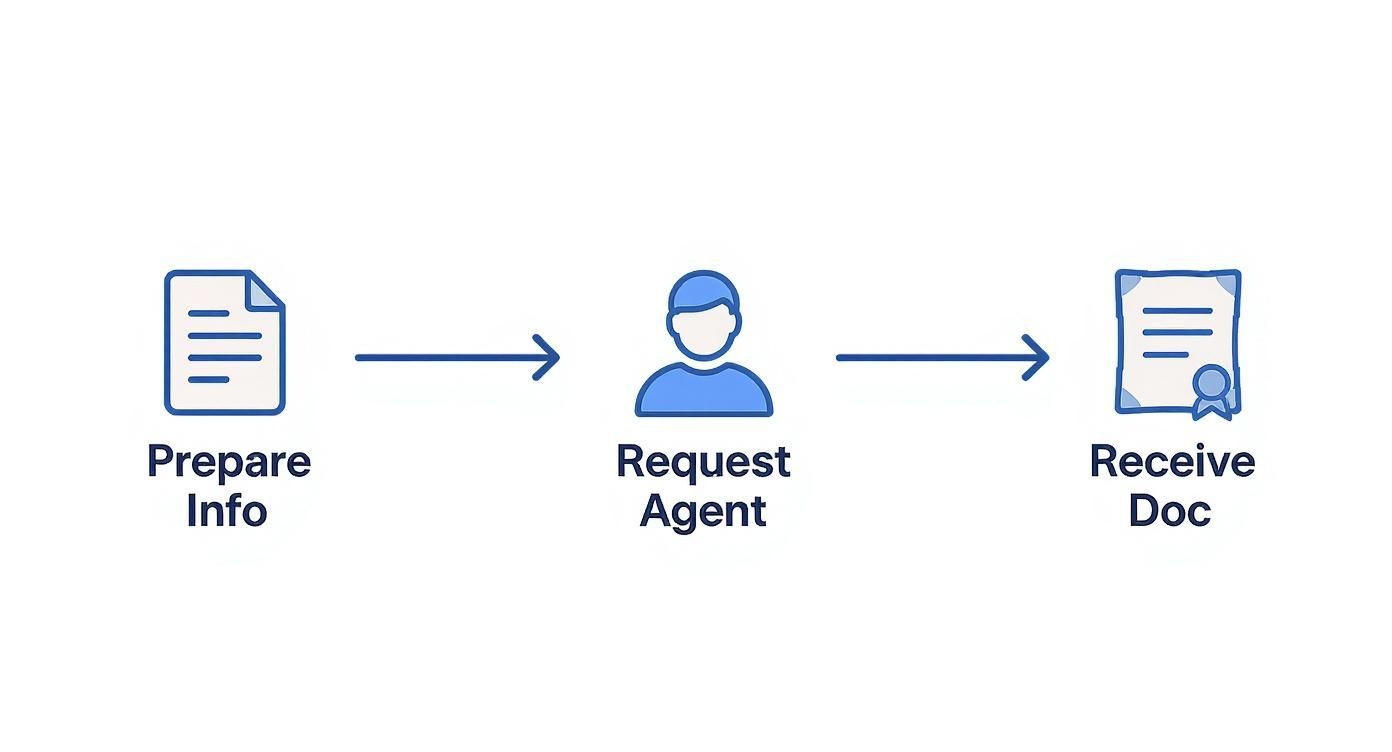
As you can see, obtaining the base document is a simple request to your Registered Agent. However, for international use, the journey doesn't stop there.
The First Step: Notarization
Notarization is the first stage in taking your document global. A licensed Notary Public in the BVI will verify the signature on your Certificate of Incumbency. Their job is to confirm that the individual from the Registered Agent's office who signed the certificate is exactly who they claim to be and that the signature is genuine.
This step adds a formal, recognized layer of trust. While it might be enough for some transactions, it’s most often just the warm-up act for the main event: the apostille.
What Is an Apostille?
An apostille is a special certificate physically attached to your original document. Its sole purpose is to make the document legally valid in foreign countries that are signatories to the 1961 Hague Convention. The BVI is part of this convention, which dramatically simplifies document authentication among member nations—a list that includes major business hubs like Hong Kong, the UK, and most of Europe.
The apostille doesn't re-verify the contents of your certificate; it certifies the authenticity of the Notary Public's signature and seal. It’s the gold standard of certification for these member countries, cutting through bureaucratic red tape.
If you're dealing with a Hague Convention member, this is rarely an optional step. A bank in Germany or a court in Japan will almost certainly reject a standard Certificate of Incumbency without a valid apostille. It is the non-negotiable proof of authenticity they demand.
When Full Legalisation is Needed
What happens if you need to use your certificate in a country that isn't part of the Hague Convention, like the UAE or China? In these situations, you’ll need a more involved process known as full legalisation or embassy legalisation.
After notarization, the document is first authenticated by the BVI government authorities. Then, it must be sent to the embassy or consulate of the destination country for final verification. This multi-step process is more time-consuming and expensive, so it's critical to know the specific requirements of the country where you'll be using the document beforehand.
These validation steps can add anywhere from USD 50 to USD 600 to the total cost and extend the processing time by 3-5 business days or even longer. Failing to get the right certification can cause serious delays in opening bank accounts or closing deals. This is just as important as understanding the corporate governance rules in the BVI Business Companies Act.
Let Us Handle the Paperwork for You
Getting a BVI Certificate of Incumbency—and making sure it’s properly notarized and apostilled—can quickly turn into a bureaucratic headache. One small mistake can lead to costly delays or outright rejection by a bank or business partner. That’s where we come in.
Think of us as your in-house compliance team. We don’t just fetch documents; we manage the entire process from start to finish, making sure everything is done right the first time.
From Your Request to Final Approval
Our approach is built to let you get on with your business, free from administrative worries. We take care of every step, from the initial filing to the final delivery, ensuring the certificate meets the exact requirements of whoever asked for it.
Here’s a quick look at how we help:
- Liaising with the Registered Agent: We communicate directly with your BVI Registered Agent, ensuring all company details are accurate and current before the certificate is even issued.
- Getting it Bank-Ready: We've spent years working with international banks in Hong Kong and other major financial hubs. We know exactly what their compliance officers are looking for and make sure your certificate ticks every box.
- Managing Authentication: Need a notary, an apostille, or even full embassy legalisation? We handle it all. No need for you to chase down different government offices; we coordinate the entire chain of authentication.
Our goal is straightforward: to turn a complex, often stressful task into a simple, background process. We handle the red tape so you can focus on what you do best—running your business.
When you ask us to handle this, you're getting more than just a piece of paper. You're getting peace of mind and the assurance that administrative hurdles won't stand in the way of your next big deal. Let us take it from here.
Answering Your BVI Certificate of Incumbency Questions
When you're running a BVI company, you'll inevitably run into requests for documents that can seem a bit confusing at first. Don't worry, that's completely normal. We've put together answers to the most common questions we hear from business owners about the certificate of incumbency BVI.
Let's clear up the confusion so you can get what you need, when you need it.
Certificate of Incumbency vs. Certificate of Good Standing
This is easily the most common mix-up. People often think they're the same thing, but they play two very different, though complementary, roles.
Let's use a simple analogy: imagine your company is a building.
-
The Certificate of Good Standing is the building's official permit from the city (the BVI government). It confirms the building is legally constructed, has paid all its property taxes (annual fees), and hasn't been condemned. It proves your company is legally sound and exists on the government's register.
-
The Certificate of Incumbency, however, is like the building's directory. It's issued by your building manager (the Registered Agent) and lists who currently has the keys—the directors, officers, and sometimes shareholders. It shows who has the authority to sign a lease or make decisions for the company.
Banks and business partners often need both. They want proof the building is legally sound (Good Standing) and confirmation that they're talking to the person who actually holds the keys (Incumbency).
How Long Is a BVI Certificate of Incumbency Valid For?
This is a great question because it's a bit of a trick one. The certificate itself doesn't come with an expiry date stamped on it. But in the real world, its usefulness is very time-sensitive.
Think of it like a photograph of you holding today's newspaper. It proves you're there on that specific day, but tomorrow, it's already old news. Company structures can change overnight—a director could resign, a new shareholder might come on board.
Because of this, financial institutions and regulatory bodies, particularly in strict jurisdictions like Hong Kong, almost always require a certificate that's fresh. They'll typically only accept one issued within the last three to six months. Anything older is seen as unreliable and will probably be rejected.
This is why you can't just get one certificate and use it forever. For every new bank account, major contract, or compliance review, you'll likely need to get a new one straight from your Registered Agent.
Can I Get a Certificate if My Company Records Are Out of Date?
This is a tough spot many business owners find themselves in. The straightforward answer is no, you can't get an accurate certificate until your records are sorted out.
Your Registered Agent has a legal duty to certify only the information they have on file. If you changed a director a year ago but never filed the official paperwork—the resolutions, the updated registers, the due diligence documents—then as far as the official record is concerned, that change never happened. The old director will still show up on the certificate.
To get a correct certificate, you first have to bring your company's records up to date. This means working with your agent to file all the necessary documents to officially record the changes. It might involve drafting resolutions, gathering ID and proof of address for new appointees, and settling any outstanding fees.
Once the company file accurately reflects its current structure, your agent can then issue a proper certificate of incumbency BVI that you can confidently present to your bank or business partners. It’s a perfect example of why staying on top of your corporate admin is so important.
At Lion Business Consultancy Limited, we don't just get documents; we make sure your BVI company is always prepared for what's next. We take the hassle out of obtaining and authenticating your Certificate of Incumbency, ensuring it’s done right the first time so you can focus on running your business, not chasing paperwork.
Let us manage your corporate compliance and banking needs seamlessly.