

 Hong Kong
 Singapore
 UAE
UAE

 Malaysia
 Turkey
 UK
UK
 EU
EU
 US
US
 Switzerland
 Bahamas Bank Account
 Cayman Islands Bank Account
 Mauritius Bank Account
 BVI
BVI
 Seychelles

Think of a British Virgin Islands company as a financial multi-tool for the global entrepreneur. It's a specific type of legal entity, officially called a BVI Business Company, designed from the ground up to offer serious flexibility, confidentiality, and tax neutrality. This combination makes it a top choice for anyone managing international business or investments.
What Is a British Virgin Islands Company?

Let's tell a story. Imagine you're running a tech startup from Hong Kong. You have clients in Europe, suppliers in Asia, and perhaps some digital assets you need to manage. Juggling contracts, payments, and investments across all those different legal systems can become a real headache, fast.
This is exactly where a BVI company steps in. It acts as a single, legally secure hub for all these global activities.
It’s not your typical brick-and-mortar company with a local office and staff. Instead, it’s a powerful corporate vehicle, purpose-built to hold assets, facilitate international trade, or own intellectual property from one stable jurisdiction. This structure neatly separates your global ventures from your domestic business, giving you a clean and efficient way to manage everything.
The BVI's legal system is specifically engineered to support this, cementing its reputation as one of the world's most trusted offshore financial centres.
Why Is It So Popular with Entrepreneurs?
For decades, entrepreneurs and SMEs have turned to the BVI because its corporate rules are both strong and refreshingly straightforward. The entire system is built on English common law, which offers a familiar and reliable legal foundation for business owners everywhere, particularly those in places like Hong Kong.
The numbers tell the story. The BVI is an absolute giant in the offshore world, holding an estimated $1.5 trillion in assets within its companies. A huge chunk of this is driven by entrepreneurs in Asia. In fact, around two-fifths of BVI company owners are based in Hong Kong and China. This underscores how much of Hong Kong’s outward international investment is channelled through BVI structures, proving its role as a vital financial gateway.
This table provides a quick look at the core features that make a BVI company so attractive.
BVI Company At a Glance: Key Features and Benefits
| Feature | Description | Primary Benefit |
|---|---|---|
| Legal Framework | Based on English common law, governed by the BVI Business Companies Act. | Provides a stable, predictable, and internationally recognised legal foundation. |
| Corporate Structure | Highly flexible, with no requirements for resident directors or a company secretary. | Allows for simple, cost-effective management from anywhere in the world. |
| Tax Regime | Zero local corporate income tax, capital gains tax, gift tax, or inheritance tax. | Maximises capital efficiency, allowing profits to be reinvested or distributed without tax friction in the BVI. |
| Shareholder Privacy | The Register of Directors is public, but the Register of Members (shareholders) is not publicly available. | Protects the confidentiality of the company's ultimate beneficial owners. |
| Global Recognition | Widely accepted by banks, investors, and legal systems worldwide for structuring transactions. | Facilitates easier cross-border banking, investment, and deal-making. |
In short, these attributes directly address the real-world needs of a modern, global business.
Think of a BVI company as a universal adapter for your business. It lets you plug your operations into different markets and legal systems smoothly, all managed from one stable and predictable platform.
The engine powering this whole system is its modern legislation. You can dive deeper into the legal specifics in our detailed guide on the BVI Business Companies Act, which is the bedrock of the flexibility and security these companies offer. Ultimately, a British Virgin Islands company gives you a powerful strategic advantage for managing assets and operations on a global scale.
Weighing the Pros and Cons of a BVI Company
Choosing the right company structure is a lot like picking the right tool for a critical job. You need something that fits the task perfectly, is reliable, and won't cause you headaches down the line. A British Virgin Islands company is a powerful tool in the international business toolkit, but it's not a one-size-fits-all solution. It's crucial to understand both its strengths and its potential drawbacks before you commit.
Let’s be real—no single corporate structure is perfect for every business. The secret is to match the structure to your specific goals. For many entrepreneurs, especially those dealing with cross-border trade or holding assets around the globe, the BVI model offers a remarkably efficient path to growth.
The Clear Advantages for Global Entrepreneurs
One of the biggest attractions of a BVI company is just how simple and efficient the whole framework is. Imagine it as stripping away all the unnecessary administrative drag, letting your business move quicker and with more agility.
This becomes crystal clear when you put it side-by-side with other jurisdictions. Take Hong Kong, for example. The compliance burden in the BVI is significantly lighter. A BVI company enjoys a tax-neutral environment, meaning no corporate income tax. Your only major obligation is an annual renewal fee; there's no requirement to submit financial statements. A Hong Kong company, on the other hand, navigates a tiered tax system, mandatory annual filings, financial audits, and tax returns. You can get a better sense of these differences by looking at a detailed comparison of BVI vs. Hong Kong compliance.
This streamlined approach delivers some very tangible benefits:
- Tax Neutrality: BVI companies don't pay local corporate income tax, capital gains tax, or inheritance tax. This is a huge plus for international holding companies, as it allows you to reinvest profits and manage capital without any tax friction inside the BVI.
- Robust Confidentiality: The BVI adheres to global transparency standards but still provides a high degree of privacy. Critically, the register of shareholders isn't open to the public, which shields the identity of the company's owners from casual inspection.
- Minimal Administration: The annual upkeep is refreshingly simple. With no mandatory audits or complex tax filings in the BVI, you save a significant amount on administrative costs and, more importantly, free up your time to run your actual business.
Think about a startup founder protecting intellectual property or a family office managing a global investment portfolio. This lean structure means less time buried in paperwork and more capital and energy focused on expansion. It’s a framework truly built for speed.
Navigating the Potential Challenges
Of course, it’s not always a perfectly smooth ride. It’s just as important to be aware of the real-world operational issues that can pop up when you're using an offshore structure like a BVI company.
One of the main hurdles is the perception, and sometimes the "stigma," that can be attached to offshore jurisdictions. This isn't just about reputation; it can lead to very practical problems, especially when it comes to banking.
To give you a clearer picture, let's compare the day-to-day compliance obligations you'd face with a BVI company versus a standard Hong Kong limited company.
Comparing BVI and Hong Kong Company Compliance
| Compliance Area | British Virgin Islands Company | Hong Kong Limited Company |
|---|---|---|
| Corporate Tax | 0% corporate tax rate in the BVI. | 8.25% on the first HK$2 million of profits, 16.5% thereafter. |
| Annual Filings | No annual tax return required. Only an annual renewal fee is due. | Must file an Annual Return with the Companies Registry and a Profits Tax Return with the Inland Revenue Department. |
| Financial Audit | No mandatory annual audit of financial statements. | An audit by a Certified Public Accountant (CPA) is required annually for most companies. |
| Public Records | Director and shareholder registers are not publicly accessible. | Director information is public. Shareholder information is accessible upon request. |
| Meeting Requirements | Meetings can be held anywhere in the world, with flexible requirements. | Annual General Meetings (AGMs) are generally required, with specific rules on location and notice. |
This table shows just how different the administrative landscapes are. While the BVI offers simplicity, the Hong Kong structure provides a more traditional, on-the-ground presence that can be beneficial in other ways.
Now, let's look at the specific hurdles this BVI simplicity can create:
- Stricter Bank Account Opening: Thanks to tough global anti-money laundering (AML) and know-your-customer (KYC) rules, banks everywhere are incredibly cautious. Opening a bank account for a BVI company is much harder than it was a decade ago and demands perfectly prepared due diligence documents.
- Economic Substance Rules: To prove they aren't just "shell companies" for tax avoidance, BVI companies involved in certain "relevant activities" (like finance, leasing, or managing intellectual property) must now demonstrate genuine business activity—or "substance"—in the islands. This is no longer a simple box-ticking exercise and requires careful planning.
These challenges aren't deal-breakers, but they are serious checkpoints on your journey. Success often comes down to working with an experienced advisor who knows how to anticipate these issues and can prepare your corporate structure and applications correctly from the very start. With the right guidance, these hurdles are just manageable steps in a well-planned process.
Getting to Grips with Tax Rules and Economic Substance
When you start exploring the world of British Virgin Islands companies, you'll quickly run into two key topics: taxes and something called "economic substance." These aren't just technical terms; they are the fundamental rules of the road for operating a BVI company legally and making the most of its structure. Let's peel back the layers and see what this means for your business.
On the surface, the BVI’s tax system looks incredibly straightforward. It's often called "tax-neutral," which is a simple way of saying there is zero corporate income tax, no capital gains tax, and no withholding tax charged within the BVI. This framework is fantastic for managing and growing capital, as your company's profits aren't being taxed at the corporate level in the BVI.
But here’s a common trip-up: "tax-neutral" does not mean "tax-free." Your tax obligations don't simply vanish. Instead, they usually follow you back home to the country where you are a tax resident. For example, if you're a director living in Hong Kong and you pay yourself a dividend from your BVI company, that income is still subject to Hong Kong's personal tax laws.
The BVI offers a tax-neutral platform, not a tax-free magic wand. Think of it as a clean and efficient conduit for international business, but the ultimate tax responsibility almost always lies where the business owner resides and operates.
For any business operating across borders, it's essential to combine your BVI company structure with a firm grasp of understanding the complexities of international trade and taxation. This ensures you stay compliant everywhere you do business.
What Is the Economic Substance Act?
While tax neutrality has been a core feature for decades, the rules around economic substance are a much newer and absolutely critical piece of the puzzle. Responding to a global push for greater financial transparency, the BVI introduced the Economic Substance (Companies and Limited Partnerships) Act. This law’s main job is to prove that BVI companies are genuine businesses, not just "letterbox companies" created to hide assets or avoid tax.
Put simply, if your company is involved in certain types of business—known as "relevant activities"—it has to demonstrate a real operational footprint in the BVI. You must show that your core money-making activities actually happen there.
So, what counts as a "relevant activity"? The law pinpoints nine specific categories:
- Banking Business
- Insurance Business
- Fund Management Business
- Finance and Leasing Business
- Headquarters Business
- Shipping Business
- Holding Business
- Intellectual Property Business
- Distribution and Service Centre Business
What Does "Substance" Actually Look Like?
This is where the rules become real. Having "substance" doesn't automatically mean you need a skyscraper office and a hundred employees in Tortola. The requirements are designed to be proportional to the kind of business you're running.
Let's look at two very different examples.
Example 1: The Simple Holding Company
Say you’ve set up a BVI company for one reason only: to hold shares in your new software startup. This falls under "holding business," which has the lightest substance requirements. All you really need is an active registered agent and office in the BVI, along with enough people (which can be provided by your agent) to manage the shares. It’s a very straightforward setup.
Example 2: The Active Consulting Firm
Now, let's imagine a BVI company that provides strategic consulting to clients around the world and also licences its proprietary software (an intellectual property business). This company is clearly performing multiple "relevant activities," and so the bar is much higher.
To prove it has real substance, it would need to show things like:
- Having qualified employees based in the BVI.
- Spending an appropriate amount of money on operations within the BVI.
- Maintaining a physical office or premises suitable for its work.
- Demonstrating that key decisions, like board meetings, are made in the BVI.
Ignoring these rules is not an option. Failing to meet substance requirements can lead to hefty fines and, in the worst case, your company being struck off the register. The trick is to correctly classify your company's business from day one and make sure its setup ticks all the right boxes. That way, you build a compliant, sustainable structure that’s ready for global business.
How to Set Up Your BVI Company Step by Step
Forming a British Virgin Islands company can feel daunting at first, but it’s far from a complicated puzzle. It’s actually a very clear, methodical process. Think of it less like navigating a maze and more like following a recipe—with a good corporate services partner, each step flows logically to the next, turning your business concept into a legally recognised entity.
The best part? The entire setup is handled remotely, so there's no need for you to travel to the BVI. It all kicks off with a few key decisions and wraps up with your new company fully incorporated and ready for business.
Defining Your Corporate Blueprint
The first practical step is picking a unique name for your company. This is more than just a branding exercise; the name has to be available and compliant with BVI rules. Your provider will run a name check to make sure it isn't already in use and doesn't contain restricted words like "Bank" or "Trust" unless you have the appropriate licence.
Next, you’ll map out the company's core structure. This means deciding:
- Who are the directors? These are the people responsible for managing the company's day-to-day operations.
- Who are the shareholders? These are the owners of the company.
- How many shares will be authorised? The BVI standard is 50,000 shares with no par value, which gives you a huge amount of flexibility.
For most entrepreneurs and SMEs, the director and shareholder can be the same person, which keeps the structure simple and clean. Getting this blueprint right from the start lays the foundation for everything else.
Preparing Your Due Diligence Documents
Before your company gets the green light, you’ll need to complete a mandatory identity verification process, often called Know Your Customer (KYC) or due diligence. This is a non-negotiable global standard designed to prevent illicit activities and ensure transparency.
It’s really just a standard background check, much like what you’d do to open a new bank account. You'll typically be asked for:
- A certified copy of your passport.
- A recent proof of your home address (a utility bill or bank statement usually works).
- A professional reference or a bank reference letter.
Getting these documents sorted out early is the single best thing you can do to speed things up. Having them ready to go means your incorporation can proceed smoothly without any frustrating delays. For a deeper dive into the specifics, you can learn more about the official BVI company registry requirements.
The Role of the Registered Agent
Finally, every British Virgin Islands company is legally required to appoint a licensed Registered Agent based in the BVI. This agent acts as your official connection to the BVI government and registry. They’re the ones who handle the official filing of incorporation documents, manage your annual government fees, and provide the mandatory registered office address in the BVI.
Your Registered Agent is essentially your company's official representative on the ground. They are legally responsible for ensuring your company's records are maintained correctly and that it remains in good standing with the authorities.
Once your documents are all checked and your company structure is finalised, your agent submits the application to the BVI Financial Services Commission. They're known for being incredibly efficient, and incorporations are often completed within just a few business days. And just like that, your company is officially live.
This flowchart illustrates the key compliance pillars you'll manage after your company is formed.
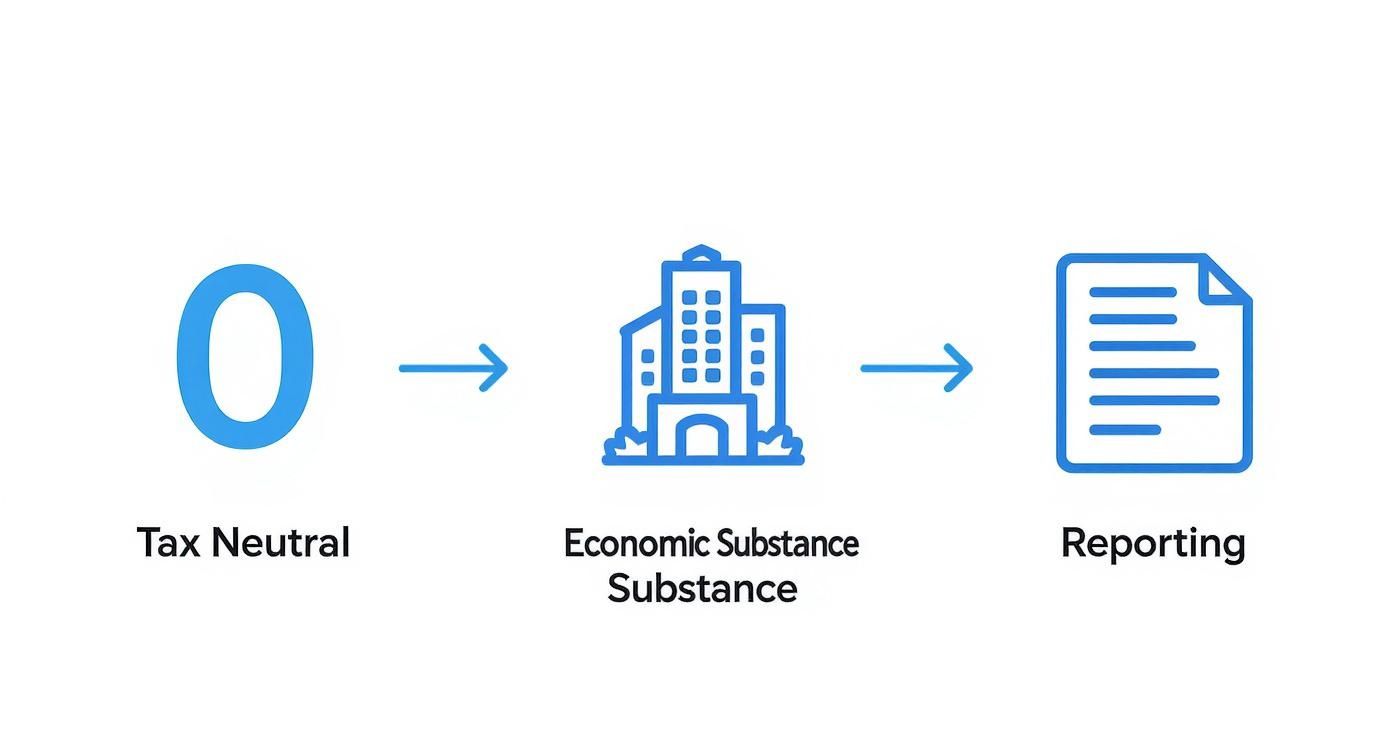
As you can see, your company’s journey begins with its tax-neutral status, then moves into fulfilling its economic substance and reporting obligations. This creates a sustainable, compliant lifecycle for your business.
Managing Your BVI Company Year After Year

Getting your British Virgin Islands company incorporated is the starting line, not the finish. The real advantage of the BVI structure reveals itself over time through predictable, hassle-free management. Think of it like owning a well-engineered car; once you've bought it, simple, regular maintenance is what keeps it running smoothly for years.
The whole system is designed to be straightforward, especially when you have professional support. Your main responsibilities are clear and consistent, letting you focus on growing your business instead of getting tangled up in administrative red tape. This predictability is precisely why so many entrepreneurs are drawn to the BVI.
Core Annual Obligations
Every year, you’ll have a few key tasks to tick off to keep your company in "good standing" with the BVI authorities. It’s crucial to stay on top of these, as missing them can lead to penalties or, in the worst case, your company being struck off the register.
Think of these duties as your company's annual rhythm:
- Pay the Annual Government Licence Fee: This is the core fee paid directly to the BVI government to maintain your company's active registration. The amount depends on the number of shares your company is authorised to issue.
- Retain a Registered Agent and Office: You must keep a licensed Registered Agent in the BVI. They provide the mandatory registered office address and serve as the official channel for all government communications.
- Complete Economic Substance Reporting: Every company must file an annual economic substance declaration, even if it doesn't conduct a "relevant activity." This report simply tells the authorities what your business did in the previous year.
The key takeaway here is simplicity. Unlike jurisdictions that demand extensive annual audits and complex tax filings, the BVI’s upkeep revolves around a handful of clear, manageable tasks. It's a system built for efficiency, not bureaucracy.
Managing Corporate Governance and Changes
Beyond the annual checklist, you need to maintain proper corporate records. This means keeping an up-to-date Register of Directors and Register of Shareholders. These documents aren't filed publicly, but they must be accurate and held securely by your Registered Agent.
Of course, business is never static. You might need to appoint a new director, transfer shares, or even amend the company's foundational documents (the Memorandum and Articles of Association). These are routine corporate changes, and the BVI framework is designed to make them easy to handle. Your service provider can draft the necessary resolutions and file the required updates, ensuring your corporate structure can evolve with your business goals without creating administrative headaches.
As your business grows, it’s also smart to understand potential legal situations. For instance, knowing how to explore breach of contract remedies can be invaluable. Equally important is getting compliance right from day one; our guide on how to pass KYC for offshore companies offers practical advice for a seamless start.
Is a BVI Company the Right Choice for You?
We've covered a lot of ground on the what, why, and how of setting up a British Virgin Islands company. Now we get to the most important question: is this sophisticated tool actually the right fit for your business? The answer isn’t found in a textbook; it’s all about practical application.
Let's step away from the abstract for a moment and look at how these companies work in the real world. By seeing how entrepreneurs and investors are already using BVI companies to solve tangible problems, you can start to see how one might slot into your own plans. It's time to connect the dots between the BVI's features and your reality.
The Hong Kong International Trader
Picture an entrepreneur based in Hong Kong. They're sourcing products from mainland China and selling them to a growing list of clients across Europe and the Middle East. This means juggling payments in multiple currencies and navigating contracts under different legal systems. Trying to manage all of this through a standard Hong Kong company can quickly turn into a headache of complex accounting and tax reporting.
This is where a British Virgin Islands company comes in. It can act as a clean, tax-neutral hub for all those international transactions. Suddenly, our entrepreneur can:
- Centralise Global Invoicing: Instead of a mess of paperwork, all international sales are invoiced through the single BVI entity. This immediately simplifies cash flow.
- Hold Multi-Currency Bank Accounts: The BVI company can open bank accounts in different currencies, slashing foreign exchange costs and friction.
- Isolate Risk: The international side of the business is legally ring-fenced from their domestic Hong Kong operations, protecting local assets from any global trade disputes.
For this business owner, the BVI structure isn't about hiding anything. It’s purely about achieving operational efficiency on a global scale.
The Global Consultant and IP Holder
Now, let's think about a digital marketing consultant. She's not just selling her time; she has also developed proprietary software tools that are the core of her business. This intellectual property (IP) is her most valuable asset. If she holds it in her own name or through her local operating company, that IP is exposed to all sorts of risks and potential tax complications.
By placing the IP into a BVI company, she achieves two critical goals:
- Asset Protection: Her valuable software is now owned by a separate legal entity. This shields it from potential liabilities or legal challenges that might arise from the consulting side of the business.
- Simplified Licensing: The BVI company can then grant licences to clients around the world. All the royalties and fees are managed through one tax-neutral vehicle, making global scaling much cleaner.
This structure lets the consultant protect her crown jewels while creating a streamlined way to monetise them worldwide.
The Family Office Managing Diverse Investments
Finally, imagine a family office that’s managing a complex portfolio—international real estate, stakes in private equity funds, and a collection of public stocks. Trying to hold each of these assets in a different country-specific entity would be an administrative nightmare.
A BVI company can step in as a master holding company, consolidating ownership of all these diverse assets under one secure and flexible corporate roof. This approach delivers:
- Estate Planning Simplicity: When the time comes, transferring shares of a single BVI holding company is far easier than trying to transfer ownership of multiple, cross-border assets.
- Confidentiality: The specifics of the underlying investments and the family's ownership are kept private, protecting them from unwanted public scrutiny.
- Operational Ease: The family gets a single, stable legal platform to manage its global portfolio from, with straightforward annual maintenance.
In each of these scenarios—the trader, the consultant, and the family office—the BVI company is a strategic tool. It's a legitimate and powerful vehicle for enabling global trade, protecting valuable assets, and simplifying complex investment structures.
This really highlights the huge, and often misunderstood, role the BVI plays in the global economy. Investment flowing through the BVI supports an estimated 2.2 million jobs worldwide, and nearly 40% of those are in China and Hong Kong. It's no coincidence that the BVI was the second-largest destination for Hong Kong's outward direct investment in 2023, clocking in at over USD 305 billion. These numbers show that the BVI is a critical and legitimate channel for global commerce and employment. To truly grasp the scale of this, it's worth exploring the insights on BVI's global contribution.
Ready to see if a BVI company is the right move for your business? At Lion Business Consultancy Limited, we specialise in the kind of one-on-one guidance that gives you clarity and confidence in international structuring, banking, and tax. Schedule a consultation with us today and let’s build the right framework to protect your assets and fuel your global growth.