
 Hong Kong
 Singapore

 UAE
UAE

 Malaysia
 Turkey
 UK
UK
 EU
EU
 US
US
 Switzerland
 Bahamas Bank Account
 Cayman Islands Bank Account
 Mauritius Bank Account
 BVI
BVI
 Seychelles
When you hear about the Hong Kong bank foreign exchange rate, the first word that comes to mind is stability. This isn't an accident. It's the result of a deliberate system that pegs the Hong Kong dollar (HKD) to the US dollar (USD).
Imagine you're steering a ship. This peg acts like a sophisticated autopilot, keeping the HKD within a very narrow trading band, which is a massive advantage for any business operating in or with Hong Kong. For an entrepreneur like you, this managed system is the foundation of the city's reputation for financial reliability, turning volatile waters into a calm, predictable harbor.
Understanding Hong Kong’s Unique Currency System
For any entrepreneur or SME dealing with Hong Kong, getting a handle on its unique currency system is step one. Unlike currencies that bounce around based on market whims, the Hong Kong dollar’s value is purposefully anchored. It's less of a complex economic theory and more of a practical price guarantee that has shaped the city’s financial world for decades.
Think of it like bumpers in a bowling lane. The Hong Kong Monetary Authority (HKMA) acts as the guide, ensuring the currency doesn't veer off course. This creates a predictable environment that’s a dream for international trade and investment.
The Linked Exchange Rate System
The engine behind all this stability is the Linked Exchange Rate System (LERS). Established way back on October 17, 1983, this system locks the Hong Kong dollar into a tight relationship with the US dollar.
The HKMA maintains an official trading range between 7.75 and 7.85 HKD per USD. If the rate ever threatens to drift outside this band, the HKMA steps in to buy or sell currency, gently nudging it back in line. This policy has been the bedrock of Hong Kong's status as a global financial hub for over 40 years, giving businesses the certainty they crave.
Thanks to this peg, you won’t see the kind of dramatic daily swings in the HKD that you might with other currencies. It’s all about consistency, which is a huge relief when you're trying to manage budgets and forecast costs.
What This Means for Your Business
So, how does this currency peg actually impact your bottom line? In short, it dramatically reduces your risk.
When you're invoicing a client in HKD or paying a supplier, you can rest easy knowing the currency's value won't suddenly plummet overnight against the US dollar. This stability is a game-changer for:
- Predictable Cash Flow: Your revenues and expenses in HKD stay stable when converting to or from USD.
- Simplified Financial Planning: Budgeting for projects based in Hong Kong becomes much less of a headache.
- Enhanced Investor Confidence: The peg is a clear signal of a secure and well-managed economic environment.
Getting to grips with this system is also essential if you're thinking about setting up an offshore banking unit, as it directly influences how you'll manage your cross-border funds. It’s the kind of foundational knowledge that helps you anticipate costs and make smarter financial moves, turning a potentially confusing topic into a real strategic advantage.
How Banks Calculate Your Foreign Exchange Rate
Have you ever seen an FX rate on a major news site, then looked at your bank statement after an international transfer and wondered why the numbers don't quite line up? It’s a common moment of confusion for business owners, but it’s not a mistake. That gap between the two numbers is where the real cost of your transaction is hiding.
Let's draw a simple analogy. Think of it like buying fruit at the market. There's a wholesale price the grocer pays the farmer, and then there's the retail price you pay at the stall. In the world of currency, that wholesale price is known as the interbank rate. It's the live, constantly moving rate that major banks use to trade massive volumes of currency with each other. It’s the purest rate available.
The rate your business receives, however, is the retail rate. This includes the bank’s markup, often called a 'spread,' which they add on top of the live interbank rate. This spread is how the bank makes its money from the service, covering its own risks, operational costs, and, of course, profit.
The Anatomy of a Bank's Exchange Rate
So, what determines the size of that spread? It’s not just a random figure. Several key factors come into play, and understanding them gives you a major advantage.
For instance, the sheer size of your transaction matters. A larger transfer gives you more leverage, often leading to a 'tighter' or more favourable spread. Conversely, if you're dealing with less common or more volatile currencies, banks will typically apply a wider spread to buffer themselves against the higher risk.
Market conditions are another huge factor. On days when the financial markets are choppy, you’ll find that banks widen their spreads to protect themselves from any sudden, dramatic currency swings.
This infographic breaks down the foundation of Hong Kong's currency system—the US Dollar peg—which is a critical factor for local businesses.
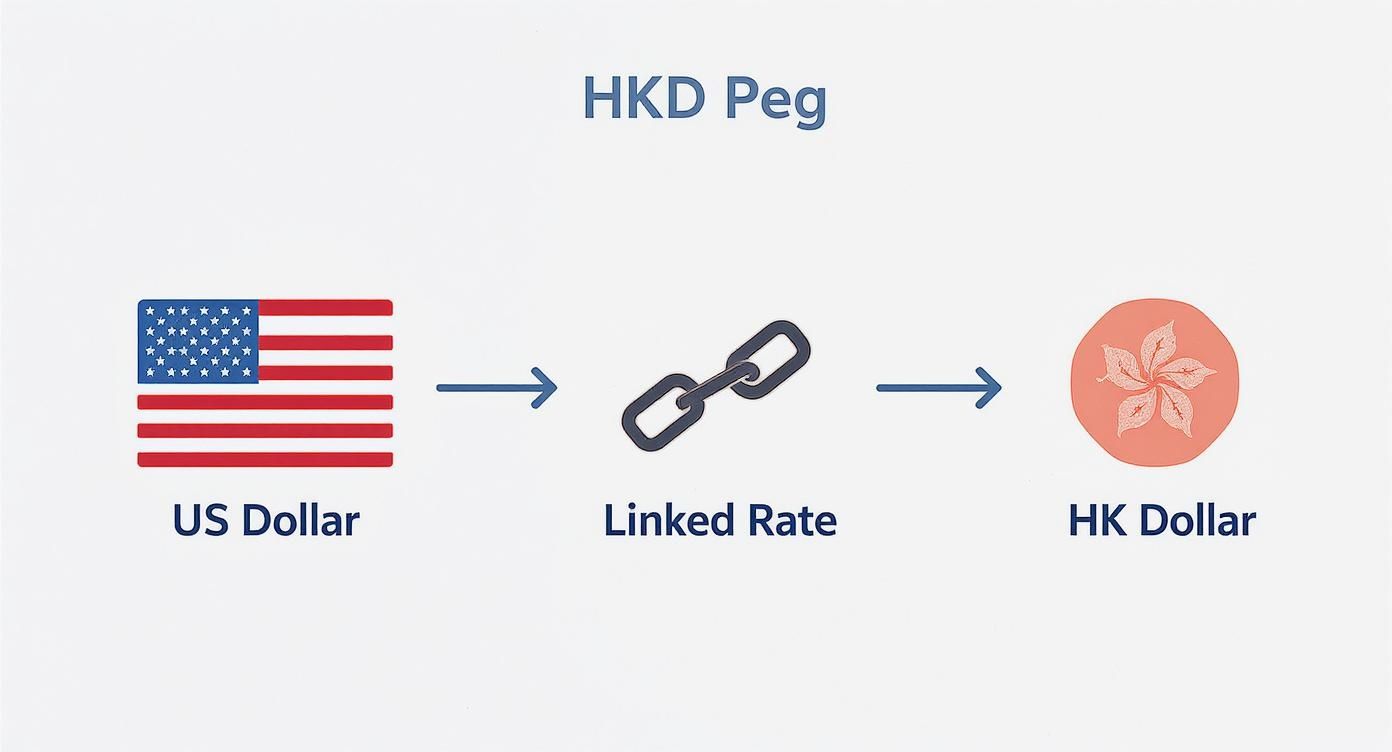
This direct link to the USD is the reason the HKD is so stable. It provides a solid, predictable base for your international dealings, but the bank’s spread is the variable you need to watch.
Deconstructing Your Bank's FX Rate
To truly get a handle on what you're paying, you need to look past the single rate presented to you.
Here’s a breakdown of what makes up the final exchange rate your business receives.
| Component | What It Is | How It Affects Your Cost |
|---|---|---|
| Interbank Rate | The live 'wholesale' price of a currency, driven by global supply and demand. | This is your baseline. The closer the rate you get is to this, the better the deal. |
| Bank's Spread | The margin or markup the bank adds on top of the interbank rate. | This is the bank’s main profit source and the biggest variable cost for your business. A wider spread means a higher cost. |
| Transaction Fees | Separate, often fixed, fees charged for processing the payment itself. | These can add significant costs, especially on smaller, more frequent transfers. |
By seeing the rate as a sum of these parts, you can stop focusing on the final number and start asking your bank about the individual components—specifically, the spread. That's where you'll find the most room for savings.
What Makes the HKD Exchange Rate Fluctuate
Even though Hong Kong’s currency system is designed for stability, the HKD exchange rate isn't set in stone. It’s less like a fixed point and more like a boat anchored in a calm harbour—the anchor keeps it in place, but small waves still make it drift back and forth. For your business, understanding these subtle movements within the 7.75 to 7.85 HKD per USD band is a real competitive advantage.
Within this narrow channel, the rate you get from a Hong Kong bank on any given day for a foreign exchange rate enquiry will still vary. These minor shifts are the result of powerful economic forces that gently nudge supply and demand. Knowing what these forces are helps you anticipate changes and make smarter, more timely financial decisions.
The Role of the Hong Kong Monetary Authority
The main reason the HKD stays so stable is the Hong Kong Monetary Authority (HKMA). Think of the HKMA as the guardian of the peg; its actions are the primary reason the rate stays within its designated corridor.
When the HKD gets stronger and nudges the 7.75 "strong-side" limit, the HKMA steps in. It sells HKD to buy USD, which increases the supply of Hong Kong dollars and pushes the rate back down. On the flip side, if the HKD weakens towards the 7.85 "weak-side" limit, the HKMA does the opposite—it buys up HKD using its massive US dollar reserves, pushing the rate back up.
The entire system is a masterclass in managed stability. The HKMA doesn't just react; it actively manages market expectations, ensuring that businesses and investors have confidence in the peg’s resilience.
Interest Rate Differentials and Capital Flows
A huge driver of these subtle movements is the difference in interest rates between Hong Kong and the United States. It's a simple concept with big consequences. When US interest rates are higher, investors have a strong incentive to sell their HKD to buy higher-yielding US dollar assets.
This common strategy is known as a carry trade. It increases the supply of HKD in the market, which naturally pushes its value toward the weaker end of the band.
These capital flows are happening all the time. International trade, major investment decisions, and even shifts in global market sentiment can cause huge sums of money to pour into or out of Hong Kong. This constant motion creates the gentle ebb and flow you see in the daily hong kong bank foreign exchange rate.
This is where the local financial infrastructure proves its worth. Hong Kong’s banks and the local foreign exchange market are the engines that keep the system liquid and stable. They process enormous volumes of USD/HKD trades and make these cross-border capital flows happen smoothly, ensuring the market operates like a well-oiled machine and stays within the HKMA’s target range.
Beyond the HKD specifically, a broader understanding of what influences exchange rates on a global scale can give you an even sharper edge. By grasping these underlying forces, you can better anticipate market shifts and protect your profit margins.
How to Compare Bank Foreign Exchange Rates
Getting the best deal on currency exchange isn't about a quick glance at a bank's website. For an SME, what looks like a tiny difference in the Hong Kong bank foreign exchange rate can easily snowball into significant costs over a year. The secret is to look past the advertised "headline rate" and learn how to see the true, all-in cost of your transaction.
Think of it like buying a car. The sticker price is just the starting point. You still have delivery charges, registration fees, and other add-ons to consider before you know the final amount. It's exactly the same with foreign exchange. The advertised rate is often just a marketing hook; the real cost is buried in the details.
Look Beyond the Headline Rate
The first step is to stop focusing only on the exchange rate itself. The total cost of any currency conversion is actually a mix of two critical factors: the exchange rate spread and any extra transaction fees.
- The Exchange Rate Spread: As we've discussed, this is the margin the bank bakes into the live interbank rate. A wider spread means a more expensive transaction for you. Simple as that.
- Transaction Fees: These are separate charges for processing the payment—think SWIFT fees or handling charges. They can really sting, especially on smaller transfers.
To get a clear picture, you need to calculate the "effective exchange rate". This is the final, blended rate you get after all costs are factored in, and it's the only way to make a true apples-to-apples comparison between different providers.
Asking the Right Questions
Armed with this knowledge, you can approach your bank with much sharper questions. Instead of just asking for their current rate, you can start a more strategic conversation. Here’s a checklist of smart questions every SME should have ready:
- "What is your spread over the live interbank rate for this transaction size?" This question signals that you know how pricing works and pushes for transparency.
- "Can we negotiate a better rate for larger or more frequent transactions?" Many banks will offer preferential rates for high-volume clients. If you have consistent business to offer, use it as leverage.
- "What are all the associated fees for this transfer?" Ask for a complete itemised list of any wire fees, correspondent bank charges, or receiving fees. Leave no stone unturned.
- "How does our overall business relationship impact the rate you can offer?" Your loyalty and the other services you use (like loans or business accounts) can be powerful bargaining chips.
It helps that the underlying currency is exceptionally stable. The Federal Reserve's own records, for instance, show the USD/HKD rate has consistently hugged the 7.8 mark for decades, all thanks to the Linked Exchange Rate System. You can see this remarkable consistency for yourself in the Federal Reserve’s data releases.
This screenshot from the Federal Reserve shows the historical exchange rates between the USD and HKD.
The data clearly shows how the rate stays tightly controlled within its narrow band, giving you a predictable foundation for your transactions. By taking this kind of investigative approach, you shift from being a passive rate-taker to an empowered negotiator, making sure you always get the most competitive deal on the table.
Proven Strategies to Secure Better Exchange Rates
Knowing how the Hong Kong bank foreign exchange rate system works is a great start. But the real win comes from using that knowledge to actively cut your costs. Let's move from theory to practice with a few proven strategies that actually work for SMEs.
These aren't complicated financial tricks. They're practical, common-sense steps you can take to make sure more of your money stays in your pocket during currency conversions. The aim is simple: stop just accepting the rate you're given and start actively managing it to get the most value from every single transaction.
Leverage Your Transaction Volume
One of the easiest yet most powerful tactics is to bundle your payments. Banks almost always reserve their best exchange rates for larger, high-volume transactions. This means one big transfer will nearly always get you a better deal than several smaller ones.
Think of it as buying in bulk. You get a better price per unit when you buy a whole case, not just a single item. It's the same principle with currency. By planning ahead and consolidating your supplier payments or international payroll into a single, larger transfer, you instantly boost your negotiating power and can access these preferential "wholesale" rates.
Time Your Transactions Strategically
Even though the HKD is pegged, it does move within its tight trading band. Paying attention to these tiny fluctuations can add up to real savings. Keep a casual eye on market trends. For instance, if you notice the HKD is getting close to the weaker end of its 7.85 band against the USD, that could be an opportune moment to convert foreign currency into HKD.
This isn't about trying to be a day trader. It's simply about being a savvy business owner. A little bit of patience—sometimes just a few hours—can translate into hundreds or even thousands of dollars saved, depending on the size of your transfer.
This approach also touches on managing risk. Beyond just watching rates, it's crucial to understand how to shield your business from negative currency swings. For a deeper look, a definitive guide on risk management in trading offers some fantastic insights that apply just as well to managing business currency exposure.
Use Hedging Tools Like Forward Contracts
What happens when you need to pay a supplier in three months, but you love the exchange rate you're seeing today? This is exactly where a forward contract comes in handy. It’s a straightforward agreement you make with your bank to lock in today's rate for a transaction you'll complete down the road.
This incredibly useful tool removes all the guesswork and stress from your future payments. You gain certainty over your costs, which protects your profit margins from being eroded by unpredictable currency movements. For any business dealing with long payment cycles, this is a non-negotiable strategy.
Another smart move is to use the right kind of account. For businesses juggling several currencies, a multi-currency account can be a game-changer. Our guide on opening a multi-currency bank account in Hong Kong breaks down how this can slash conversion costs even further.
Let's look at how this plays out in a real-world scenario.
Case Study: A Hong Kong Trading Company
Imagine a local SME that imports electronics from the US. They were in the habit of paying their USD invoices with lots of small transfers throughout the month, simply taking whatever rate their bank offered that day. Once they realised how much this was costing them, they made two simple changes:
- Consolidation: They began grouping all their monthly invoices into one larger payment. This small change immediately gave them access to a better rate, saving them 0.5% on every transaction.
- Forward Contracts: For their biggest orders, they started using forward contracts to lock in the exchange rate 90 days in advance. This protected them from any sudden weakening of the HKD and made their cost of goods perfectly predictable.
By applying just these two straightforward strategies, the company saved over HKD 150,000 in a single year. That’s a massive boost to their bottom line, all without finding a new supplier or changing a single product.
The Future of FX for Hong Kong SMEs
The world of finance never sits still, and foreign exchange is right at the heart of that constant motion. For SMEs in Hong Kong, the old way of relying solely on your bank for currency exchange is quickly becoming outdated. New technology and more agile competitors are changing the game, and for businesses like yours, this means a huge opportunity to cut costs and work smarter.
The biggest shake-up has come from fintech platforms and digital banks. Traditional banks often bake their profits into the exchange rate they offer you, making it hard to see the true cost. These newer platforms, however, were built with transparency in mind. They usually provide rates much closer to the real interbank rate and state their fees upfront—a total departure from the old model. This new competition is putting pressure on everyone to offer better value, which is fantastic news for your company's finances.
The Next Wave of Innovation
Looking ahead, the evolution is far from over. While they're not quite mainstream for everyday business yet, digital currencies are on the horizon and could completely change how we think about cross-border payments. Once the technology becomes more established, it might offer a way to sidestep the traditional banking infrastructure, leading to even faster and cheaper international transactions.
For any SME, keeping an eye on these developments isn't just about saving a bit of cash—it's about gaining a real strategic advantage. A forward-thinking financial strategy keeps your business nimble, cost-effective, and ready for whatever comes next in global finance.
Getting a handle on these shifts is a critical part of controlling risk exposures in foreign exchange for companies in Hong Kong, ensuring your business is built for the future.
A Few Lingering Questions on Hong Kong Forex Rates
Even with a solid plan, a few questions about the Hong Kong bank foreign exchange rate can still pop up. That’s perfectly normal. Let's tackle some of the most common queries we get from entrepreneurs and SMEs to make sure you're fully covered.
Think of this as your quick-fire FAQ. These are the practical, in-the-moment questions that arise when you're about to make a transfer, and having the answers handy can be a real money-saver.
Can I Actually Get a Better Rate Than My Bank Offers?
Yes, almost always. Your main business bank offers convenience, but that convenience often comes at a cost. They rarely have the sharpest rates on the market.
Specialist foreign exchange providers and newer fintech platforms can usually offer much better deals. Why? Because foreign exchange is their entire business, not just another department. They operate on tighter margins (spreads) and often have lower fees. Before you commit to a large transfer, always get a quote from a specialist to see how it stacks up against your bank's all-in cost.
What’s the Deal with CNY vs. CNH?
This is a critical one for anyone doing business with mainland China. It's a common point of confusion, but the distinction is quite simple.
CNY (Onshore Yuan): This is the version of the renminbi that circulates within mainland China. Its value is tightly managed by the Chinese government.
CNH (Offshore Yuan): This is the renminbi that trades outside of mainland China, including here in Hong Kong. Its value floats more freely and is driven by open market supply and demand.
Since Hong Kong is a major offshore financial hub, you'll be working with CNH. The big advantage is that it can be traded freely without the strict capital controls that apply to CNY on the mainland. Understanding this is key to planning any cross-border payments.
Is It Cheaper to Convert Currency in Hong Kong or My Home Country?
This is the classic "it depends" scenario. There's no universal answer, as the best option hinges on the specific banks and services available in both places.
That said, Hong Kong is a global financial powerhouse with an incredibly competitive FX market, which often translates to better rates. The only way to know for sure is to compare the effective exchange rate—the final rate you get after all spreads and fees are baked in. Get a quote from a provider in your home country and one in Hong Kong to see who truly offers the better deal for that specific transaction.
Navigating the complexities of international finance is our specialty. At Lion Business Consultancy Limited, we provide the private, 1:1 advisory you need to build secure banking structures and optimise your global financial operations.