

 Hong Kong

 Singapore


 UAE
UAE


 Malaysia
 Turkey


 UK
UK
 EU
EU
 US
US
 Switzerland
 Bahamas Bank Account
 Cayman Islands Bank Account
 Mauritius Bank Account

 BVI
BVI
 Seychelles

The BVI Business Companies Act is the core legislation that dictates how companies in the British Virgin Islands are formed, run, and managed. It's this modern and highly adaptable corporate framework that has positioned the BVI as one of the top offshore jurisdictions for international business.
Why the BVI Business Companies Act Is Your Company's Operating System
If you're an entrepreneur scaling your business, it helps to think of the BVI Business Companies Act as the operating system for your offshore company. Just like iOS or Android on your phone, the Act sets the rules and defines the capabilities of your BVI entity. It’s the playbook that governs its flexibility, confidentiality, and efficiency, turning a simple legal structure into a powerful tool for global growth.
For decades, this powerful piece of legislation has been the engine behind global investment, asset protection, and international trade for countless businesses. Imagine a small family-owned trading firm in Hong Kong that wanted to expand into European markets. By setting up a BVI company, they created a tax-neutral hub to manage international sales and hold intellectual property, all governed by a legal system they understood—one built on the principles of English common law.
From the IBC Act to a Modern Framework
The current law came into force in 2004, replacing the older but wildly successful International Business Companies Act of 1984. This wasn't just a simple refresh; it was a major upgrade. The new Act brought in more sophisticated corporate governance features, gave companies greater flexibility in how they could structure themselves, and started building the foundation for the global compliance standards we see today. You can learn more about the structure of BVI business companies and their advantages in our detailed guide.
This shift from the old to the new cemented the BVI's reputation as a top-tier jurisdiction. The fundamental goal remained the same: to support legitimate international business with a reliable and predictable legal system.
The Act’s enduring appeal lies in its balance. It offers the structural freedom that ambitious entrepreneurs need while maintaining a robust regulatory environment that inspires confidence in global partners, banks, and investors.
A Magnet for Hong Kong Entrepreneurs
The link between Hong Kong and the BVI is incredibly strong. For entrepreneurs here, a BVI company is a standard, time-tested tool for structuring international investments, holding assets, or managing global trading operations.
The statistics speak for themselves. As of Q2 2024, there were 358,592 companies actively registered under the BVI Business Companies Act. Industry analysis suggests that Hong Kong is the single largest market for these entities, with some estimates claiming that over 40% of all BVI companies are managed or have their principal operations based out of Hong Kong. This powerful synergy exists for a simple reason: the Act provides exactly what cross-border businesses need—a stable, tax-neutral platform built for growth.
How to Incorporate Your BVI Company
Setting up a BVI company isn't some bureaucratic nightmare; it's a surprisingly logical and efficient process. Think of it as laying the groundwork for your international business structure. Get the foundation right, and everything else falls into place.
It all starts with a couple of key decisions that will define your company's identity and its local presence. This isn't just about paperwork—it's about building a solid legal entity from the ground up, one that will serve you for years to come.
The Essential First Steps
First up, you need a unique company name. The BVI Business Companies Act is quite specific here. Your chosen name can't already be taken, and it must end with a recognised corporate suffix like "Limited," "Corporation," or "Incorporated" (or their abbreviations, like "Ltd." or "Inc."). This isn't just for show; it’s a legal requirement that clearly signals its corporate status to the world.
Next, and this is a big one: you absolutely must appoint a licensed registered agent in the BVI. This is non-negotiable. Your agent is your company's official anchor in the British Virgin Islands. They handle all official correspondence with the BVI Registrar of Corporate Affairs and are your partner in keeping the company in good legal standing.
Drafting Your Company's Constitution
With a name chosen and an agent on board, it’s time to draft the two most important documents your company will ever have: the Memorandum of Association and the Articles of Association. These are the constitutional DNA of your new entity.
- Memorandum of Association: This is the public-facing charter. It sets out the basics: the company's name, its BVI registered address (which will be your agent's office), and the framework for its share capital. It essentially tells the world, "We exist, and here’s our basic structure."
- Articles of Association: This document is the internal rulebook. It gets into the nitty-gritty of how your company actually runs—the powers and responsibilities of directors, the rights of shareholders, how meetings are held, and how decisions are made. The BVI framework gives you incredible flexibility here, so you can really tailor these rules to fit your business model.
Think of it this way: the Memorandum is the "what" and "where" of your company, establishing its legal identity. The Articles are the "how," defining the power dynamics and operational rules for everyone involved.
This is where you see the real appeal of the BVI for entrepreneurs: the system is designed for flexibility, tax neutrality, and solid asset protection.
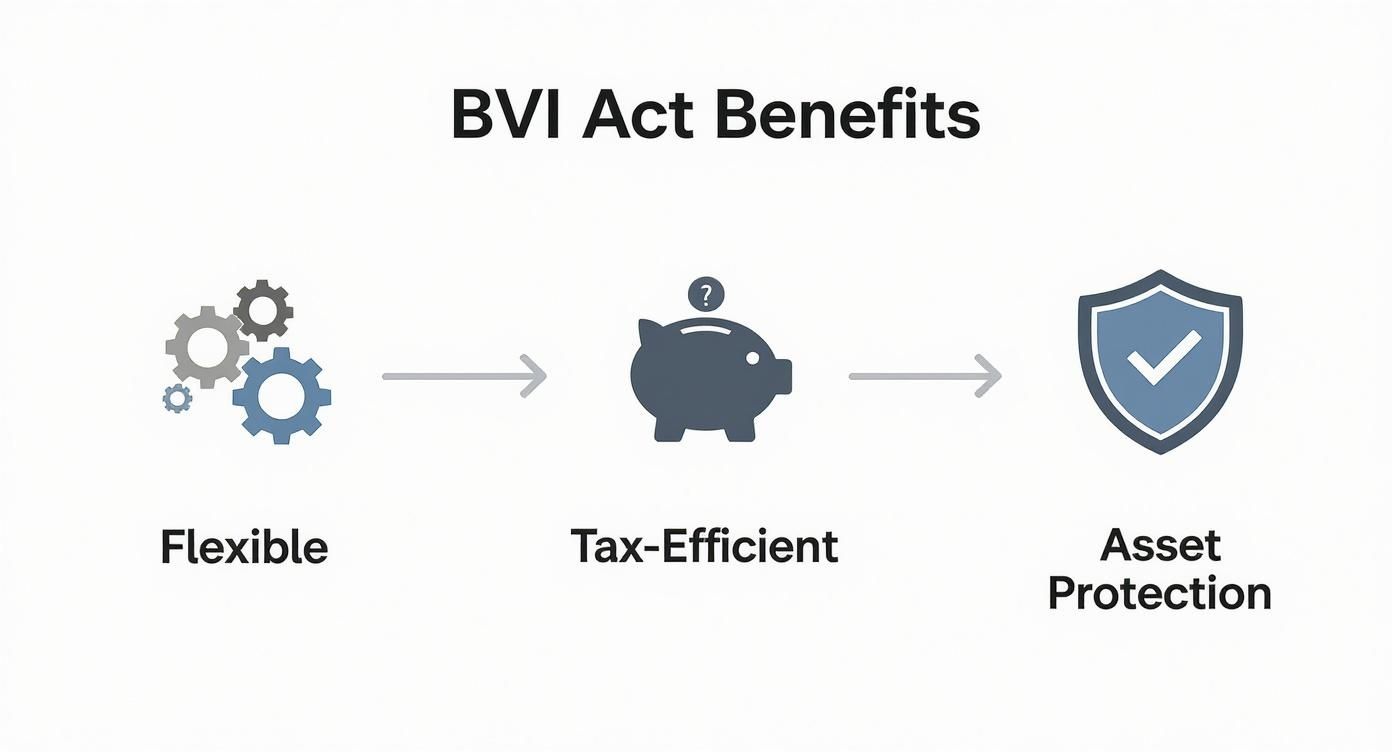
These benefits aren't just bullet points on a brochure; they work together to create an incredibly powerful and practical tool for international business.
From Application to Certification
Once these documents are drafted and signed, your registered agent handles the submission to the BVI Registrar. The BVI is known for its efficiency, and this part of the process is no exception. As long as everything is in order, the Registrar will issue a Certificate of Incorporation.
This certificate is your company's official birth certificate. It's the proof that your company is legally registered and ready to do business.
The entire process, from start to finish, can often be wrapped up in just a few business days. Once you have that certificate in hand, your BVI company legally exists. You can then formally appoint its first directors, issue shares, and get down to business. A common next step is setting up banking, and this guide to opening US bank accounts for non-residents can be a helpful resource for international companies looking to do just that.
Managing Your Company and Corporate Governance

So, your BVI company is officially incorporated. You've got the certificate in hand and you're ready to get down to business. Now what? This is where corporate governance enters the picture. It’s not just a stuffy buzzword; it’s the practical rulebook for running your company legally and effectively. The BVI Business Companies Act provides a clear, yet incredibly flexible, framework for managing your company’s internal affairs.
I like to think of it this way: incorporation was the act of building the ship. Governance is the art and science of steering it. You need a captain (the directors) to navigate the day-to-day journey and owners (the shareholders) who decide on the ultimate destination. Getting these roles straight is the key to smooth sailing.
The Power Players: Directors and Shareholders
In the world of BVI company law, power is neatly divided between two key groups: directors and shareholders. The Act deliberately separates their functions to ensure everyone knows their role, which fosters clear lines of accountability.
Directors: The Day-to-Day Managers
Directors are the operational brains of the company. They are the ones on the bridge, making the daily business decisions, signing contracts, managing company assets, and setting the strategic course. The BVI Business Companies Act grants directors very broad powers to manage the business.
For an entrepreneur running an international trading company, this means the director is the one authorising payments to suppliers, negotiating with clients, and overseeing logistics. They have the authority to act without constant shareholder oversight.
Shareholders: The Ultimate Owners
Shareholders, on the other hand, are the owners. Their power is exercised from a higher altitude, primarily through voting on major company decisions. They aren't involved in the daily grind but make the fundamental calls that shape the company’s future.
Typically, key shareholder responsibilities include:
- Appointing and removing directors: If the shareholders lose confidence in the management, they hold the power to make a change.
- Amending the Memorandum and Articles of Association: Any changes to the company's core constitutional documents must be approved by the shareholders.
- Approving major transactions: This would cover huge decisions like selling the entire company or merging with another business.
This separation of powers is purpose-built for efficiency. Directors can get on with running the business without constant interference, while shareholders retain ultimate control over their investment.
A Framework Built for Entrepreneurs
One of the most attractive features of the BVI Business Companies Act, particularly for SMEs and solo entrepreneurs, is its incredible structural flexibility. Unlike more rigid jurisdictions, the BVI framework understands that modern businesses don't always fit into a neat, traditional corporate box.
This is best illustrated by a key, and very practical, provision:
A BVI company can be legally operated with just a single director who is also the sole shareholder. This is a genuine game-changer for solo founders or small family businesses.
This means you don’t need to assemble a complex board or find nominee shareholders just to satisfy some outdated legal requirement. You can be the owner and the manager, maintaining complete control over your business without adding unnecessary layers of administration. This streamlined structure saves time, cuts down on complexity, and allows you to make decisions quickly.
Officers: The Hands-On Implementers
While directors set strategy and shareholders hold ownership, officers are often the ones who execute the day-to-day tasks. The Act allows for the appointment of officers like a President, Treasurer, or Secretary, though in many cases, it isn't mandatory.
These roles are appointed by the directors to handle specific operational duties. For instance, a director might appoint a Treasurer to manage the company's bank accounts and financial records. This delegation allows directors to focus on high-level strategy while ensuring the essential functions of the business are being handled effectively.
Ultimately, mastering governance under the BVI Business Companies Act isn't about memorising legal clauses. It's about understanding this simple but powerful structure: directors manage, shareholders own, and the entire system is flexible enough to adapt to your specific business needs.
Navigating Annual Filings and Compliance
Keeping your BVI company in good standing isn't a one-time event; it's an ongoing commitment. The BVI Business Companies Act has evolved over the years, steadily moving towards greater transparency and accountability. For any entrepreneur using a BVI structure, getting a firm grip on these yearly obligations is non-negotiable.
Think of it like an annual health check for your company. Just as you'd see a doctor to make sure everything is ticking along nicely, your BVI entity needs regular attention to stay legally healthy. Ignoring these duties leads to steep financial penalties and, ultimately, the risk of being struck off the register.
The Foundation of Good Standing: Company Registers
At the very heart of BVI compliance are your company's statutory registers. These aren't just dusty files; they're the official, living records that prove your company's ownership and management structure. The Act is crystal clear: every company must maintain several key registers.
The most important ones are:
- Register of Members: This is the definitive list of who owns the company—the shareholders.
- Register of Directors: This details who is in charge of running the company's day-to-day affairs.
- Copies of key documents: This includes all passed resolutions and minutes from any meetings held.
These registers have to be kept meticulously up-to-date. If a director steps down or you issue a new batch of shares, those changes need to be recorded immediately. Our guide to the BVI company registry goes into more depth on how these essential records are managed.
The Annual Financial Return: A New Era of Reporting
One of the biggest recent changes under the BVI Business Companies Act is the requirement to file an Annual Financial Return. Don't panic—this isn't a full-blown audited financial statement. It's a much simpler document, essentially a basic income statement and balance sheet, designed to give a high-level financial snapshot of the company.
You need to file this return with your BVI registered agent within nine months of your company's financial year-end. For example, if your financial year closes on December 31, your deadline is September 30 of the following year. Crucially, this is a private filing with your agent; it isn't made public, so you maintain commercial confidentiality while still meeting regulatory demands.
Key Takeaway: The Annual Financial Return is a mandatory, non-public filing that gives your registered agent a summary of your company's financial health. Missing this deadline creates an immediate compliance problem.
Strict Deadlines and Heavy Penalties
Let's be clear: the BVI authorities take filing deadlines very seriously. Recent amendments have clamped down on the rules, especially around the Register of Members. Starting in early 2025, BVI companies—including those managed out of places like Hong Kong—must file their Register of Members with the BVI Registrar within a strict timeframe.
Mess this up, and the penalties kick in fast, starting at US$300 for the first month and climbing to a maximum of US$5,000. The penalties for a late Annual Financial Return are just as tough. If you miss that deadline, your registered agent is legally obligated to report you to the BVI Financial Services Commission (FSC). This can result in fines and could lead to your company being struck off, which effectively freezes its assets.
For many, staying on top of this can be a real headache. Engaging professional outsourced legal support services can be a smart move to ensure you never miss a beat. Simply put, staying organised is your best defence.
To help you keep track, here is a simple checklist of the key annual compliance tasks.
BVI Company Annual Compliance Checklist
This table provides a quick summary of the core annual obligations your BVI Business Company must meet to remain in good standing with the authorities.
| Requirement | What It Is | Key Deadline | Associated Cost/Penalty |
|---|---|---|---|
| Annual Government Fee | The yearly fee paid to the BVI government to maintain the company’s legal status. | 31 May each year (for Jan-Jun incorporations) or 30 Nov (for Jul-Dec). | Late fees apply, followed by strike-off for non-payment. |
| Registered Agent Fees | The annual fee paid to your service provider for registered agent and office services as required by law. | Varies by agent, but typically due alongside the government fee. | Failure to pay can lead to the agent resigning, making the company non-compliant. |
| Annual Financial Return | A simple balance sheet and income statement filed privately with your registered agent. | Within 9 months of the company's financial year-end. | The agent must notify the FSC of non-compliance, leading to fines and potential strike-off. |
| Economic Substance Report | A declaration filed via the registered agent confirming if the company conducts a "relevant activity". | Within 6 months of the end of the financial period. | Significant fines ranging from US$5,000 to US$400,000 and potential imprisonment for providing false information. |
| Update Registers | Ensuring the registers of directors, members, and beneficial owners are current and accurate at all times. | Immediately upon any change. | Failure to maintain accurate records can lead to operational issues and penalties during regulatory checks. |
Keeping this checklist in mind will help you structure your company's annual calendar and avoid any unwelcome surprises from the BVI authorities.
Understanding Economic Substance and Ownership Rules
The global financial world has changed. The push for greater transparency is undeniable, and the BVI has adapted to keep pace. For anyone running a BVI company, two concepts are now absolutely central to staying compliant: Beneficial Ownership and Economic Substance. Getting these right isn't just about paperwork; it's about making sure your company is built on a solid, legally defensible foundation.
Think of it this way: for a long time, the main concern was who held the title deeds to a house. Now, regulators also want to know if anyone is actually living there—if there’s real activity happening inside. The BVI Business Companies Act has woven these new global standards directly into its DNA.
Pulling Back the Curtain on Beneficial Ownership
The days of complete corporate secrecy are long gone. Every BVI company is now required to identify and report its ultimate beneficial owners (UBOs)—the actual people who own or control it behind the scenes. This isn't just about scribbling down a list of names; it means providing clear, verified details to your registered agent.
This information is then securely uploaded to a private platform called the Beneficial Ownership Secure Search system (BOSS). It’s important to understand this is not a public register. Instead, it’s a confidential database that can only be accessed by designated BVI authorities with a legitimate, formal request, like during a tax investigation.
The rules here have only gotten stricter. These changes have particularly impacted BVI companies with links to Hong Kong, demanding more rigorous disclosure. The BVI Financial Services Commission takes this very seriously—failure to comply can lead to hefty penalties ranging from US$10,000 to US$75,000, or even having the company struck off the register.
Decoding Economic Substance Requirements
Beyond just knowing who the owner is, the BVI's Economic Substance laws tackle a more fundamental question: is your company a genuine, functioning business, or is it just a "letterbox"? If your company is involved in certain types of business, officially called "relevant activities," you have to prove that it has a real economic footprint in the BVI.
So, what exactly is a "relevant activity"? For most international entrepreneurs, the key ones are:
- Holding company business: Your company's primary function is holding shares or other equity in other companies.
- Intellectual property business: The company holds and earns income from things like patents, trademarks, or copyrights.
- Distribution and service centre business: It acts as a hub for buying and reselling goods or providing services to related group companies.
If your BVI entity does any of these, it can no longer be just a name on a piece of paper. You must be able to demonstrate "adequate substance" on the ground in the BVI.
Analogy: Let's say your BVI company manages a portfolio of valuable patents. The economic substance rules mean you have to show that qualified people are making decisions about those patents in the BVI, that you're incurring appropriate expenses there, and that you have a physical office or resources dedicated to genuinely managing that portfolio.
This translates into having adequate employees, a physical presence, and operational spending within the BVI, all in proportion to the scale of your business. For a straightforward holding company, the bar is quite low ("reduced substance"). But for a high-risk IP company, the expectations are significantly higher. If you ever need to check the declared activities of another entity, running a BVI company search can give you that initial overview.
Getting your head around these twin pillars—ownership transparency and economic substance—is non-negotiable for operating a BVI company today. It’s the BVI’s clear statement that it is a jurisdiction for legitimate, active businesses.
Got Questions About the BVI Business Companies Act? We've Got Answers.
When you're structuring a business, you’re bound to have questions. The BVI Business Companies Act is a powerful piece of legislation, but it’s the practical, day-to-day stuff that really matters to entrepreneurs.
We've pulled together the questions we hear most often and answered them plainly. Think of this as a chat with a seasoned advisor, cutting through the legal jargon to give you the clarity you need.
Why Is a BVI Company So Popular for Hong Kong Businesses?
For anyone running a business from Hong Kong, a BVI company offers a potent mix of benefits that’s tough to beat. It’s not just about one feature; it’s how they all work together to create an incredibly effective structure for international trade and investment.
Here’s the breakdown:
- A Tax-Neutral Platform: The BVI has no corporate income tax, no capital gains tax, and no inheritance tax. This makes it an exceptionally efficient vehicle for holding international assets and managing profits without adding another layer of tax.
- Incredibly Flexible Structure: The Act was written for modern business. It allows one person to be the sole director and the sole shareholder—perfect for solo entrepreneurs or small to medium-sized enterprises (SMEs).
- Commercial Confidentiality: While global transparency rules have certainly tightened, the BVI still offers a high degree of commercial privacy. Key details about beneficial ownership are held securely and aren't on a public database, which helps protect legitimate business interests.
- Familiar Legal Ground: BVI corporate law is rooted in English common law, the very same system that underpins Hong Kong’s legal framework. This shared foundation makes legal and financial structuring predictable, stable, and much easier for professionals in the region to navigate.
Do I Physically Need to Go to the BVI to Run My Company?
This is a great question, and the answer is a firm no. You never have to set foot in the British Virgin Islands to set up or manage your company. The whole system is designed to be run from anywhere in the world, which is a big reason for its global appeal.
Your BVI Registered Agent is your official presence on the ground. They handle all the paperwork, file documents with the Registrar, and make sure your company stays on the right side of the BVI Business Companies Act. All your duties, from holding director's meetings to signing resolutions, can be done right from your office.
What Happens if I Miss Paying the Annual Fees?
Failing to pay your annual government fees is one of the worst mistakes you can make. The consequences are automatic and get serious, fast.
If you miss the deadline for the annual government licence fee, penalties are applied immediately. If those fees and penalties go unpaid for too long, your company gets struck off the Register of Corporate Affairs. A struck-off company isn't dissolved; it's in a state of limbo. It can't trade, transfer assets, or conduct any business. Worse, its assets—including any money in its bank accounts—are technically forfeited to the BVI government.
While you can sometimes restore a struck-off company, it’s a complicated, expensive, and time-consuming process. It's far smarter and cheaper to just stay compliant from the start.
With All the Recent Changes, Is My Information Still Confidential?
Recent amendments to the Act have struck a new balance between the BVI's tradition of privacy and today's international transparency standards. The game has changed, but a high degree of confidentiality for legitimate business remains.
The biggest shift is that basic information from the Register of Directors can now be searched by third parties who request it. However, sensitive personal details like a director's date of birth or full home address are still kept private.
Most importantly, the detailed information on beneficial ownership, filed through the secure BOSS system, is not public. This database can only be accessed by designated authorities, like tax agencies or law enforcement, and only after they make a formal, lawful request. So, while the days of absolute secrecy are gone, the BVI continues to protect the commercial privacy of business owners from prying eyes.
Conclusion
Making sense of the BVI Business Companies Act requires more than just knowing the rules—it demands a strategic partner who can make those rules work for your long-term vision. At Lion Business Consultancy Limited, we act as your private financial manager, ensuring your international structure is not only compliant but also built for security and growth.