

 Hong Kong

 Singapore


 UAE
UAE



 Malaysia
 Turkey

 UK
UK
 EU
EU
 US
US
 Switzerland
 Bahamas Bank Account
 Cayman Islands Bank Account
 Mauritius Bank Account

 BVI
BVI
 Seychelles

When you’re dealing with a British Virgin Islands entity, an official company search isn’t just a formality—it’s your most fundamental piece of due diligence. Think of it as the foundational step before you even consider entering into a significant business transaction. It’s the only official way to confirm a company’s existence, its current legal standing, and its registered details, straight from the source: the BVI Registrar of Companies.
Why a BVI Entity Search Is Your Most Critical Due Diligence Tool
Let’s imagine a scenario. You’re about to close a major supply deal with a company registered in the BVI. On the surface, everything looks solid—the proposal is strong, the terms are favorable, and the potential payoff is significant. But a small question lingers in the back of your mind: how much do you really know about this company you’re about to partner with?
This is where a formal British Virgin Islands entity search transforms from a simple box-ticking exercise into an essential risk management strategy. It’s the difference between operating on blind faith and making decisions based on cold, hard, verified facts. You can’t just ‘Google’ a BVI company and expect to find what you need. The jurisdiction’s corporate framework is built around privacy which, while a major plus for legitimate businesses, can also serve as a shield for entities you need to be wary of.
Navigating the BVI’s Corporate Privacy Shield
The legal framework in the British Virgin Islands is designed to restrict public access to corporate information. This is great for protecting legitimate commercial interests, but it means your usual due diligence playbook won’t work here. A standard internet search will yield next to nothing, leaving you exposed to misinformation or, even worse, outright fraud.
While the official registry provides a baseline of verifiable data, the most sensitive details are kept private. Here’s a quick breakdown of what you can and can’t expect to find in a standard search:
- What you CAN see: The official company name, its registration number, the date of incorporation, its current status (e.g., Active, Struck-off), and the details of its Registered Agent.
- What you CANNOT see: Information on directors, shareholders, or the ultimate beneficial owners (UBOs).
This privacy-first approach is precisely why a formal search is non-negotiable. It’s the only official method to confirm that the company legally exists and is in good standing with the BVI authorities.
“In a jurisdiction like the BVI, an official entity search isn’t just about ticking a box. It’s your first line of defense against financial risk and your foundational tool for legal compliance.”
Real-World Scenarios Where a Search Is Non-Negotiable
Consider this practical example. An SME in Hong Kong is looking to onboard a new supplier from the BVI for a critical component in their manufacturing line. Before wiring a substantial deposit, the finance director wisely insists on an entity search. The report comes back confirming the company is Active and its official registration number perfectly matches the invoice. This simple, low-cost check provides the confidence to move forward.
Now, let’s look at the flip side. A tech startup is in late-stage talks to receive funding from a BVI-based venture capital fund. A preliminary search reveals the fund’s status is “In Penalty“—a massive red flag indicating it has failed to pay its annual government fees. This discovery would immediately trigger a much deeper investigation before any capital is accepted, potentially saving the startup from a partnership that could have ended in disaster.
These are the real-world stakes. A British Virgin Islands entity search cuts through the opacity and gives you a clear, factual starting point for navigating the complex world of BVI Business Companies.
Getting to Grips With the Official BVI Corporate Registry
If you’re accustomed to jurisdictions with open, searchable online databases, you’ll find that a British Virgin Islands entity search operates quite differently. There’s no public portal you can simply log into and browse. Instead, the BVI Registry of Corporate Affairs uses a more traditional, manual system. Think of it less like a self-service database and more like commissioning a specific, official report.
The entire process hinges on a single document: Form R820. This is the formal application submitted to the Registrar to request information on a BVI company. Getting this part right is the cornerstone of any serious due diligence.
The Realities of Form R820 and the Search Process
Submitting this form is your direct line to the official records. To search any registry effectively, you need a unique identifier, much like understanding the Company Registration Number (CRN) in the UK. For the BVI, you’ll need the company’s full, exact legal name or, even better, its registration number to kick things off.
The process is methodical. As of early 2025, the BVI regulator requires these formal requests and a statutory US$50 search fee for an official company report. Once the completed Form R820 is submitted, you can typically expect the search results within 24 hours. This report provides that crucial baseline data: the company’s name, number, incorporation date, status, registered agent, and capital structure. If you want to dive deeper into the specifics, we cover the nuances of the BVI company registry in another guide.
This is the homepage of the BVI Financial Services Commission, which is the governing body for the Registry of Corporate Affairs.
While this is the official portal for all regulatory matters, you won’t find a public search function here. It really highlights the formal, channelled nature of information requests in the BVI.
What the Official Search Report Actually Tells You
When you receive the report, what you have is a clear, verified snapshot of the company’s corporate health. It’s the foundational layer of your investigation, confirming the entity legally exists and is compliant.
Here’s a breakdown of what a standard official search provides:
- Company Name and Number: The official legal name and its unique registration number.
- Incorporation Date: The exact date the company was legally formed.
- Current Status: This is critical. It will tell you if the company is ‘Active’, ‘In Penalty’, ‘Struck-off’, or ‘Dissolved’.
- Registered Agent Details: The name and address of the official agent responsible for the company in the BVI.
- Transaction History: A list of key filings, like name changes or mergers, giving you a sense of the company’s corporate timeline.
This information is invaluable in the real world. Imagine you’re about to sign a major contract. Confirming the counterparty is ‘Active’ and in good standing can save you from doing business with a non-compliant or even non-existent entity.
Remember, the official BVI search report is your source of truth for the company’s legal status. It’s not an opinion or a third-party database entry; it’s a direct confirmation from the government registry itself.
Knowing the Limits: What a Standard Search Won’t Reveal
It’s just as important to understand what you won’t find. A standard British Virgin Islands entity search will not reveal the names of the company’s directors or its shareholders. This information is not part of the public record.
This isn’t an oversight; it’s a deliberate feature of the BVI’s legal framework, designed to protect privacy. If your goal is to identify the people behind the company—the beneficial owners—the official registry search is only your first step. You’ll need to explore other avenues, like requesting the information from the company directly or engaging a specialist service provider who can liaise with the Registered Agent. We’ll touch on how that works a bit later.
The Shifting Sands of BVI Corporate Transparency
When you’re digging into a British Virgin Islands entity, you need to understand one key thing: the ground is constantly shifting. The BVI’s regulatory world isn’t a dusty old rulebook; it’s a dynamic framework being reshaped by global pressures. This directly impacts what information you can find and how you should approach your due diligence.
The old image of the BVI as a completely opaque jurisdiction is fading. In recent years, facing pressure from international bodies to combat financial crime, the BVI government has rolled out significant legal reforms. The goal is clear: bring the territory in line with global anti-money laundering (AML) and counter-terrorism financing (CTF) standards.
At its core, the official search process is straightforward, but it’s just the tip of the iceberg.
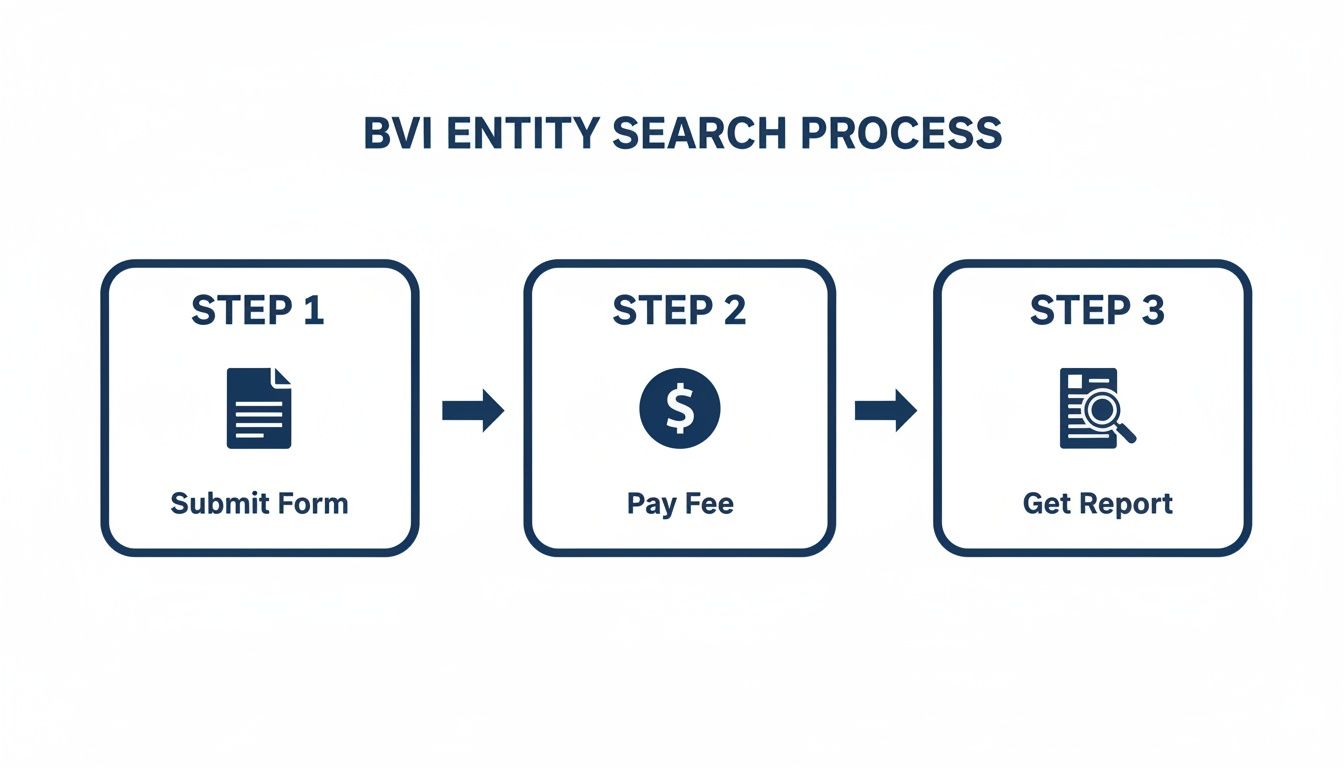
This simple flow shows that getting basic information is designed to be easy. However, it’s what this initial search doesn’t tell you that often matters most in serious due diligence.
The Elephant in the Room: Beneficial Ownership
The biggest change, without a doubt, revolves around Beneficial Ownership. For decades, the identity of who truly owned and controlled a BVI company was kept under lock and key by the company’s Registered Agent, far from public view. That’s changing, though not in the way you might expect.
Don’t think you can just log on and search for a BVI company’s owner. That’s not happening. Instead, new laws are compelling BVI companies to identify, verify, and report their beneficial owners. This information is now fed into a centralized, highly secure government system. For the general public, it’s still inaccessible. But for law enforcement and competent authorities with a legal basis, the door is now ajar.
This shift creates a two-sided coin. On one hand, it adds a layer of accountability, meaning background checks on potential partners are becoming more robust, even if you can’t see the data yourself. On the other hand, it places a much heavier compliance burden on anyone operating a BVI company.
What Recent Legal Changes Mean for Your Search
The laws here aren’t just changing; they are actively being rewritten. For example, a major raft of regulatory reforms that took effect on 1 January 2023 fundamentally altered the rules around transparency and corporate governance. Key amendments to BVI company law introduced new reporting requirements and gave existing companies a deadline to get their houses in order.
So, how does this affect your search in the real world?
- Future Glimpses: While the beneficial ownership register remains private for now, the new framework is built for a future where certain “obliged entities” (like banks and law firms) might gain controlled access.
- More Reliable Data: Because companies now face serious penalties for inaccuracies, the director and owner information held by their Registered Agents is under much greater scrutiny and more likely to be accurate.
- Stronger Health Signals: In this new environment, a company’s ability to quickly produce documents like a Certificate of Good Standing is a powerful signal. It shows they are on top of their compliance and operating a legitimate, well-managed entity.
These reforms are more than just bureaucratic box-ticking. They represent a deep modernization of the BVI’s corporate world. Understanding the intent behind these regulations, particularly as laid out in the BVI Business Companies Act, allows you to read between the lines of any search report. It helps you see not just a snapshot of a company today, but how it’s preparing for a future where transparency is no longer optional.
What to Do When the Official Search Isn’t Enough
You’ve completed the initial check with the BVI’s official registry. The report confirms the company is ‘Active’ and the registration details line up. That’s a solid start, but often, it’s just the beginning of the story.
What if you need to know who the directors are? Or perhaps a bank is demanding an official Certificate of Good Standing before they’ll open an account for the entity? This is where the limitations of the public search become crystal clear.
The most critical information—like the names of directors, shareholders, and the company’s constitutional documents—isn’t on the public file. It’s held confidentially by the company’s Registered Agent. To get any further, you’ll need to work with a specialized service provider who knows the local landscape.
BVI’s Corporate Gatekeepers: The Registered Agents
Think of a BVI Registered Agent as the official custodian for a company’s most sensitive records. They are legally required to maintain copies of the register of directors, the register of members (shareholders), and crucial beneficial ownership information.
But here’s the catch: they are also bound by strict confidentiality rules. They won’t just hand this information over to anyone who asks. This creates a classic due diligence puzzle—you know the information exists, but you can’t access it directly.
This is where engaging a professional corporate services firm becomes your key. These firms act as your boots on the ground, using their established relationships and deep understanding of BVI protocols to request documents directly from the Registered Agent.
For instance, say you’re about to enter into a joint venture. You absolutely need a certified copy of your partner’s Memorandum and Articles of Association to confirm their corporate structure allows for such a deal. The public registry won’t have it. A service provider, however, can make a formal request to the Registered Agent, who will then seek the company’s permission to release the document. It’s a formal, controlled process.
Comparing BVI Entity Search Methods
Choosing the right approach depends entirely on your objective. A quick, free search has its place, but for anything substantial, you’ll need to go deeper. Here’s a quick comparison to help you decide.
| Feature | Official Registry Search | Third-Party Service Provider |
|---|---|---|
| Information Available | Basic details: Company name, registration number, status (e.g., Active, Struck-Off), date of incorporation. | Comprehensive data: All public info plus access to non-public documents like Director Registers, Certificates of Good Standing, and constitutional documents (with company consent). |
| Cost | Typically free for a basic name search. Small fee for an official extract. | Varies by document and urgency. Expect to pay for professional service, document fees, and courier charges. |
| Speed & Process | Instant for online searches. A few days for an official extract. You do the work yourself. | Turnaround can be from 24 hours to a few days, depending on the Registered Agent’s responsiveness. They handle the entire process. |
| Use Case | Quick verification of a company’s existence and basic legal standing. | In-depth due diligence, KYC checks, legal proceedings, opening bank accounts, or major business transactions. |
In short, the official search tells you if the company exists. A third-party service helps you understand who is behind it and how it operates.
Unlocking the Documents You Actually Need
Working with a third-party provider opens the door to a range of documents that paint a much clearer picture of the company you’re dealing with, going far beyond the basic details from a public search.
Here are some of the critical documents you can typically obtain:
- Certificate of Good Standing: This is the gold standard. It’s an official certificate issued by the Registrar confirming the company has paid its government fees and met its filing obligations. It’s the ultimate proof of a company’s healthy legal status.
- Certified Constitutional Documents: This includes the Memorandum and Articles of Association—the company’s internal rulebook. These documents spell out how the company is governed, the rights of its shareholders, and the powers of its directors.
- Register of Directors: Although not public, a copy of this register can often be obtained through the proper channels. Seeing who is officially running the company is a cornerstone of any serious KYC check.
- Certificate of Incumbency: This is a document issued by the Registered Agent (not the government) that confirms the identity of the current directors and officers. It’s frequently requested by banks and financial institutions during onboarding.
It’s a common misconception that getting this information is impossible. It’s not. It’s just not public. Accessing it simply requires navigating the correct channels, which is precisely what professional service providers are for.
When Is It Worth Engaging a Professional?
Do you always need to pay for these extra services? Not necessarily. If you’re just verifying that a small supplier is a legitimate registered company, the basic official search might suffice.
However, when the stakes are high—think major transactions, investments, or high-risk partnerships—the cost of a deeper search is a tiny price to pay for peace of mind. Consider it an insurance policy. For a few hundred dollars, you get a level of verification that could save you from a multi-million-dollar mistake down the road.
Ultimately, the official registry search answers the question, “Does this company legally exist and is it compliant?” Engaging a professional service helps answer the far more important questions: “Who is behind this company, and can I trust them?”
Making Sense of Your BVI Search Results

Getting a search report back is just the first step. The real skill lies in knowing how to interpret it. The raw details—company status, incorporation date, registered agent—are simply pieces of a much larger puzzle. To get the full picture, you need to understand the unique world these BVI companies operate in.
Think of it this way: a single data point on a stock chart tells you very little. You need to see market trends, industry health, and the wider economic climate to make an informed decision. It’s the same with a British Virgin Islands entity search. The results only become truly valuable when you appreciate the jurisdiction’s pivotal role on the global stage.
The Sheer Scale of BVI Companies
First, it’s important to grasp the staggering number of companies registered in the BVI. As of mid-2023, the corporate registry was home to 366,050 active BVI Business Companies. This number alone tells you why the BVI is a global powerhouse in corporate services, but it also sounds a note of caution: you must have precise, verified information to navigate this sea of entities.
This isn’t a random collection of companies. This massive scale is the direct result of a legal framework meticulously built for international business—designed for efficiency, neutrality, and commercial sense. So, when your search confirms a company is ‘Active’, you’re not just ticking a box; you’re confirming its good standing within this vast, highly structured ecosystem.
Understanding the Global Footprint
The next crucial piece of context is understanding who uses BVI companies and why. The jurisdiction’s appeal isn’t uniform across the globe; it has an especially strong, long-standing connection with Asian markets.
Viewing a BVI entity in isolation is a classic mistake. More often than not, it’s a vital link in a complex cross-border structure, connecting capital, assets, and operations between continents.
Industry observers have long pointed out the deep ties between the BVI and Asia. For instance, a press release from BVI Finance estimated that an incredible 57% of new incorporations come from Asia. To put that in perspective, Europe and North America combined only accounted for about 17%. You can explore the analysis of BVI company statistics for a closer look at these figures.
This powerful Asian connection is vital context. If you’re an entrepreneur in Hong Kong or Singapore dealing with a BVI entity, the odds are high that the ultimate beneficial owners or core business operations are based right in your region. This insight can completely change how you approach everything from negotiations to due diligence, explaining why the BVI framework is so perfectly adapted to the needs of international trade and investment flowing from the East.
Turning Raw Data into Strategic Decisions
With this background knowledge, your search results suddenly become much more powerful. You can now interpret the basic facts with a strategic eye, understanding the drivers behind the data.
- An ‘Active’ Status: This means more than just paying annual fees. It signifies the company maintains its legal standing in a premier global financial center, likely as a vehicle for significant international business.
- Registered Agent Details: The agent’s name can be a clue. Well-established, reputable agents manage thousands of companies and have stringent compliance procedures, which offers an indirect layer of assurance.
- Incorporation Date: An older company isn’t just an older company. It could suggest a stable, long-term structure, perhaps for holding family assets or legacy investments—a very common setup for Asian UBOs.
At the end of the day, a British Virgin Islands entity search gives you a solid anchor of factual certainty. When you combine that hard data with a real-world understanding of the BVI’s role in global commerce, you elevate a simple compliance check into a genuinely strategic business tool.
Getting to the Bottom of Your BVI Search Questions
When you’re digging into a British Virgin Islands company, you’re bound to have questions. The BVI’s unique approach to corporate privacy can feel like a maze, especially when you need clear answers for a big business decision. Let’s walk through some of the most common queries we get from clients.
Can I Find Out Who Owns a BVI Company?
This is usually the first question on everyone’s mind, and the direct answer is no—at least, not from a public search. A standard check on the BVI Registry of Corporate Affairs won’t show you the names of shareholders or the ultimate beneficial owners (UBOs).
That level of detail is kept confidential by the company’s official Registered Agent. Access generally requires a formal legal instrument, like a court order, or the company’s consent to share it with you. While the BVI has moved towards greater transparency for regulatory purposes, public access to ownership data isn’t on the horizon. For your due diligence, the most straightforward approach is simply to ask the company for this information.
What Exactly Is a BVI Certificate of Good Standing?
Think of it as an official health certificate for the company. A Certificate of Good Standing is a document issued directly by the BVI Registrar, confirming that the entity is properly registered, has paid all its annual government fees, and is compliant with local corporate rules.
It’s a crucial document you’ll almost certainly need when:
- Opening a corporate bank account.
- Applying for a business loan or other financing.
- Verifying the company’s legitimacy before signing a major contract.
This certificate provides a much stronger assurance than a simple search report. You can obtain one through the company’s Registered Agent, or you can have a third-party service provider handle the request for you.
What Are the Red Flags in a BVI Search?
Some findings from a British Virgin Islands entity search should give you immediate pause. The most obvious one is seeing any status other than ‘Active’ or ‘In Good Standing’.
If a company’s status is ‘Struck-off’ or ‘In Penalty’, that’s a clear warning. It could be something as simple as administrative oversight, but it could also signal serious financial trouble or even a deliberate attempt to disappear and dodge liabilities.
Other warning signs to watch for include:
- Frequent changes of Registered Agent: This can sometimes be a sign that a company is trying to stay one step ahead of scrutiny.
- A history of name changes: While there are plenty of legitimate reasons for this, multiple unexplained changes can be a way to hide a company’s past.
- Resistance to providing documents: If a potential partner won’t provide a Certificate of Good Standing upon request, that’s a major red flag.
These aren’t just minor details. They’re potential clues to bigger risks that demand a much closer look before you move forward.
How Do I Get Certified Copies of BVI Company Documents?
Official, certified copies of core documents—like the Certificate of Incorporation or the Memorandum and Articles of Association—aren’t something you can just download from a public database. These documents carry legal weight.
Getting your hands on them requires a formal request to the BVI Registry, a process almost always managed by the company’s Registered Agent or a specialized corporate services firm. These certified copies serve as legal proof of the company’s existence and its internal operating rules, often essential for court proceedings, major transactions, or setting up shop in another country.
Conclusion
Trying to piece together the full picture of a BVI entity requires a deep understanding of the local rules and what’s realistically available. At Lion Business Consultancy Limited, we provide the hands-on advisory you need to ensure your due diligence is thorough and gives you the confidence to act. We don’t just pull reports; we help you understand what they mean for your business goals.