
 Hong Kong
 Singapore
 UAE
UAE

 Malaysia
 Turkey
 UK
UK
 EU
EU
 US
US
 Switzerland
 Bahamas Bank Account
 Cayman Islands Bank Account
 Mauritius Bank Account
 BVI
BVI
 Seychelles

When you're building a business that crosses borders, you need a solid foundation. For thousands of entrepreneurs and investors, that foundation is a British Virgin Islands (BVI) Business Company. Think of it not just as a legal structure, but as a strategic toolkit designed for global commerce, giving you a powerful mix of corporate flexibility, asset protection, and a highly respected legal framework.
What Exactly Is a BVI Business Company?
On paper, a BVI Business Company is a legal entity formed under the BVI Business Companies Act. But in practice, its role is far more dynamic. It creates a separate legal 'person' for your business—one that can own assets, sign contracts, and operate confidently on the world stage.
Consider it a purpose-built vehicle for your international ambitions. This isn't just a tool for massive multinational corporations. It’s incredibly useful for small to medium-sized enterprises (SMEs) and even startups that need to:
- Hold global investments: Securely own shares, property, or other assets in different jurisdictions.
- Manage international trade: Streamline transactions and contracts with partners around the world.
- Protect intellectual property: House valuable patents, trademarks, and copyrights under one secure corporate roof.
- Structure wealth and succession plans: Create a stable and private vehicle for managing and passing on family assets.
This very versatility is why BVI business companies are now a cornerstone of modern international corporate strategy.
A History Built on Trust and Innovation
The BVI's journey to becoming a top-tier financial centre really took off with the International Business Companies Act of 1984. This landmark legislation introduced a corporate vehicle that was simple, efficient, and private—a perfect fit for the fast-paced needs of global entrepreneurs.
The model was a runaway success. By June 2012, an incredible 447,801 active BVI companies were on the register. To put that in perspective, that's roughly 30 times the islands' actual population. The BVI’s reputation for fast, confidential incorporations and flexible corporate governance made it a go-to choice, particularly for Hong Kong investors structuring deals into mainland China. For a deeper dive into this enduring relationship, Vistra.com offers great insights into the BVI's role in global business.
This isn't just a history lesson; it explains the deep-seated trust and reliability that businesses worldwide have in the BVI today. The jurisdiction has never stood still, continuously evolving to meet international standards while preserving the agility that made it so attractive in the first place.
So, Why Do Entrepreneurs Actually Choose the BVI?
There's a very good reason why business hubs like Hong Kong have maintained such a strong, long-standing relationship with the British Virgin Islands. It's no accident. This connection is built on decades of proven reliability, legal stability, and sheer practicality. Entrepreneurs and global investors don't pick a BVI business company on a whim; they do it for solid, strategic reasons that align perfectly with the realities of modern global business.
The biggest draw is the BVI's legal system, which is rooted in English common law. For anyone familiar with international commerce, this is a huge advantage. It provides a predictable and stable foundation for commercial matters—exactly what you need when you're navigating cross-border deals or managing high-value assets.
I like to think of a BVI company in two ways: it's either a secure ‘vault’ for your assets or a nimble ‘hub’ for your international operations.
The BVI Edge: A Blend of Security and Flexibility
When you see it as a vault, its power in asset protection becomes clear. A BVI company can hold shares in other businesses, real estate, or valuable intellectual property, creating a legal firewall between those assets and your personal liabilities. This is a classic strategy for family offices and investors focused on wealth preservation and succession planning.
As a hub, it offers incredible freedom. The rules are designed for agility. You don't face a long list of restrictions on what the company can do, and there are no requirements for local directors or cumbersome annual meetings held in the jurisdiction. This allows you to structure your business based on commercial needs, not bureaucratic red tape.
It's this unique combination of rock-solid security and operational flexibility that has cemented the BVI's position as a go-to choice in the world of corporate services.
The statistics really drive this point home. As of March 2023, Asia was the single largest source of new BVI company formations, making up about 57% of the total. That's a clear indicator of how deeply the jurisdiction is woven into Asia's investment fabric. You can learn more about the BVI's economic landscape and its global standing.
A Global Benchmark for Corporate Structures
Deciding where to incorporate your company is one of the most fundamental choices you'll make. Every jurisdiction has its own unique flavour of rules, benefits, and compliance headaches that shape how you can operate.
For example, a complete guide to incorporating federally in Canada reveals a completely different set of considerations that drive business decisions there. Entrepreneurs gravitate towards the BVI because its entire framework was built from the ground up for international business. It offers a combination of efficiency, privacy, and a globally respected legal system that is hard to find anywhere else.
This makes it a near-perfect vehicle for structuring international trade, holding investment portfolios, and managing assets spread across different countries.
Your BVI Incorporation Process Explained
Setting up a BVI business company is a surprisingly straightforward process, especially when you know the steps. Think of it less like navigating a complex legal labyrinth and more like following a clear, well-marked path to building a powerful corporate structure for the global stage.
The entire procedure is designed for efficiency and can be managed from anywhere in the world—you never have to set foot in the British Virgin Islands. Your most important partner on this journey will be a licensed Registered Agent. This is a BVI-based firm that acts as your guide and official liaison, handling all the filings and ensuring every detail is perfect.
The Core Steps to Incorporation
The journey kicks off with a couple of key decisions. First, you need to choose a unique name for your company. Your Registered Agent will run a name check with the official registry to confirm it’s available and meets BVI guidelines. For instance, it must end with a recognized suffix like "Limited," "Ltd.," "Incorporated," or "Inc."
Next, you'll establish the internal rulebook for your company using two crucial documents:
- Memorandum of Association: This document outlines the basics—the company's name, its purpose (which can be as broad as "to engage in any lawful act"), and details about its share capital.
- Articles of Association: These are the day-to-day operating procedures. They cover everything from how directors are appointed and meetings are conducted to how shares are issued, giving you a clear playbook for running the business.
Once these documents are drafted and you've provided the required due diligence information on the company's directors and shareholders, your Registered Agent submits the application. Thanks to the BVI's modern digital systems, your company can often be officially incorporated in just a couple of business days. To see how this all connects with the official bodies, you can learn more about the BVI Company Registry here.
The infographic below neatly captures the core concepts that make this streamlined process so popular with entrepreneurs.
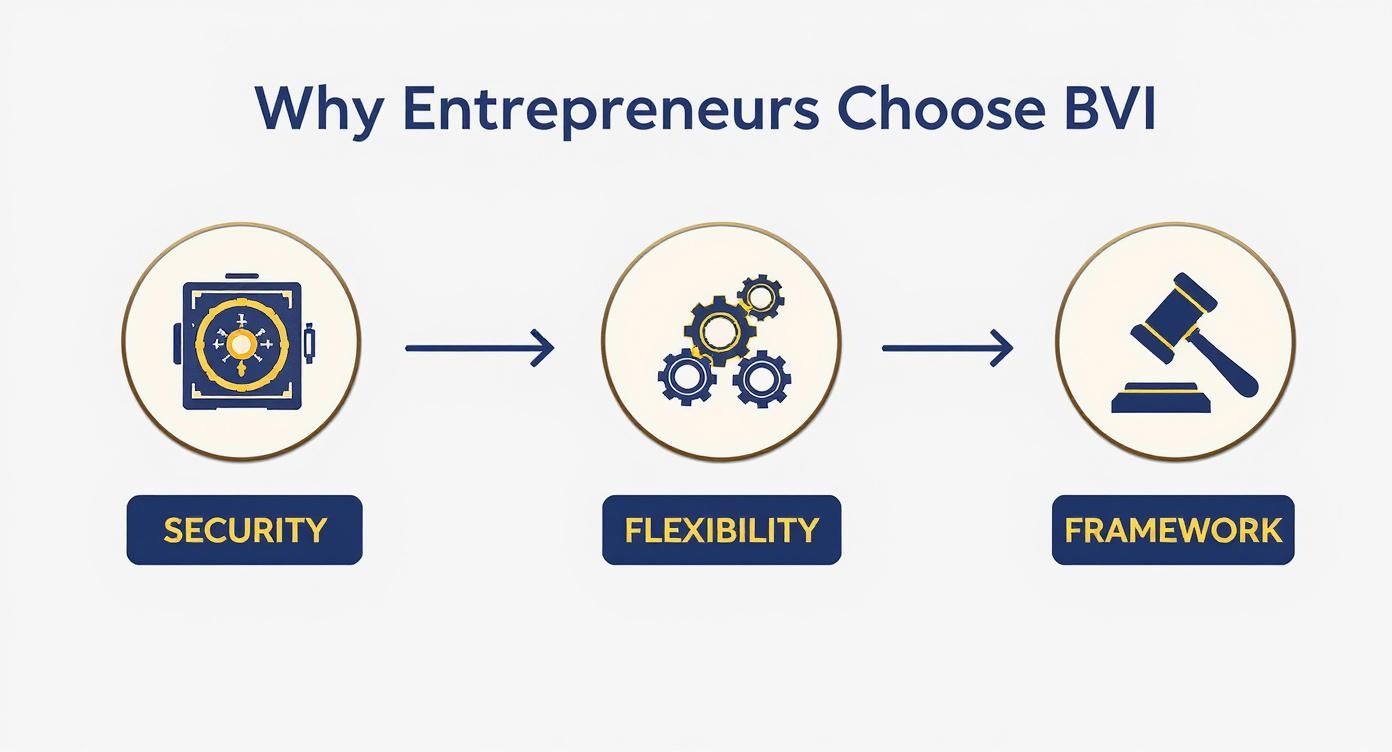
This visual brings it all together, showing how the BVI’s solid legal framework and corporate flexibility create a secure and highly effective environment for international business.
Finalising Your Company Setup
After the Registrar of Corporate Affairs approves your application and issues the Certificate of Incorporation, your BVI Business Company is officially born. Your Registered Agent will then assemble the complete company kit for you.
Think of this kit as your corporate "owner's manual." It typically contains the Certificate of Incorporation, the official stamped Memorandum and Articles of Association, share certificates, and the initial registers of directors and members. With these documents in hand, your company is fully operational and ready to open bank accounts, own assets, and enter into contracts.
This simple, professional approach is precisely why so many founders and investors choose the BVI. It provides a world-class corporate vehicle without the usual red tape, letting you focus on what's truly important: growing your business.
Managing Your Legal and Compliance Duties

Once your BVI business company is incorporated, the journey shifts from setup to smart stewardship. Think of it like a new ship; the real work begins once it's in the water. To keep your company in peak condition and successfully navigate the corporate seas, you need to stay on top of its ongoing legal and compliance responsibilities.
This isn’t about getting bogged down in endless paperwork. While the BVI’s framework is famously business-friendly, its rules are firm. Staying ahead of these duties is the best way to protect your company's good standing, sidestep potential penalties, and ensure you're always ready to seize the next opportunity without administrative hurdles.
Essentially, your ongoing obligations boil down to a few key pillars: paying annual government fees, keeping organized records, and meeting the territory's economic substance requirements. Each one plays a vital part in proving your company is a legitimate, well-run operation.
Understanding Economic Substance
The phrase "economic substance" might sound technical, but the idea behind it is straightforward. It's a global standard designed to ensure that a company is conducting real business activity, not just existing on paper to park profits. The good news? For the vast majority of BVI business companies, particularly those established for simple asset or investment holding, this usually just means making a simple annual declaration.
Now, if your company is involved in more specialized sectors—think banking, insurance, or managing intellectual property—the requirements become more detailed. You'll need to demonstrate that the core income-generating activities are actually taking place in the BVI. This is where a good Registered Agent earns their keep, as they can guide you on the specific evidence needed for your business model. The key is to address it every year, not let it become an afterthought.
Annual Compliance Checklist for Your BVI Company
To make things easier, it helps to have a clear roadmap of your yearly tasks. Here’s a simple checklist covering the essential duties that will keep your BVI company compliant and in good standing with the authorities.
| Compliance Task | Requirement Details | Typical Deadline |
|---|---|---|
| Annual Government Fee | This is the standard licence fee that must be paid to the government to keep your company active and listed on the Register. | Due by 31 May or 30 November, depending on your incorporation date. |
| Registered Agent Fee | You'll pay an annual fee to your BVI Registered Agent for their essential services, like providing an official address and managing filings. | Varies by agent, but it’s usually invoiced alongside the government fee. |
| Economic Substance | You must file an annual declaration that confirms your company's status and its compliance with the Economic Substance Act. | Typically filed around the same time as your annual agent renewal. |
| Annual Return Filing | A newer requirement involves submitting a basic financial return to your Registered Agent (not the government directly). Deadlines have been extended to help companies adapt. | Your Registered Agent will provide the exact due date. |
Staying organized with these annual checkpoints is fundamental. It's also worth knowing that you can perform a BVI company search to check the public status of any company, which is incredibly useful for due diligence. Our guide on how to conduct a BVI company search walks you through that process.
Ultimately, keeping these duties in order ensures your corporate structure remains a powerful and reliable tool for achieving your global business goals.
How to Use a BVI Company Strategically
Getting a BVI Business Company registered is just the first step. The real magic happens when you start using it strategically. Think of it less as a piece of paper and more as a multi-tool for your global business ambitions.
Its true power lies in its flexibility. A BVI company can be a secure vault for your assets, a central hub for international trade, or even a guardian for your intellectual property. For entrepreneurs, especially those operating in fast-paced markets like Hong Kong, this adaptability is invaluable.
Holding International Assets and Investments
One of the most common roles for a BVI business company is to act as a holding company. Let’s say you own a mix of international stocks, property in a few different countries, and shares in a couple of startups. Holding all of this in your personal name can become a messy tangle of liabilities and paperwork.
By transferring ownership of these assets to your BVI company, you create a clean, centralized structure. This places a protective corporate layer between you and the assets—a game-changer for asset protection. It also simplifies management significantly. Selling a property or transferring shares can be done cleanly at the company level, often with greater privacy and speed.
This setup is incredibly effective for wealth preservation and planning for the future. Assets held within the company can be passed down to the next generation simply by transferring shares, a process far simpler and more confidential than dealing with probate laws across multiple countries.
Facilitating Cross-Border Trade and Commerce
If your business involves international trade, a BVI company can serve as an incredibly nimble operational hub. Picture a Hong Kong business sourcing products from Vietnam to sell to customers in Europe. By running the invoicing, contracts, and payments through a BVI company, the entire operation becomes much smoother.
This approach brings several key benefits:
- Centralised Contracting: Your BVI company becomes the single legal entity signing deals with suppliers and customers, keeping things clean.
- Simplified Banking: It can open multi-currency bank accounts, making it a breeze to handle international payments without losing a fortune on conversion fees.
- Tax Efficiency: The BVI has a zero-tax policy on corporate profits, which is a significant advantage. Of course, you need to be clear on how this interacts with your home country's tax rules. You can dive deeper into this topic in our guide on demystifying offshore sourced income tax exemption.
Protecting Valuable Intellectual Property
For many modern companies, their most precious assets aren't physical—they're intangible things like trademarks, patents, and software code. A BVI company offers a secure, neutral home for this valuable intellectual property (IP).
You can assign ownership of your IP to the BVI entity and then license its use to your operating companies around the world. This strategy centralizes control and revenue from your IP, shielding it from legal or financial troubles that might hit your day-to-day operations. It's a smart way to protect your best ideas. When structured correctly, these arrangements can also form part of advanced high net worth tax strategies for long-term wealth preservation.
Common BVI Myths and Misconceptions
The world of offshore finance is often painted with a broad, mysterious brush, which unfortunately leads to a lot of confusion. When it comes to BVI business companies, a few stubborn myths can cloud an entrepreneur's judgment. It's time to clear the air and separate outdated fiction from today's reality.
The biggest misconception? That the BVI is some kind of shadowy, unregulated hideaway for illicit funds. Frankly, that image is decades out of date.
The modern BVI is a well-regulated financial centre, fully committed to global transparency and a key partner in the international fight against financial crime. There’s a world of difference between corporate privacy, which the BVI respects, and absolute secrecy, which it does not support.
The New Era of Transparency
The BVI hasn't just reluctantly complied with global standards; it has actively embraced them. Take the Common Reporting Standard (CRS), for example. This isn't some minor rule; it's a system for the automatic exchange of financial account information between tax authorities across the globe. Think of it as a superhighway of compliance data, ensuring everyone pays their fair share of tax where they're supposed to.
Recent legal changes have gone even further. BVI companies are now required to maintain and file a Register of Beneficial Ownership (ROBO) with the authorities. This creates a clear, official record of who ultimately owns and controls every company. While this information isn’t public, it is readily available to regulators and law enforcement when they have a lawful reason to request it.
A BVI Business Company is a legitimate and highly effective tool for global corporate structuring, asset protection, and international trade. Its purpose is to create efficiency and legal certainty—not to hide from the law.
Legitimate Tool vs Illicit Activity
Another common myth is that only people with something to hide would ever use an offshore company. The reality couldn't be more different.
Entrepreneurs and investors, particularly from major hubs like Hong Kong, use BVI business companies for a host of perfectly legitimate, strategic reasons. Here are just a few common examples:
- Corporate Neutrality: Imagine you're starting a joint venture with partners from several different countries. Using a BVI company provides a stable, neutral legal ground for everyone involved.
- Asset Protection: It’s simply smart business to create a legal shield between your business assets and your personal liabilities. A BVI company does this effectively.
- Estate Planning: A BVI structure can make passing wealth to the next generation much simpler, helping to avoid the headache of complex probate laws in multiple jurisdictions.
Once you understand these facts, you can see the BVI for what it truly is: a premier international financial centre, not the stuff of sensationalist myths.
Questions About BVI Companies
It's only natural to have questions when exploring international business structures. To give you the clarity you need, we've put together straightforward answers to the most common queries we hear from entrepreneurs about BVI business companies.
What Does It Cost to Set Up and Maintain a BVI Company?
The initial setup cost isn't one-size-fits-all; it can shift a bit depending on the Registered Agent you work with and the complexity of your company structure. That said, the fees are known for being very competitive.
On an ongoing basis, you'll have two main costs: the government's annual licence fee and the professional service fee for your Registered Agent. Most founders see these predictable expenses as a small price to pay for the immense flexibility and robust asset protection a BVI company offers.
Do I Have to Travel to the BVI to Open a Company?
Absolutely not, and that’s one of the biggest draws. The entire process for setting up BVI business companies is designed to be handled from wherever you are in the world.
You'll work closely with a licensed Registered Agent who takes care of all the paperwork and communication with the BVI authorities on your behalf. It’s a completely remote and streamlined experience.
Is My BVI Company Information Made Public?
The BVI has found a smart middle ground between protecting corporate privacy and meeting international compliance standards. While the names of the company directors are on file with the BVI Registry, this information is not open for public viewing.
Crucial records, like the Register of Members and the Register of Beneficial Owners, are held confidentially by your Registered Agent. This information is only shared with official authorities when they make a legitimate request under specific international treaties, which keeps your details private while upholding the law.
Conclusion
At Lion Business Consultancy Limited, we do more than just set up your company; we provide the strategic insight you need to confidently manage every part of your BVI structure. Think of us as your private financial manager, making sure your business is secure, compliant, and perfectly positioned for your international ambitions.