

 Hong Kong
 Singapore

 UAE
UAE

 Malaysia
 Turkey


 UK
UK
 EU
EU
 US
US
 Switzerland
 Bahamas Bank Account
 Cayman Islands Bank Account
 Mauritius Bank Account
 BVI
BVI
 Seychelles

Thinking of setting up shop in Hong Kong? It’s an incredibly smart move for entrepreneurs worldwide. The city is a powerhouse, known for its remarkably low taxes, refreshingly simple paperwork, and an unbeatable position as the gateway to Asian markets. This powerful combination makes it the perfect launchpad, whether you're a solo consultant just starting out or a multinational firm looking to expand your footprint.
Why Hong Kong Is Still the Go-To Hub for Entrepreneurs

So, what’s the real story behind this city’s magnetic pull on business leaders? It’s about more than just the iconic skyline. Hong Kong offers a unique fusion of Eastern and Western business cultures, all built on a solid legal framework derived from the English common law system. For international entrepreneurs, this means stepping into an environment that feels both familiar and predictable.
Picture this: you're running a European tech startup, and your next big goal is breaking into the massive mainland China market. By establishing your company in Hong Kong, you gain a strategic foothold right on its doorstep. You get to operate under a legal system you already understand, handle transactions in a freely convertible currency, and even leverage agreements like the Closer Economic Partnership Arrangement (CEPA) for preferential access. It’s the best of both worlds.
The Power of Simplicity and Stability
One of the biggest draws, without a doubt, is Hong Kong's refreshingly straightforward tax system. The city operates on a territorial principle, which means you only pay tax on profits earned in Hong Kong. There’s no capital gains tax, no VAT or GST, and no withholding tax on dividends or interest. This level of clarity is a game-changer for financial planning and forecasting.
The numbers don't lie. In the first half of a recent year alone, a staggering 84,293 new local companies were registered, pushing the total number of active businesses to an all-time high. This surge, highlighted in reports about Hong Kong's booming company registrations, is a powerful testament to the city's enduring appeal.
This growth is supercharged by an ecosystem built for speed and efficiency. The entire incorporation process is designed to be quick, often letting you get your business up and running in just a few days.
Hong Kong's pro-business mindset isn't just a government policy—it's woven into the city's DNA. Everything from its world-class logistics to its deep pool of multilingual professionals is geared towards helping businesses thrive.
What This Means for Your Business
To give you a clearer picture, I've put together a quick summary of the core benefits. This table breaks down what makes Hong Kong such a strategic choice for entrepreneurs and small to medium-sized enterprises.
Key Advantages of a Hong Kong Business at a Glance
| Advantage | What It Means for Your Business |
|---|---|
| Gateway to Asia | Your business gets unparalleled access to mainland China and other key Asian economies, perfect for supply chain, manufacturing, or regional sales. |
| Low and Simple Taxes | A low corporate tax rate and a simple system mean you can reinvest more profits back into growing your company. |
| Robust Legal Framework | The common law system and independent judiciary offer strong protection for contracts and intellectual property, giving you and your investors peace of mind. |
| Free Flow of Capital | Move money in and out of the city freely with no foreign exchange controls, making international trade and investment seamless. |
These advantages work in harmony to create an environment where businesses can not only start but also scale effectively on the global stage.
Here's a closer look at what those benefits mean in practice:
- Strategic Gateway to Asia: Its prime location isn't just a dot on the map. It translates into deep trade links that are vital for anyone focused on sourcing, manufacturing, or selling across the region.
- Low and Simple Tax Regime: Keeping more of what you earn is fundamental to growth. We dive deeper into how you can make the most of the corporate tax rate in Hong Kong in our detailed guide.
- Robust Legal Framework: Confidence is key in business. Knowing your contracts, intellectual property, and shareholder rights are rigorously protected allows you to operate with certainty.
- Free Flow of Capital: Imagine managing global finances without getting bogged down in red tape. Hong Kong's lack of restrictions on capital movement is a massive operational advantage for any international business.
Choosing the Right Business Structure
Picking the right business structure is one of the very first, and most critical, decisions you'll make. This isn't just a box-ticking exercise; it's the foundation of your entire venture. Your choice will dictate everything from your personal liability and tax obligations to how easily you can bring on investors down the line.
Think of it like choosing the right vehicle. A freelance graphic designer just starting out might be perfectly happy with a nimble scooter—a Sole Proprietorship. It’s easy to get going, simple to manage, and lets you hit the road fast.
But if you’re building a tech startup with dreams of raising venture capital, you need something more robust—an armoured car, if you will. That's your Private Limited Company. It’s built for growth and, most importantly, protects you if things get rocky.
The Private Limited Company: The Go-To for a Reason
For most entrepreneurs setting up here, the Private Limited Company (Ltd.) is the default choice, and for good reason. The biggest draw is limited liability, which creates a legal firewall between the business and its owners (the shareholders).
So, what does that mean in practice? If your company runs into financial trouble, your personal assets—your home, your savings—are safe. Creditors can only pursue what the company itself owns. For anyone taking a serious business risk, this protection is non-negotiable.
Another huge advantage is perpetual succession. A sole proprietorship dies with its owner. A limited company, however, keeps on existing even if ownership changes hands. This kind of stability is exactly what investors, partners, and top-tier employees look for.
Sole Proprietorships and Partnerships: Keeping It Simple
What if you're not trying to build the next global giant just yet? For solo flyers or small teams, other structures offer a much simpler path.
A Sole Proprietorship is as straightforward as it gets—it's just you, running the business. Legally, there's no distinction between you and the company.
- The upside? It’s incredibly cheap and easy to set up and run. All your profits are simply taxed as part of your personal income.
- The downside? You have unlimited liability. If the business racks up debt, your personal assets are fair game.
A Partnership is a similar concept, but for two or more people pooling their resources. It's a great way to share the workload and capital. However, like a sole proprietorship, most partnerships saddle the partners with that same unlimited liability. It's often used by professional firms, but the personal risk is still a major factor to consider.
Comparing Hong Kong Business Structures
To help you get a clearer picture, let's look at the main options side-by-side. Each structure has its place, depending on your goals, risk tolerance, and the scale of your ambition.
| Feature | Limited Company | Sole Proprietorship | Partnership |
|---|---|---|---|
| Legal Status | A completely separate legal entity from you. | The business and the owner are one and the same. | The business and its partners are legally intertwined. |
| Liability | Limited to the amount you invest in shares. | Unlimited. Your personal assets are on the line. | Unlimited for all general partners. |
| Ownership | Can have from 1 to 50 shareholders. | Just one single owner. | Requires 2 or more partners to get started. |
| Taxation | The company pays Corporate Profits Tax. | Profits are taxed at your personal income tax rate. | Each partner is taxed on their share of the profits. |
| Best For | Scalable startups, SMEs, international traders. | Freelancers, consultants, and small local shops. | Professional firms like lawyers or accountants. |
Choosing the right entity is a strategic move that needs to align perfectly with your long-term vision. Getting this part right from the beginning will save you a world of trouble later on.
All roads to incorporation eventually lead through the Hong Kong Companies Registry, the official government hub where you'll handle most of the administrative side of things.
Don't treat your business structure as just another administrative task. It's a strategic decision that should directly support your vision, risk appetite, and plans for growth. Getting this right from day one is one of the smartest things you can do.
A Practical Walkthrough of the Incorporation Process
So, you've settled on the right business structure. Fantastic. Now comes the part that often feels a bit daunting: actually bringing your company to life. It’s easy to get bogged down in forms and legal jargon, but I like to think of it like building quality flat-pack furniture. It looks intimidating at first, but with clear instructions, it's just a series of straightforward, manageable steps.
Let's break down that bureaucratic checklist and turn it into a simple game plan. We'll cover everything from picking a name that gets the green light to appointing the key people who will run your new venture.
Choosing a Compliant Company Name
First things first, your company needs a name. This isn't just about branding; your proposed name has to be approved by the Companies Registry. The rules are there to prevent public confusion, which means your name can't be too similar to an existing one or use restricted words that might imply a government connection.
A classic mistake I see is people trying to register a name that's nearly identical to another company, maybe by just tacking on "Global" or "Asia." That’s usually a quick rejection. Before you get too attached to a name, do yourself a favour and run a quick search on the Companies Registry’s Cyber Search Centre. It'll save you a lot of headaches.
This is the typical journey entrepreneurs take when figuring out the right structure before they even get to the naming stage.
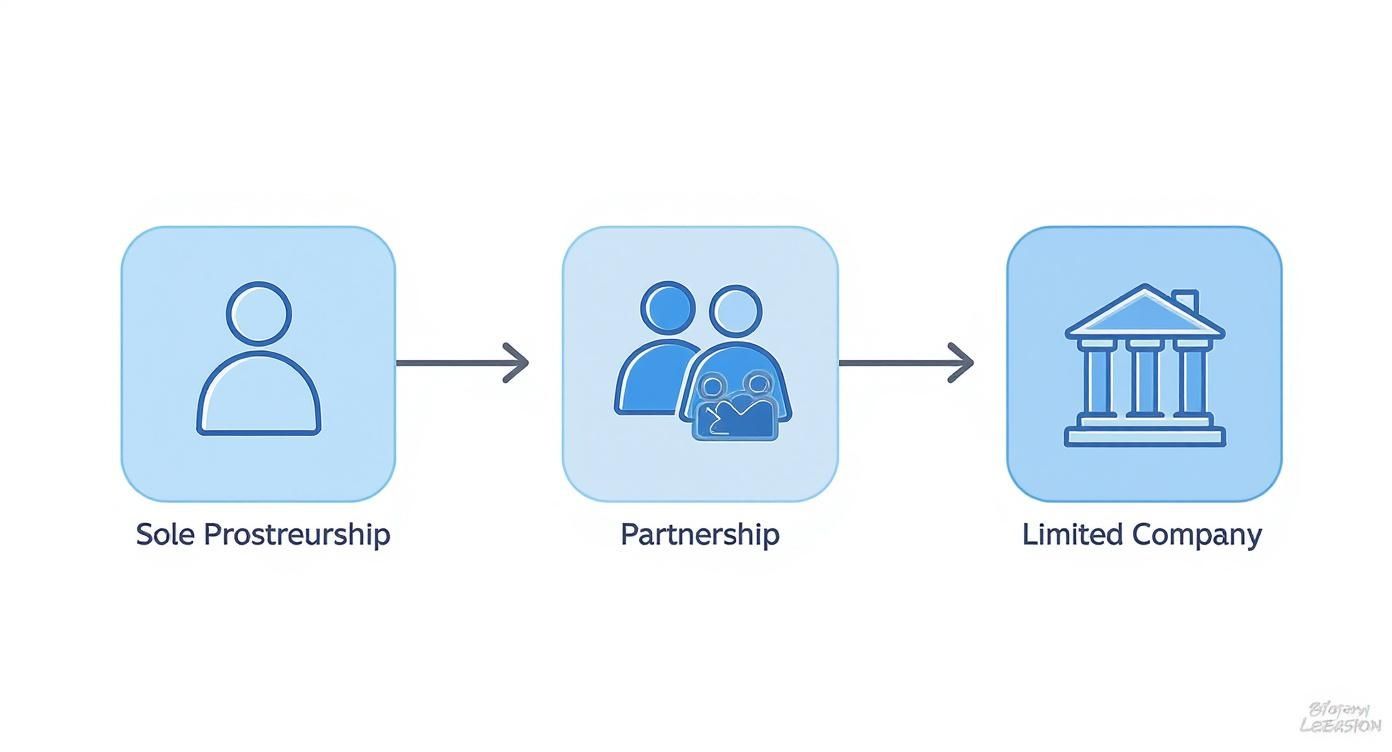
As you can see, a business's legal form often has to evolve as it grows in complexity and ambition. For most scalable ventures, the Limited Company is the end goal.
Preparing Your Foundational Documents
Once you've got a name cleared, it's time to draft the legal building blocks of your company. For a private limited company in Hong Kong, you’re mainly looking at two key documents:
- Incorporation Form (NNC1): Think of this as the master document. It lays out all the essential details: your approved company name, your registered address in Hong Kong, the share capital structure, and the particulars of your founding directors and company secretary.
- Articles of Association: This is your company's internal rulebook. It's a critical document that dictates how the company will be run, covering everything from shareholder rights and director appointments to how official meetings are conducted.
A crucial example of these foundational documents is the Memorandum of Association, which sets out the company's constitution and its core objectives.
Appointing Your Key Personnel
Every Hong Kong limited company legally needs a specific team in place from day one. This isn't a suggestion; it's a hard requirement.
- At least one Director: This must be a real person (you can't appoint another company) but can be of any nationality. Crucially, there's no requirement for the director to be a Hong Kong resident.
- A Company Secretary: This is a non-negotiable role. The Company Secretary must be a Hong Kong resident or a corporate body with a registered office in Hong Kong. Their job is to keep the company compliant with all its administrative and legal duties.
Many foreign entrepreneurs hire a professional corporate services provider to fill the Company Secretary role. It’s a smart move, ensuring you have a local expert on the ground managing your compliance and preventing any accidental slip-ups. Our detailed guide on how to incorporate a Hong Kong company dives deeper into how to best fill these positions.
Filing With the Companies Registry
With your documents drafted and your team appointed, you're ready to make it official. You have two ways to file: the modern, digital route via the e-Registry or the traditional paper-based submission.
The e-Registry is an online portal that’s open 24/7. It's the faster option by a long shot—if all your paperwork is perfect, you can get your incorporation certificate in as little as an hour. If you’re comfortable with online systems, this is the way to go.
Alternatively, you can submit paper filings by physically delivering your documents to the Companies Registry at Queensway Government Offices. It works just fine, but be prepared to wait a bit longer, usually a few working days.
Pro Tip: A tiny mistake on your NNC1 form—a single typo in an address or a wrong digit in an ID number—can get your entire application kicked back. Before you submit anything, check every single field. Then check it again. This one simple habit can save you days of frustrating delays.
The sheer volume of paperwork handled by the Companies Registry gives you a sense of Hong Kong's dynamic business scene. In a recent fiscal year, the Registry's revenue hit HK$701.3 million after processing an incredible 3,250,478 documents. That’s an average of 13,267 documents per day. You can discover more insights in the Registry's annual report if you're curious.
Once your application gets the stamp of approval, the Companies Registry will issue two certificates: the Certificate of Incorporation and the Business Registration Certificate. With these in hand, your company is officially real and legally ready to trade.
Opening Your Hong Kong Corporate Bank Account: The Real Challenge

So, you've successfully registered your company. Congratulations! Now comes what many entrepreneurs find to be the single most challenging hurdle in the entire setup process: opening a corporate bank account.
This isn't just a box-ticking exercise. It's the moment your new company is put under a microscope. The days when you could just walk into a bank and open an account in an afternoon are long gone. Thanks to incredibly strict international anti-money laundering (AML) and know-your-customer (KYC) regulations, banks are more cautious than ever.
They need to see a real, breathing business—not just a paper company.
Why Are the Banks So Tough?
Put yourself in the bank’s shoes for a moment. They're on the front line, acting as gatekeepers to the global financial system. The penalties for getting it wrong and allowing illicit funds to pass through are massive. This means their compliance departments will dig deep into your business model, where your money is coming from, and what you plan to do with it.
They’re all trying to answer one fundamental question: "Is this a legitimate business?"
It’s your job to give them an undeniable "yes". The key to this is demonstrating business substance. You must prove that your Hong Kong company has a genuine reason for being.
This isn't as daunting as it sounds. Proof of substance can be things like:
- A practical, well-thought-out business plan detailing your services, target market, and financial forecasts.
- Tangible supporting documents such as signed client contracts, supplier agreements, invoices, or even a professional company website.
- Clear evidence of the director's experience, like a CV that highlights their expertise in your industry.
Essentially, you need to paint a clear and convincing picture of a credible, active business. An incorporation certificate alone just won't cut it anymore.
Traditional Banks vs. Digital Upstarts
The Hong Kong banking landscape is split into two camps: the old-guard legacy banks and the newer, nimble digital alternatives. Each has its place, and the best fit really depends on your specific needs.
Traditional Banks (HSBC, Standard Chartered, Bank of China)
Going with a big, established name gives you instant credibility and access to a full suite of complex financial services. But be prepared for a marathon, not a sprint. These banks are notorious for their lengthy application processes, endless paperwork, and a rigid requirement for all directors to attend meetings in person.
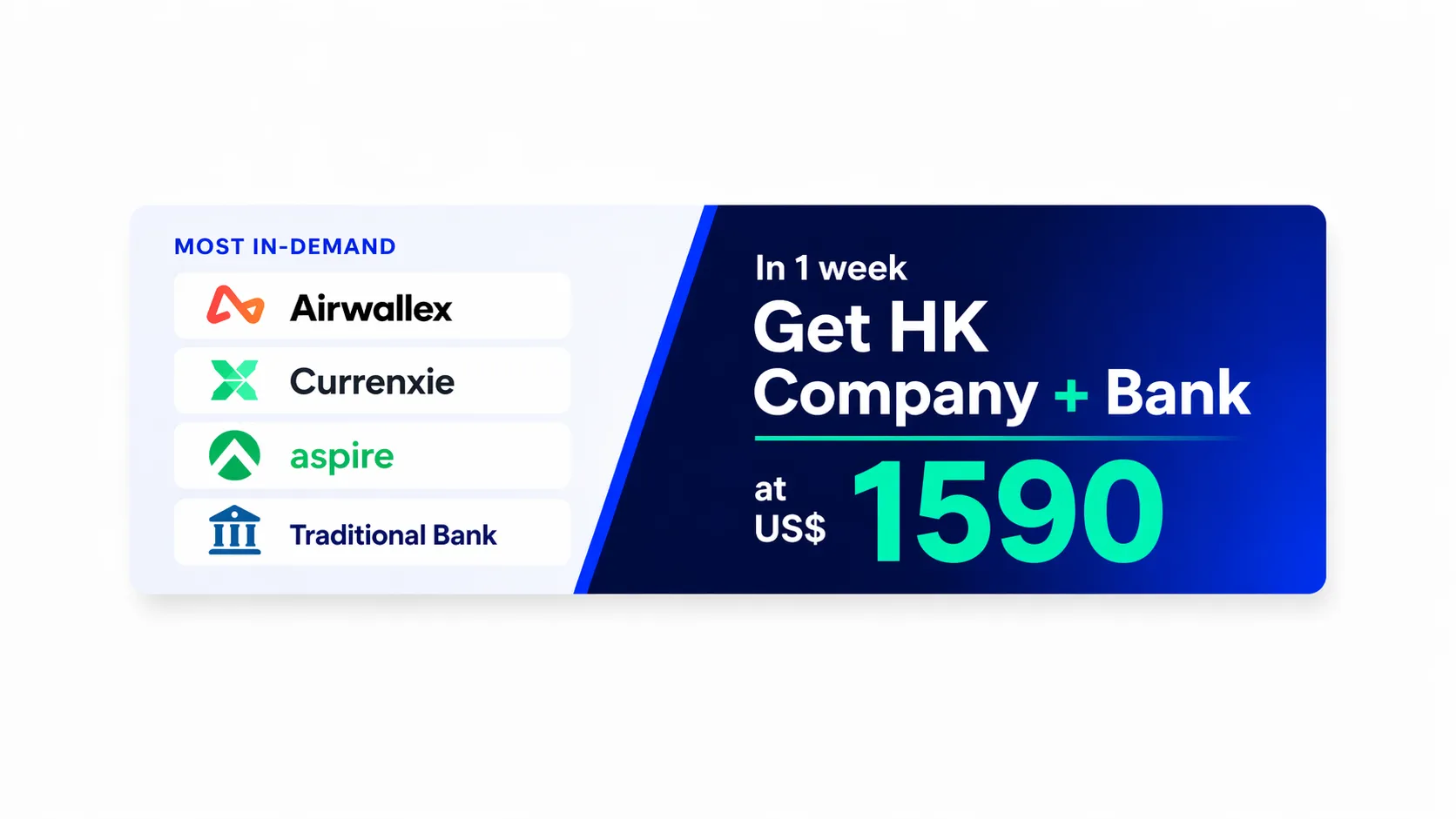
Digital Alternatives (Airwallex, Statrys, Currenxie)
These fintech companies offer a much more modern, streamlined approach. The onboarding is usually faster, can often be handled remotely, and they tend to be more welcoming to online and international businesses. The trade-off? They might not offer the heavy-duty services like trade finance or large-scale business loans that you'd get from a traditional bank.
My Advice: Never underestimate the importance of preparation. Banks are actively looking for red flags and reasons to say no. Your mission is to provide them with such clear, organised, and verifiable proof of your business's legitimacy that saying yes is their only logical choice.
Nailing Your Bank Meeting
Whether you go traditional or digital, how you prepare will make or break your application. Showing up unprepared is the quickest route to rejection, which can set you back by weeks or even months.
Before you even book a meeting, get your house in order. To make sure you haven't missed anything crucial, it's a smart move to follow a comprehensive guide, like this Hong Kong banking checklist that helps SMEs avoid account freezes.
Here's what you absolutely must have ready:
- Your Full Company Kit: This means the original Certificate of Incorporation, Business Registration Certificate, and Articles of Association.
- Proof of Business Substance: This is your knockout punch. Bring every contract, invoice, supplier agreement, and marketing brochure you have.
- Director & Shareholder Details: Organise certified true copies of passports and recent proof of address (e.g., a utility bill) for everyone involved. Be ready to explain who does what.
- A Clear Story: Be able to confidently and concisely explain what your business does, who you sell to, where your funding comes from, and the nature of your expected transactions.
Opening your bank account is the final gateway to making your Hong Kong company fully operational. It demands patience and meticulous preparation. If you can demonstrate real business substance, you can turn this often-frustrating process into a straightforward success.
Staying Compliant After Your Business Is Registered
So, you've done it. Your company is officially a legal entity in Hong Kong. It's a fantastic milestone, but this is the starting line, not the finish. The real work of building a sustainable, successful business begins now, and a huge part of that is staying on the right side of the law.
Think of it like this: you’ve just been handed the keys to a brand-new car. The registration is done, but you still need to handle the ongoing maintenance—the oil changes, tune-ups, and annual inspections—to keep it running smoothly and legally on the road. For your Hong Kong company, that "maintenance" is your annual compliance.
Ignoring these duties simply isn't an option. It leads to hefty fines, potential legal trouble, and a damaged reputation that makes it incredibly difficult to operate. Let's break down the key responsibilities you need to manage to keep your business in good standing.
Your Annual Compliance Checklist
That first year in business often flies by. When you're laser-focused on finding customers and building your product, it's all too easy to let administrative deadlines slip. That's why having a straightforward checklist of your core obligations is so important.
Here are the non-negotiable tasks you'll need to handle every year:
- Renew Your Business Registration Certificate: This is one of the simplest but most critical tasks. Your certificate is typically valid for one or three years. The Inland Revenue Department (IRD) will send you a renewal demand note about a month before it expires. Pay it on time to avoid penalties.
- File an Annual Return: Every year, you must file an Annual Return (Form NAR1) with the Companies Registry. This form confirms that your company's details—like its registered address, directors, and shareholders—are all up to date. You have to get this filed within 42 days of the anniversary of your company's incorporation.
- Hold an Annual General Meeting (AGM): While most small businesses can waive the requirement for a physical AGM, you're still required to prepare the related financial statements and resolutions. It's the formal process for reviewing the company’s performance for the year.
The Annual Audit and Tax Filing Process
Now for the big one. Every single limited company in Hong Kong must have its financial statements audited by a Hong Kong Certified Public Accountant (CPA) each year. There are no shortcuts; this cannot be skipped. The audit is a professional review that verifies your company's financial health and the accuracy of your books.
Once the audit is done, your CPA will prepare an official audit report. This report, along with your financial statements and a completed Profits Tax Return (Form BIR51), must be submitted to the IRD. The tax department typically issues your first Profits Tax Return about 18 months after your incorporation date.
Don’t just view the audit as a chore. See it as an annual health check for your business. A clean audit report gives you, your investors, and your bank confidence that your finances are in excellent order. It really is a hallmark of a well-run company.
The best way to make this process painless is to set up a basic accounting system from day one. You don't need anything complex; even simple cloud-based software can work wonders. Just be disciplined about keeping meticulous records of all your invoices, receipts, and bank statements.
To ensure your business maintains compliance and is always ready for regulatory scrutiny, it’s wise to understand what it takes to prepare for potential audits. Being ready in advance turns what could be a stressful event into a routine procedure.
Staying Organised Is Your Best Defence
Managing compliance isn't about becoming a legal expert; it's about being organised. A simple calendar with reminders for your key filing dates can save you thousands of dollars in late fees. Many entrepreneurs, busy focusing on growth, choose to retain a corporate services firm to handle these administrative burdens.
This ensures deadlines are never missed and that all filings are accurate, leaving you free to focus on what you do best—running your business. This initial investment in professional support often pays for itself many times over by preventing costly mistakes. After all, successfully setting up a business in Hong Kong is only half the battle; keeping it compliant is what guarantees its long-term success.
Your Top Questions About Starting a Business in Hong Kong
Even with the clearest plan, a few questions always pop up just before you make a big move. This is where we’ll tackle those nagging "what ifs" and "how-to's" that often surface when you're about to launch your Hong Kong venture. I've pulled together the most common queries I hear from entrepreneurs just like you, offering straightforward answers to give you that final boost of confidence.
The idea is to clear up any lingering confusion about the finer details of setting up a business in Hong Kong, so you can move forward feeling fully prepared.
Can a Foreigner Really Own 100% of a Hong Kong Company?
Yes, absolutely. This is one of the main reasons Hong Kong is such a magnet for international business. The city's legal framework is built to be open, allowing foreign nationals to be the sole director and hold 100% of the shares in a private limited company.
You won't be forced to find a local partner, and crucially, there are no residency rules for directors or shareholders. This setup makes it incredibly simple for entrepreneurs from anywhere in the world to establish a base here without having to uproot their lives.
That said, there are two local requirements you can't skip:
- You must have a registered office address in Hong Kong.
- You need to appoint a local Company Secretary (this can be an individual who lives here or a licensed corporate body).
What’s the Minimum Capital I Need to Start?
Here’s a detail that often surprises people. Legally speaking, Hong Kong has no official minimum share capital requirement. You could technically incorporate a company with just a single Hong Kong dollar.
But just because you can, doesn't mean you should. In practice, most founders set up their companies with a more practical nominal amount, like HK$10,000. This is usually divided into 10,000 shares valued at HK$1 each.
Choosing a more substantial, though still modest, initial share capital sends a positive signal. It shows banks, partners, and even your first clients that you're serious. It’s a small touch that can subtly boost your company's credibility from day one without being a major financial burden.
Do I Have to Fly to Hong Kong to Register My Company?
No, you don't need to be physically present in Hong Kong to get your company incorporated. The entire registration can be handled remotely by a professional corporate services provider. They’ll take care of all the paperwork and submissions to the Companies Registry for you.
This is a massive advantage for global founders. The one time this rule used to be a sticking point was during the bank account opening stage. Most of the big, traditional banks like HSBC or Standard Chartered still require at least one director to show up for an in-person meeting. Thankfully, a new wave of digital banks and fintech solutions now offer fully remote onboarding, giving you a way around this old hurdle.
What's the Difference Between the Companies Registry and the IRD?
Getting the roles of these two government bodies straight is essential for staying on the right side of the law. Just think of them as two different departments managing separate parts of your company's life.
The Companies Registry (CR) is essentially your company's birthplace. It's the government body in charge of:
- Approving your proposed company name.
- Officially incorporating your business as a legal entity.
- Keeping a public record of your company's details, like who the directors and shareholders are.
The Inland Revenue Department (IRD) is the tax authority. Its involvement begins the moment your company is formed. The IRD handles:
- Issuing your Business Registration Certificate, which is your official license to operate.
- Managing everything tax-related, from collecting Profits Tax to overseeing your obligations as an employer.
Put simply: the CR creates the company, and the IRD makes sure it's registered for tax and stays compliant.
Conclusion
Feeling ready to make your move? At Lion Business Consultancy Limited, we do more than just file paperwork. We specialize in turning this complex process into a seamless launchpad for your global ambitions, building compliant, bankable structures that are designed for real, long-term growth.