
 Hong Kong
 Singapore
 UAE
UAE
 Malaysia
 Turkey
 UK
UK
 EU
EU
 US
US
 Switzerland
 Bahamas Bank Account
 Cayman Islands Bank Account
 Mauritius Bank Account
 BVI
BVI
 Seychelles
Opening a bank account in the European Union for your business in 2025 is less about luck and more about preparation. As a private banking advisor at Lion Business Co., I’ve seen countless entrepreneurs succeed or fail based on one simple thing: the story their documents tell. Your goal is to give the bank a clear, consistent narrative that answers all their compliance questions before they even have to ask.
Think of this as a pre-flight check. With EU regulations tightening every year, banks are more cautious than ever. Our job is to make saying ‘yes’ to your application an absolute no-brainer.
TL;DR: Three Quick Takeaways for Success
- Tell a Cohesive Story: Every single document must support one easy-to-understand narrative. Who are you, what does your business do, and where does the money come from? Any contradiction, however small, creates doubt and delays.
- Think Like a Compliance Officer: They aren’t trying to be difficult; they are ticking boxes to manage risk. A simple business profile, a clear source of funds declaration, and up-to-date proofs show you respect their process and make their job easy.
- Presentation Matters: We’ve seen dozens of clients face rejection just because their invoice format didn’t match the application. A rejection is often a failure in communication, not a problem with your business itself. Simple things, like a professionally translated document, can make all the difference.
A Step-by-Step Process to Open an Account in the EU
Navigating the EU banking maze feels complicated, but it breaks down into a few logical steps. Whether you're an individual or a company, the core principles of verification and transparency remain the same.
- Select the Right Country & Bank: Don't just pick the first bank you find. As we'll discuss, a fintech-friendly bank in Lithuania has a very different risk appetite than a traditional institution in France. Research which jurisdiction aligns with your business model.
- Prepare Your Document Pack: This is the most critical phase. Gather all the required documents (we'll detail these next) and ensure they are up-to-date, certified where necessary, and tell a consistent story. This is where most applications fail.
- Complete the Application Form: Fill out the bank’s forms with meticulous care. Double-check that every name, address, and date perfectly matches your supporting documents.
- Submit and Respond: After submitting your application, be prepared for follow-up questions. A prompt, clear, and well-documented response shows professionalism and helps build trust with the compliance team.
- Final Verification & Onboarding: Some banks may require a final video call or, in rare cases, an in-person visit to sign final documents before your IBAN is issued.
Honestly, with the right preparation, opening an account is very achievable. While we're focused on the EU here, these principles apply almost everywhere. For instance, a similar methodical approach is needed for how to set up a business bank account in the UK.
Your Updated 2025 Document Checklist
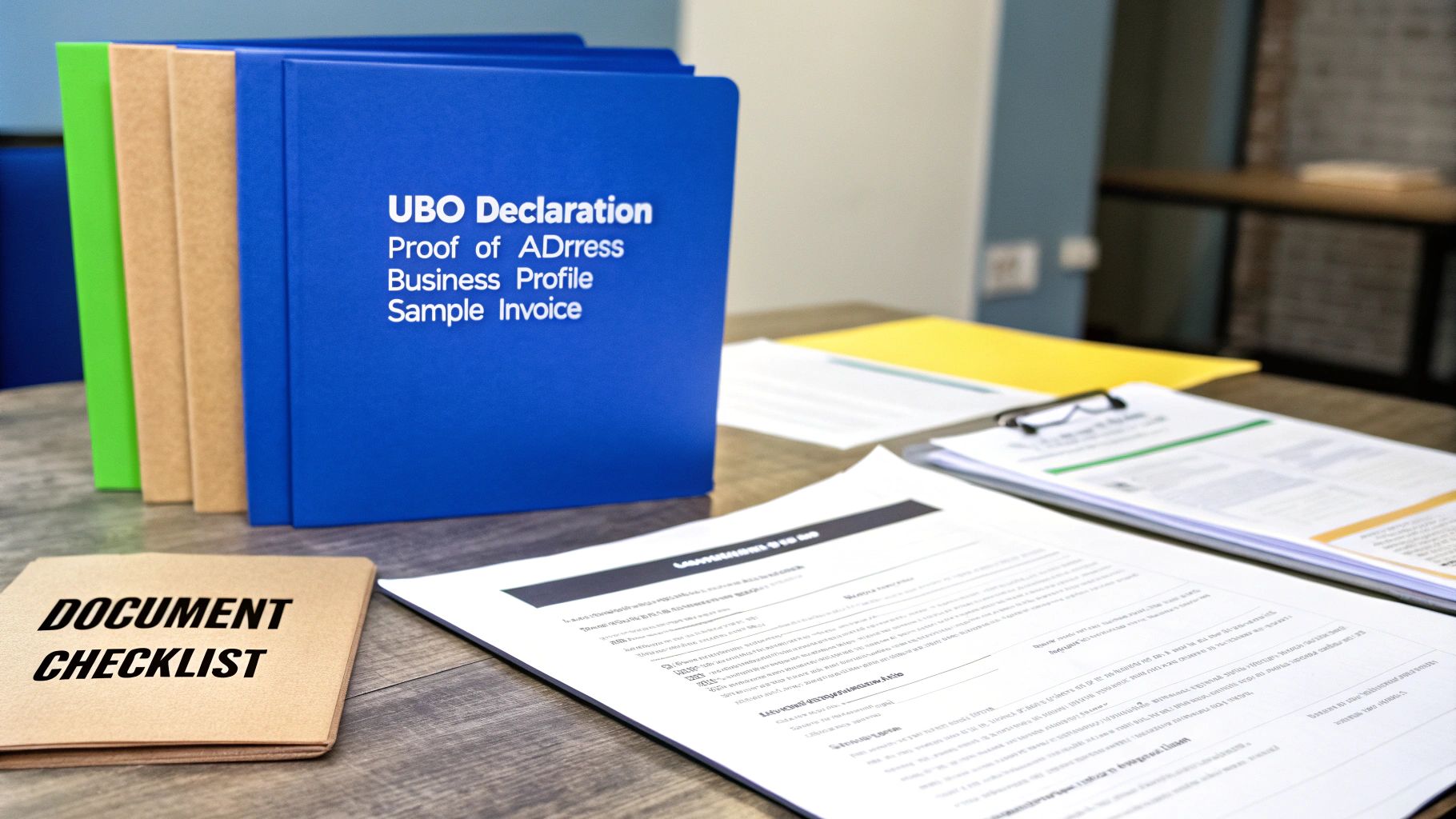
Let’s get your application file in order. Think of this less as a paper-shuffling exercise and more like building a convincing case for your business. When you want to open an account in the EU, these tiny details are everything.
Core Documents for Businesses & Individuals
At its heart, your application needs to answer three simple questions: Who are you? What do you do (or what is the purpose of the account)? And where is the money coming from?
- Ultimate Beneficial Owner (UBO) Declaration (For Companies): This is non-negotiable. Banks are legally required to know who ultimately owns or controls 25% or more of the company. Hiding ownership through complex corporate layers is one of the biggest red flags.
- Certified ID & Proof of Address: You'll need high-resolution, certified copies of passports for all directors, UBOs, or the individual applicant. The proof of address—usually a utility bill or bank statement—must be recent, meaning less than three months old. A six-month-old bill is a surefire way to get delayed.
- Proof of Business (For Companies): Don't just submit your incorporation certificate. Craft a sharp, one-page business profile. Explain what you do, who your target customers are, and the nature of your typical transactions. Support this with real-world examples like recent invoices, supplier agreements, or draft contracts.
- Source of Funds (SoF) & Source of Wealth (SoW) Declaration: This is vital for both individuals and companies. It’s a signed letter explaining where the money comes from. Don’t be vague. Instead of "personal savings," be specific: "personal savings from a 10-year career as a software engineer, supported by tax returns." Transparency here builds immense trust.
For a deeper dive into this, our guide on how to prepare compliance documents for a bank account has detailed templates and real-world examples. Getting this right from the start will save you weeks of frustration.
Common Red Flags That Trigger Rejection or Delay
After handling hundreds of these applications, you start to see the same mistakes pop up time and again. The files that get rejected almost always share a few predictable, easily avoidable errors.
Vague or Inconsistent Information
The fastest way to get your application rejected? A story that doesn’t add up.
A classic example is a wishy-washy business description. Stating your company does "international consulting" tells a compliance officer nothing. It just raises more questions. Another deal-breaker is inconsistency—a director’s name spelled one way on the application and another on their passport, or an old address on a utility bill. These small slips shatter trust.
High-Risk Indicators
Let's be clear: certain business types and company structures will get a much closer look.
- High-Risk Industries: Businesses in crypto, online gambling, or precious metals are automatically flagged. It’s not impossible to get banked, but your documentation must be flawless.
- Overly Complex Ownership: A company owned by another company, which is in turn owned by a trust in a different jurisdiction—this is a compliance nightmare. If your structure is complex, you must include a simple ownership chart and a cover letter explaining the commercial logic.
- Links to Sanctioned Jurisdictions: Any connection, direct or indirect, to a sanctioned country is almost always a non-starter. Banks simply won't take the risk.
Frankly, learning what gets other applications flagged is the smartest way to ensure yours sails right through.
Fixes & Solutions: How to Turn Rejection into Approval
Getting a rejection notice is frustrating, but it's rarely the end of the road. I always tell my clients to think of it as a communication problem. Nine times out of ten, the bank just didn't get the full picture. Our job now is to tell your story better.
A Real Client Story
One of our clients — an Indian technology exporter — applied to open a company account in Lithuania in early 2024. The application was rejected twice due to vague business proof and an outdated utility bill under the director’s old address.
After reviewing the file, our team at Lion Business Co. restructured the documentation pack: updated address verification, issued a director’s declaration letter, and prepared a simplified company profile with transaction references. Within 12 days, the same bank approved the account.
This case shows that account rejections in the EU often come down to how documents are presented, not the business itself.
Pinpointing and Fixing the Weak Links
If the bank said your proof of business was "unclear," we need to build a stronger case. Don't just resend the same documents.
- Show, Don't Just Tell: Provide real-world proof. Think recent client invoices, signed contracts, or a link to a professional company website.
- Write a Simple Company Profile: Put together a one-page document explaining your business model, customer base, and typical transactions.
What if the problem was an unclear source of funds? The solution is a paper trail that’s impossible to misunderstand. A brief declaration letter explaining exactly where the capital came from, backed by a bank statement or an accountant's note, can clear up doubts instantly.
Getting to the bottom of why the bank said no is key. For a more detailed look at common tripwires, you can learn more about why a bank account application might be rejected and how to prepare.
Timelines, Costs, and Practical Preparation Tips
Let's talk brass tacks: how long does this take, and what will it cost? Opening an EU bank account in 2025 isn't a one-day affair, but with good preparation, you can streamline the process. A typical application can take anywhere from a few weeks to several months, depending on the bank’s workload and your company's complexity.
The quoted opening fee is just the start. You should also budget for:
- Document Notarisation & Apostilles: Essential for proving your corporate documents are legitimate.
- Professional Translations: Required if your documents aren't in English or the bank's local language.
- Advisory Fees: An expert pre-check can be the difference between a swift approval and a costly rejection.
For anyone looking at a more complex international setup, it’s worth exploring the broader financial landscape. This guide to offshore company costs and benefits gives a solid overview of what to expect.
Country Highlights: Lithuania vs. Cyprus vs. France
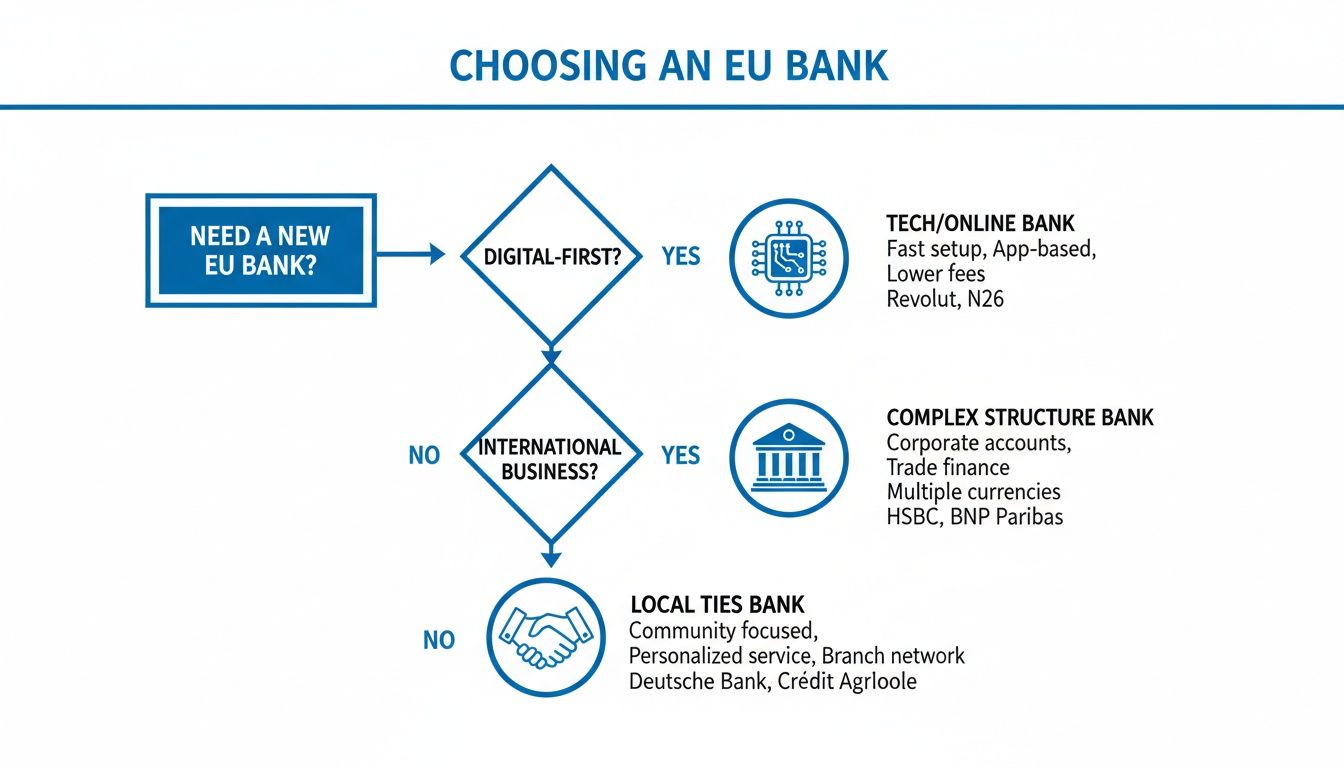
Figuring out where to open an account in the EU is about finding the right banking culture for your business. Let's compare three very different jurisdictions.
Lithuania: The Fintech Powerhouse
Ideal for tech, e-commerce, and digital-first businesses. Lithuanian banks and EMIs offer slick, efficient digital onboarding. However, they are exceptionally thorough on compliance, especially regarding source of funds for non-EU applicants.
Cyprus: The International Business Hub
Cyprus has a long history as a hub for international business. Banks here are more accustomed to complex corporate structures and global trade. The process is often more relationship-driven, but due diligence can be deeper and more prolonged.
France: The Traditional Powerhouse
France represents the classic Western European banking system: stable and robust, but also more challenging for non-residents. French banks almost always want to see a clear, tangible link to France (local clients, suppliers, or an office).
EU Banking Onboarding Comparison 2025
| Country | Onboarding Approach & Speed | Key Strengths | Common Hurdle |
|---|---|---|---|
| Lithuania | Fast & Digital. Heavily online. | Excellent for fintech and e-commerce. | Intense scrutiny on source of funds and business model clarity. |
| Cyprus | Moderate & Relationship-Based. | Accustomed to complex international corporate structures. | Requires patience and a well-established business history. |
| France | Slow & Bureaucratic. | High stability and deep integration with the core EU system. | Proving "local substance" or a tangible link to France. |
Your company's country of incorporation and director nationalities heavily influence a bank's risk assessment. Understanding how country risk tiers impact compliance will give you a better idea of the questions you'll face.
Here are some straight answers to the most common queries we get at Lion Business Co.
Can I open an EU bank account completely remotely?
Yes, you often can, especially in fintech-forward countries like Lithuania. However, many traditional banks in places like France or Cyprus may still require an in-person meeting, particularly for non-resident applicants.
Which EU country is best for a non-resident?
It depends entirely on your business. For tech and e-commerce, Lithuania is often a great choice. For complex international trade, Cyprus has deep expertise. For businesses with a strong local presence, a bank in that specific country (like France) makes the most sense.
Can I get an account if my business is in crypto?
It’s tough, but not impossible. Mainstream EU banks are generally crypto-averse. Your best bet is to look at specialised Electronic Money Institutions (EMIs), particularly in Lithuania. Be prepared for intense scrutiny and have rock-solid compliance policies in place.
How much do I need for an initial deposit?
This is a common worry, but it’s often less of a hurdle than you think. Most banks don’t have a rigid, sky-high minimum. They are more interested in a convincing business plan. An initial deposit of €1,000 to €5,000 is usually fine, as long as your application is solid.
Conclusion
Feeling overwhelmed by the paperwork and red tape? The team at Lion Business Co. specialises in pre-checking applications to ensure they meet the bank’s expectations before you even submit. A little expert guidance can prevent months of delays.