

 Hong Kong
 Singapore
 UAE
UAE
 Malaysia
 Turkey
 UK
UK
 EU
EU
 US
US
 Switzerland
 Bahamas Bank Account
 Cayman Islands Bank Account
 Mauritius Bank Account
 BVI
BVI
 Seychelles

Picture this: you've finally incorporated your new venture, your business plan is solid, and you're ready to start transacting. The last hurdle? Opening a business bank account. You figure it's just a matter of filling out some forms. But soon, you're buried under a mountain of document requests, jargon-filled emails, and a process that feels more like an interrogation than an application.
If that sounds familiar, you're not alone. Preparing compliance documents for a bank account today isn’t just about collecting paperwork. It's about telling a compelling, verifiable story about your business—its legal standing, its operational legitimacy, and its financial transparency. You need more than just corporate filings; you need to build a clear narrative backed by hard evidence like contracts, financial projections, and unambiguous details on who ultimately owns and controls the company.
Navigating the New Era of Hong Kong Bank Compliance
Let's be blunt: opening a business bank account in Hong Kong has changed. The days of simple checklists and quick approvals are a distant memory. Today, banks operate within a strict, risk-based framework, which means they need to understand your business almost as well as you do.
Think of the process less like a simple application and more like a detailed partnership proposal. The bank needs to be convinced that you're a credible, low-risk partner. Your job is to tell that compelling and verifiable story. Who are you? What exactly does your business do? Where does your funding come from, and where will the money go? These are the fundamental questions your compliance documents must answer clearly and consistently.
Understanding Today's Compliance Demands
For many entrepreneurs, this level of scrutiny can feel overwhelming. But here's the good news: with the right preparation, it's completely manageable. The key is to be organised, proactive, and transparent from the get-go.
Fortunately, technology has smoothed out some of the rough edges. Hong Kong banks have heavily invested in advanced regulatory technology (Regtech) to manage their compliance obligations. In fact, a staggering 97% of retail banks in Hong Kong now use Regtech for everything from remote account opening to enhanced due diligence. They're leveraging AI for sophisticated tasks like deepfake detection and automated transaction monitoring, a trend highlighted in the Hong Kong Monetary Authority’s 2025 Tech Maturity Stock-take.
What does this mean for you? It means your documentation has to be flawless. Every single piece of paper, from your incorporation certificate to your business plan, must align and tell the same story. Any small inconsistency—a mismatched address, an unclear source of funds—is a red flag that can cause major delays or even get your application rejected.
A Consultant's Insight: The biggest mistake I see founders make is treating the application like a box-ticking exercise. Banks aren't just collecting documents; they're actively assessing risk. Your true goal is to build a "trust portfolio" that proves your business is legitimate, viable, and transparent right from the start.
To help you put together a powerful application, let’s break down the main compliance pillars that Hong Kong banks are laser-focused on.
Core Compliance Areas for HK Bank Accounts
This table gives a quick summary of the fundamental compliance categories your business documentation must satisfy. Getting these right is non-negotiable.
| Compliance Pillar | What It Means for You | Primary Documents Needed |
|---|---|---|
| Corporate Identity & Legal Status | Proving your company is a legally registered entity in good standing. | Certificate of Incorporation, Business Registration Certificate, Articles of Association. |
| Beneficial Ownership (UBO) | Identifying all individuals who ultimately own or control the company. | Shareholder register, UBO declaration forms, passports and proof of address for all UBOs. |
| Business Legitimacy & Purpose | Demonstrating you have a real, operating business with a clear purpose. | Detailed business plan, supplier contracts, client invoices, marketing materials. |
| Source of Funds & Wealth (SOF/SOW) | Verifying where the initial capital and ongoing revenue come from. | Founder's bank statements, loan agreements, investor contracts, financial projections. |
Understanding how your documents fit into these categories will help you anticipate what the bank is looking for and prepare a much stronger case.
The first, and most critical, step is getting organised. Start by building a master checklist of every single document the bank might ask for. Having everything ready to go beforehand can dramatically speed up the process. You can use our detailed bank onboarding checklist for 2025 to make sure you haven't missed a single thing.
Getting Your Corporate Documents in Order
Think of your company's paperwork as its official biography. Before any bank in Hong Kong will do business with you, they need to read this story and see a clear, consistent, and complete picture of your company's legal identity. This isn't just about checking boxes; it’s about proving your business is legitimate. Nail this part, and you'll sidestep a world of headaches and delays.
At the heart of your application are three documents that are absolutely non-negotiable. Without these, you’re a non-starter.
- Certificate of Incorporation (CI): This is your company's birth certificate. It's the official proof from the Hong Kong Companies Registry that your business legally exists.
- Business Registration Certificate (BRC): Issued by the Inland Revenue Department, this certificate shows you're registered for tax purposes and includes your unique business registration number. We have a great guide explaining the role of the Hong Kong business registration number if you want to dig deeper.
- Articles of Association (A&A): This is the rulebook for your company. It lays out the internal governance, detailing the powers of directors, the rights of shareholders, and how everything is managed.
These three documents are the foundation, but the bank's due diligence goes much further. They need to know who is really running the show.
Putting a Face to the Company
Banks today are laser-focused on identifying every single person with significant control. This means every director, major shareholder (usually anyone holding 25% or more), and most importantly, the Ultimate Beneficial Owners (UBOs). A UBO is the actual person who benefits from or controls the company, even if they're not listed as a direct shareholder. It's a critical piece of the puzzle for anti-money laundering compliance.
For each of these key individuals, you’ll need to have two things ready:
- A Certified True Copy of their Passport: A simple photocopy won't cut it. You need a qualified professional, like a lawyer or certified public accountant, to formally certify that the copy is an exact duplicate of the original document.
- Proof of Residential Address: This is usually a recent utility bill or a bank statement from the last three months. The name and address on this proof must match exactly what's on the application forms. No exceptions.
This diagram shows how all your prepared documents feed into the bank's assessment process.
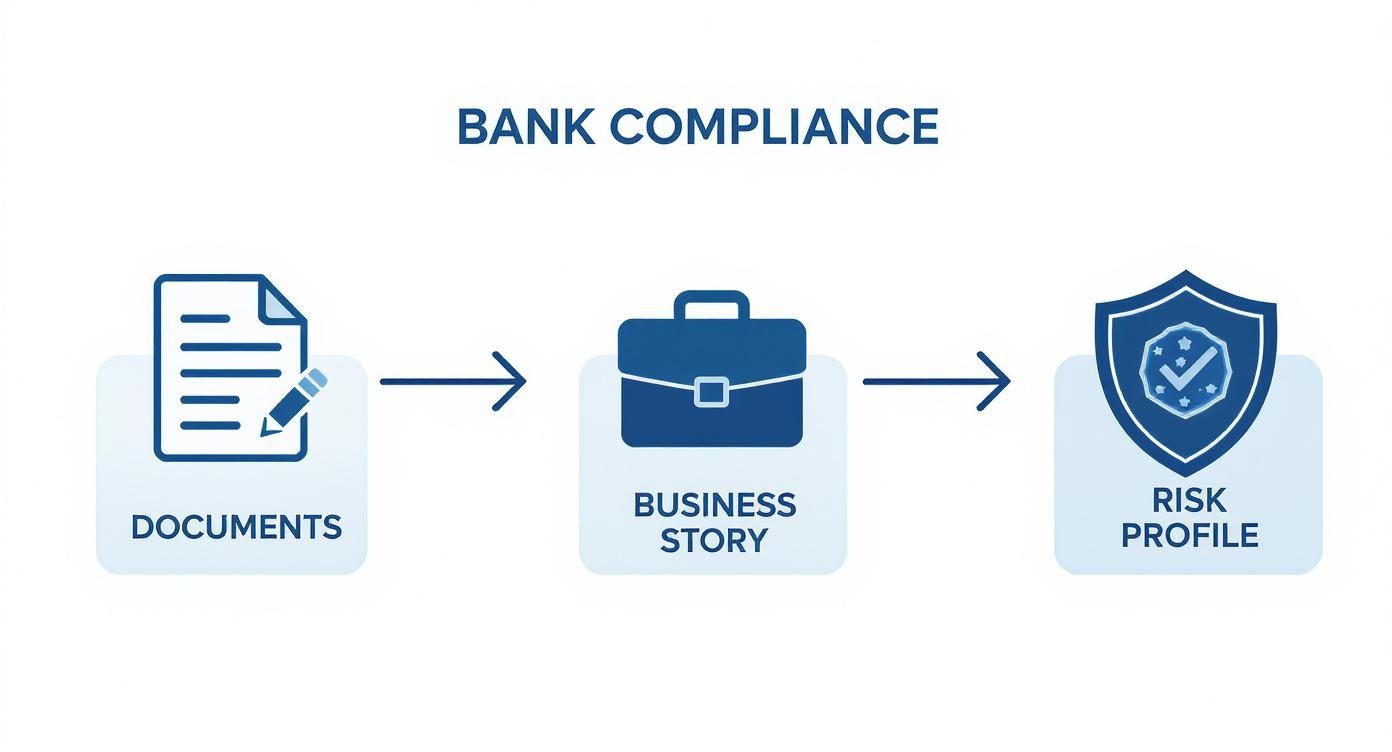
As you can see, gathering these documents is the first critical step that allows the bank to build your business story and understand your risk profile.
Where Things Often Go Wrong: A Real-World Example
I've seen this happen countless times. Imagine a tech startup founded by two partners—one in Hong Kong, the other in the UK. They get all their corporate papers together but trip up on the personal ID details. The UK partner submits a passport that expires in two months and a recent utility bill. Simple enough, right?
But the bill lists their address as "Flat 5, 10 Main St," while on the bank application, they wrote "5, 10 Main Street."
That tiny difference is an instant red flag for a sharp-eyed compliance officer. The nearly expired passport just adds to the problem. These seemingly minor slip-ups grind the entire process to a halt. The bank now has to circle back, request new, correctly certified documents, and your account opening is suddenly pushed back by weeks.
My Pro Tip: Create a simple "master details" sheet before you even start. List the full, official name and residential address for every director and UBO. Then, check every single document—passports, bills, application forms—against this master sheet to ensure 100% consistency. It’s a five-minute task that can save you a month of hassle.
Once you have your document portfolio perfectly assembled, you’ll need to get it to the bank. While many processes are digital now, some banks still require physical submissions or even faxes for certain forms. If you find yourself in that situation, knowing how to fax documents securely without a machine can be a lifesaver, ensuring your sensitive data gets there safely and in the right format.
Demonstrating Your Business Legitimacy and Viability
Your incorporation papers prove your business exists on paper, but banks in Hong Kong need to see that it's more than just a legal shell. They’re looking for tangible, real-world evidence that you’re running a legitimate, operational company.
Think of it this way: your incorporation documents are the theory, but your operational documents are the proof. This is where you show your business is a living, breathing entity. Your "Proof of Business" package is your chance to tell a compelling story about your commercial activities. You’re not just submitting paperwork; you're making a case that your business is active, viable, and a good partner for the bank.
Building Your Proof of Business Package
If your business is already up and running, pulling this information together is fairly straightforward. Your goal is to gather documents that paint a clear picture of your day-to-day operations and business relationships, demonstrating a consistent commercial cycle.
A strong package for an active SME should include things like:
- Signed client contracts or purchase orders: These are gold. They show that other businesses have vetted you and are willing to pay for what you offer.
- Recent customer invoices: A steady stream of invoices, ideally matched with payments, proves you have ongoing revenue.
- Supplier or vendor agreements: This shows the bank you have the infrastructure and supply chain in place to deliver on your promises.
- Marketing and sales assets: Your company website, product brochures, or even a solid company presentation can bring your business model to life.
My advice? Don’t just dump a pile of papers on the bank's desk. Organise everything logically. For instance, present a signed contract, the invoice you sent for that work, and the proof of payment all together. This creates a clean, undeniable record of a completed business transaction.
What If You're a New Business?
But what happens if your company is brand new? You won't have a history of invoices or a long list of client contracts. This is a common hurdle for startups, and it’s where the story you tell becomes absolutely critical. You have to sell the bank on your future potential.
Instead of historical proof, you’ll be providing forward-looking evidence. Your objective is to build a credible picture of future success, grounded in a solid strategy and the expertise of your team.
Here's how you can demonstrate viability without a trading history:
- A Detailed Business Plan: This is your most important tool. It needs to clearly outline your business model, target market, marketing strategy, and how you plan to operate.
- Realistic Financial Projections: You'll need a forecast for at least the first 12-24 months. This should include projected revenues, key expenses, and cash flow analysis to show you’ve thought through your financial sustainability.
- Founder and Key Personnel Profiles: Lean on the professional credibility of your team. Include links to detailed LinkedIn profiles or short bios that highlight relevant industry experience and past successes.
A Consultant’s Insight: For a new business, the bank is betting on the founders as much as the business idea. A strong, well-presented team with relevant experience can significantly outweigh the lack of a trading history. Make sure your team's expertise shines through in your application.
A Case Study in Action: An E-commerce Startup
Let’s walk through a real-world scenario. A new e-commerce SME in Hong Kong, specialising in artisanal coffee beans from South America, needs to open an account. The major hurdle? They have zero sales history.
Instead of hitting a wall, they built a compelling "Proof of Business" package focused on their operational readiness and future potential.
Here’s what they prepared:
- Supplier Contracts: They provided signed agreements with two coffee bean plantations in Colombia. This proved they had a secure supply chain locked in and were ready to go.
- Shopify Store Analytics: They included screenshots of their fully developed Shopify website, showing product listings and a functioning checkout process. This demonstrated they were operationally ready to start selling.
- Marketing Plan and Ad Budget: A simple one-pager outlined their launch strategy on social media, complete with a projected ad spend for the first three months.
- Founder's LinkedIn Profile: The founder’s profile was key. It highlighted 10+ years of experience in logistics and supply chain management for a major F&B company, which added immense credibility.
This package told a powerful story. It showed the bank that even without a single sale, this wasn't just an idea—it was a real business on the cusp of launching, backed by a credible founder and solid planning. They got their account approved in under four weeks. This proactive approach is exactly what's needed when you prepare compliance documents for a bank account.
Telling Your Financial Story
When you get to the financial part of the application, get ready for some serious scrutiny. This is where banks really focus their attention. More than anything, they need to understand exactly where your money is coming from to manage their own risk.
You'll quickly run into two terms: Source of Funds (SOF) and Source of Wealth (SOW). They sound alike, but they're distinct pieces of your financial history. Getting them right is a huge part of preparing your compliance documents.
Unpacking Source of Funds (SOF)
Think of your Source of Funds as the "how." It's the direct origin of the money you're putting into the new company bank account to get things started. The bank needs to see a clear paper trail showing how this specific capital moved from point A to point B (your business).
Your SOF documents need to be direct and leave no room for questions. Here’s what this usually looks like:
- Shareholder Loan Agreements: If you or another shareholder is lending money to the company, don't just transfer it. You need a formal, signed loan agreement outlining the amount, terms, and repayment plan.
- Personal Bank Statements: Using your own savings? Perfect. Just provide statements covering the last 6-12 months that show how those funds built up over time. A large, out-of-the-blue deposit just before you transfer the capital is a major red flag.
- Investment Portfolio Statements: If you sold some stocks or other investments to raise the capital, you'll need the transaction confirmations and portfolio statements that prove the sale and the resulting cash withdrawal.
The idea is to give the bank a clean, step-by-step map of the specific funds you’re using.
Defining Source of Wealth (SOW)
While SOF is about the immediate transaction, Source of Wealth is the bigger picture. It answers the "why." Why do you have this capital to begin with? It’s the story of how you accumulated your net worth over your lifetime.
This is a much deeper dive. The bank is doing its due diligence to make sure your wealth is legitimate and has no ties to illicit activities. With financial crime risks constantly on the rise, banks are becoming more thorough than ever. A recent survey showed that 70% of Hong Kong financial sector executives expect these risks to increase, which means you can expect even stricter documentation requirements.
To prove your SOW, you'll need to dig into your financial past.
Some of the most common documents for establishing your Source of Wealth include:
- Salary Slips and Employment Contracts: If you built your wealth through a long, successful career, historical pay slips and your most recent employment contract are great evidence of your income.
- Property Sale Contracts: Sold a flat? The signed contract of sale, paired with a bank statement showing the deposit, creates an undeniable trail.
- Inheritance Documents: If the funds came from an inheritance, you’ll need the relevant legal papers, like a will or a formal letter from the estate’s solicitor.
- Business Sale Agreement: The ultimate SOW document for any entrepreneur is the sale agreement from a previous business you owned and sold.
Using a professional financial statements template can also help organise your information, presenting it clearly and professionally to the bank.
A Consultant's Insight: I've seen countless applications, and the ones that sail through are always the simplest. Don't overcomplicate things. A linear story—"I worked for 15 years, saved my bonuses, and I'm using those savings to fund my new venture"—backed by clean, matching documents is far more powerful than a convoluted explanation.
Putting It All Together: A Real-World Example
Let's imagine a marketing consultant who, after a decade at a top agency, decides to set up her own firm in Hong Kong. She plans to inject HKD 500,000 of her personal savings as the initial capital.
Without meticulous preparation, her application could have been stuck in compliance for weeks. Here’s how she built a bulletproof financial narrative:
- For her Source of Funds (SOF): She submitted her personal bank statements from the last 12 months. They clearly showed her monthly salary coming in and a consistent pattern of saving. The balance grew steadily to over HKD 500,000 with no sudden, unexplained deposits.
- For her Source of Wealth (SOW): She took it a step further. She included her final three annual bonus statements from her old job and a confirmation letter from their HR department detailing her 10-year tenure and final salary.
This two-part approach created a financial story that was impossible to question. The SOW documents proved how she earned the money over a decade, and the SOF documents showed the clean accumulation of those earnings in her personal account, ready for the business. The bank's compliance team had a clear, logical, and fully verifiable narrative. Her account was approved without a single follow-up question.
Navigating AML and CFT Requirements
Beyond your company’s structure and financials, we get to what banks care about most: Anti-Money Laundering (AML) and Counter-Terrorist Financing (CFT). These aren't just acronyms; they are the very foundation of modern banking compliance. For you, this means the bank needs to understand not just what your business is, but what it does every single day.
Think of it this way: the bank is legally required to know its customers. They need a crystal-clear picture of your typical transactions, who your clients and suppliers are, and where in the world you do business. Getting your compliance documents ready means painting that picture for them proactively, leaving no room for questions or suspicion.
Understanding Your Business Risk Profile
Every business has a risk profile. It’s unavoidable. A local bakery selling pineapple buns in Central has a vastly different profile than a company importing electronics from multiple continents. The goal isn't to pretend you have zero risk; it's to show the bank you understand your specific risks and have solid systems to manage them.
Banks will look at a few key things to figure out your risk level:
- Your Industry: Some sectors are naturally under more scrutiny. Think international trade, precious metals, or fintech.
- Geographic Footprint: Are you regularly dealing with clients or suppliers in countries known for high corruption or weak AML rules?
- Transaction Style: Are your payments typically large, frequent, and cross-border? Or are they small and domestic?
- Customer Base: Is your business built on a handful of well-known corporate clients, or do you serve a large, anonymous online audience?
Knowing where your business fits is the first step. If you're in a sector that might raise a red flag, don't panic. It just means you’ll need to provide more detailed documentation to give the bank comfort. You can learn more about what this entails in our guide on Enhanced Due diligence (EDD) requirements for high-risk businesses.
Showing How You Manage Your Risk
Once you’ve got a handle on your risk profile, you need to show the bank how you control it. This is where you prove you’re a responsible and forward-thinking business owner. In Hong Kong, the stakes couldn't be higher. Financial institutions face penalties up to HKD 10 million for compliance failures under the AML/CFT Ordinance. Naturally, they expect their clients to be just as serious. You can get a sense of these strict rules by looking at the Insurance Authority’s latest guidelines.
A Quick Story on Being Upfront: I once worked with a trading company sourcing components from Southeast Asia for clients in Europe. On paper, their business model screamed "high risk." A standard, bare-bones application would have been rejected almost immediately.
But they didn't hide from it. They tackled the issue head-on. Their application included a dedicated AML compliance section that spelled out:
- Supplier Vetting: They had a checklist for every new supplier, showing how they verified business registrations and checked them against international watchlists.
- Customer Onboarding: For each new European client, they documented their "know-your-customer" (KYC) process, which involved confirming the company’s identity and its ultimate owners.
- The Flow of Money: They clearly explained their payment logic—funds came from established EU corporate accounts and went to verified supplier accounts in specific countries. No exceptions.
By providing this framework, they completely changed the narrative. They weren't just a "trading company" anymore; they were a trading company with a transparent, documented, and responsible compliance system. This proactive approach wasn't just helpful—it was the single reason their account was approved so quickly. They didn't just submit documents; they submitted a powerful argument for their own integrity.
Answering Your Top Questions on Bank Compliance Documents
Even with the best preparation in the world, you're bound to have a few nagging questions when you're pulling together compliance documents. Getting inside the bank's head on these common sticking points can make the difference between a smooth approval and a frustrating delay.
Let's tackle the questions we hear most often from entrepreneurs knee-deep in this process.
How Long Does This Whole Bank Account Thing Actually Take?
This is the big one, isn't it? The honest answer is, it varies. If you hand over a perfectly organised, complete set of documents, you're likely looking at a timeline of two to six weeks.
But here's the catch: if the bank has to come back to you for clarifications or finds anything that doesn't quite add up, that timeline can easily stretch into several months. Every single request for more information adds weeks, not days, to the process. The fastest path to an open account is getting everything right the first time. A clean, transparent submission shows them you're a serious client, and that's exactly what they want to see.
I Run An Online Business. Do I Need Anything Extra?
Absolutely. For businesses that operate online, especially with customers all over the world, banks take a much closer look at how you prove you're a legitimate operation. Your digital presence is your physical storefront, so you need to document it meticulously.
On top of the standard company paperwork, you'll need to pull together:
- Proof of Your Digital Operations: Think screenshots. Show them your live website, what the customer sign-up process looks like, and how your payment gateway is integrated.
- Your Legal Housekeeping: Have your Terms of Service and Privacy Policy ready to go. These aren't just legal fluff; they show the bank you’ve built a proper framework for your business.
- How You Verify Customers: You need to map out your Know Your Customer (KYC) process in detail. How do you confirm who your customers are when you never meet them? Explain how you manage the risks that come with international transactions.
This package of information proves you’re running a secure, well-managed online company, not just a slick website.
What's The Single Biggest Reason Applications Get Rejected?
Hands down, the number one reason we see applications get rejected in Hong Kong is an incomplete or inconsistent business story. This almost always comes down to two things: a poorly explained Source of Funds or a business model that just doesn’t match the transactions you're planning.
For example, you can't say you're a local consulting firm and then have a business plan showing large, frequent payments going to high-risk countries. A bank's compliance software is designed to catch exactly these kinds of contradictions, and it will raise a massive red flag.
The other major pitfall is any murkiness around the Ultimate Beneficial Owners (UBOs). If your ownership structure isn't crystal clear and transparent, you're setting yourself up for a quick "no." Your story, from where the money comes from to who ultimately owns the company, has to be clear, consistent, and easy for them to verify.
Navigating the world of global banking and compliance can feel like a full-time job. At Lion Business Consultancy Limited, our expertise is in building secure, compliant financial foundations that not only protect your business but also set it up for international success. Think of us as your private financial manager, making sure every single detail of your banking is handled perfectly.
Secure your global banking and compliance strategy with a private consultation today.