

 Hong Kong
 Singapore


 UAE
UAE



 Malaysia

 Turkey



 UK
UK
 EU
EU
 US
US
 Switzerland
 Bahamas Bank Account
 Cayman Islands Bank Account
 Mauritius Bank Account

 BVI
BVI
 Seychelles

Think of corporate secretarial services as the silent partner you never knew you needed—the one handling all the critical legal and administrative tasks that keep your business running smoothly and legally in any new territory. This isn't just about shuffling papers; it's a vital function that ensures your company stays compliant, bankable, and perfectly positioned for growth. It’s your first line of defence against hefty fines and legal headaches.
Your Silent Partner in Global Expansion

Let's paint a picture. Your e-commerce business is finally hitting its stride, and you've set your sights on expanding into the vibrant market of Hong Kong. The initial buzz is incredible. But before you know it, you're buried under a mountain of unfamiliar jargon: Annual Returns, Significant Controllers Registers, and a calendar full of strict filing deadlines you weren't even aware of.
This isn't just a worst-case scenario; it's the reality for many entrepreneurs who jump into new markets without a seasoned local guide. The initial excitement of expansion can quickly get bogged down by the sheer weight of statutory compliance. You end up spending more time trying to understand legal forms than you do winning over new customers.
From Chaos to Compliance
This is exactly where professional corporate secretarial services come in to turn that chaos into a well-oiled, compliant machine. Don’t think of a corporate secretary as just another expense. See them as your strategic co-pilot for navigating international business. They're the local specialists who grab the controls of the complex regulatory engine, making sure every 'i' is dotted and every 't' is crossed on time, every time.
For our hypothetical e-commerce founder, bringing a corporate secretary on board changed everything:
- Suddenly, there were no more missed deadlines or threatening letters from the Companies Registry.
- The company's statutory books were impeccably maintained, making it an attractive prospect for potential investors.
- They finally had peace of mind, knowing all corporate governance was being handled by an expert.
This simple change allowed the founder to get back to focusing on what they do best—scaling their business. The administrative nightmare was gone, replaced by a solid foundation for future success.
A great corporate secretary does far more than just file paperwork. They actively protect your assets, make sure your business stays in good standing with financial institutions, and build a compliant framework that can support your biggest ambitions.
More Than Just a Legal Necessity
In many places, including Hong Kong, having a company secretary isn't optional—it's the law. But their real value goes way beyond just satisfying a legal requirement. They act as your financial bodyguard, ensuring your company structure is robust and your operations remain bankable. A clean compliance record is non-negotiable for everything from opening a business bank account to securing that next round of funding. Establishing a physical presence can also be a key component, and you can learn more about the benefits of a virtual office in Hong Kong as part of a comprehensive strategy.
Successfully expanding abroad also means thinking about the bigger picture, which can include strategic approaches to Business and Investment Migration. By taking care of these foundational pieces, corporate secretarial services ensure your business isn't just surviving—it's ready for its next big move.
What Does a Corporate Secretary Actually Do?
It’s a common misconception to see the corporate secretary as just another administrator. That’s a bit like saying a ship’s navigator just looks at maps. In reality, they are the ones steering your company through a complex maze of legal and administrative requirements, making sure you stay on course and out of trouble.
Think of their work as the invisible scaffolding that supports your entire business. Without it, even the most brilliant business idea can get bogged down by fines, legal headaches, or worse, be forced to a complete standstill. Let's break down exactly what they handle.
They Are Your Company's Official Record-Keeper
At the very core of the job is the meticulous maintenance of your company’s statutory books and registers. These aren’t just dusty files in a cabinet; they are the legal DNA of your business. They provide the definitive, legally-binding proof of who owns the company, who is in charge, and every major decision made along the way.
This isn't just about good organisation—it's a strict legal demand. These records must be perfect and include:
- The Register of Members, listing every single shareholder.
- The Register of Directors, detailing the history of the company's leadership.
- Minutes of all meetings, capturing the official record of board and shareholder decisions.
Why is this so critical? Imagine you're about to close a major investment round. The first thing any serious investor or bank will do is pore over these records. Any mistake or outdated entry can instantly raise red flags and derail the entire deal.
They Manage the Never-Ending Stream of Filings
One of the most relentless tasks is managing all the required statutory filings with government registries, such as the Hong Kong Companies Registry. Every jurisdiction has its own unique calendar of non-negotiable deadlines, and missing one can trigger immediate penalties that often increase over time.
Your corporate secretary is your human compliance calendar, ensuring everything from your Annual Return to event-driven updates gets filed accurately and on schedule. Did you appoint a new director? Change your registered office? Alter your share capital? Each of these events triggers a specific filing requirement, and any error can lead to a rejection and painful delays.
A great corporate secretary isn't just reactive; they're proactive. They build a forward-looking compliance plan to keep you well ahead of deadlines, saving you from the stress and expense of last-minute fire drills.
They Formalise Your Key Business Decisions
Every important decision your company makes—from taking out a major loan to issuing new shares—needs to be properly documented through board resolutions and formal meeting minutes. This is the bedrock of good corporate governance.
The corporate secretary drafts these vital documents, ensuring they perfectly capture the board's intentions and comply with the company's own internal rules (its articles of association). For instance, if you want to secure a business loan, the bank will demand a board resolution that formally authorises it. Without that piece of paper, professionally drafted and signed, the deal is dead on arrival. This formal process is what protects the company and its directors from future legal challenges.
These services are indispensable in bustling business hubs. In 2023 alone, industry data showed that over 62,000 new businesses across the Asia-Pacific region were set up with secretarial support. Zooming in, roughly 70% of new Hong Kong companies now depend on a professional provider for their statutory compliance. You can learn more about how company secretaries support thousands of SMEs in Hong Kong's dynamic business environment.
Navigating Compliance Across Different Jurisdictions
Taking a business across borders is a huge milestone, but it also throws you into a maze of different corporate compliance rules. What keeps your business in good standing in Hong Kong won't necessarily fly in Singapore, the UAE, or an offshore hub like the British Virgin Islands (BVI). If you try to apply one country's playbook everywhere, you're setting yourself up for mistakes, fines, and a lot of unnecessary stress.
For any entrepreneur juggling operations in multiple countries, getting a handle on these differences isn't just a good idea—it's absolutely essential. Every location has its own distinct flavour of regulations, filing deadlines, and governance standards. This is where a sharp corporate secretarial services provider becomes your best ally, helping you weave these separate threads into a single, coherent compliance strategy.
Hong Kong versus Singapore: A Tale of Two Hubs
On the surface, Hong Kong and Singapore look like twins—both are top-tier Asian business centres. Dig into their corporate secretarial rules, however, and you'll find they have very different personalities.
- Local Presence: Singapore is firm on this: every company needs a secretary who is a real person living locally. Hong Kong is more flexible, allowing a corporate body to fill the role, provided its registered office is in Hong Kong.
- Filing Deadlines: In Hong Kong, you must file your Annual Return within 42 days of your company's incorporation anniversary. Singapore, on the other hand, links its annual filing deadlines to the date of its Annual General Meeting (AGM), which means you're working on a completely different timeline.
These might sound like minor points, but for a founder with companies in both cities, they create two entirely different sets of deadlines and staffing needs that have to be managed in parallel.
The Offshore Perspective: Economic Substance and Beyond
When you move into offshore jurisdictions like the BVI, you encounter another critical layer: economic substance. Driven by global pressure for transparency, these locations now demand that companies prove they have a genuine, physical presence and are managed from within the territory. The old "set it and forget it" days for offshore companies are long gone.
A classic mistake entrepreneurs make is assuming an offshore company comes with zero compliance baggage. Today, failing to meet economic substance tests can lead to eye-watering penalties—up to $400,000 in some jurisdictions—and trigger an automatic exchange of your information with tax authorities back home.
A corporate secretarial provider in these places is now vital for helping businesses prove they have real substance. This isn't just paperwork; it involves everything from arranging for local directors and maintaining a proper office to meticulously documenting that all major decisions are made from the jurisdiction. To get a feel for the specifics, you can dig into the requirements under the BVI Business Companies Act.
A Practical Case Study: The Tech Start-up
Let’s picture a fintech start-up. Its holding company is in the BVI, its main development hub is in Hong Kong, and it has a regional sales office in Singapore.
Without a central strategy, its compliance could easily become a train wreck. The Hong Kong team might miss a filing because they were focused on a Singapore deadline, while the BVI entity's economic substance report gets forgotten completely. This kind of fragmented approach puts their bank accounts in jeopardy and opens them up to serious legal risks.
This is where a corporate secretary brings order to the chaos, as the core duties show.
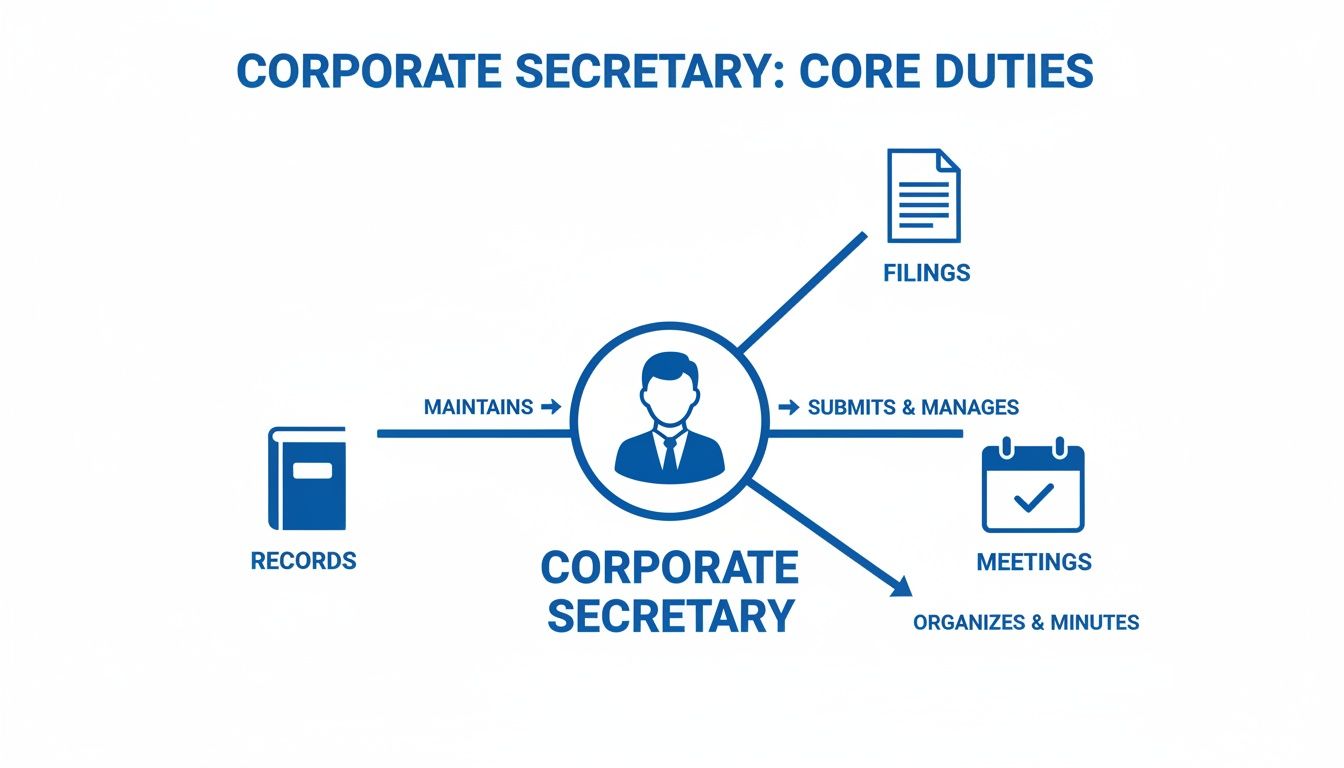
The image really drives home how a corporate secretarial function acts as the central coordinator, managing the distinct pillars of compliance—records, filings, and meetings—across the entire group.
With an expert on board, the strategy becomes integrated. The corporate secretary creates a master compliance calendar so no deadline is ever missed. They ensure the board minutes from Hong Kong properly document decisions that support the BVI company’s substance claims. The result? A smooth, compliant structure where each part of the business reinforces the others, shielding the whole enterprise from risk. It's also worth remembering that compliance now extends beyond corporate law; understanding data privacy rules, like those in this GDPR Compliance Checklist, is crucial for any business operating globally.
Understanding the Real Cost of Getting it Wrong
It's easy to look at corporate secretarial services as just another cost, a box to tick on the expense sheet. But that’s a dangerous way to see it. It's a bit like viewing a fire extinguisher as a piece of wall art until your kitchen is actually on fire. This kind of thinking completely misses the point, ignoring the very real financial and operational disasters that can spring from what seems like a tiny compliance mistake.
The consequences aren't some abstract legal theory; they're the kind of real-world problems that can stop a growing business in its tracks. Imagine trying to pay your team or a key supplier, only to find your company's bank account has been frozen solid. This isn't a far-fetched scenario. It can happen simply because your Register of Directors wasn't updated after a team change, creating a mismatch with what the bank has on file. Just like that, you can't pay your bills, run payroll, or keep the lights on.
The Domino Effect of One Missed Deadline
Trouble often starts with something that feels minor. Let's say you miss the deadline for filing an annual return. That's not just a one-off slap on the wrist. In a jurisdiction like Hong Kong, it kicks off a series of escalating daily fines that can spiral out of control before you even know there's a problem.
And these penalties are designed to hurt. In Hong Kong, fines for a late annual return start at HKD 300 and can quickly jump to HKD 700 per day. A simple oversight can quietly balloon into thousands of dollars. For more serious slip-ups, the fines can hit HKD 50,000, and in some situations, directors can find themselves personally liable.
Think of professional corporate secretarial support not as an expense, but as a high-return investment in risk management. It's the critical defence standing between your hard-earned success and a completely preventable, company-ending disaster.
There's a reason demand for these services in Hong Kong is so high. As a major gateway for global trade, the regulators are always watching. This makes having a professional secretary your financial bodyguard against these kinds of threats. When you consider the huge inflows of private equity and the fact that over half of the 2.1 million recent global incorporations used secretarial support, it’s clear that smart entrepreneurs get it. You can dig deeper into the growing corporate secretarial market to see the trends for yourself.
It's Not Just Fines – It’s Full Operational Paralysis
The true cost of non-compliance goes way beyond the penalties. It poisons trust with your bank, spooks potential investors, and can bring your entire business to a grinding halt.
Picture these all-too-common situations:
- A Funding Round Collapses: An investor you've been courting for months walks away during due diligence because your company records are a shambles.
- Payments Are Blocked: Your bank freezes all transactions, incoming and outgoing, after flagging your company for having outdated information.
- Good Standing Is Lost: Your company loses its "Certificate of Good Standing," which suddenly makes it impossible to sign new contracts or expand into that new market you were targeting.
Each of these examples shows just how fundamental good compliance is to simply staying in business. Bringing in expert corporate secretarial services isn't about offloading paperwork. It's about building a resilient company that can handle scrutiny and grab opportunities without being tripped up by completely avoidable admin failures. It keeps you bankable, investable, and ready to grow.
How Technology Is Reshaping Corporate Secretarial Support

The traditional picture of a company secretary—drowning in stacks of paper and physical ledgers—is becoming a relic of the past. Much like fintech disrupted banking, technology is now fundamentally changing the game for corporate compliance. This isn't just about scanning documents; it's about making corporate secretarial services more intelligent, efficient, and strategically valuable to entrepreneurs like you.
This shift is a huge win for business owners. It takes the repetitive, manual grind off the plates of human experts, letting them focus on what they do best: providing high-level, strategic advice that helps your business thrive. Instead of just chasing deadlines, a modern company secretary uses tech to see what's coming and tackle issues before they become problems.
The Rise of Automated Compliance
Think about it: a system that automatically tracks every filing deadline you have, across multiple countries, and pings both you and your provider with plenty of notice. That’s not a futuristic concept; it's the new standard. AI-driven tools are now handling routine compliance checks, catching potential red flags in your company records long before an auditor ever could.
These tools are making a real impact, especially in forward-thinking jurisdictions like Hong Kong, which has been quick to weave technology into corporate governance. In 2023 alone, over 15,000 firms in the Asia-Pacific region moved to digital-first workflows, with automation touching more than 50% of their secretarial tasks. The result? A 41% drop in manual errors, which speaks volumes about the accuracy technology brings. You can dive deeper into the growth of the digital corporate secretarial market to see how it’s affecting businesses today.
Your Corporate Records in the Cloud
For an entrepreneur with global ambitions, one of the biggest practical perks is the move to secure cloud-based platforms. The days of requesting a courier to send physical copies of your company records or waiting for someone in a different time zone to dig up a document are over.
Today's best providers give you a secure client portal with 24/7 access to everything you need:
- Digital Minute Books: All your board resolutions and meeting minutes, organised and accessible in seconds.
- Live Share Registers: A real-time, accurate view of your company's ownership structure, available whenever you need it.
- Document Vaults: Your company’s most important documents—articles of association, business registration certificates, and key filings—are all in one secure place.
This isn’t just a nice-to-have feature anymore; it’s a core expectation. It means you can pull up a document for a potential investor, a new bank, or a business partner in minutes, not days. In the fast-paced world of international business, that speed is a serious competitive advantage.
The real value of technology in corporate secretarial work isn't just about automation. It's about transforming the service from a reactive, administrative function into a proactive, data-driven partnership that supports your strategic decisions.
At the end of the day, this tech-driven evolution translates into a more reliable and error-proof service for you. It ensures you’re partnering with a firm that isn’t just keeping up, but is actively using the best tools to protect and support your business. When you're vetting providers, asking about their technology stack is just as crucial as asking about their years of experience. It tells you whether they’re truly equipped to support your growth in a digital world.
Finding Your Ideal Corporate Secretarial Partner
Choosing a provider for your corporate secretarial services is one of the most critical decisions you'll make when taking your business international. This isn't just about hiring another vendor; it's about bringing on a guardian for your company's legal and financial well-being.
Sure, a cheap, mass-market provider can tick a box for you. But a true partner acts as a genuine advisor, helping you build a secure and resilient company for the long haul.
The difference between a basic filing service and a real partner becomes crystal clear when you look past the price. Low-cost providers often push you onto an automated portal with minimal human oversight, which should be a major red flag. Technology is a great tool, no doubt, but it's a poor substitute for seasoned expert judgement, especially when you're navigating complex, cross-border business structures.
Look Beyond the Price Tag
As an ambitious entrepreneur, you need a partner who gets the bigger picture. Your corporate secretary shouldn't just be filing your annual return; they should be advising you on how your corporate structure impacts your banking relationships, tax planning, and even your asset protection strategies.
If a provider can't hold an intelligent conversation about how these pieces fit together, they're likely just a filing agent, not the advisor you need.
When you're vetting potential partners, ask some pointed questions that cut right to their experience:
- How have you handled banking compliance for clients with a business structure like mine?
- Can you walk me through how you typically work alongside a client's tax advisor?
- What's your process for managing compliance deadlines across multiple countries?
Their answers will tell you everything you need to know. You'll quickly see whether you're dealing with real expertise or just a standardised, one-size-fits-all service.
Green Flags of a True Strategic Partner
So, how do you spot a high-quality provider? It comes down to looking for specific "green flags" that signal a much deeper level of service and a genuine commitment to your success. A real partner will always put personalised, expert-led guidance ahead of a purely automated experience.
A top-tier corporate secretarial partner doesn't just ask for your company documents. They ask about your business goals, your banking needs, and your expansion plans to ensure every compliance action supports your strategic vision.
Keep an eye out for these positive signs:
- Joined-Up Expertise: They can talk fluently about how corporate compliance, international banking, and tax planning all interconnect.
- Proactive Communication: They aren't just reacting to deadlines. They give you forward-looking advice and warn you about regulatory changes coming down the line.
- Direct Access to Experts: You can actually speak to a seasoned professional who understands your business, not just a generic customer service agent reading from a script.
Provider Selection Checklist: Is Your Corporate Secretary a True Partner?
When you're evaluating your options, it's easy to get lost in the details. This checklist is designed to help you ask the right questions and see beyond the marketing copy to find a provider who will truly support your global ambitions.
| Evaluation Criteria | What to Look For (The Green Flags) | What to Avoid (The Red Flags) |
|---|---|---|
| Scope of Expertise | They proactively discuss banking, tax, and asset protection implications. They have in-house experts or a strong network. | They only talk about filing documents and meeting basic deadlines. They can't answer questions outside their narrow scope. |
| Communication Style | You get a dedicated point of contact. They provide proactive updates and strategic advice, not just reminders. | Communication is through a generic support ticket system. You only hear from them when a deadline is imminent. |
| Technology Approach | Technology is used to enhance expert service, providing you with visibility and efficiency, but not replacing the human element. | They rely entirely on an automated, self-service portal with little to no expert oversight or personalised guidance. |
| Client Onboarding | The process involves a deep dive into your business model, growth plans, and specific cross-border needs. | Onboarding is a simple, impersonal form-filling exercise focused only on collecting your company documents. |
| Pricing Structure | Transparent, value-based pricing that reflects the level of expertise and advisory support provided. | Extremely low "all-inclusive" prices that often hide extra fees or indicate a lack of personalised service. |
Choosing the right partner is an investment in your company's future. It gives you the confidence to focus on growth while they handle the complexities of global compliance.
To get a clearer picture of what a dedicated partner can bring to the table, our detailed guide on the Lion Business Co. company secretary service offers a complete overview of our approach.