
 Hong Kong
 Singapore
 UAE
UAE
 Malaysia
 Turkey
 UK
UK
 EU
EU
 US
US
 Switzerland
 Bahamas Bank Account
 Cayman Islands Bank Account
 Mauritius Bank Account
 BVI
BVI
 Seychelles

Picture this: you've got a brilliant international business idea, your strategy is locked in, but then you hit a wall. A very old, paper-covered wall. The bank. Suddenly, you're tangled in endless paperwork, mandatory in-person meetings, and processes that feel like they were designed a century ago.
For a long time, that was the reality for entrepreneurs looking to operate on a global scale. But the game has changed dramatically. Online bank account opening isn't just a convenience anymore; it's a core strategic advantage that gives you the speed and flexibility to compete internationally. We've moved from bureaucratic roadblocks to digital efficiency, finally making cross-border business as accessible as it should be.
Kissing Banking Bureaucracy Goodbye
For decades, getting a business bank account—especially an offshore one—was a gruelling marathon. It meant appointments booked weeks in advance, stacks of documents needing official certification, and then… waiting. And waiting. If you're an entrepreneur with a global vision, you know this story well. Your ambition is moving at the speed of light, while the banking system is stuck in first gear.
This created a massive bottleneck. A simple administrative task could delay your market entry, hold up crucial supplier payments, and ultimately, cost you real opportunities.
Let's be honest, the old model was built for a different world, one where global commerce wasn't happening in an instant. It just wasn't designed for a Hong Kong e-commerce store with suppliers in Vietnam and customers across Europe. The friction was immense, and it was holding businesses back.
A New Chapter in Financial Access
Thankfully, that chapter is closing. The entire process has been re-engineered from the ground up. With the rise of digital-first financial institutions and the long-overdue modernisation of traditional banks, opening an account remotely is now the standard, not the exception. This isn't just about saving a trip to the bank; it's a fundamental shift in how international business gets done.
The benefits are immediate and powerful:
- Move at Business Speed: Applications that used to drag on for months can now be wrapped up in days, sometimes even hours. You can get your financial foundations in place just as quickly as you build the rest of your business.
- Slash the Paperwork: Forget about couriering sensitive documents across continents. Secure digital uploads and quick video verification calls have replaced the need for most physical paperwork and face-to-face meetings.
- Real Choice and Better Partners: The digital shift has blown the market wide open. New financial providers have emerged, giving you more options to find a banking partner who actually gets your international business model.
This isn't just a niche trend; it's a massive, market-wide shift. Take Hong Kong, for example. Since the city introduced its eight Digital Banks (DBs) in 2020, financial access for SMEs and international entrepreneurs has been completely transformed. A recent survey found that over 99% of SMEs reported positive experiences, a testament to how seamless online account opening is fuelling growth. You can explore more about this digital shift in Hong Kong banking to see the impact firsthand.
Think of this guide as your roadmap for this new world. We're going to walk you through the practical steps and share the insider knowledge you need to master the online bank account opening process. The goal is to keep your business agile, compliant, and ready to take on the world.
Choosing Your Financial Partner: Banks vs EMIs
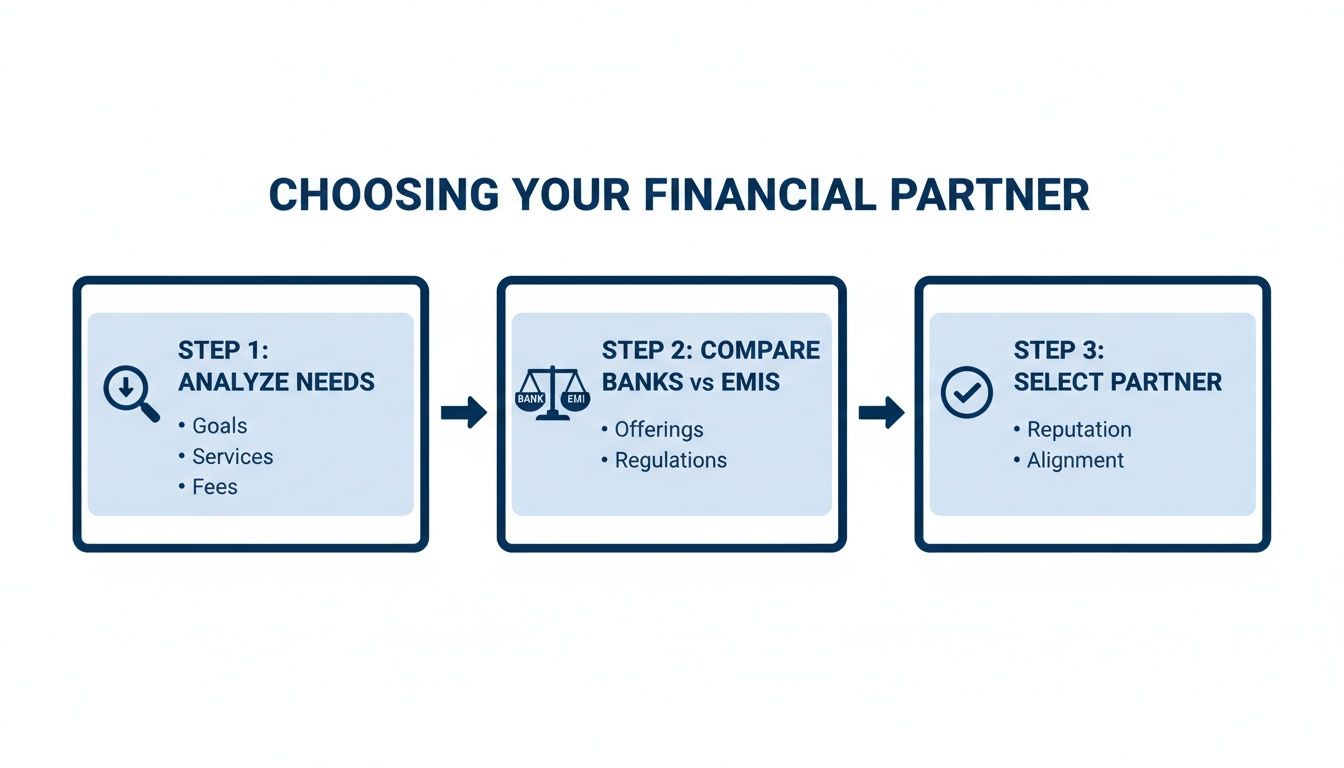
Picking the right financial institution is one of the most fundamental decisions you’ll make for your international business. This goes far beyond just comparing features on a website; it’s a strategic choice that has to line up perfectly with your business model, how you handle transactions, and where you plan to grow. The partner you pick today will either be a springboard for your expansion or a major headache down the road.
Think of it like choosing a shipping partner. If you're a local bakery, a neighbourhood delivery service is all you need. But if you're an international e-commerce brand, you need a global logistics network that understands customs inside and out. It’s the same with banking. A Hong Kong trading company needing letters of credit has completely different requirements than a European SaaS startup that just wants clean API integrations and super-low fees for subscription payments.
The Great Divide: Traditional Banks and Agile EMIs
For today's entrepreneur, the financial world really boils down to two main options: the old-guard traditional banks (with their digital offerings) and the newer, more nimble Electronic Money Institutions (EMIs). Neither one is universally "better"—the right fit is all about your company's operational DNA.
Traditional banks, especially the big global names, offer a sense of deep-rooted stability and trust. They’re the ones who can provide a whole suite of complex products like hefty business loans, trade finance instruments, and wealth management services. If your business deals with physical goods or needs significant credit lines, their established reputation and comprehensive offerings are often essential.
On the other hand, EMIs were practically built for the modern, digital-first economy. Their bread and butter is speed, flexibility, and a seamless user experience. They absolutely excel at providing multi-currency accounts, offering fantastic foreign exchange rates, and creating slick API integrations that let you plug your finances straight into your accounting software. For digital nomads, online service businesses, and tech startups, they're often the obvious choice. If you're looking for https://lionbusinessco.com/embracing-an-innovative-alternative-to-traditional-banks/, EMIs are where you should be looking.
A Practical Framework for Your Decision
To make the right call, you have to start by looking at your own business operations. It's easy to get swayed by flashy marketing, but you need to ground your decision in the practical reality of how your company actually moves and uses money.
To help you think through this, let's break down how they stack up based on what might matter most to you.
Traditional Bank vs EMI: Which Is Right for Your Business?
| Business Priority | Best Fit: Traditional Bank | Best Fit: EMI (Electronic Money Institution) |
|---|---|---|
| Access to Credit & Loans | Strong. They have an established history and the infrastructure for lending. | Limited to non-existent. EMIs are not banks and typically cannot lend money. |
| Global Reputation & Trust | High. Decades or even centuries of history build significant trust. | Varies. Newer players are still building brand recognition and a track record. |
| API & Tech Integration | Often clunky and limited, though some are slowly improving. | Excellent. This is a core strength, with modern, developer-friendly APIs. |
| Account & Transaction Fees | Generally higher, with more complex and sometimes hidden fee structures. | Typically lower and more transparent, especially for international transfers. |
| Onboarding Speed | Slower. The online bank account opening process can be far more rigorous. | Faster. Often fully digital and can be completed within days or even hours. |
Ultimately, the choice comes down to what you truly need. Are you a capital-intensive business that will need a loan to buy inventory? A traditional bank is probably your only real option. Are you a lean, remote-first consultancy that bills clients in five different currencies? An EMI will almost certainly serve you better and save you a small fortune in fees.
A Quick Word on Security: It doesn't matter if you go with a bank or an EMI—doing your homework is non-negotiable. It's crucial to understand their commitment to robust financial controls, which is often proven through their compliance with industry standards. For instance, understanding SOC 1 reports can give you real insight into how they protect client financial data.
This isn't just about finding a place to park your cash. It's about finding a partner that understands the rhythm of your business and is equipped to support your ambitions for the long haul.
Mastering the Digital KYC Handshake
Once you've shortlisted a financial partner, it's time for the formal introduction. This isn't just about handing over paperwork; it’s about successfully navigating the Know Your Customer (KYC) process. Don't think of it as a bureaucratic hurdle. I always tell my clients to see it as a digital handshake—your first real chance to build a relationship of trust with your new bank or EMI.
Many entrepreneurs get intimidated by the KYC checklist. But if you understand why they're asking for all this stuff, it changes everything. Financial institutions aren't trying to be difficult. They are legally required to verify who you are and what your business does to prevent financial crime. A clear, well-organised application package is your opportunity to show them you're a legitimate, transparent, and low-risk client.
This entire process is shaped by strict global standards. Getting a grip on the core principles, like Anti-Money Laundering (AML) regulations, helps you anticipate what they need before they even ask. This simple shift in mindset makes the whole online bank account opening experience feel much smoother.
Why They Need What They Need
When a compliance officer picks up your file, they're trying to piece together the story of your business. Every document you provide is a chapter in that story.
- Certificate of Incorporation & Business Registration: This is your company's birth certificate. It proves your business legally exists and is properly registered.
- Memorandum & Articles of Association: Think of this as the company's rulebook. It tells the bank who has the authority to make decisions, like opening accounts.
- Register of Directors & Shareholders: This lays out the cast of characters. The bank needs to know exactly who owns and controls the company.
- Details of Ultimate Beneficial Owners (UBOs): This is absolutely critical. A UBO is the actual person who ultimately benefits from or controls the company, even if they aren't on the share register directly. Banks have to dig this deep to ensure the real owner isn't a sanctioned individual or trying to hide their identity.
If you're running a more complex structure—say, a Hong Kong company that's owned by a holding company in the BVI—you need to map it out for them. Provide a crystal-clear chart showing the full ownership chain right up to the individuals at the very top. The goal is total transparency. If this sounds like your situation, you’ll find our guide on how to pass KYC for offshore companies incredibly useful.
Navigating Modern Remote Verification
Gone are the days of needing to fly halfway around the world for an in-person meeting. Technology has replaced the physical handshake with a digital one, using some pretty sophisticated methods to prove you are who you say you are.
These remote verification processes usually involve a few key steps:
- The "Liveness" Check: You’ll likely be asked to use your phone or webcam for a short video. They might ask you to turn your head or say a few words out loud. It’s a simple but effective way to prove you’re a real, live person and not just a static photo.
- Biometric Scans: Many banking apps will scan your face and compare it to the photograph on your government-issued ID. The technology here is incredibly advanced, matching facial geometry to confirm your identity with a high degree of accuracy.
- Document Authentication: You'll upload a clear photo of your passport or national ID. The system's software analyses it for security features like holograms and watermarks to check that it’s genuine.
A Pro Tip from the Trenches: Always do your video verification in a well-lit room with a plain, neutral background. I've seen countless applications delayed because of glare, shadows, or a cluttered room confusing the automated systems and triggering a manual review.
The trust in these digital methods is remarkably high, especially in forward-thinking financial hubs like Hong Kong. Recent surveys show that over 94.5% of individuals and nearly 100% of SMEs now trust the data security measures for online banking. This confidence is built on solid ground, with banks reporting a 75% AI adoption rate for complex tasks like deepfake detection, all under the watchful eye of regulators.
How to Keep Your New Account Safe and Active
Congratulations, your account is open. You’ve made it through the KYC gauntlet and your business is officially bankable. But this is where the real work starts. An online bank account opening is just the beginning; the constant challenge is keeping that account active, secure, and free from the dreaded compliance freeze.
For a global business, an account freeze isn't just an inconvenience—it's a catastrophe. It can halt supplier payments, derail payroll, and shatter your company's reputation overnight. The secret is to stop thinking reactively and start managing your finances proactively. You need to anticipate the red flags that trigger automated compliance systems before they ever become a problem.
Think of your new account like a high-performance engine. You wouldn’t just fill it with any fuel and hope for the best. You'd use the right grade, perform regular maintenance, and listen for any unusual noises. Your business finances demand that same disciplined approach.
The Golden Rule: Every Transaction Needs a Story
Every single transaction that flows through your account must tell a clear, consistent story. Compliance algorithms are always scanning for activity that doesn't match the business profile you provided during your application. A mismatch is the number one reason for an automated account freeze.
For instance, if you registered your company as a "management consultancy" but the bank sees a high volume of payments for "used auto parts," their system will immediately flag it. The story doesn't add up.
Always make sure your payment descriptions are professional and directly related to your stated business activities. A vague description like "Payment" is an open invitation for scrutiny. A clear one, like "Invoice 8345 – Q3 Consulting Services," tells the right story and keeps the algorithms happy.
Handling Large and Unusual Transfers
Sooner or later, your business will need to handle a transaction that falls outside its normal pattern. This could be a large capital injection from an investor, a payment from a new client in a high-risk jurisdiction, or the purchase of a significant asset. These are perfectly legitimate activities, but to a bank’s monitoring system, they look suspicious without context.
This is where proactive communication is your most powerful tool.
- Give Your Bank a Heads-Up: Before a large or unusual transaction hits your account, get in touch with your relationship manager or the bank’s support team. Give them the context—an invoice, a sales agreement, or a loan document. This turns a potential red flag into a documented, expected event.
- Keep a Flawless Paper Trail: Maintain meticulous records for any non-standard transactions. If you get funds from a country often labelled as high-risk, be ready to show the complete paper trail proving the deal's legitimacy.
- Avoid Erratic Patterns: Try not to move large sums in and out of the account in rapid succession without a clear commercial reason. This behaviour mirrors patterns that anti-money laundering (AML) systems are specifically designed to catch.
It all boils down to a simple principle: Never surprise your bank. An unexpected seven-figure deposit is far more likely to trigger a freeze than one the bank was told to expect. By providing the narrative beforehand, you stay in control of your financial story.
The Non-Negotiable: Keeping Your Records Updated
Businesses evolve, and your corporate records must evolve with them. Financial institutions are legally obligated to conduct periodic reviews to ensure the information they hold on your company is still accurate. Ignoring these requests is a fast track to getting your account restricted.
Keeping your records pristine isn't just a compliance chore; it's fundamental to maintaining a healthy banking relationship.
Essential Business Housekeeping:
- Director & Shareholder Changes: Did you bring on a new partner or has a director left? Update your company registry and inform your bank immediately.
- Address Updates: If your business or its directors move, provide the new proof of address documents without delay.
- Business Model Pivots: If you significantly change what your business does, it’s critical to discuss this with your bank. You may need to update your business profile to ensure your transactions continue to align with their records.
Treat your banking partner like a key stakeholder in your business. A well-informed bank is a supportive bank. By mastering these compliance and communication fundamentals, you’re not just avoiding problems—you’re building a resilient financial foundation that can support your global ambitions for years to come.
Troubleshooting Common Application Hurdles
Even with perfect preparation, opening an online bank account isn't always a straight line. You can have all your documents lined up, pick the right banking partner, and still get that dreaded email saying there’s a problem. It’s frustrating, but it’s almost never the end of the road.
Think of it less as a flat-out rejection and more as a request for more information. Banks and EMIs are under enormous regulatory scrutiny, so their systems are built to be extra cautious. The trick is to see these hiccups not as roadblocks, but as minor detours you can navigate quickly and calmly.
Decoding Document Rejections
One of the most common snags is a rejected document. Nine times out of ten, this isn't about the document itself, but how you presented it. Before you rush to re-upload, take a moment to figure out exactly what went wrong.
- Blurry or Low-Resolution Scans: Your phone camera is probably great, but that doesn't guarantee a good scan. Make sure the image is perfectly sharp, with no shadows or glare obscuring any details. It's also crucial that all four corners of the document are visible.
- Wrong File Format: A simple but frequent error. Some portals only want PDFs; others need JPEGs. Double-check the upload requirements before you hit submit.
- Expired Documents: This one’s a classic. Always glance at the expiry date on your passport, national ID, or anything else that has one. It's an easy thing to miss.
Here’s a small tip I always give my clients: rename your files logically. Instead of uploading "IMG_4057.jpg," change it to something like "John_Doe_Passport_2024.pdf." It’s a tiny detail, but it shows a level of organisation that compliance officers definitely notice.
The Proof of Address Puzzle for Global Nomads
For entrepreneurs living a nomadic or location-independent lifestyle, the “proof of address” requirement can feel like a checkmate. If you’re hopping between countries, you likely don’t have a utility bill or traditional bank statement in your name.
Don’t panic. There are almost always other ways to solve this puzzle.
The goal is simply to show a stable, verifiable link to a residential address, even if it isn't your permanent home. Thankfully, many modern financial institutions understand how global business works and have become more flexible.
Here are a few alternatives that often get the green light:
- A rental agreement, even a short-term one, can be a powerful piece of evidence.
- A formal letter from your co-working space or serviced office provider that confirms your membership and the address they handle your mail at.
- In some jurisdictions, a notarised affidavit or a letter from a lawyer can also work.
The best approach is to be proactive. If you know this will be a sticking point, email the institution before you apply and ask for their list of acceptable alternative documents. It shows you’re on top of things and saves everyone a lot of time.
When Your Application Is Denied Without Explanation
Getting a denial with no reason given is easily the most disheartening outcome. While your first reaction might be frustration, a calm and professional response will get you much further. Financial institutions are often legally barred from giving specific reasons for a rejection, usually due to strict anti-money laundering (AML) rules.
That doesn't mean you have no options. You can still politely ask if they can provide a general reason for their decision. This might nudge them to point you towards an area of concern—perhaps they viewed your business activity as high-risk, or they found a mismatch in the information you provided. If you have a strong reason to believe they made a mistake, a polite follow-up is worthwhile. For a much deeper look at this, our guide on why a bank account application might be rejected has more detailed steps.
Sometimes, though, the best move is to just move on. A rejection from one bank doesn't make you unbankable. It could just mean your business model wasn't a good match for their particular risk profile. Treat it as a learning experience, polish your application, and approach your second-choice provider with even better preparation.
Your Questions Answered: Common Hurdles in Online Account Opening
Even with a solid plan, you're bound to have questions pop up. It’s a complex world, after all. We get asked a lot of the same things by entrepreneurs just starting this journey, so let's tackle the most common ones head-on.
"Can I really open a business account if I'm not a resident?"
Yes, you absolutely can. This is one of the single biggest shifts in modern finance and a huge win for global entrepreneurs. Many EMIs and even some of the more modern traditional banks are specifically built to cater to international founders and non-resident directors. The trick is picking the right place to do it.
A jurisdiction like Hong Kong, for instance, is a major hub precisely because its financial infrastructure is designed for this kind of global business. The deciding factor won't be where you live; it will be whether you can clearly and completely satisfy their Know Your Customer (KYC) requirements from a distance. As we’ve covered, that means painting a perfect digital picture of your business, its ownership structure, and your own identity.
"Realistically, how long is this going to take?"
This is the big one, and the honest answer is: it depends entirely on who you choose.
-
EMIs (Electronic Money Institutions): These guys are built for speed. If you have all your documents ready to go, it's genuinely possible to get an account approved and running in 24 to 72 hours. Their systems are slick, automated, and designed for precisely this purpose.
-
Traditional Banks (even with online portals): The old guard is, unsurprisingly, more cautious. Their process usually involves more manual checks by human compliance teams. A realistic timeframe here is anywhere from one to four weeks. If your company has a complicated ownership structure or you're in an industry they see as higher-risk, don't be surprised if it takes even longer.
My best advice? Always budget your time based on the longer estimate. If you need to start transacting urgently, an EMI is almost always the quickest path forward.
"What's the number one reason applications get rejected?"
It's almost never the business idea itself. By far, the most common reason for rejection is an incomplete or inconsistent KYC submission. It really comes down to small, avoidable mistakes that plant a seed of doubt in a compliance officer's mind.
Put yourself in their shoes for a second. If a director's name on their passport is spelled slightly differently from how it appears on the company registration certificate, that's a problem. If your description of business activities is vague or doesn't seem to line up with the kinds of payments you expect to make, that’s a red flag.
The single biggest mistake is a lack of clarity. Your application should tell a simple, consistent, and transparent story about who you are, what your business does, and who ultimately owns it. Any ambiguity forces the compliance team to assume the worst.
Another classic mistake is a fundamental mismatch. Applying to a conservative, old-school bank for your new crypto-trading venture is a surefire way to get a polite "no." It just underscores how critical it is to pick the right banking partner from day one.
"How much should I expect to pay for all this?"
The costs for an online bank account opening can be all over the map, so it’s crucial to look past just the initial setup fee.
Here’s a quick comparison of what you’ll typically see:
| Cost Type | The EMI Approach | The Traditional Bank Approach |
|---|---|---|
| Setup Fee | Often very low or even zero. It's how they get you in the door. | Can have a one-time application fee, sometimes running several hundred dollars. |
| Monthly Fee | Usually a low, fixed monthly cost. Some offer free tiers with transaction limits. | Often higher, but they might waive it if you keep a certain minimum balance. |
| Transaction Fees | This is where they shine. Very competitive rates for international transfers. | Generally more expensive, especially for SWIFT payments and currency exchange. |
Remember, the "cheapest" account isn't always the most cost-effective. An account with no monthly fee might hit you with high charges on the exact types of international payments your business relies on. You have to do the maths based on your own activity to see which option truly saves you money in the long run.
Navigating the maze of global banking shouldn't be what holds your business back. If you're looking for a partner to help design a secure, compliant, and tax-efficient financial structure, the team at Lion Business Consultancy Limited is here to help. We provide the one-on-one strategic guidance that ensures your business is bankable today and ready for whatever comes next.