

 Hong Kong


 Singapore


 UAE
UAE



 Malaysia

 Turkey


 UK
UK
 EU
EU
 US
US
 Switzerland
 Bahamas Bank Account
 Cayman Islands Bank Account
 Mauritius Bank Account

 BVI
BVI
 Seychelles

When we talk about minimum MPF benefits, we’re cutting through the complexity to get to one simple, non-negotiable rule for every Hong Kong business: you and your employee must each contribute 5% of their monthly relevant income into their retirement fund. This is the bedrock of your legal duties as an employer.
Decoding Your Core MPF Obligations
For many entrepreneurs and SME owners in Hong Kong, the Mandatory Provident Fund (MPF) can feel like a maze of red tape. But let's pull back the curtain. At its heart, the system is a straightforward retirement savings plan designed for your team's future.
Think of it as a mandatory financial partnership. You're not just an employer; you're a co-builder of your employee's financial safety net.
Your most critical task is ensuring these contributions happen accurately and on time, every time. This isn't just an administrative chore; it’s a fundamental legal duty that covers nearly every employee, full-time or part-time, once they’ve been with you for 60 days or more.
The Contribution Formula Simplified
The calculation itself hinges on specific income brackets. The system is tiered to be fair—it protects lower-income earners from contributing while capping contributions for high earners.
Here’s a quick snapshot of how the numbers stack up.
MPF Contribution Levels at a Glance
This table clearly shows who pays what based on an employee's monthly earnings.
| Monthly Relevant Income | Employee Contribution | Employer Contribution |
|---|---|---|
| Below HK$7,100 | HK$0 (Not required) | 5% of income |
| HK$7,100 to HK$30,000 | 5% of income | 5% of income |
| Above HK$30,000 | HK$1,500 (Capped) | HK$1,500 (Capped) |
As you can see, even if your employee earns less than HK$7,100 and is exempt from contributing, your 5% contribution is still mandatory. Once their income crosses HK$30,000 a month, both contributions are capped at HK$1,500 each.
Why This Matters for Your Business
Getting these details right is about more than just compliance. Yes, it keeps you on the right side of the law and helps you avoid hefty fines from the MPFA. But it also sends a powerful message to your team: you're invested in their long-term well-being.
Properly managing these contributions is a crucial part of your company's financial health. It's no wonder many small businesses find it easier to outsource this, relying on professional https://lionbusinessco.com/blog/accounting-services-in-hong-kong to handle payroll and ensure every 'i' is dotted and 't' is crossed.
Your role extends beyond paying a salary—you are facilitating a critical savings plan for your people. For a wider lens, understanding workplace pension schemes in other parts of the world can offer valuable context on how different retirement systems function.
How to Calculate MPF Contributions Correctly
Getting the MPF numbers right isn't just good practice; it's a legal imperative. Even small miscalculations can attract penalties from the MPFA, creating a world of financial and administrative pain for your business. The good news? The calculation is surprisingly straightforward once you grasp the framework.
Think of it as a simple tiered system that hinges entirely on an employee's relevant income. This isn't just their base salary; it includes commissions, bonuses, and almost all cash allowances. Your main job each pay period is to determine which income bracket each employee falls into.
Understanding the Income Brackets
The entire calculation for minimum MPF benefits comes down to three key income levels. Your contribution duties shift depending on whether an employee's monthly earnings fall below, within, or above a specific range defined by the government.
This infographic gives a great visual breakdown of how the contributions work across these different tiers.
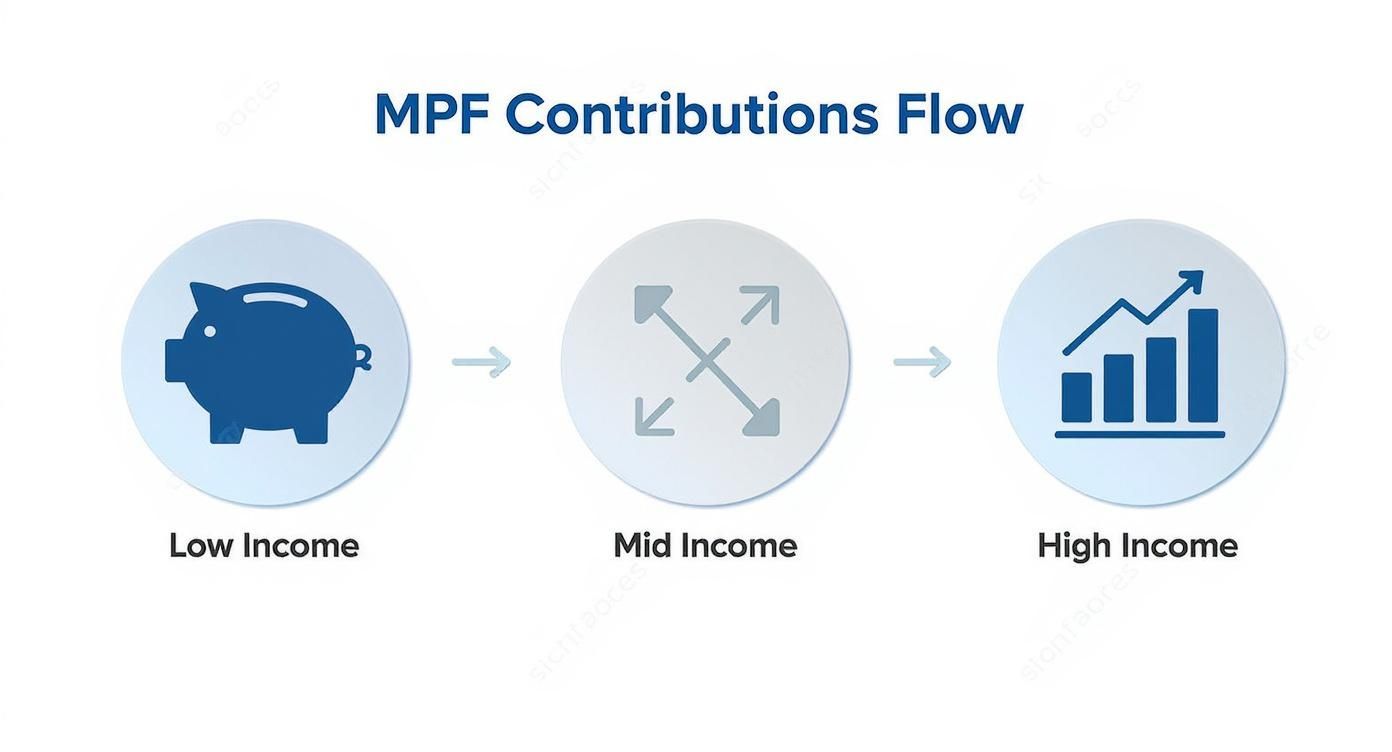
The key takeaway is that the employer always contributes. It’s the employee’s contribution that gets waived at the lowest income level, easing their financial load while still building their retirement savings.
Putting Calculations into Practice
Let's walk through a few real-world examples to see how this plays out. Imagine you have three different people on your team.
-
Case Study 1: The Part-Time Assistant
- Scenario: Alex works part-time and earned HK$6,000 this month.
- Calculation: Because Alex’s income is below the HK$7,100 minimum threshold, they don't have to contribute anything. You, as the employer, still need to contribute 5% of their salary. That comes to HK$300 (HK$6,000 x 5%).
-
Case Study 2: The Full-Time Marketer
- Scenario: Ben is a full-time employee earning a steady HK$25,000 a month.
- Calculation: Ben's salary sits comfortably in that middle bracket. This is the standard 50/50 split. You'll deduct HK$1,250 (5%) from his pay, and your business will contribute a matching HK$1,250. A total of HK$2,500 goes into his MPF account.
-
Case Study 3: The High-Earning Sales Manager
- Scenario: Chloe, your star salesperson, had a brilliant month and brought in HK$40,000 with her commission.
- Calculation: Her income is over the HK$30,000 maximum level, so contributions are capped. Both your contribution and hers are locked in at the maximum of HK$1,500 each, making the total for the month HK$3,000. If you want to explore these caps in more detail, our guide on the MPF maximum contribution has you covered.
By following this simple, tier-based logic for every employee during your payroll run, you can take the guesswork out of the equation. It builds a reliable process that ensures every single contribution is spot-on and fully compliant.
How MPF Benefits Grow for Your Employees
As a business owner, it’s easy to see MPF contributions as just another line item on the payroll. But for your employees, this is the very seed of their financial future. These regular contributions don’t just sit in a bank account; they get invested and have the chance to grow, turning a monthly compliance task into a potentially substantial retirement nest egg.
Imagine an MPF account as a small, personal investment portfolio that you and your employee build together, month by month. Each contribution buys small pieces, or 'units', of different investment funds that the employee gets to choose. Over a career spanning decades, this steady drip of investment, combined with the power of compounding and market growth, is how real wealth can be built.
This system is now a massive part of Hong Kong's retirement landscape, covering around 4.7 million members and 360,000 employers. The total pot has swelled to over HK$1,100 billion. Since the scheme started, it has managed an annualised return of about 2.5% after fees. If you're interested in the numbers, this comprehensive MPF system review offers a much deeper dive into the system's performance.
Understanding Vesting (Or, "Whose Money Is It?")
One of the key concepts to get right is vesting. It’s a formal-sounding word that simply answers the question, "When does the money in the MPF account legally and irrevocably belong to the employee?"
Vesting is simply the point at which an employee has full legal rights to the benefits in their retirement account. It's when the money is officially theirs to keep, no strings attached.
Luckily, the MPF system keeps this incredibly straightforward and pro-employee. Here’s the breakdown:
- Employee's Share: The 5% that comes out of your employee's salary is 100% theirs from the moment it hits their account. No question.
- Your Company's Share: The 5% you contribute on their behalf is also 100% theirs immediately. There are no lengthy waiting periods or conditions.
This immediate vesting is a powerful part of the minimum MPF benefits. Every dollar you contribute becomes a direct, personal asset for your employee from day one. It transforms a legal requirement into a genuine and tangible benefit for your team.
The Critical Role of Investment Choices
The final amount an employee walks away with at retirement doesn't just depend on the contributions; it's hugely influenced by how that money is invested along the way. MPF providers offer a menu of different fund options, and each comes with its own risk level and potential for growth.
Typically, employees can choose from a range of funds:
- Equity Funds: These invest in stocks. They carry higher risk but also offer the highest potential returns over the long run.
- Mixed Asset Funds: A balanced approach, holding a mix of stocks and bonds to smooth out the ride.
- Bond Funds: Lower risk, aiming for more stable and predictable, albeit lower, returns.
- MPF Conservative Funds: The most cautious option, focusing on preserving capital rather than chasing big gains.
It's a great practice to encourage your team to periodically review their fund choices. This empowers them to take ownership and ensure their retirement savings strategy aligns with their personal financial goals and risk tolerance.
Managing Employee Departures and Withdrawals
When a team member decides to leave, your MPF duties don't end on their last day. A smooth and compliant offboarding process is your final responsibility, and it’s a crucial step in protecting your business from compliance hiccups down the road.
Your role here is quite specific and, most importantly, time-sensitive. You need to make their final MPF contribution and formally notify your trustee that they are no longer with the company. It’s a task that can’t be left to drift; getting it done on time is essential.
The Offboarding Checklist
Getting an employee’s MPF departure right comes down to a few key actions. The most important deadline to remember is the 10th day of the month that follows their final month of employment. By this date, you must have two things sorted:
- Submit the Final Contribution: Calculate and pay their very last MPF contribution, which will be based on their final salary payment. This brings their account completely up to date.
- Notify the Trustee: You must inform your MPF provider in writing about the employee's termination date. Often, you can do this on the same remittance statement you use for their final payment.
Missing the notification deadline can result in penalties, so it's wise to make this a non-negotiable part of your standard offboarding procedure. Meticulous record-keeping is your best friend here. If you're looking to tighten up your financial workflows, it might be worth exploring the advantages of outsourcing accounting to ensure every detail is handled with professional care.
Rules for Early Withdrawal of MPF Benefits
The whole point of the MPF system is to build a nest egg for retirement at age 65. But life is unpredictable, and the rules account for certain situations where someone might need to access their funds much earlier. While your direct involvement as an employer is minimal, knowing these rules allows you to answer questions and point former employees in the right direction.
An employee can apply to their trustee to withdraw their minimum MPF benefits early, but only under very specific and legally defined circumstances.
An employee’s accrued benefits are their personal assets. Early withdrawal is a formal process between them and their trustee, but knowing the rules helps you provide accurate information during their exit interview, reinforcing a positive final impression of your company.
Let's look at the specific conditions that allow an employee to access their MPF savings before reaching the standard retirement age.
Conditions for Early MPF Withdrawal
| Reason for Withdrawal | Key Requirement | Employer's Role |
|---|---|---|
| Permanent Departure from Hong Kong | The employee must declare they are leaving HK permanently with no intention to return for work or residency. | None. This is a personal declaration made by the employee to their trustee. |
| Total Incapacity | A medical certificate must prove the employee is permanently unfit for their specific kind of work. | None. This is a medical and personal matter between the employee and trustee. |
| Terminal Illness | A registered medical practitioner must certify that the employee has a life expectancy of 12 months or less. | None. This is handled confidentially between the employee and their trustee. |
| Small Account Balance | The account balance is HK$5,000 or less, and no contributions have been made for at least 12 months. | None. The employee must declare they do not intend to become employed again. |
Understanding these scenarios ensures you're prepared for any questions that might arise during an otherwise busy offboarding process.
Common MPF Mistakes Every SME Should Avoid
Navigating the world of MPF compliance can feel like walking a tightrope, especially for a busy SME owner. It’s easy to make a wrong move, and unfortunately, even well-intentioned mistakes can lead to serious headaches and costly penalties. Let’s look at the most common tripwires so you can sidestep them altogether.

Think of MPF compliance less as a burden and more as good business hygiene. Getting it right from the start builds trust with your team and keeps the regulators happy, freeing you up to focus on what really matters—growing your business.
Misclassifying Employees as Contractors
This is hands down the most frequent and expensive mistake I see. A business might hire someone as a "freelancer" or "contractor" to keep admin simple, thinking they don't need to worry about MPF. But the law looks past the job title. If the working relationship functions like regular employment—think set hours, direct supervision, or using company equipment—the MPFA will almost certainly see them as an employee.
- A Classic Scenario: A small tech startup hires a developer on a "contractor" basis. The developer works exclusively for them, from their office, and receives a fixed monthly payment.
- The Real Risk: The MPFA could investigate and rule this is a disguised employment relationship. This can lead to a demand for all back-dated contributions, plus surcharges and steep fines for non-enrolment.
- The Smart Solution: Always look at the reality of the working arrangement, not just the contract's label. If you're ever in doubt, it’s far safer to enrol the person and make sure their minimum MPF benefits are covered.
Missing Critical Enrolment and Contribution Deadlines
The MPF system runs on strict deadlines. You have precisely 60 days from an employee's first day of work to get them enrolled in your scheme. After that, contributions for each pay period must be paid by the 10th day of the following month.
Forgetting these dates is like missing a tax deadline—the consequences are automatic. The MPFA can slap on a penalty of HK$5,000 or 10% of the amount due, whichever is greater, just for being late.
Even the income thresholds for contributions are a finely tuned balance. A recent legislative review looked into raising the minimum income level for contributions but ultimately decided against it, finding it could reduce an employee’s final retirement fund by an average of HK$335,000. This really drives home how vital every single contribution is for your team's future. You can dive into the full analysis on the Legislative Council's website.
Keeping Inaccurate Records
Messy paperwork is a ticking time bomb. It might seem like a low-priority task, but poor record-keeping can quickly become a massive compliance nightmare. By law, you must keep detailed payroll and MPF contribution records for at least seven years. If the MPFA decides to conduct an inspection and your files are a shambles, proving you’ve done everything correctly becomes nearly impossible.
Getting your MPF administration right isn't just about dodging fines. It's about building a solid operational foundation for your business. It protects you, it shows your team you care, and it gives you the peace of mind to run your company without constantly looking over your shoulder.
Frequently Asked Questions About MPF Benefits
Even with the best guides, specific questions always pop up. That’s completely normal, especially when you’re dealing with something as important as your team's retirement savings. So, I've put together this final section to tackle the most common queries we hear from SME owners, giving you quick, straightforward answers for those tricky situations.
Think of this as your go-to reference for all the "what if" scenarios. Getting these details right not only keeps you compliant but also builds trust with your team, showing you’re an employer who knows their stuff.
What Happens If I Miss an MPF Contribution Deadline?
Missing a contribution deadline, even by a single day, is a big deal to the MPFA. It’s not just a matter of paying late; it automatically kicks off a compliance process. The MPFA will hit you with a payment notice that includes the original outstanding amount plus a 5% surcharge on top.
Letting it slide can escalate things quickly. Continued non-payment can lead to much heftier financial penalties and even legal action against your company. The absolute best way to dodge this bullet is to build a rock-solid payroll process that ensures contributions are made by the 10th of each month, no exceptions. If you ever think you might be late, your first call should be to your MPF trustee to explain the situation.
Do I Need to Make MPF Contributions for Interns or Temporary Staff?
This all boils down to one simple rule: the length of their employment. It doesn't matter what their title is—intern, temp, part-timer, or contractor. If they work for your company for 60 consecutive days or more, you are legally required to enrol them in your MPF scheme.
That "60-day rule" is a hard and fast line. For anyone employed for a shorter period, you're generally off the hook for MPF. This is precisely why keeping meticulous records of start and end dates for everyone on your payroll, regardless of their status, is non-negotiable for proving compliance.
Can I Use Employer MPF Contributions to Offset Severance Pay?
Yes, under current Hong Kong law, you can. Employers are allowed to use the accrued benefits from their own contributions in an employee's MPF account to offset any statutory severance or long service payments owed. It's a common practice that can help soften the financial blow of offboarding.
Crucial Point: This offsetting mechanism only applies to the employer's portion of the contributions. An employee's own mandatory and voluntary contributions are completely protected and can never be used for this purpose. It's also worth noting that this is a controversial topic, and the government is already planning to abolish this offsetting arrangement soon.
How Do I Choose the Right MPF Provider for My Business?
Picking an MPF provider is a more strategic decision than most people realise. Sure, any provider will help you meet your basic legal duties, but the right partner can offer genuine value to your employees and save you a ton of administrative headaches.
When you're weighing up your options, look beyond the basic compliance tick-boxes. A good provider should be a long-term partner in your team's financial wellbeing.
- Investment Fund Options: Look for a provider with a diverse range of high-performing funds. This is a huge perk for your employees, giving them real control over how their retirement savings grow.
- Fees and Charges: Get into the weeds on management fees, admin charges, and any other hidden costs. Even a tiny difference in fees can make a massive difference to an employee's final payout after a few decades.
- Employer Support and Technology: How good is their online portal? What’s their customer service like? A user-friendly, efficient system that makes contributions and reporting a breeze will save you an incredible amount of time and effort every single month.
Conclusion
Navigating MPF is a critical part of running a compliant and successful business in Hong Kong. At Lion Business Consultancy Limited, we specialise in creating secure, compliant, and tax-efficient structures for entrepreneurs and SMEs. Let us act as your private financial manager, so you can focus on growth with confidence. Secure your global expansion strategy with us today.