

 Hong Kong

 Singapore


 UAE
UAE


 Malaysia
 Turkey

 UK
UK
 EU
EU
 US
US
 Switzerland
 Bahamas Bank Account
 Cayman Islands Bank Account
 Mauritius Bank Account

 BVI
BVI
 Seychelles

Embarking on a BVI company registry search is a bit like planning a trip to a foreign country—it’s essential to understand the local customs before you go. The British Virgin Islands built its reputation on corporate privacy, which means the rules of the road are different here. While a search can give you vital details like a company's registration number and its current status, many of the deeper insights you might be looking for aren't on public display.
Demystifying the BVI Company Registry
Let’s walk through a common scenario. Imagine you’re an entrepreneur on the verge of signing a major contract with a new international supplier. They're incorporated in the BVI, a popular and efficient jurisdiction for global business. Your first instinct, quite rightly, is to perform some due diligence—a quick check to verify they are who they say they are.
This is where your journey into the BVI company registry begins, and it’s probably not what you’re used to.
The entire system is managed by the BVI Financial Services Commission (FSC), the official gatekeeper for all corporate information. The FSC's online portal, VIRRGIN (Virtual Integrated Registry and Regulatory General Information Network), is the digital heart of this operation. Think of it as the central library for every company registered in the BVI.
But unlike a public library where every book is on an open shelf, the BVI registry keeps its most sensitive records behind a locked door. This brings us to the most critical point to grasp from the outset.
The Balance Between Privacy and Transparency
The BVI has spent decades perfecting a delicate dance: offering robust corporate privacy while slowly adapting to global demands for more financial transparency. For years, this privacy-first approach was a massive draw for founders and investors who needed to structure their international assets efficiently and, just as importantly, confidentially. You could set up a BVI Business Company without your name—or the names of your fellow shareholders—appearing on any public list.
This deep-rooted emphasis on confidentiality is the single most important factor shaping what you can and cannot find in a standard BVI company search. Setting realistic expectations from the start is key.
However, the landscape is shifting. Under pressure from global bodies like the Financial Action Task Force (FATF), jurisdictions like the BVI have had to increase transparency to help combat financial crime. This has led to significant changes, such as the requirement for companies to file their Register of Directors with the FSC.
But here’s the crucial catch: just because this information is filed with the registry doesn't automatically mean it's public.
What to Expect From Your Search
So, what does this all mean for you, the person trying to verify a potential partner? It means you have to approach a BVI company search with a clear-eyed view of what’s possible. A standard search will confirm the basics, but it won’t give you the whole story.
Here’s a quick rundown of the environment you're navigating:
- Official Authority: The BVI FSC is the one and only source of truth. All official searches and corporate documents originate here.
- The VIRRGIN Portal: This is the primary tool used by registered agents to access registry data. Public access is extremely limited.
- Privacy by Default: Always assume that details about who owns or runs a company (shareholders and directors) are private, unless a company has voluntarily chosen to make this information public.
Understanding this framework is the first real step toward a successful due diligence process. Knowing the unique environment of the BVI registry is your best tool for navigating it effectively.
What You Can Actually Find: Public vs. Private Data
One of the biggest misconceptions about a BVI company registry search revolves around the information you can actually access. If you’re accustomed to jurisdictions where director names, shareholder lists, and financial accounts are just a click away, the BVI’s approach can be surprising. It’s a system built on a long-standing tradition of corporate privacy, and knowing where the lines are drawn is essential.
Let’s put this into a real-world context. Say you run a small business in Hong Kong and you’re about to partner with a BVI-based logistics company. Before you sign on the dotted line, you need to do your homework. Your first goal is simple: confirm the company is real and in good standing. This is precisely where you’ll encounter the divide between public and private data.
This graphic sums up the BVI registry's core philosophy pretty well.
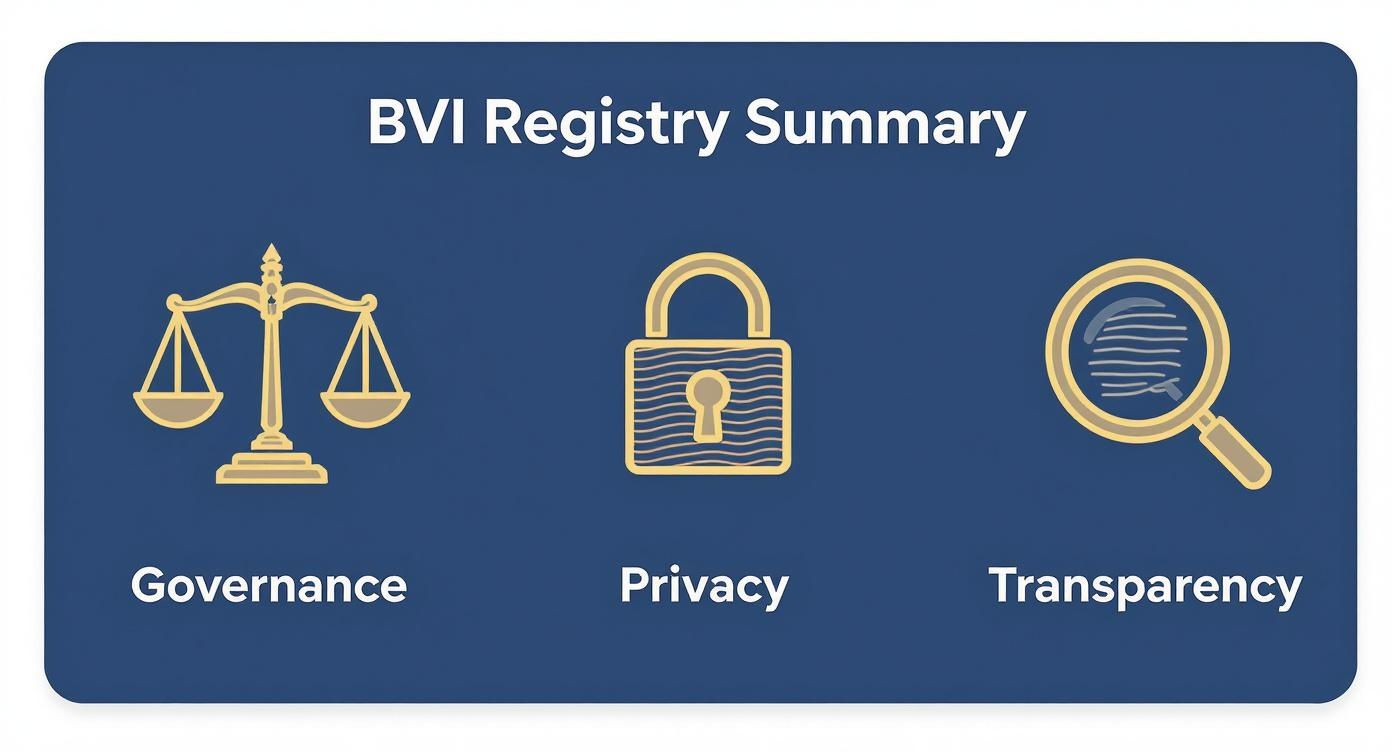
It’s all about striking a careful balance between strong governance, robust privacy, and the growing global demand for transparency.
The Public Trail: What You'll See
When you conduct a standard search, you're getting a snapshot of the company. It's foundational information, but it's intentionally limited. Think of it as the cover of a book—it gives you the title and author, but not the story inside.
So, what can you expect to find in a publicly accessible search report?
- Company Name: The full, official legal name.
- Company Number: The unique incorporation number assigned by the registry.
- Incorporation Date: When the company was officially formed.
- Current Status: This is a big one. It will tell you if the company is 'Active', 'Struck-Off', or dissolved. An 'Active' status is your first green light.
- Registered Agent & Office: The name and address of the licensed agent in the BVI handling the company's affairs.
Key Takeaway: A standard search confirms a company's existence and its basic legal standing. It's the first and most essential step in your verification process, but it is not the last.
The Confidential Veil: What Stays Private
This is where many due diligence efforts hit a brick wall. The information you often want most—like who owns the company—remains confidential by default. The BVI’s legal framework is specifically designed to protect this data, which is held securely by the company’s registered agent, not on a public database.
To help manage your expectations, this table clearly separates what you can find from what you can’t.
Public vs Private BVI Company Information
| Information Type | Publicly Available? | Notes & Context |
|---|---|---|
| Company Name & Number | Yes | Basic identifiers to confirm the entity exists. |
| Incorporation Date | Yes | Helps establish the company's age and history. |
| Company Status | Yes | Critical for verifying if the company is in good standing. |
| Registered Agent/Office | Yes | Confirms the official point of contact in the BVI. |
| Director Names | Yes (since 2023) | A recent major change. Searchable for a fee. |
| Shareholder Details | No | The identity of the owners (members) is confidential. |
| Beneficial Ownership (UBO) | No | Information on the ultimate beneficial owners is private. |
| Financial Records | No | BVI companies are not required to file public financial statements. |
| Company Resolutions | No | Internal corporate decisions and minutes are not public. |
As the table shows, the BVI system prioritizes shareholder and financial privacy while offering just enough public data for basic verification.
Once you have the public documents, knowing effective document analysis techniques becomes crucial for extracting every ounce of value from the limited information available.
A Recent Shift Towards Transparency: Director Names
There has been a significant change recently. While the Register of Directors was historically kept private, amendments to the BVI Business Companies Act have shaken things up. Companies must now file a copy of their director register with the BVI Financial Services Commission (FSC).
As of early 2023, the names of current directors became searchable for a fee. This was a massive step for the BVI, bringing it more in line with global transparency standards. Considering the jurisdiction hosts an incredible number of companies—around 374,890 active entities as of late 2022—this was a major undertaking.
This change is a game-changer for due diligence. While you still can't see who owns the company, you can now verify who is managing it. And in many cases, that's a critical piece of the puzzle.
How to Conduct an Official BVI Registry Search
Trying to perform an official BVI company registry search can feel like trying to get into an exclusive club. You can't just browse a public website. The main gateway is the BVI Financial Services Commission's (FSC) digital platform, known as VIRRGIN, and it’s built primarily for registered agents, not the general public.
However, understanding this system is the key to solid due diligence. It's the ultimate source of truth for any BVI company.
Let's return to our real-world scenario. You're a Hong Kong-based entrepreneur about to enter into a joint venture with a BVI tech company. Before you transfer that first major payment, you have to verify that they are who they claim to be and are in good standing. Your first, and most reliable, move is to go directly to the source: the official registry.
Your Starting Point: The VIRRGIN System
Unlike many jurisdictions where a quick online search yields instant results, the BVI process is more formalized. The entire ecosystem runs on VIRRGIN, which stands for Virtual Integrated Registry and Regulatory General Information Network. It's the electronic hub where all official company filings are managed, representing a huge leap in the BVI's modernization.
The registry has transformed dramatically over the years, especially after the BVI Business Companies Act was introduced in 2004. This act overhauled the legal framework, leading to a boom in company formations and cementing the BVI's reputation as a top offshore center. With over 350,000 active companies today, VIRRGIN is the essential tool for managing this massive volume of data with both efficiency and strict compliance.
So, how do you, as an outsider, gain access? You’ll almost always need to work through an intermediary—a local BVI registered agent or a corporate services firm that holds direct login credentials for VIRRGIN. While you might be able to approach the Registry of Corporate Affairs directly for some basic requests, using a service provider is far more common.
Navigating the Search Process
Before you do anything else, get your facts straight. To get a successful result from the registry, you need one of two things:
- The company's exact, full legal name.
- The unique company incorporation number.
Don't bother with partial names or "trading as" names; the system will simply come up empty. Precision is everything. Once you have the correct identifier, you can request a basic company search, which will typically cost around US$50.
The image below gives you a sense of the formal guidance provided by the BVI FSC. It's a reminder that every interaction is structured and must follow a specific procedure.

This structured approach is what ensures the data you receive is authoritative and reliable.
What the Search Results Tell You
Usually within 24 hours, you'll receive a search report. This document isn't a deep dive into the company's entire history, but it provides the critical vital signs you need to make an informed decision.
Pro Tip: The single most important piece of information on this initial report is the company's status. This one word tells you whether to move forward with confidence or stop everything immediately.
Here's a quick rundown of what each status means for your deal:
- Active: This is the green light. It confirms the company is in good standing and has paid its annual government fees.
- Struck-Off: A massive red flag. The company has been removed from the register, almost always for failing to pay its fees. It has no legal standing and cannot conduct business or manage its assets.
- In Penalty: The company has missed a payment deadline but is still in the grace period before being struck off. Think of it as a warning sign of potential administrative or financial trouble.
- In Liquidation: The company is being formally wound up, and its assets are in the process of being distributed to creditors and shareholders.
Ordering Official Documents for Deeper Checks
If the company's status comes back as 'Active', your next logical step is to order official documents to build out your due diligence file. These are legally recognized records that offer concrete proof of a company's standing and structure.
You can request these documents through the same registered agent or service provider. Here are the most common ones:
| Document Type | Typical Fee (USD) | What It Proves |
|---|---|---|
| Certificate of Good Standing | $100 | A snapshot in time confirming the company is active and compliant. |
| Certificate of Incorporation | $50 – $75 | Verifies the company's legal existence and date of formation. |
| Memorandum & Articles | $100 | The company's rulebook, outlining its powers and governance. |
| List of Directors Search | $75 | Confirms the names of the currently registered directors. |
Getting your hands on these documents gives you hard, verifiable data straight from the official source. In our joint venture scenario, a fresh Certificate of Good Standing would give you the confidence to proceed, knowing your potential partner has met their core regulatory duties. It's a formal, methodical process, but it's designed to deliver reliable, authoritative information.
When to Hire a Third-Party Search Service
An official BVI company registry search is your most reliable first step. It gives you foundational facts straight from the source. But what happens when that initial report hints there's more to the story? Sometimes, the public trail just isn’t enough, especially when millions of dollars and your business's reputation are on the line.
This is precisely when a professional third-party search service becomes invaluable. These specialists—usually local BVI registered agents or established corporate service providers—hold the keys to information you simply can't get on your own. They have direct access to the VIRRGIN system and, just as importantly, the local relationships needed to pull non-public documents.
Think of it this way: your official search confirms a building exists at a specific address. A third-party service gets you the blueprints.
Going Beyond the Basics
Certain situations demand far more than a simple Certificate of Good Standing. If you're involved in any high-stakes activity, you must move beyond basic verification.
It’s time to call in a professional when you need to:
- Obtain Confidential Documents: Critical records like the Memorandum and Articles of Association or a detailed Register of Charges aren't typically handed out. A local agent can formally request these on your behalf.
- Verify Director Information: While director names are now searchable, obtaining a certified copy of the Register of Directors provides an official, verified record essential for legal or compliance purposes.
- Conduct Enhanced Due Diligence: For mergers, acquisitions, or major investments, you need a complete picture of a company’s internal governance and history. A third party can collate a full suite of documents to give you that clarity.
This level of scrutiny is also crucial for your own compliance. Ensuring your partners meet international standards is non-negotiable. A deep-dive search helps you understand how to pass KYC for offshore companies by confirming the legitimacy of the entities you're about to do business with.

A Real-World Case Study
Picture a Singapore-based private equity firm eyeing a promising BVI tech company for acquisition. The initial VIRRGIN search confirmed the target was 'Active' and provided the names of its two directors. On the surface, everything looked fine.
But for a deal of this size, "surface level" was a non-starter. They hired a BVI-based corporate services firm to dig deeper. This agent was able to obtain the company's full Memorandum and Articles of Association.
The discovery was critical: Buried in the articles was a "poison pill" provision. It was designed to trigger a massive stock issuance if the company was acquired, which would have severely diluted the value for the new owners. This clause was completely invisible in the public record.
The acquisition was immediately paused, and the terms were renegotiated. The third-party agent’s work saved the firm from a multi-million-dollar mistake—a perfect illustration of when expert help is indispensable. For firms managing numerous investigations like this, exploring what legal process outsourcing offers can be a smart way to handle these complex tasks efficiently.
Vetting Your Search Partner
Not all providers are created equal. When choosing a firm for a sensitive BVI company search, you need to ask some pointed questions to make sure they can actually deliver.
Here's what to clarify before you engage them:
- Direct VIRRGIN Access: Do they have their own direct login, or are they just outsourcing to another firm? Direct access means faster, more reliable service.
- Turnaround Times: Get specific timelines. Ask, "How long will it take to get a certified copy of the Register of Directors?" You need firm commitments, not vague promises.
- Fee Structure: Demand a complete breakdown of costs. Are there separate fees for the search, document retrieval, and certification? Steer clear of providers with opaque pricing.
- Experience: How long have they been operating in the BVI? Local knowledge and established relationships with the registry are incredibly valuable and can make all the difference.
Choosing the right partner transforms your search from a simple data pull into a strategic intelligence-gathering mission. It’s about knowing when to stop digging yourself and when to hand the shovel to an expert.
Common Search Mistakes and How to Avoid Them
Venturing into a BVI company registry search can feel like navigating a minefield. Even with the best intentions, small oversights can lead to incorrect information, wasted time, and unnecessary costs. I’ve guided countless entrepreneurs through this process, and I’ve seen the same few tripwires derail an entire due diligence effort time and again.
The good news? These mistakes are entirely avoidable. If you know what to look for, you can approach your search with confidence, ensuring you get it right the first time. It’s all about being proactive, not reactive.
Searching with Incomplete or Incorrect Details
The most common error is also the most basic: trying to search with a slightly incorrect company name. You have to remember the BVI registry's search tool is brutally literal. It won't guess what you mean or offer helpful suggestions like Google. If you search for "Global Ventures Ltd" when the official name is "Global Ventures Limited," you'll probably get nothing back.
It's a classic scenario. You're trying to vet a new supplier, but all you have is their trading name from an invoice. Searching with that name is almost guaranteed to be a dead end.
Actionable Tip: Before you start, insist on getting either the full, exact legal name or the company incorporation number. These are the only two pieces of information that guarantee a direct hit in the official registry. Don't move forward without one of them.
Misinterpreting Company Status
Another major pitfall is not understanding what a company's status actually means in the real world. Simply finding the company listed isn't enough; its status tells the most critical part of the story. I recall an entrepreneur who saw a potential partner’s company listed and assumed everything was fine, only to discover later its status was "Struck-Off."
This mistake can be incredibly costly. A "Struck-Off" company cannot legally do business, sign contracts, or manage its assets. Partnering with one is a huge risk, leaving you with zero legal recourse if things go wrong.
- Active: This is your green light. The company is up-to-date with its annual government fees.
- Struck-Off: A massive red flag. The company has been removed from the register for non-payment and has lost its legal standing.
- In Liquidation: The company is being formally wound up and its assets sold off. Steer clear of any new business dealings.
Relying on Outdated Unofficial Data
The internet is filled with third-party databases promising instant access to BVI company information. While convenient, many of these sites run on scraped or old data. Using them is like trying to navigate a new city with a five-year-old map—the main roads might still be there, but all the critical details have changed.
The BVI's corporate register is constantly in flux. For instance, statistics from mid-2023 showed a small dip in total registered companies, falling to 366,050 in Q2 from 372,439 in Q1 of that year. This movement highlights just how dynamic the registry is, which is why real-time, official data is non-negotiable for proper due diligence. You can dig deeper into these figures and their meaning in detailed industry reports on BVI company statistics.
Always remember: only data pulled directly from the official VIRRGIN system or a reputable, registered BVI agent is verifiably current. Your entire investigation hinges on the quality of your source, so this is one corner you can't afford to cut.
Your Questions, Answered
When you start digging into the BVI company registry, a few questions almost always pop up. Over the years, I’ve heard them all. Here are the straightforward, no-nonsense answers to the most common queries I get from clients.
Can I Find Out Who Owns a BVI Company?
This is the big one, and the short answer is almost always no—at least, not from a public search. The BVI’s corporate framework is built on a foundation of shareholder privacy. The document listing the owners, known as the Register of Members, is held securely by the company’s registered agent. It’s not a public record.
Accessing that information is exceptionally difficult. It typically requires a formal BVI court order or a request from a recognized regulatory authority as part of an official investigation. For standard business due diligence, you must assume that shareholder details will remain private.
How Long Does It Take to Get Official Documents?
The turnaround time really depends on what you're after.
- For instant results: A basic online check through the VIRRGIN portal (usually done via a service provider) to confirm a company's name, number, and current status is practically immediate.
- For official documents: If you need to order certified paperwork like a Certificate of Good Standing or a copy of the company's Memorandum and Articles, you’ll need a bit of patience. The registry can take several business days to process and issue these.
- For a faster track: This is where using a good third-party service or the company's registered agent pays off. Many can get official documents back to you within 24 to 72 hours. Just be sure to ask about their specific service times before you commit.
What Does a Struck-Off Status Mean?
Seeing "Struck-Off" next to a company name is a serious red flag that should stop you in your tracks. It means the BVI Registrar has removed the company from the official register, almost always because it failed to pay its annual government fees.
A "Struck-Off" company exists in a state of legal limbo. It cannot legally trade, manage its assets, sign new contracts, or even defend itself in court. Crucially, its directors and members lose the protection of limited liability during this period.
While a company can be restored, this status points to significant compliance issues or potential financial distress. In any due diligence check, it's a clear warning to proceed with extreme caution.
Is Information from an Online Search Legally Valid?
This is a really important distinction. The data you get directly from the BVI Registry's VIRRGIN portal is considered the official, accurate record at that specific moment in time. Think of it as a reliable snapshot.
However, for legal proceedings, major contracts, or any scenario where you need formal proof, a simple search printout won’t be enough. You must order certified copies of documents from the registry, like a Certificate of Incorporation or a Certificate of Good Standing. These come embossed with an official seal, giving them legal authority.
On the flip side, any information you find on unverified third-party websites or random online databases should never be treated as legally valid. Relying on that kind of data is a huge risk, as it’s often outdated or simply incorrect. Always go to the official source or use a reputable provider with direct access.
Conclusion
A BVI company registry search is more than just a box-ticking exercise; it’s a fundamental step in protecting your interests. But as you've seen, it's often just the first piece of the puzzle. At Lion Business Consultancy Limited, our expertise is in helping entrepreneurs navigate the intricate world of international corporate structures, from initial due diligence to secure banking and tax optimisation.
If you’re looking for a partner to bring clarity and expert support to your global operations, we’re here to help. See how our private advisory services can safeguard your business and clear the path for your expansion.