

 Hong Kong
 Singapore

 UAE
UAE



 Malaysia

 Turkey
 UK
UK
 EU
EU
 US
US
 Switzerland
 Bahamas Bank Account
 Cayman Islands Bank Account
 Mauritius Bank Account

 BVI
BVI
 Seychelles

Choosing the right accounting firm in hk isn't just about ticking a compliance box. Think of it as hiring a financial co-pilot for your business journey. The right one helps you navigate turbulence and find the clearest path to your destination. The wrong one? They’re just a passenger looking out the back window, telling you where you've already been.
Why Your Accounting Firm Is a Strategic Partner, Not Just a Bookkeeper

For busy entrepreneurs in Hong Kong, it's tempting to view accounting as just another overhead cost. That's a huge, and surprisingly common, mistake. A great accounting partnership is a powerful investment in your company's future. They don't just count the beans; they help you figure out how to grow more. They’ll help you master cash flow, spot hidden growth opportunities, and stay ahead of the city’s complex regulations.
Let’s imagine two startups. One partners with a proactive, tech-savvy firm that provides real-time financial dashboards and sharp strategic advice. The other hires a traditional firm that only calls when a tax deadline is breathing down their neck. The first startup scales smoothly, confidently securing investor funding with pristine, insightful financials. The second is constantly putting out financial fires, missing opportunities because their data is always out of date.
Beyond Compliance to Strategic Growth
The real difference lies in their mindset. A compliance-focused firm ensures you file everything on time. A strategic partner considers that the absolute bare minimum. Their true value comes from helping you understand the story your numbers are telling.
They help you answer the big questions:
- Is our pricing model truly profitable?
- Where are the invisible leaks in our cash flow?
- Is our current business structure the most tax-efficient for our next stage of growth?
The best accounting partnerships shift the focus from historical reporting to forward-looking strategy. They don’t just tell you where you’ve been; they help you map out where you’re going.
This distinction is crucial in Hong Kong's competitive market. The accounting industry here is vast, with 6,545 establishments employing nearly 35,000 people, many within the major international players. With so much choice, finding a genuine partner means looking beyond the basic promises of statutory audits and tax filing.
This is where the real value of finance and accounting outsourcing shines. It isn't just about offloading tasks; it's about plugging into specialist expertise that can drive real growth and efficiency.
To see what a high-calibre firm can really bring to the table, have a look at our complete guide to accounting services in Hong Kong.
What to Expect From Your Accounting Partner
Not all accounting firms are created equal. Here’s a quick breakdown of what separates a basic service from a true partnership that can help your SME thrive.
| Attribute | Basic Compliance Firm | Strategic Growth Partner |
|---|---|---|
| Focus | Historical data and tax deadlines | Future-focused financial strategy and growth |
| Communication | Reactive, often only at year-end | Proactive, with regular check-ins and insights |
| Technology | Traditional spreadsheets, manual processes | Cloud-based software, real-time dashboards |
| Value Proposition | Keeps you compliant with regulations | Provides actionable advice to improve profitability |
| Relationship | A necessary service provider | An integrated part of your leadership team |
Choosing a strategic partner means you’re not just hiring a number-cruncher; you’re investing in a financial brain trust for your business.
Defining What Your SME Actually Needs
Before you dive into a Google search for “accounting firm HK” and get lost in a sea of slick websites, pause. The most critical work happens right now, before you speak to a single firm. You need to get brutally honest and map out what your business actually requires.
Think of it like building a house. You wouldn't hire a contractor without a detailed blueprint, would you? It's the same principle. This internal brief is your blueprint—the one thing that will prevent you from being swayed by a sales pitch for services you don’t need. Without this clarity, you're just guessing, and that’s a surefire way to end up with a firm that’s a poor fit.
From Startup Basics to Scale-Up Complexities
Naturally, your needs will vary dramatically depending on where you are in your business journey. A brand-new e-commerce store needs a completely different kind of support than an established F&B chain with multiple locations.
Start by asking a few pointed questions:
- What’s our current stage? Are we a pre-revenue startup needing help with the fundamentals, like company setup? Or are we a growing SME facing our first statutory audit?
- What services are non-negotiable? Do we just need someone for annual compliance and tax filing to keep the IRD happy? Or do we need an expert in the trenches with us, providing regular, professional bookkeeping services to manage daily operations?
- Do we need a scorekeeper or a strategist? Are we looking for someone to just tick the boxes, or do we need a strategic partner who can offer real advice on cash flow, profitability, and our next big move?
Answering these questions honestly helps you filter out unsuitable firms immediately. For instance, if you handle numerous cross-border transactions, you absolutely need a firm with deep international tax experience, not one that only focuses on local compliance. A mismatch here isn't just an inconvenience; it can lead to seriously expensive mistakes down the line.
Your brief isn’t just a wish list; it's a strategic document. It defines the scope of the partnership and becomes the yardstick against which you measure every potential firm.
This initial self-assessment is, without a doubt, the most powerful step you can take to find the right accounting partner in Hong Kong. It puts you in the driver's seat, ensuring you focus on what truly matters for your company’s financial health and future.
How to Vet a Hong Kong Accounting Firm Beyond the Brochure
A polished website and a glossy brochure don’t tell the whole story. Many entrepreneurs learn this the hard way, falling for a great online presence only to discover the firm is unresponsive, disorganized, and completely out of sync with their business. That's a frustrating and costly mistake.
I’ve seen it happen. A founder, let's call her Sarah, chose an accounting firm in HK because their digital footprint was impressive. A few weeks in, urgent emails about tax filings were met with silence, and the financial reports she finally received were riddled with errors. Her initial excitement quickly turned into a mad scramble to find a competent partner before critical deadlines loomed.
To avoid Sarah’s fate, you need to dig deeper. Your due diligence must go far beyond a quick glance at their service list.
Your first move? Always verify that the firm and its key people are properly registered with the Hong Kong Institute of Certified Public Accountants (HKICPA). This is the absolute baseline for professional conduct and quality—a non-negotiable.
Before you even start shortlisting firms, it’s vital to get your own house in order. This infographic lays out a simple process for figuring out what you actually need.
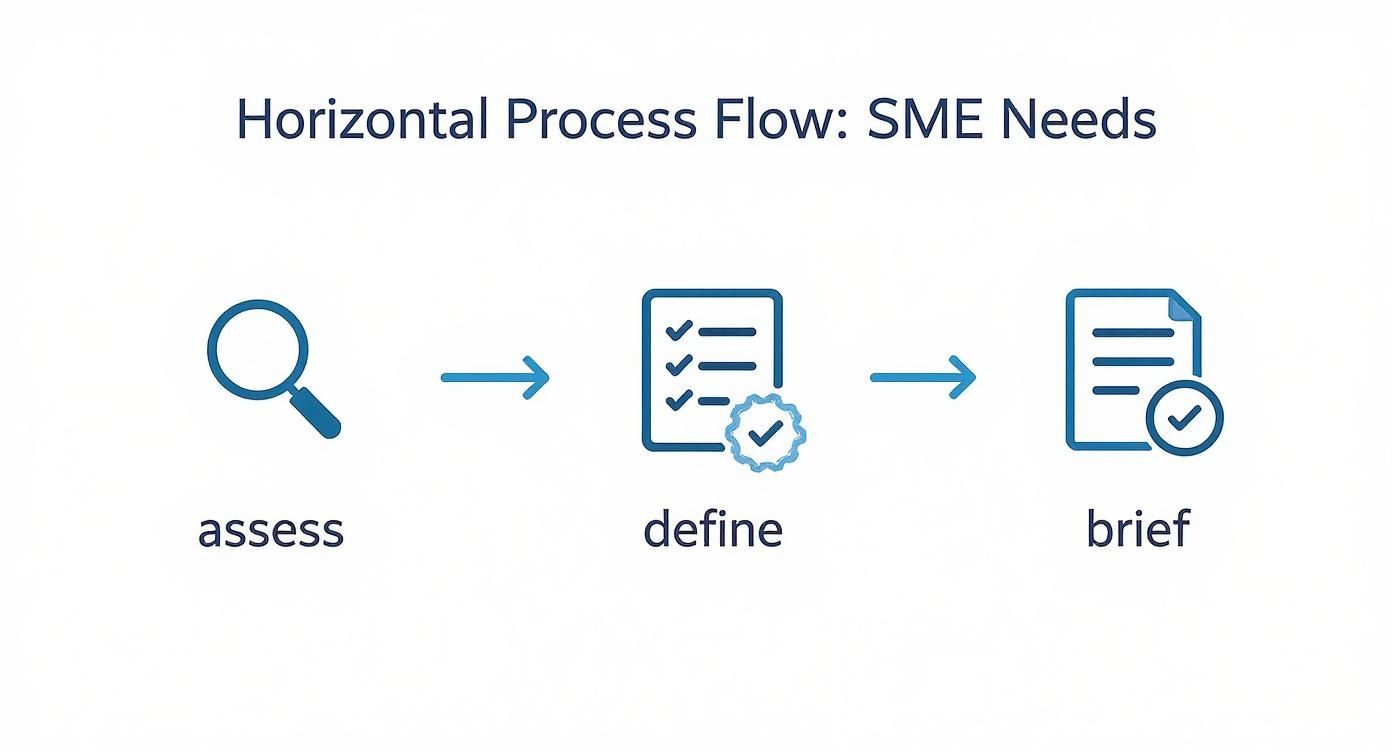
Following these steps ensures you’re assessing potential partners based on a clear understanding of your business, not just on how well they market themselves.
Asking the Right Questions in Your First Meeting
Once you have a shortlist, the initial consultation is your chance to gather real intelligence. Don't be shy. You need to ask direct, probing questions that reveal how they really operate.
Go beyond the basics. Try asking things like:
- Who’s on my team? "Who will be my day-to-day contact, and what's their seniority? Will I work directly with a partner, or will my account be passed to a junior associate?"
- How do you communicate? "What are your standard response times for emails and calls? How often should I expect scheduled meetings to review my financials?"
- Who do you typically work with? "Can you describe your ideal client? What percentage of your clients are in my industry and at a similar growth stage?"
Getting specific about their experience with businesses like yours is crucial. A firm that excels with established trading companies might not grasp the fast-paced, often chaotic world of a tech startup, no matter how skilled they are on paper.
Finally, probe their approach to tax. Ask how they stay on top of regulatory changes and how they proactively advise clients on improving tax efficiency. Understanding their perspective on the Hong Kong profits tax framework will tell you everything. Are they reactive compliance clerks, or are they genuine strategic advisors who can help you grow?
Decoding Service Packages and Fee Structures
Getting a straight answer on pricing can be one of the biggest headaches when choosing an accounting firm in HK. The quotes and fee structures often feel intentionally confusing, but once you know what to look for, you can cut through the noise and see which firm offers genuine value.
Let's demystify the common packages so you can compare quotes with confidence.
Most firms will offer bundled service packages. You'll see terms like ‘bookkeeping,’ ‘tax advisory,’ and ‘corporate secretarial services’ grouped together. Think of bookkeeping as the daily financial scorekeeping. Tax advisory is the strategic game plan to keep your tax bill as low as legally possible. Corporate secretarial services handle the critical, but often tedious, compliance paperwork required by Hong Kong law.
Fixed Fees Versus Hourly Rates
You'll almost always encounter two pricing models: fixed-fee packages or billing by the hour. A fixed fee is predictable—you pay a set amount monthly or annually for a clearly defined scope of services. Simple. Hourly rates, on the other hand, can look tempting at first but often become a nightmare for a growing business.
Imagine this: you're a startup that signs on with a firm offering a low hourly rate. For the first few months, things are slow, and the bills are manageable. But then business picks up. You're making more sales, hiring staff, and naturally have more questions. Suddenly, every quick phone call and email chain adds to a rapidly growing invoice. That 'affordable' rate has become a major source of stress.
A fixed-fee model forces an accounting firm to be efficient. Their incentive is to get the work done right and on time, not to drag it out to log more hours. It aligns their success with yours.
This is precisely why a transparent, fixed-fee package is almost always the smarter choice for SMEs. It provides cost certainty, allowing you to budget properly without the fear of a surprise bill every time you need advice. It’s the foundation for a real partnership, not just a transaction.
What to Look for in a Quote
When a proposal lands in your inbox, it's time to put on your detective hat. A good quote is crystal clear about the scope of work. It lists exactly what’s included and, just as importantly, what’s not.
Watch out for vague language or hidden costs. Will you be charged extra for annual audit support? What about special tax filings or responding to an IRD inquiry? These are the kinds of 'out-of-scope' items that can emerge as nasty surprises.
The Hong Kong accounting scene features everyone from global giants like PwC and Deloitte to fantastic local specialists. The bigger firms are known for comprehensive services covering audit, tax, and a wide range of advisory. This breadth is something to consider. To get a feel for the major players, it’s worth taking a look at Hong Kong's audit firm rankings to understand what they bring to the table.
Making Your Final Choice and Onboarding for Success

You’ve narrowed down the contenders. Now, the decision moves beyond a credentials checklist. This is where you need to get a feel for the firm's culture and communication style. You're not just hiring a service; you're building a relationship that needs to click with your own team.
Pay close attention to the human element in your final interactions. Are they proactive with ideas, or do you find yourself constantly chasing them for updates? These small cues are often the best predictors of what a long-term partnership will actually feel like.
To sharpen your focus, here are a few final checks I always recommend:
- Scalability Potential: Can they genuinely grow with you? Ask for examples of clients they've helped scale from your size to the next level.
- Technology Alignment: This is non-negotiable. Ensure they are experts in your preferred accounting software, not just familiar with it.
- Vision Fit: Do their long-term strategic insights complement your business goals?
- Cultural Sync: Do your working styles and company values align? A mismatch here can cause endless friction.
- Communication Rhythm: How often will you connect? Agree on the frequency and channels for updates to ensure a seamless dialogue.
A Smooth Handoff: The Onboarding Process
Once you've made your decision, a structured onboarding process is the key to a strong start. Don't just hand over a box of receipts and hope for the best.
Kick things off with a formal meeting to introduce your respective teams and set clear expectations from day one. This is your chance to map out the entire handover.
Your initial steps should look something like this:
- Document Transfer: Securely share access to all necessary financial records, past reports, and tax filings.
- System Setup: Grant the required permissions in your cloud accounting platforms, whether it's Xero, QuickBooks, or another system.
- Clarify Roles: Define exactly who is responsible for what. This avoids confusion and prevents tasks from falling through the cracks.
- Set a Reporting Schedule: Establish a clear cadence for financial reviews and strategic planning sessions. Monthly? Quarterly? Get it on the calendar.
This structured approach sets the right tone, establishing a partnership built on efficiency and clear communication. The good news is that many firms are ready for this kind of growth. In fact, sentiment among Hong Kong’s accounting and finance professionals is largely optimistic.
A recent CPA Australia survey found that over half of respondents expect to increase their headcount, with an impressive 64% of larger firms planning to hire more staff. You can read more in the full Hong Kong economic and business sentiment report.
A proper, structured onboarding process is what transforms a simple vendor relationship into a genuine strategic partnership. It aligns everyone on roles, technology, and objectives right from the start.
This blend of human insight and methodical onboarding ensures your new accounting firm HK partnership is built on solid ground.
Final Tips Before You Sign
When it comes down to it, trust your instincts but back them up with evidence.
One of the best ways to get a real-world feel for their workflow is to ask for a small trial project or a short-term pilot. This gives you a low-risk way to see them in action before committing long-term.
And finally, always schedule a quick review a month or two after onboarding to iron out any early wrinkles.
A short pilot project can reveal potential communication gaps or workflow inefficiencies before the formal engagement begins.
With these steps, you’ll be ready to kick off your new accounting partnership with confidence.
Common Questions When Choosing an Accounting Firm
Even with a solid plan, you're bound to have a few final questions as you get ready to appoint a new financial partner. Getting clear answers is crucial for moving forward with confidence. Let's tackle some of the most common queries we hear from SMEs.
What’s the Real Cost for SME Accounting in Hong Kong?
This is always the first question, and the honest answer is: it depends. The cost for an accounting firm in HK can vary significantly based on your business complexity, transaction volume, and the depth of service you need.
For a straightforward small business, basic monthly bookkeeping might start at a few thousand HKD. But if you’re looking for a comprehensive package—including strategic tax advice, corporate secretarial duties, and audit preparation—you should expect a higher investment.
My Advice: Always insist on a detailed proposal that clearly outlines a fixed scope of work. This is your best defense against unpredictable hourly billing, where costs can quickly spiral as your business grows.
Should I Go with a Big International Firm or a Local One?
The right answer here depends entirely on your business model. If you're a large multinational with complex cross-border operations, or you need the weight of a "Big Four" name on your audit report to satisfy investors, then a major international firm makes sense.
For most SMEs, however, a well-regarded local Hong Kong firm often provides a much better fit. You’ll typically receive more personalized attention, they tend to be more flexible, and you'll likely find they offer better value for money.
- Look for expertise that matches your specific industry.
- Don't underestimate cultural fit and the value of a strong working relationship.
- Try not to be swayed by a big brand name alone.
How Often Should I Expect to Hear from My Accountant?
A good firm will establish a clear communication rhythm from the start. For most growing businesses, a monthly check-in to review financials and a deeper quarterly meeting for strategic planning is a great baseline.
But the true test of a firm is how they handle your questions between those meetings. Are they responsive? Do they get back to you promptly? Proactive communication is the hallmark of a true partner. If you feel like you’re always the one chasing them for an update, that’s a major red flag.
Conclusion
At Lion Business Consultancy Limited, we don’t just provide a service; we build genuine partnerships. Think of us as your private financial manager, delivering the one-on-one guidance and strategic structuring you need to expand your business globally. If you need a financial bodyguard who spots problems before they happen, let's talk.