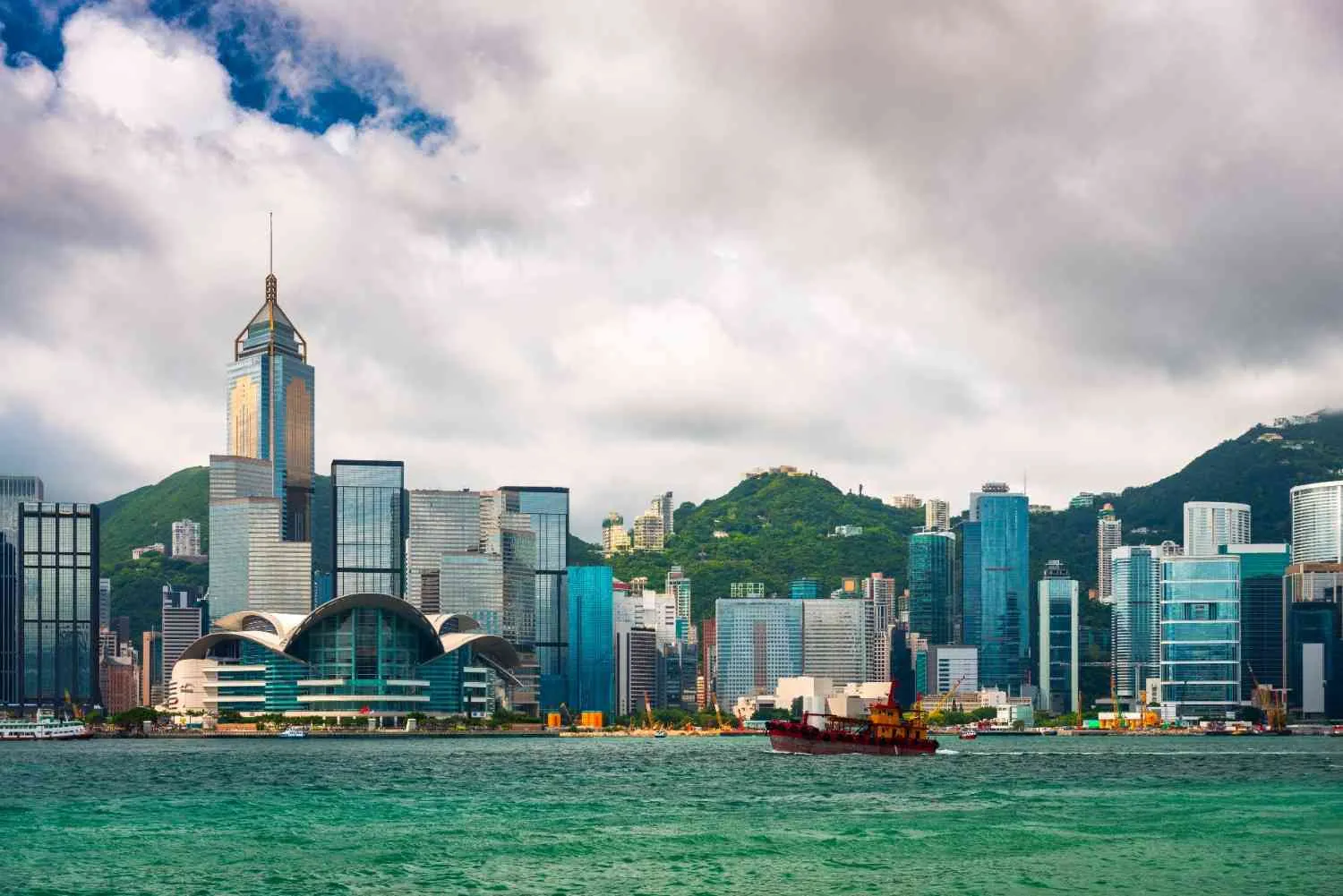

 Hong Kong
 Singapore
 UAE
UAE


 Malaysia
 Turkey
 UK
UK
 EU
EU
 US
US
 Switzerland
 Bahamas Bank Account
 Cayman Islands Bank Account
 Mauritius Bank Account
 BVI
BVI
 Seychelles

For any entrepreneur with global ambitions, securing a reliable bank account in Hong Kong isn't just another item on a checklist—it's a foundational strategic move. Think of it less as a simple account and more as a financial super-connector, expertly bridging the gap between Eastern and Western markets with a level of efficiency and stability that’s hard to find elsewhere.
Why Hong Kong Is a Top Choice for Global Banking

Before we dive into the practicalities, let's appreciate why Hong Kong holds such magnetic appeal for international business. For decades, it has meticulously crafted a reputation as a fortress of financial stability. It's more than a city; it's an ecosystem engineered from the ground up for global commerce.
It's a bit like choosing the foundation for your headquarters. You wouldn't build on shaky ground. Your business's capital deserves the same rock-solid footing, and Hong Kong's infrastructure makes it the premier choice for ambitious SMEs and international founders.
A Gateway to Global Markets
Hong Kong’s most potent advantage is its unique position. It serves as a direct, frictionless gateway into Mainland China while maintaining deep financial roots with Western economies. This dual role means businesses can seamlessly manage multiple currencies, access vastly different markets, and operate with a truly global mindset.
Beyond geography, the city's banking system is built on a bedrock of trust and international standards. Its regulatory framework is clear and predictable, giving business owners the security essential for long-term planning. It's this reliability that attracts capital from every corner of the world.
The sheer scale of Hong Kong's banking sector is a testament to its strength. Total deposits hit a colossal $2,452.554 billion USD as of October 2025, a figure that showcases the incredible liquidity available to power international trade and investment. You can explore more financial insights on CEIC Data.
The Strategic Advantages for Entrepreneurs
For an entrepreneur, banking in Hong Kong is about more than convenience. It’s about plugging into a system genuinely designed for business success.
Hong Kong offers a unique combination of a low-tax environment, a world-class legal system based on English Common Law, and the free flow of capital. This trifecta is precisely what international businesses need to thrive without unnecessary friction.
Here are the core benefits that make opening a bank account in Hong Kong so compelling:
- Tax Efficiency: Hong Kong employs a territorial tax system. In simple terms, this means profits your business generates outside of Hong Kong are not taxed there. For a company with a global client base, this is a game-changer.
- Financial Stability: The Hong Kong Dollar (HKD) is pegged to the US Dollar. This link creates a stable currency, dramatically reducing the risk of exchange rate volatility disrupting your international transactions.
- Unrestricted Capital Flow: Unlike many other major hubs, Hong Kong has no foreign exchange controls. You can move capital in and out freely, a critical feature for managing a global enterprise.
When you boil it down, setting up your financial base in Hong Kong builds a powerful, growth-oriented foundation for your business.
Choosing the Right Bank Account for Your Business
Picking the right bank account in Hong Kong is like a chef choosing the perfect knife. A heavy cleaver for delicate garnishes? A paring knife for butchering? Of course not. The tool must match the task. Similarly, your business account needs to be perfectly suited to the unique size, shape, and ambition of your company.
Hong Kong's banking landscape is a comprehensive financial toolbox, with each option designed for a specific purpose. Your job is to look beyond the big brand names and truly understand which tool will help you build your business most effectively—not just for today, but for the long haul.
This isn't just about finding a place to park your cash. It's a strategic decision that directly impacts your daily efficiency, international trading capabilities, and bottom line. Get it right, and global transactions feel effortless. Get it wrong, and you’ll find yourself tangled in unnecessary friction and fees.
Your Financial Toolbox Explained
Let's break down the main options. Each is tailored to different business models and their operational needs. Understanding what each does best is the first step toward finding your perfect fit.
-
Traditional Corporate Accounts: These are the established workhorses from giants like HSBC and Standard Chartered. They are the go-to for established SMEs and larger corporations needing a full spectrum of services—think trade finance, credit facilities, and dedicated relationship managers. Their key strengths are unparalleled stability and a global reputation.
-
Multi-Currency Accounts: An absolute must-have if your business lives and breathes international trade. Whether you're an e-commerce store selling in USD, EUR, and GBP, or a consulting firm invoicing clients across the globe, a multi-currency account is your best friend. It lets you hold, send, and receive different currencies without getting hammered by conversion fees on every transaction. Those savings add up fast.
-
Digital Banks & EMIs (Electronic Money Institutions): These are the modern, agile tools in the box. Players like ZA Bank and Airwallex deliver a slick, online-first experience. They are a fantastic match for startups, freelancers, and tech companies who value speed, low fees, and a great digital platform over a physical branch network.
The key is to match the account's features to your business's daily reality. An e-commerce business with high-volume, low-value transactions has fundamentally different needs than a consulting firm managing a few large international payments per month.
The scale of traditional banking in Hong Kong is immense, giving these institutions the capacity to handle massive transaction volumes. For instance, HSBC's Hongkong and Shanghai Banking Corporation reported customer accounts totalling HK$6,240.261 billion as of mid-2025, demonstrating the sector's incredible depth. You can explore more in their HSBC 2025 Interim Report.
Comparing Hong Kong Account Types for Your Business
To make the choice clearer, let's put the old guard and the new players side-by-side. This should help you pinpoint which camp your business falls into.
| Feature | Traditional Corporate Bank Account (e.g., HSBC, Standard Chartered) | Digital Bank or EMI (e.g., ZA Bank, Airwallex) |
|---|---|---|
| Best For | Established SMEs, large corporations, businesses needing trade finance or credit facilities. | Startups, freelancers, e-commerce, tech companies, and digital nomads. |
| Onboarding Process | Often requires in-person visits and extensive paperwork. Can be slow. | Fully online, often completed in hours or days. Much faster and more convenient. |
| Fees | Typically higher monthly fees, setup costs, and international transfer fees (SWIFT). | Lower or no monthly fees. Often better FX rates and cheaper international payments. |
| Services Offered | Full suite: loans, credit, trade finance, wealth management, in-person support. | Core focus on accounts, multi-currency wallets, cards, and fast international transfers. |
| User Experience | Can be clunky online banking portals, though they are improving. Strong branch network. | Modern, user-friendly apps and web platforms designed for a digital-first experience. |
| Global Reach | Excellent, with established correspondent banking relationships worldwide. | Strong in major corridors, but may have limitations with more obscure currencies or countries. |
Ultimately, there's no single "best" option—only the best option for your business. A traditional bank offers credibility and a massive service menu, while a digital provider offers speed and cost efficiency.
Making the Right Strategic Choice
So, how do you decide? Start with a few practical questions. The answers will guide you.
- What is your primary business activity? A local service provider has far simpler needs than a global import-export business.
- What does your transaction flow look like? Consider the volume and average value of your monthly payments, both incoming and outgoing.
- Which currencies will you handle? If you regularly work with more than just HKD and USD, a multi-currency account is a necessity, not a luxury.
- Will you need credit or trade financing? If the answer is yes, a traditional bank is almost certainly your best bet.
Before committing, get a bird's-eye view of the entire landscape. Our detailed guide on the full list of banks in Hong Kong can provide a deeper understanding of all your options.
Remember, a business bank account should never be a one-size-fits-all solution. It’s also worth reflecting on the importance of a dedicated business bank account for maintaining clean finances. By carefully weighing your needs against the available tools, you can choose a bank account HK that not only serves you today but is ready to scale with you tomorrow.
The Account Opening Process Demystified
Navigating the application for a bank account in Hong Kong can feel like trying to solve a puzzle without the picture on the box. It’s easy to get intimidated by the long checklists, but it's far from impossible. The secret is to stop seeing it as a series of bureaucratic hurdles and start seeing it as a structured conversation—a chance to tell your business's story in a way the bank understands and trusts.
Think of it this way: the bank isn't trying to make your life difficult. It's performing its due diligence to protect itself and the integrity of Hong Kong's financial system. Your job is to present a "bankable story"—a clear, compelling narrative backed by solid proof that shows your business is legitimate, well-run, and low-risk.
With the right preparation, this process transforms from a stressful ordeal into a straightforward roadmap. Let's walk through that map together.
Preparing Your Document Arsenal
This first stage is all about preparation. Banks in Hong Kong operate under strict Know Your Customer (KYC) and Anti-Money Laundering (AML) regulations, so they need a thorough set of documents to verify who you are and what your business does. Getting this right from the start is the single most effective way to avoid delays.
This simple flowchart breaks down the strategic thinking you should do before gathering any files.
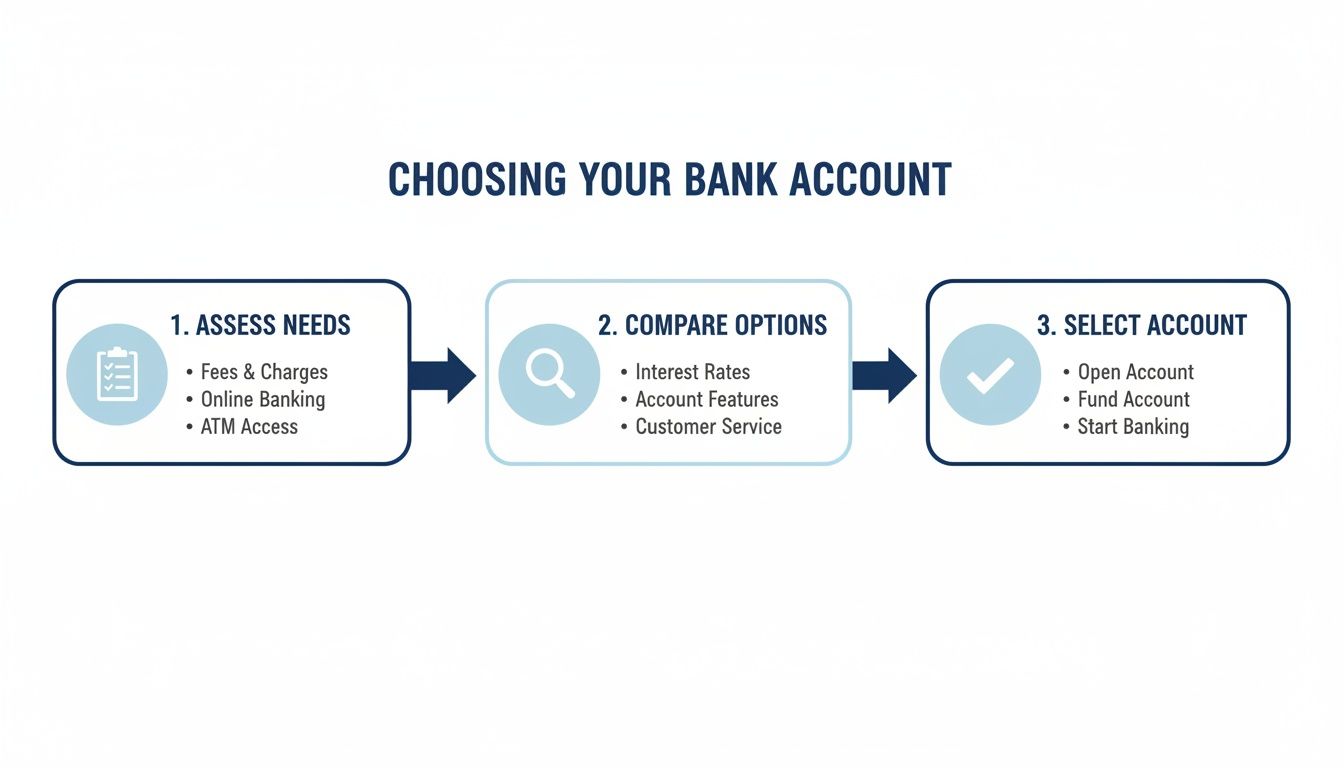
As you can see, a successful application begins long before you fill out a form; it starts with having absolute clarity on your business needs.
While specifics can vary slightly between banks, your document package will generally need to include:
1. Corporate Documents: These official papers prove your company legally exists and is in good standing.
- Certificate of Incorporation and Business Registration Certificate
- Articles of Association (your company's rulebook)
- A chart showing your company's ownership structure, especially if it involves multiple layers.
- A formal Board Resolution that officially greenlights opening the bank account hk.
2. Personal Identification: The bank needs to know exactly who is behind the business.
- Certified copies of passports and proof of residential address for all directors, significant shareholders (usually anyone holding 10% or more), and authorised account signatories.
3. Proof of Business Substance: This is where you demonstrate your business is a real, operating entity and not just a paper company.
- A comprehensive business plan is non-negotiable. It should clearly outline your business model, target market, and revenue projections.
- Proof of business activity is crucial. This could be existing contracts with suppliers or clients, recent invoices, or even a professional business website.
- Information about your expected transaction patterns, including the volume, value, and geographic origins of payments.
The Power of a Compelling Business Narrative
Your business plan is so much more than a formality; it's the heart of your application. This is your chance to tell the bank who you are, what you do, and why you specifically need a bank account in Hong Kong. A vague or poorly written plan is one of the fastest routes to rejection.
Your business plan should answer three core questions for the bank manager: Is this business legitimate? Do I understand its revenue model? And does its activity align with our bank’s risk appetite? A clear 'yes' to all three is your goal.
For instance, an e-commerce company should detail its product sourcing, logistics, and primary customer markets. A consulting firm should specify its areas of expertise, typical client profile, and invoicing process. This level of detail removes ambiguity and builds the bank’s confidence. For a deeper look at what banks are looking for, our guide on how to prepare compliance documents for a bank account offers a detailed checklist.
The Bank Interview: What to Expect
For most traditional banks, the process culminates in a face-to-face meeting in Hong Kong. This isn't an interrogation; it's a professional conversation. The relationship manager will simply ask questions based on your documents to confirm their understanding of your business.
Be prepared to speak confidently about:
- Your business operations and revenue streams.
- The specific reason you chose Hong Kong for your banking.
- Your key suppliers and customer base.
- Your anticipated account activity.
Consistency is key. The story you tell in the meeting must perfectly match the one laid out in your paperwork. Any discrepancies can raise red flags. Treat it as a pitch—you're selling the bank on why your business is a credible and valuable client. By demystifying the steps, you can navigate the process with confidence.
Navigating Compliance and Keeping Your Account Healthy

Getting your bank account in Hong Kong opened is a fantastic milestone, but it's just the beginning of the relationship. The real work is keeping that account in good standing and avoiding the dreaded freeze. It's easy to see the bank's periodic questions as a hassle, but there’s a vital reason for their vigilance.
This diligence is precisely what makes Hong Kong’s banking system so trusted. Banks aren't just holding your money; they're gatekeepers for the global financial network. They have a legal duty to combat money laundering (AML) and to know their customers (KYC). Think of it less as a hurdle and more as a security system that protects everyone.
Your job, from day one, is to build trust through transparency and impeccable record-keeping, not just for the application but for the entire life of your account.
Why Are the Banks So Strict?
To play by the rules, you have to understand the game. Hong Kong's financial stability is a magnet for international business. A key indicator of its economic strength is its consistent current account surplus, which hit 8.4918% of GDP in 2023. This points to high savings and strong exports, all underpinning the banking system's resilience.
But this strong position also makes it a target for illicit funds. So, regulators and banks enforce tough compliance rules to protect the city's integrity. Their caution is your protection, ensuring the system remains stable for legitimate businesses like yours.
A Cautionary Tale: The High Cost of Messy Paperwork
Let me paint a picture. An e-commerce business, thriving with international sales, opens a corporate account. Everything is smooth for a few months. Then, a large, unexpected payment lands in their account from a new supplier in a country the bank flags as high-risk.
The bank, doing its job, temporarily freezes the account and requests documents to verify the funds. This is standard procedure. The problem? The business owner had been sloppy with records. The invoice was informal, the contract was a quick email exchange, and there was no clean paper trail. What should have been a simple check turned into a month-long scramble for proof, freezing their cash flow and damaging their reputation with partners.
Here’s the key lesson: Proactive compliance isn't about dodging trouble; it's about being ready for scrutiny at all times. The bank will assume nothing and verify everything.
This entire nightmare was avoidable. With organised, professional documents ready, the bank's query could have been resolved in days, not weeks.
Proactive Steps to Stay in Good Standing
Building trust and avoiding freezes comes down to a few core habits. Making these part of your routine signals to the bank that you’re a reliable, low-risk client. For a step-by-step guide, our Hong Kong banking checklist helps SMEs avoid freezes and stay compliant.
Staying on top of local and global rules is a critical part of maintaining a healthy bank account in Hong Kong. For a deeper dive, it's worth reading up on mastering compliance in the financial services industry.
Here are the essential practices to build into your operations:
-
Keep Meticulous Records: Every significant payment—in or out—needs a clear paper trail. This means professional invoices, signed contracts, and shipping documents that all match up. Keep digital copies handy for quick access.
-
Communicate Before You Act: Expecting a big change? Tell your bank manager beforehand. Whether you're entering a new market, signing a major client, or receiving an unusually large payment, a heads-up turns a potential red flag into a documented part of your business growth.
-
Maintain Business Substance: Ensure your day-to-day activities align with the business plan you provided. If you pivot your business model, update the bank. A sudden, unexplained shift in transaction patterns is one of the quickest ways to trigger a review.
-
Respond to Inquiries Immediately: If the bank asks for information, make it your top priority. A prompt, detailed, and well-documented reply demonstrates professionalism and transparency, which goes a long way in building trust.
Ultimately, navigating compliance is about future-proofing your business. When you understand the bank’s perspective and operate with transparency, your bank account HK becomes a powerful asset for growth, not a source of stress.
Understanding Banking Fees and Tax Implications
Opening a bank account in Hong Kong is a smart move, but like any powerful tool, you need to understand how it works and what it costs. Getting a handle on the fees and tax rules isn't just about avoiding surprises on your monthly statement; it's about unlocking the full financial potential of your Hong Kong company.
Too many entrepreneurs focus so intently on getting the account approved that they overlook the running costs and, more importantly, the incredible tax advantages available. Let’s break down both, so you can structure your business for maximum profitability while ensuring full compliance.
Decoding Common Banking Fees
Think of bank fees as the price of admission to a world-class financial hub. They might seem complex at first, but they generally fall into a few standard categories. Knowing what to expect helps you budget effectively and choose an account that truly fits your business model, preventing you from leaking money on unnecessary charges.
Here’s a breakdown of typical fees:
- Initial Setup and Activation Fees: This is a one-time charge to get your account operational. For major banks like HSBC or Standard Chartered, expect this to range from HKD 1,200 to over HKD 10,000, often depending on your company's jurisdiction and structural complexity.
- Monthly Maintenance Fees: Most business accounts carry a monthly service fee. The good news is that banks often waive this if you maintain a minimum balance, which can range from HKD 50,000 to HKD 200,000 or more.
- International Transfer Charges: Moving money globally via SWIFT isn't free. You'll typically pay a fixed fee per transaction, plus potential charges from intermediary banks. For businesses in import/export or international services, these are critical costs to monitor.
- Foreign Exchange (FX) Spreads: When you exchange currencies, the bank takes a small margin. This "spread" is the difference between the interbank rate and the rate you receive. While seemingly small, this hidden cost can become significant for businesses handling multiple currencies.
By anticipating these charges, you can incorporate them into your financial planning and make a much smarter decision when comparing banks.
The Crown Jewel: Hong Kong's Territorial Tax System
Now for the exciting part. The fees are the cost of entry; the real prize is leveraging Hong Kong’s tax system. This is where your bank account HK transforms from a simple operational tool into a cornerstone of your global financial strategy.
Hong Kong operates on a territorial tax principle. The concept is brilliantly simple yet incredibly powerful.
The rule is straightforward: you only pay tax on profits generated in or from Hong Kong. If your business earns money from activities that happen completely outside of Hong Kong, those profits can be legally subject to a 0% tax rate.
This isn't a loophole; it's a fundamental pillar of the city's pro-business framework. For a digital marketing agency with European clients, an e-commerce brand selling to North American customers, or a consultant working with firms in the Middle East, this means your Hong Kong company can operate with zero corporate tax on its offshore profits.
Of course, to claim this "offshore status," you must manage your company and its bank account correctly. It's about proving that your core profit-generating activities—from client negotiations to product delivery—occur outside the city. This requires pristine records and a clear operational footprint that is demonstrably international.
By mastering both the costs and the enormous tax benefits, you can structure your business to be not just operational, but truly optimized for profit.
How a Strategic Partner Can Make All the Difference
Trying to open and maintain a bank account in Hong Kong on your own can feel less like an administrative task and more like navigating a minefield. We've talked about the demanding application, the constant compliance hurdles, and the need for a crystal-clear business story. One small misstep can lead to significant delays or even outright rejection.
This is where the game changes. Instead of going it alone, imagine having an expert in your corner—someone who knows the system inside out, anticipates roadblocks, and ensures every move is the right one. This isn't just about paperwork; it's about setting up your company's financial future correctly from day one.
More Than Just Filling in Forms
The problem with most cookie-cutter services is that they treat your business like just another file. They provide generic templates and checklists, but they miss the most crucial element: understanding what makes your business unique. For any serious entrepreneur who values privacy, security, and long-term stability, this one-size-fits-all approach is a recipe for frustration.
A true strategic partner operates differently. They begin by getting to know your business—where your money comes from, where it’s going, and what your long-term goals are. This one-on-one guidance ensures your application isn't just complete, it's compelling.
Think of a strategic partner as your financial bodyguard. They prevent banking and compliance problems before they start, turning a reactive, stressful process into a proactive, confident plan.
This personalised guidance is what separates hoping for an approval from walking in expecting one. It’s about building a solid, bankable business structure that can withstand the intense scrutiny of Hong Kong’s top-tier financial institutions.
Securing Your Financial Future with Confidence
Ultimately, working with a specialist is one of the smartest investments an ambitious entrepreneur can make. It ensures things are done right and efficiently, freeing you to focus on what you do best: running your business. You gain access to a network and a depth of knowledge that would otherwise take years to build.
This partnership is for founders who think five steps ahead, who see a secure bank account hk not just as a necessity, but as a critical foundation for their global ambitions. It delivers:
- A Smooth Opening Process: By identifying the right bank for your specific needs and crafting a perfect application, success is no longer a game of chance.
- Proactive Account Protection: Your partner monitors your account's health, helping you stay ahead of compliance rules and avoid the nightmare of a freeze.
- Long-Term Strategic Thinking: Every financial decision is made with your growth in mind, from optimising your tax position to protecting your assets.
By taking this route, you’re not just opening an account. You’re building a resilient financial foundation designed to support your company for years to come. See how a dedicated advisory service at Lion Business Co. can give your business the expert support it deserves.
Frequently Asked Questions
We've covered a lot of ground, but you likely still have a few questions. That's perfectly normal. Here are quick, straightforward answers to the most common queries from entrepreneurs looking to open a bank account in Hong Kong.
Can a Foreigner Open a Bank Account in Hong Kong Without Visiting?
This is a classic question. While traditional high-street banks almost always insist on at least one director visiting in person, the landscape is shifting.
Think of it like dining out: you can have a fantastic meal at a traditional restaurant, or you can get an equally great meal from a high-end delivery service. The delivery model is simply built for convenience. Similarly, modern digital banks, EMIs, and specialised advisors like us can often facilitate remote account opening. We leverage our established relationships with banks to find pathways that don't require you to book a flight—a huge time and money saver for international founders.
What Are the Main Reasons a Bank Account Application in HK Gets Rejected?
Rejections almost always boil down to two factors: ambiguity and perceived risk. Hong Kong banks are incredibly risk-averse, so any gray area in your application is a potential deal-breaker.
A bank's compliance department operates on a simple premise: if they can't easily understand and verify your business, the answer is no. It’s always up to you, the applicant, to present a clear, complete, and convincing case.
The most common tripwires we see are:
- An Unclear Business Model: If a bank manager can't explain what your company does and how it makes money in two sentences, you're in trouble.
- Inconsistent Documentation: Mismatched names, addresses, or figures across your company documents, passport, and business plan are immediate red flags.
- Failure to Prove Source of Funds: You must show, with evidence, where your startup capital is coming from. Vague statements won't cut it.
- Ties to High-Risk Jurisdictions: Any connection to countries on international watchlists will trigger a deep compliance dive that most applications don't survive.
Your best defense against rejection is a professionally prepared business plan and perfectly organized documents.
How Long Does It Take to Open a Corporate Bank Account in Hong Kong?
The timeline can vary significantly, depending on the bank's workload and, more importantly, the quality of your application. With a flawless set of documents and a simple business structure, you could be looking at 2 to 4 weeks after your initial meeting.
However, for non-residents or companies with complex ownership, the process can easily stretch to 2-3 months or longer, especially if the bank requests additional information. Partnering with an experienced advisor helps accelerate this because we ensure your application is complete and compelling from day one, anticipating the bank's questions before they are even asked.
Conclusion
Success in Hong Kong’s banking world requires precision and insider knowledge. Lion Business Co. acts as your private advisory firm, ensuring every step is strategically planned for success—from securing your account to optimising your global finances.