

 Hong Kong
 Singapore
 UAE
UAE

 Malaysia
 Turkey
 UK
UK
 EU
EU
 US
US
 Switzerland
 Bahamas Bank Account
 Cayman Islands Bank Account
 Mauritius Bank Account
 BVI
BVI
 Seychelles

Diving into the freelance Hong Kong scene is an amazing opportunity to plug into one of Asia's most energetic markets. The trick is to start smart. Get the administrative groundwork right from the beginning, and you'll set yourself up for a successful run.
Your Roadmap to a Thriving Freelance Career in Hong Kong
Jumping into self-employment in a city like Hong Kong is a huge move. It's totally normal to feel a bit lost about where to even start. The first few steps can feel like a maze of legal forms, registration portals, and bank accounts. This guide is here to clear the path.
Think of this as the practical advice you'd get from a seasoned consultant who’s been through it all. We'll walk through the big milestones, from picking the right business structure to handling your money like a pro. The goal here is to take the confusion out of the process and turn it into confident, actionable steps.
The Current Freelance Landscape
Hong Kong’s freelance market is buzzing, especially in a few key areas. If you’ve got skills in these fields, you’re in a great spot:
- Technology: Developers, data scientists, and cybersecurity gurus are in constant demand.
- Creative Services: Businesses are always on the hunt for sharp content creators, graphic designers, and digital marketers to help them get noticed.
- Consulting: Experts in finance, business strategy, and management can build a solid client roster here.
This isn't just a fleeting trend. Both nimble startups and established corporations are actively looking for specialised talent without the long-term commitment of hiring full-time staff. For a freelancer with the right skills, this is prime territory for growth. Once your business is officially set up, the next big step is finding work. You'll want to explore proven strategies to get consulting clients to start building that project pipeline.
A common trap freelancers fall into is thinking it's all about their craft. The reality? Successful freelancing is 30% skill and 70% business management. Nailing your setup from day one is the single best investment you can make.
To give you a bird's-eye view, here's a quick checklist of what's involved in getting your freelance business off the ground legally in Hong Kong.
Freelance Hong Kong Quick Start Checklist
| Milestone | Key Action | Primary Goal |
|---|---|---|
| Choose Your Structure | Decide between a Sole Proprietorship or a Limited Company. | Establish the legal foundation for your business operations. |
| Register Your Business | Complete the Business Registration with the Inland Revenue Department (IRD). | Obtain your Business Registration Certificate and operate legally. |
| Open a Business Bank Account | Set up a dedicated bank account for all your freelance income and expenses. | Separate personal and business finances for clear bookkeeping and tax purposes. |
| Understand Your Tax Obligations | Familiarise yourself with Profits Tax, Salaries Tax, and filing deadlines. | Ensure full compliance with Hong Kong's tax laws and avoid penalties. |
| Secure Your Work | Implement contracts, manage invoices professionally, and get paid on time. | Protect yourself legally and maintain healthy cash flow. |
By the time you're done with this guide, you’ll have a clear picture of the road ahead. You'll have the practical knowledge needed to handle the essentials, freeing you up to focus on what really matters: building a profitable and sustainable freelance business in Hong Kong.
Choosing Your Business Structure
One of the very first decisions you’ll make on your freelance Hong Kong journey is how to legally set up your business. This isn't just about paperwork; it's the foundation that determines your personal liability, how you're taxed, and the amount of admin you'll be handling. Getting this right from the start can save you a world of trouble down the line.
Think of it like choosing the right vehicle. A zippy little car is perfect for nipping around the city—it’s easy to park and light on fuel. But if you’re planning on hauling heavy cargo across the country, you’ll need a robust truck. Each has its purpose, and your business structure is no different.
Hong Kong gives freelancers three main paths to choose from. Let's skip the dense legal jargon and get straight to what these options actually mean for you day-to-day.
The Straightforward Path: Sole Proprietorship
For most freelancers dipping their toes in the water, a Sole Proprietorship is the go-to choice, and for good reason. It’s the simplest and cheapest way to get your business off the ground. Essentially, you and your business are treated as one and the same in the eyes of the law.
Registration is a breeze, and your business profits are simply taxed at your personal income tax rate. It’s clean and uncomplicated. But that’s also where the catch is: unlimited liability. If your business racks up debt or gets sued, your personal assets—like your home or savings—could be on the line. It's the perfect "zippy car" for a freelance graphic designer with local clients, but it might feel a bit exposed for a consultant advising on multi-million dollar projects.
Teaming Up: The Partnership
What if you’re not flying solo? A Partnership is designed for two or more people (up to 20) who want to own a business together. It works much like a Sole Proprietorship, with profits taxed as personal income for each partner.
The absolute must-have here is a partnership agreement. While not legally required, starting without one is like setting sail without a rudder. This document should spell out everyone's roles, how profits will be split, and the plan for if a partner decides to leave. Just like a Sole Proprietorship, this structure usually comes with unlimited liability, though you can explore limited partnerships for a bit more protection.
This model is a great fit for, say, a pair of web developers launching a creative agency where collaboration is the name of the game.
Building a Fortress: The Limited Company
Setting up a Limited Company is the most formal and protective route you can take. It creates a completely separate legal entity, which means the company's finances and liabilities are walled off from your own. This is the "truck" of business structures—built to handle bigger things and offer maximum protection.
If your freelance business ever hits a rough patch financially, your personal assets are shielded. This separation, often called the "corporate veil," is the main reason freelancers choose this path, especially if they're in high-risk fields or have big plans to scale.
The trade-off? More complexity and higher costs. You're looking at higher setup fees, annual audits, and stricter compliance rules from the Companies Registry. But for a freelance consultant managing large corporate contracts or a tech pro who plans to hire staff and seek investment, the credibility and peace of mind it provides are worth every penny.
Comparing Business Structures for Hong Kong Freelancers
To make things clearer, let’s put these options side-by-side. Seeing the key differences laid out can really help you pinpoint the best fit for your specific freelance ambitions.
| Feature | Sole Proprietorship | Partnership | Limited Company |
|---|---|---|---|
| Legal Status | You and the business are one entity | Partners and the business are one entity | A separate legal entity from its owners |
| Liability | Unlimited personal liability | Unlimited personal liability (usually) | Limited to the value of shares |
| Taxation | Profits taxed at personal rates | Profits taxed at partners' personal rates | Profits taxed at corporate rates; owners taxed on salary/dividends |
| Setup Cost | Low | Low to moderate | High |
| Admin Burden | Minimal | Low | High (annual returns, audits, etc.) |
| Best For | Solo freelancers starting out, low-risk work | Two or more co-founders, collaborative projects | High-risk industries, businesses planning to scale or hire |
Ultimately, there's no single "best" choice—only the best choice for you. Consider where you are now and where you want your freelance business to be in a few years.
This decision tree gives you a visual of the initial steps on your journey.
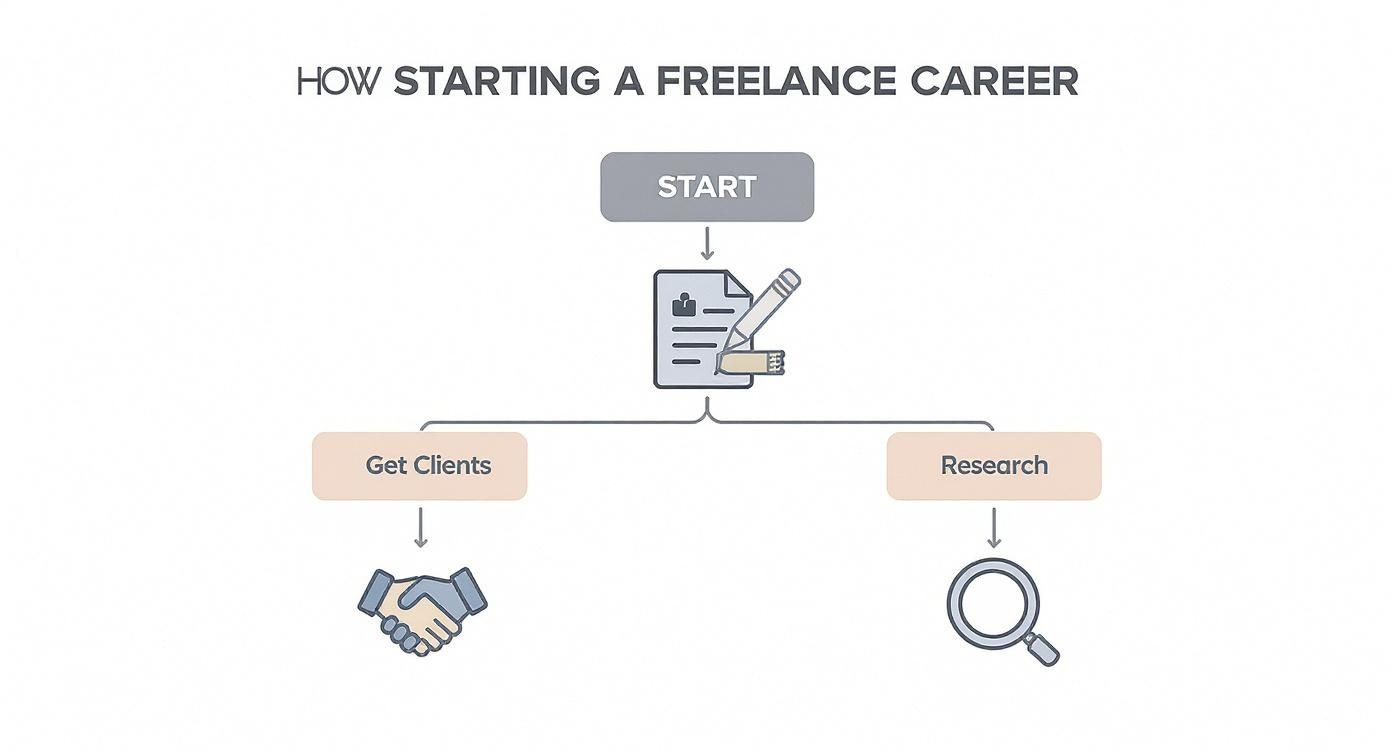
As the infographic shows, your first major decision is whether to formalise your business, which naturally leads to the all-important task of finding clients. When you do this, you're not just starting a small venture; you're joining a powerful segment of the local economy. In Hong Kong, self-employed individuals—a group dominated by freelancers—made up about 8.46% of total employment in 2023. This figure really highlights how vital independent professionals are to the city's workforce. You can dig into more of these labour market trends and see the data for yourself on Trading Economics.
Handling Business Registration and Licensing
Alright, you’ve decided on your business structure. Now it’s time to make it official. This is the part where your freelance hustle formally becomes a legitimate business in the eyes of the Hong Kong government. It might sound a bit daunting, but honestly, the process is pretty direct once you know the steps.
Think of it like getting the keys to your new shop. You wouldn't just open the doors and start selling without registering the address and getting the right permits. It's the same principle in the digital world, and for any serious freelance Hong Kong professional, this is a non-negotiable part of the journey.
Securing Your Business Registration Certificate
First thing's first: you need to register with the Inland Revenue Department (IRD). This isn't something to put on the back burner—you must get it done within one month of starting your business activities. Procrastinating here can lead to fines you really don't need, and it’s a simple process to get right from the get-go.
Once your registration is approved, you'll be issued a Business Registration Certificate. This document is your proof of legitimacy. It holds your unique Business Registration Number, a crucial identifier you'll need for practically everything—opening a business bank account, invoicing clients, and filing your taxes. If you want to dig deeper, our guide gives a complete overview of the Hong Kong Business Registration Number and why it’s so important.
The biggest mistake I see new freelancers make is waiting until they've landed a big client to register. My advice? Register before you even think about sending that first invoice. It signals professionalism and keeps you compliant from day one, saving you from a world of potential legal headaches.
Navigating the Right Forms
The exact form you’ll need is tied directly to the business structure you chose earlier. The IRD keeps it simple by having a different form for each setup.
- For Sole Proprietors: You'll be filling out Form 1(a). This is the go-to for most solo freelancers.
- For Partnerships: If you're teaming up with someone, Form 1(c) is the one you need.
- For Limited Companies: This is a more involved setup that’s handled via the Companies Registry, which then loops in the IRD automatically.
Before you start filling anything out, it pays to have your information ready. This will make the whole process much smoother.
Here’s what you'll typically need to provide:
- Business Name: This can be your own legal name or a specific trading name. If you pick a trading name, do a quick search to make sure it isn't already taken.
- Business Address: Your official place of business. For most freelancers, this is simply their home address.
- Nature of Business: Get specific. Instead of a vague term like "consulting," try "Marketing Strategy Consulting" or "IT Project Management." Clarity helps.
- Date of Commencement: The official date your business kicked off.
You can submit these forms online through the IRD’s e-Services portal, e-TAX, or do it the old-fashioned way in person. The online route is usually the quickest and most convenient option.
Do You Need Industry-Specific Licences?
While every business needs a Business Registration Certificate, some professions require extra permits to operate legally in Hong Kong. This is especially true for fields where your work has a direct impact on a client’s finances, health, or safety.
Here’s a good way to think about it: your Business Registration is like a general driver's licence. It gets you on the road. An industry-specific licence, however, is like the special permit you’d need to drive a double-decker bus—it proves you have specialised, regulated skills.
A few examples of professions that might need extra paperwork include:
- Financial Advisors: Usually need a licence from the Securities and Futures Commission (SFC).
- Personal Trainers: May require certain certifications and insurance to work in gyms or public venues.
- Education Tutors: Could need to register with the Education Bureau, particularly if running a small tutorial centre.
- Real Estate Agents: Must be licensed by the Estate Agents Authority (EAA).
Always do your homework and check the requirements for your specific field. A quick search on the relevant government authority's website can save you a ton of compliance trouble down the line. Getting this sorted from the start ensures your freelance Hong Kong business is built on a solid, legal foundation and is truly ready for success.
Setting Up Your Business Finances and Banking
Solid financial habits are the bedrock of any successful freelance career, especially in a dynamic market like Hong Kong. I’ll tell you the single most important rule right now, and it’s a simple one: keep your business and personal finances separate from day one.
Trust me on this. Mixing them is like trying to have a business meeting during a family dinner—it's messy, confusing, and you’re asking for trouble.
This separation isn't just about tidy bookkeeping. It gives you a crystal-clear view of your business's financial health, makes tax filing a breeze, and helps you look professional to clients. Think of it as drawing a line in the sand; on one side is your personal life, and on the other is your thriving freelance Hong Kong business.

Opening a Dedicated Business Bank Account
Your first port of call is to open a dedicated business bank account. This account becomes the central hub for every dollar you earn and spend as a freelancer. It might feel like just another piece of admin, but it’s a non-negotiable step that lays the financial foundation for your entire operation.
When you walk into a bank in Hong Kong, they'll want to see that you're a legitimate business. This is where all the prep work you’ve already done pays off. For a much deeper look into the specifics, check out our guide on how to open a bank account in Hong Kong, which breaks down the process for different business structures.
Generally, you'll need to have a few key documents ready:
- Your Hong Kong Identity Card (HKID) and a recent proof of address.
- Your official Business Registration Certificate from the IRD.
- A clear description of your business activities—what services you offer and who you typically work with.
A quick tip: some banks are more freelancer-friendly than others. It's worth looking at both the traditional high-street banks and the newer digital banks. The digital options often have faster sign-up processes and lower fees that are perfect for solo operators.
Mastering Your Invoicing and Cash Flow
With your account up and running, it's time to get paid. Professional invoicing is an art, and getting it right has a direct impact on your cash flow. A vague or late invoice often leads to a late payment, which can derail your financial plans in a heartbeat.
Make sure your invoices are always crystal clear and include these essentials:
- Your business name and details (including your Business Registration Number).
- The client's full name and address.
- A unique invoice number for easy tracking.
- A detailed breakdown of the services you provided.
- The total amount due and your payment terms (e.g., "Payment due within 14 days").
- Your new business bank account details.
A professional invoice does more than just ask for money. It reinforces your brand, sets clear expectations, and creates a paper trail that protects both you and your client. Treat it as a key piece of business communication, not just an administrative chore.
Managing cash flow effectively is about more than just sending invoices; it's about knowing what’s coming in and what’s going out. Keep a close eye on your payment cycles, and don't be afraid to send a polite follow-up for overdue payments. Healthy cash flow is the lifeblood of your freelance business.
Tracking Expenses and Leveraging Software
Every dollar you spend on your business—from a software subscription to a co-working space membership—is a potential tax deduction. The catch? You can only claim what you track. Diligent expense tracking from the get-go will save you a world of pain during tax season and ensure you aren’t paying more than you have to.
While a simple spreadsheet might do the trick when you're just starting out, switching to dedicated accounting software is a real game-changer. Tools like Xero or QuickBooks can automate a ton of this tedious work. They can link to your business bank account, categorise your spending, and generate professional invoices, freeing you up to focus on what you do best.
This organised approach is more important than ever. Hong Kong’s workforce is shifting, with many companies facing talent shortages in high-tech fields. It's projected that 30% or more of these businesses will turn to independent contractors to fill critical roles. In a field like AI, freelancers can command salary premiums of up to 45% higher. Having streamlined finances means you can confidently chase these high-value opportunities without getting bogged down in admin.
Getting to Grips with Hong Kong Tax and MPF
Alright, now that you’ve got your business finances sorted, it’s time to talk about the two things that can seem daunting for any new freelancer: taxes and pension contributions. For anyone serious about building a sustainable freelance career in Hong Kong, this isn't just administrative fluff—it's the bedrock of your financial health.
The great news is that Hong Kong’s system is refreshingly straightforward once you know the rules. Don't think of it as a barrier; see it as a predictable process you can plan for. Nailing this from the get-go means you can manage your cash flow confidently and sidestep any nasty surprises from the taxman.

Profits Tax: What Freelancers Need to Know
As a freelancer running a Sole Proprietorship or Partnership, you’re not dealing with corporate tax. Your income falls under Profits Tax. The Inland Revenue Department (IRD) simply looks at your total income, subtracts all your allowable business expenses, and that final number is your assessable profit.
Hong Kong has a two-tiered profits tax system, which is a huge advantage for freelancers just starting out or scaling up. Your first HK$2 million of assessable profits are taxed at a lower rate of just 7.5%. Anything you earn above that threshold is taxed at the standard 15% rate. This structure is designed to give smaller businesses like yours a leg up.
The Real Secret: Claiming Every Legitimate Expense
Here’s where you can make a real difference to your bottom line: diligently tracking and claiming every single business expense. This is precisely why having a separate business bank account is so crucial. An expense is generally deductible if it was incurred "wholly and exclusively" to produce your profits.
Put simply, you can legally shrink your taxable income by accounting for what it costs to run your freelance gig. It’s one of the most powerful financial tools at your disposal.
Wondering what counts? Here are some of the most common deductible expenses for Hong Kong freelancers:
- Workspace Costs: Rent for your spot at a co-working space, virtual office fees, or even a portion of your home utility bills if you have a dedicated office setup at home.
- Professional Fees: Any money paid to accountants, lawyers, or business consultants is 100% deductible.
- Tools of the Trade: Your subscriptions to essential software like Adobe Creative Suite, project management platforms, or industry-specific online journals are all claimable.
- Marketing & Promotion: Expenses for running social media ads, printing business cards, or hosting your professional website all reduce your taxable profit.
- Client-Related Travel & Networking: Costs for attending industry conferences or travelling to meet clients are fair game.
Meticulous record-keeping isn't just good admin; it's your first line of defence if the IRD ever comes knocking. Use accounting software or a simple spreadsheet to log every receipt. The little bit of effort this takes each day will save you a world of pain—and money—later on.
Meeting Your MPF Obligations as a Self-Employed Professional
On top of tax, you also need to plan for your retirement through the Mandatory Provident Fund (MPF) scheme. When you’re an employee, your company handles this for you. But as a self-employed person, the ball is entirely in your court.
You are legally required to enrol in an MPF scheme within 60 days of starting your freelance business. The good part is you get to choose your own MPF provider (trustee) and decide how your money is invested across their various funds. This gives you direct control over your retirement nest egg.
Your contributions are based on your "relevant income," which is your gross income minus your business expenses—basically, the same profit figure you calculate for your tax return. You can choose to make these contributions either monthly or annually. It's a critical piece of compliance, and you can learn more about the specific requirements, like the MPF maximum contribution, in our detailed breakdown.
The freelance path is well-trodden in Hong Kong. In fact, 2023 data showed that self-employed men made up about 11.83% of all employed men in the city. This shows just how significant independent work is in our labour market. By proactively managing your tax and MPF, you’re not just staying compliant; you're joining a thriving community of professionals who are successfully building their own careers.
Your Top Questions About Freelancing in Hong Kong
As you gear up to launch or scale your freelance business, a bunch of practical questions are bound to pop up. Think of this as a rapid-fire Q&A, tackling the most common hurdles and queries we see from freelancers making their way in Hong Kong. These are the nitty-gritty, real-world issues that surface once you’ve sorted out the initial paperwork.
Getting straight answers here will help you move forward with confidence, making sure you’re not just following the rules, but also making smart decisions for your business.
Do I Need a Special Visa to Freelance in Hong Kong?
This is a huge one, and the answer isn't always cut-and-dried. If you're not a Hong Kong permanent resident, you can't just start freelancing on a standard employment visa. Those visas tie you directly to a single, sponsoring employer, which doesn't work for independent work.
To operate a freelance Hong Kong business legitimately, you’ll likely need to explore other paths. One common route is to establish a limited company and then apply for an investment visa under the General Employment Policy. Hong Kong's immigration rules are notoriously complex and strictly enforced, so this isn't something to take lightly.
My best advice is to never, ever make assumptions about your visa status. Seriously. Consulting with an immigration specialist is one of the smartest investments you can make. Getting this wrong can have major consequences, so it’s a step you absolutely cannot afford to skip.
How Should I Handle Contracts with International Clients?
Working with clients across the globe is one of the best parts of freelancing, but it demands a rock-solid approach to your paperwork and payments. First rule of freelancing: always, always get a signed contract in place before a single minute of work begins.
Your contract needs to be crystal clear on a few key things:
- Scope of Work: What exactly are you delivering? Be specific.
- Payment Terms: Lay out the total fee, the payment schedule (e.g., 50% upfront), and what methods you accept.
- Timeline: Note key deadlines and project milestones to keep everyone on the same page.
- Jurisdiction: Specify which country's laws will govern the agreement if a dispute ever arises.
When it comes to getting paid, a multi-currency business account is a lifesaver. Fintech platforms like Wise or Payoneer are also fantastic, low-fee options that have become incredibly popular with the freelance crowd in Hong Kong. Just be sure to specify the currency (e.g., HKD or USD) on your invoices to sidestep any confusion over conversion rates.
What Is the Best Way to Find Freelance Work in Hong Kong?
There's no magic formula here; a blended approach almost always wins. In Hong Kong, personal connections are incredibly valuable, so you need to make networking a real priority. Get out to industry events, join relevant business associations, and keep your LinkedIn profile polished and active.
Of course, online platforms like Upwork or Fiverr can be a decent place to start and build a portfolio, but don't lean on them as your only source of work. It’s also worth keeping an eye on local job boards and business publications.
But honestly, the most sustainable way to get consistent, high-quality work is to build a strong personal brand. A professional portfolio website that showcases your best projects, client testimonials, and clear service offerings is your number one marketing tool. It positions you as an expert, not just another freelancer in a crowded market.
Can I Run My Freelance Business from Home?
Yes, you absolutely can! In fact, this is how most freelancers in Hong Kong start out. When you register as a Sole Proprietorship, you can list your residential address as your official business address with the IRD. It's simple, cost-effective, and perfectly legitimate.
That said, it’s always a good idea to do a quick check of your building's tenancy agreement or management rules. You just want to make sure there are no clauses that restrict you from conducting business activities from your flat.
If you’d rather keep your home address private or need a more professional front for client meetings, you've got plenty of great options. A virtual office service can give you a prestigious business address and handle your mail. Or, you could grab a membership at one of Hong Kong's many co-working spaces, which offers both a flexible workspace and fantastic networking opportunities.
Conclusion
Navigating the complexities of business setup, banking, and tax optimisation in Hong Kong is a significant undertaking. At Lion Business Consultancy Limited, we specialise in creating secure, compliant, and tax-efficient structures for entrepreneurs and SMEs. If you’re ready for a strategic partner to guide your global expansion, we’re here to help.