

 Hong Kong

 Singapore


 UAE
UAE



 Malaysia
 Turkey
 UK
UK
 EU
EU
 US
US
 Switzerland
 Bahamas Bank Account
 Cayman Islands Bank Account
 Mauritius Bank Account

 BVI
BVI
 Seychelles

Whether you're bringing on a new partner, rewarding a key employee with equity, or planning your exit strategy, the simple act of transferring shares comes with a tax implication. This is the share transfer stamp duty, and in Hong Kong, it's a non-negotiable part of your corporate paperwork.
Think of it as the government's official processing fee for updating your company's ownership records. It’s a vital step in maintaining good corporate governance and ensuring every change is legally locked in.
What Is Share Transfer Stamp Duty Anyway?

It’s a bit like the fee you pay to the Land Registry when you buy or sell a house. That small payment makes the change of property ownership official and legally binding. Share transfer stamp duty does exactly the same thing, but for the ownership of your company. It’s the government's way of formally acknowledging that a piece of your business has a new owner.
This isn't just bureaucratic box-ticking. It’s a core mechanism that ensures every ownership change is properly documented and legally recognised. For entrepreneurs and SME owners, getting this right is critical. It keeps your corporate structure clean, which is essential for any future fundraising rounds, audits, or even selling the company down the line.
Why It Matters to Your Business
Properly handling stamp duty is about more than just paying a tax; it’s about making sure your company’s legal foundations are rock-solid. Here’s why it’s so important:
- Legal Validity: In Hong Kong, an unstamped transfer document isn't legally enforceable. It can't even be used in court as evidence of ownership.
- Investor Confidence: A clean record of duly stamped share transfers shows potential investors that your company is well-managed, transparent, and a safe bet.
- Operational Integrity: It ensures your company’s register of members is always accurate and up-to-date, which helps prevent messy ownership disputes later on.
Stamp duty is a significant source of government revenue in Hong Kong and applies to every transfer of shares for locally registered companies. The rate is currently set at 0.2% of the share value or the price paid—whichever is higher—plus a fixed fee of HKD 5.
Typically, the buyer and seller split this cost, each paying 0.1%. However, they can agree to a different arrangement in their sale and purchase agreement. You can find more details on Hong Kong's fiscal regulations in Baker McKenzie's resource hub. This process is a fundamental part of a business's lifecycle, right from the very beginning. You can learn more about the initial steps in our detailed guide on the incorporation of a Hong Kong company.
Calculating Your Stamp Duty Liability Without The Headaches

Running the numbers for your share transfer stamp duty doesn't have to be a headache. The formula itself is straightforward, but getting it right is non-negotiable. One wrong move, and you could find yourself facing penalties from the Inland Revenue Department (IRD).
At its heart, the calculation boils down to two critical values: the consideration (the price paid for the shares) and the net asset value (what the shares are actually worth).
So, why both? The IRD has a simple but effective rule: they charge duty on whichever of these two figures is higher. This is a clever way to prevent artificially lowering the tax bill by, for example, selling valuable shares to a connected party for a token amount.
A Practical Calculation Example
Let's walk through a common scenario for an SME founder. Imagine you're selling a 10% stake in your growing business to bring on a new investor.
- Agreed Sale Price (Consideration): You shake hands on a deal for HKD 500,000.
- Fair Market Value of the Shares: A recent professional valuation puts that same 10% stake at HKD 520,000.
Because of the "higher of" rule, the IRD isn't interested in your HKD 500,000 sale price. They'll base the entire calculation on the HKD 520,000 fair market value. This is why having a solid grasp of business valuation methods and techniques is so important—it determines the real basis of your tax liability.
Key Takeaway: The government’s “higher of” rule is designed to ensure the tax paid reflects the true economic value of the transaction, protecting against arrangements that might artificially lower the tax payable.
Once you have that base figure, the maths is easy:
- Total Ad Valorem Duty: HKD 520,000 x 0.2% = HKD 1,040
- Fixed Duty: Add the small, flat fee of HKD 5.
- Total Stamp Duty Payable: HKD 1,040 + HKD 5 = HKD 1,045
This total is then split straight down the middle. The buyer pays HKD 522.50, and the seller pays an identical HKD 522.50.
To make this even clearer, let's break down a HKD 1,000,000 transfer.
Stamp Duty Calculation at a Glance
This table breaks down the stamp duty calculation for a typical HKD 1,000,000 share transfer to illustrate the liability for each party.
| Component | Calculation | Amount (HKD) |
|---|---|---|
| Total Transfer Value | (Higher of Consideration or Fair Market Value) | HKD 1,000,000 |
| Buyer's Ad Valorem Duty | HKD 1,000,000 x 0.1% | HKD 1,000 |
| Seller's Ad Valorem Duty | HKD 1,000,000 x 0.1% | HKD 1,000 |
| Fixed Duty (per Instrument) | Split between two instruments (bought/sold notes) | HKD 5 |
| Total Stamp Duty | (HKD 1,000 + HKD 1,000 + HKD 5) | HKD 2,005 |
| Buyer's Total Liability | (HKD 1,000 + HKD 2.50) | HKD 1,002.50 |
| Seller's Total Liability | (HKD 1,000 + HKD 2.50) | HKD 1,002.50 |
By understanding this simple process, you can confidently work out your liability and ensure your share transfer is fully compliant. Keeping these records clean is a fundamental part of good financial housekeeping, a principle we apply across all our accounting services.
Why Stamp Duty is a Big Deal in Hong Kong
Ever wondered why this seemingly small tax is taken so seriously? Let's step back and look at the bigger picture. In a city famous for its light and business-friendly tax system, share transfer stamp duty isn't just another administrative fee; it's one of the foundations of Hong Kong's financial stability.
For entrepreneurs, Hong Kong’s appeal is often about what it doesn’t tax. You won't find any capital gains tax, no VAT or GST, and no withholding tax on dividends. This minimalist approach has turned the city into a global magnet for investment. But the government still needs to pay for the world-class infrastructure that makes it such a great place to run a business.
That’s where stamp duty fits in. It acts as one of the government's most consistent and significant sources of revenue.
A Pillar of Public Revenue
Rather than levying broad taxes that hit everyone, Hong Kong’s government has long relied on transaction-based duties. Stamp duty on share transfers is a massive contributor, so much so that it makes up a huge slice of the official transaction fees on the Hong Kong Exchange (HKEX). In fact, it accounts for roughly 90% of those fees.
Even after several rate cuts since the 1990s, its importance has never faded. To give you an idea, in the 2017-2018 fiscal year, stamp duties from share transfers alone brought in about 6% of the Hong Kong government's entire revenue. You can find more details on its financial impact in Exegy's analysis of HK's stamp duty framework.
This deep-seated reliance is precisely why the government consistently pushes back against calls to abolish the duty. It’s a critical piece of the puzzle that makes the city's overall low-tax model work.
When you understand its role in the wider economy, your perspective shifts. This isn't just another compliance cost; it’s a direct contribution to the stable economic environment your business benefits from every single day.
This context also explains why the Inland Revenue Department (IRD) is so strict about enforcement. The integrity of this revenue stream is non-negotiable for the city's financial health. There's a direct line between your paperwork and the thriving business ecosystem all around you. Seeing this connection is the key to appreciating Hong Kong’s unique economic model, a model underpinned by a simple and clear approach to corporate taxation. To learn more, check out our guide on the Hong Kong corporation tax rate .
Your Step-by-Step Compliance Checklist for Share Transfers
Dealing with the paperwork for a share transfer can feel like navigating a maze, especially when you're racing against the clock. To make things straightforward, I've put together an actionable roadmap you can follow every time. Think of it as your guide to getting share transfers done smoothly, correctly, and without any nasty surprises.
Following these steps in order is the key. It cuts out the confusion and ensures you don't miss a single critical deadline, which is fundamental to keeping your company's legal structure clean and in good standing.
This visual gives you a quick overview of the main stages, from getting your documents ready to the final submission.
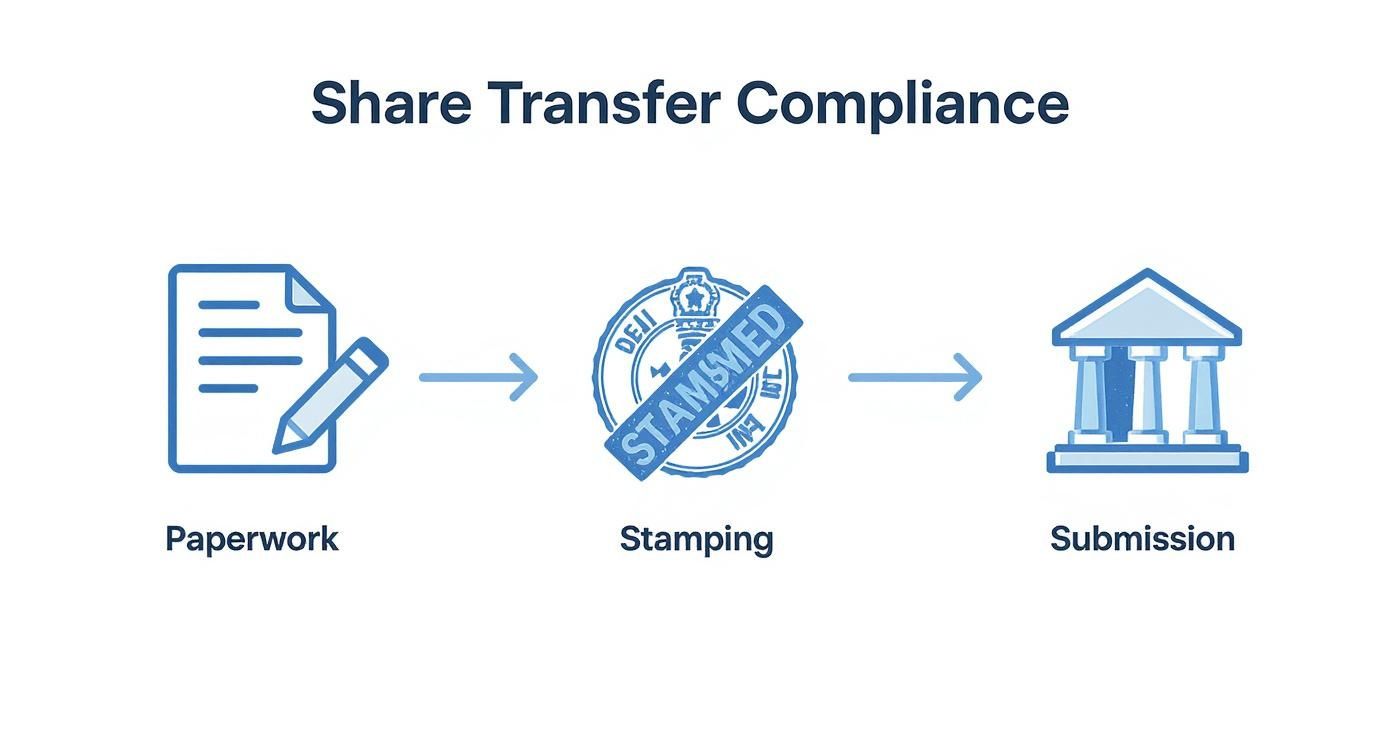
As you can see, everything starts with proper document preparation. Get this right, and the rest of the process will fall into place much more easily.
Step 1: Prepare the Essential Documents
Before a single dollar of tax is paid, you need to get your paperwork in order. This is the foundation of the whole transaction and exactly what the Inland Revenue Department (IRD) will be looking at. Without these documents, you simply can't move forward.
For every share transfer, there are two non-negotiable forms you'll need to complete:
- Instrument of Transfer: This is the official legal document that formally records the share transfer from the seller to the buyer. It's crucial that both parties sign it.
- Bought and Sold Notes: These act as a contract note, spelling out the specific details of the deal. You'll need two of them – one for the buyer (the bought note) and one for the seller (the sold note).
In addition to these forms, you’ll want to have supporting documents ready. This includes things like your company’s latest audited financial statements and its articles of association. This evidence is what helps the IRD verify the share valuation you’re declaring.
Step 2: Calculate and Submit for Stamping
Once your documents are all lined up, the next step is to get them officially stamped. This is the point where the actual duty payment happens. You'll need to submit your completed Instrument of Transfer and the Bought and Sold Notes to the IRD’s Stamp Office.
The IRD will then review your submission and confirm the amount of stamp duty you need to pay, based on your own calculations. After you’ve paid, the documents get stamped, which is what makes the transfer legally binding.
Crucial Timing Alert: The deadlines for stamping are incredibly strict here in Hong Kong. For any transfer that happens locally, you have just two days from the transaction date to get everything stamped. Miss that window, and you’re looking at immediate penalties.
Step 3: Meet Deadlines to Avoid Heavy Penalties
Frankly, this is the most critical step of all. Stamping your documents late isn't a minor slip-up; it comes with serious financial consequences. The IRD has a clear penalty system that escalates depending on how late you are.
Here’s a quick breakdown of what you could be facing:
- Up to 1 month late: The penalty is 2 times the original stamp duty.
- Between 1 and 2 months late: It jumps to a penalty of 4 times the duty.
- Over 2 months late: The penalty can soar to a staggering 10 times the original stamp duty amount.
Let that sink in. A simple HKD 2,000 duty payment could easily blow up into a HKD 20,000 penalty if you delay for more than two months. The good news is these fines are completely avoidable with a bit of planning. By following this checklist methodically, you can ensure your share transfer is not only compliant but also cost-effective.
Common Exemptions That Can Save You Money
Paying share transfer stamp duty isn't always a foregone conclusion. Just as any smart business owner looks for ways to operate more efficiently, understanding the available exemptions is simply good financial management. Certain transfers, particularly those that happen within the same corporate family, can qualify for relief that brings your duty liability right down to zero.
Think of these exemptions as established pathways that allow for genuine business restructuring without the tax hit. The government recognizes that not every share transfer is a sale to a third party. Many are just internal reorganisations needed for growth or cleaner governance, and these rules are designed to accommodate that. Knowing when and how to use them can save your company a serious amount of cash.
The Power of Intra-Group Relief
For SMEs and growing businesses, one of the most useful exemptions you’ll come across is intra-group relief. It's a powerful tool, specifically designed to make corporate restructuring easier. Picture this: you have a parent company that owns a subsidiary outright. If that parent company needs to transfer shares from one of its subsidiaries to another for strategic purposes, this relief can often wipe out the stamp duty bill completely.
Let’s put it into a real-world context.
Case Study: Streamlining Operations Without the Tax Bill
Imagine a Hong Kong holding company, "Innovate Holdings Ltd.," which fully owns two subsidiaries: "Tech Solutions Ltd." and "Marketing Gurus Ltd." To streamline their operations, Innovate Holdings decides to move its entire shareholding in Tech Solutions over to Marketing Gurus.
Ordinarily, a transfer like this would trigger a hefty stamp duty payment based on the value of the shares. But here’s the key: because the transfer is happening between two companies that are at least 90% owned by the same parent, it qualifies for intra-group relief. By applying for this exemption, the entire transaction is cleared from stamp duty, saving the group thousands of dollars that can go straight back into the business.
This relief isn't automatic, though. You have to actively apply for it and demonstrate to the Inland Revenue Department (IRD) that your corporate structure fits the strict criteria. It’s a classic case where good planning and proper paperwork really pay off.
Other Key Exemptions to Know
While intra-group relief is a big one, it's not the only game in town. Other situations can also qualify for an exemption, often involving specific financial market activities or transfers where the ultimate beneficial owner doesn't actually change.
Here are a few other key examples to be aware of:
- Associated Companies: This works similarly to intra-group relief. Transfers between closely associated companies can be exempt as long as they meet specific ownership thresholds.
- Stock Borrowing and Lending: Relief is often granted for transfers that are part of formal stock borrowing and lending agreements, a common practice in the financial markets.
- Transfers to Charities: In some jurisdictions, gifting shares to a registered charity might be exempt from stamp duty.
Navigating these exemptions requires a sharp eye for detail. The rules are very precise, and whether you qualify will depend entirely on your specific situation. To discover more ways to lower your tax obligations, it's always a good idea to explore broader tax-saving tips for business owners and investors. Even with these potential savings on the table, always get professional advice to confirm you’re eligible before you move ahead with a transfer.
How Stamp Duty Rates Have Changed Over Time
Tax laws aren't set in stone. They ebb and flow with economic currents and shifting government priorities, and share transfer stamp duty is no exception. This is a crucial lesson for any founder: always check the current rules before you sign anything.
Think of the stamp duty rate as a dial the government can adjust. A slight increase can top up public funds, while a decrease can make the market more liquid and attractive to investors. For an entrepreneur, this isn't just a minor detail—it's a real-world cost that can affect the timing of a fundraising round or a company restructure.
We've seen this play out right here in Hong Kong. The rate you'll pay today is different from what it was just a short while ago, and it's almost certain to change again.
A Look at Recent Adjustments
If you look back over the past few decades, Hong Kong's stamp duty on stock transfers has been adjusted several times. The rate for contract notes, for example, went from 0.15% in the 1990s down to 0.13% for a long stretch.
Then, on 17 November 2023, the government lowered the rate to 0.1% for both the buyer and the seller. This was a deliberate move to boost the stock market's competitiveness while still ensuring a stable source of revenue. For a complete timeline, you can see the full history in the official IRD documentation.
The takeaway here is simple: yesterday's numbers don't guarantee tomorrow's tax bill. This constant state of flux is exactly why getting timely, professional advice isn't just a good idea—it's a fundamental part of smart business planning.
This isn't just a history lesson. It’s a practical reminder that staying on top of these changes is your best defence against surprise costs and compliance headaches. Building this awareness into your financial strategy will help you stay agile, no matter what comes next.
Got Questions About Stamp Duty? We've Got Answers
When you get down to the nitty-gritty of transferring shares, the same practical questions tend to pop up time and time again. Let’s tackle some of the most common ones that founders and business owners run into.
What If My Share Transfer Isn't for Cash?
This is a classic scenario. Maybe you’re giving a key advisor equity for their expertise, or perhaps you're swapping shares as part of a merger. Just because no cash is changing hands doesn't mean you can skip the stamp duty.
The Inland Revenue Department (IRD) looks at the fair market value of the shares. If you grant a 5% stake in your company worth HKD 200,000 to an advisor, stamp duty is calculated on that HKD 200,000 figure. That’s why getting a professional valuation is so important—it provides the evidence you need to back up your numbers.
Remember, a non-cash deal isn't a no-tax deal. The IRD operates on the principle of 'money's worth', taxing the real economic value of what's being transferred. It keeps things fair for everyone.
Does Stamp Duty Apply If I'm Gifting Shares?
Yes, absolutely. Gifting shares to a family member or placing them into a trust is what the IRD calls a "voluntary disposition." Legally, it's treated just like any other transfer.
The logic is straightforward: an asset with real value has changed hands. The stamp duty is calculated on the fair market value of those shares at the moment you make the gift. The stamp makes the transfer official and legally binding, regardless of whether money was involved.
What Happens If a Deal Falls Through After We've Stamped the Documents?
It happens. You pay the stamp duty, but for one reason or another, the share transfer agreement gets cancelled. The good news is, you're not necessarily out of pocket. You can apply to the IRD for a full refund.
Of course, you’ll need to prove the deal was genuinely terminated. This usually means submitting the rescission agreement and any other documents that show the transfer was never completed. It takes a bit of paperwork, but it ensures you don't end up paying tax on a ghost transaction.
At Lion Business Consultancy Limited, we live and breathe these details. We offer the kind of expert, one-on-one guidance that helps you navigate Hong Kong's corporate world with confidence. We make sure you stay compliant, protected, and ready for whatever comes next. Let us handle the complexities, so you can focus on building your business.
Ready to secure your global operations? Explore our private advisory services today.