

 Hong Kong
 Singapore

 UAE
UAE

 Malaysia
 Turkey

 UK
UK
 EU
EU
 US
US
 Switzerland
 Bahamas Bank Account
 Cayman Islands Bank Account
 Mauritius Bank Account
 BVI
BVI
 Seychelles

Thinking about setting up a company in Hong Kong? You’re on the right track. For decades, entrepreneurs have flocked to this city as a launchpad for their Asian and global ambitions, and for good reason. It offers a unique and powerful blend of Eastern and Western business cultures that’s hard to find anywhere else.
Why Hong Kong Is a Top Choice for Global Entrepreneurs

Choosing where to base your business is one of the biggest decisions you'll make. It can genuinely make or break your success. Hong Kong consistently comes out on top, and it’s not just because of its iconic skyline. The city provides a powerful ecosystem specifically designed to help entrepreneurs and SMEs grow.
It's more than just a pin on a map; it's a strategic move.
Let’s use a real-world example. Imagine you run a European e-commerce brand and want to break into the massive Mainland China market. Going direct can be a regulatory nightmare. By setting up shop in Hong Kong first, you create a strategic gateway. You can manage international payments, sign contracts under a reliable common law system, and approach the Chinese market with far more credibility and ease. That’s the Hong Kong advantage in action.
The Pillars of Hong Kong's Business Appeal
So, what’s the secret sauce? What makes Hong Kong such a magnet for international business? It really comes down to a few core strengths that create the perfect environment for a company to flourish.
- Strategic Gateway to Asia: Its location is simply unbeatable. You have direct, easy access to Mainland China and other key Asian markets, making it the perfect hub for international trade.
- Simple and Low Taxation: The tax system here is legendary for its simplicity. There’s no VAT, no capital gains tax, and a territorial source principle, which means you’re only taxed on profits earned in Hong Kong.
- World-Class Infrastructure: Everything just works. From its incredibly efficient ports and logistics to its cutting-edge financial and telecom networks, the city is built from the ground up to support global commerce.
The real power of Hong Kong is its stability and predictability. The English common law system provides a familiar and secure legal framework, giving entrepreneurs confidence that their investments and intellectual property are protected.
This winning combination keeps attracting businesses in droves. In fact, the first half of 2025 saw a remarkable 84,293 new local companies registered—an all-time high that pushed the total number of registered companies to over 1.49 million. That surge speaks volumes about the enduring confidence entrepreneurs have in the city.
A Tax System Built for Growth
One of the biggest draws for any business owner is Hong Kong’s pro-business tax regime. The city uses a two-tiered profits tax system that is a huge advantage for startups and SMEs.
Your first HK$2 million in profits is taxed at just 8.25%. Anything above that is taxed at the standard rate of 16.5%.
This structure is designed to let new businesses keep more of their early earnings, giving them the capital to reinvest in growth, innovation, and hiring. You can dive deeper into the specifics of the Hong Kong corporate tax rate to see just how it could work for your business.
This guide will walk you through every step of the journey, giving you the clarity you need for a smooth and successful incorporation.
Laying the Groundwork: Your Pre-Incorporation Game Plan
Rushing to fill out incorporation forms without a clear strategy is a classic mistake I see all the time. A successful Hong Kong company isn't born from paperwork; it's built on a solid foundation laid well before you even think about submitting an application. Think of this stage as drawing up the architectural plans for your business—get it right now, and you’ll save yourself a world of expensive headaches later.
Your first big decision, and it's a critical one, is choosing the right company structure. While Hong Kong offers different options like public companies or companies limited by guarantee, these are highly specialised. Public companies are for raising capital from the public, and guarantee companies are typically for non-profits.
For almost every entrepreneur, founder, or SME I've worked with, the conversation begins and ends with one structure: the Private Company Limited by Shares. It's the go-to for good reason, offering a fantastic mix of personal liability protection, professional credibility, and operational flexibility. Most importantly, it creates a legal shield between your personal assets and your business debts—a non-negotiable safety net for any founder.
The Overwhelming Favourite for a Reason
This isn't just a popular choice; it's the standard. The numbers from the Hong Kong Companies Registry speak for themselves. In the first ten months of 2025, out of 133,274 new local companies, a whopping 132,375 were private companies. That’s over 99% of all new incorporations, making it the undisputed champion for savvy business owners.
This structure gives you a foundation that's simple enough to manage day-to-day but robust enough to scale as your ambitions grow.
Choosing Your Company Structure
To help you visualise the options, here's a quick comparison of the most common company types. It clearly illustrates why the Private Company Limited by Shares is the default choice for most business ventures.
| Feature | Private Company Limited by Shares | Company Limited by Guarantee | Public Company Limited by Shares |
|---|---|---|---|
| Primary Purpose | For-profit commercial activities | Non-profit organisations (charities, clubs) | Raising capital from the public |
| Liability | Limited to unpaid amount on shares | Limited to a pre-agreed guarantee amount | Limited to unpaid amount on shares |
| Shareholders | 1 to 50 shareholders | Members, not shareholders | At least 1 shareholder, no upper limit |
| Capital | Private funding from shareholders | Funded by guarantees, donations, grants | Can offer shares to the general public |
| Ideal For | Start-ups, SMEs, entrepreneurs, subsidiaries | Charities, industry associations, schools | Large corporations planning an IPO |
As you can see, for any typical business, the private limited company structure is the most logical and practical starting point.
Assembling the Key Pieces
Once you’ve locked in the structure, it’s time to define the core roles and legal addresses required to bring your company to life. Getting these fundamentals right from day one is absolutely essential for staying compliant.
-
Directors: You need at least one. A huge advantage of Hong Kong is that your director can be of any nationality and live anywhere in the world. They are legally responsible for steering the ship and making key management decisions.
-
Shareholders: You also need a minimum of one shareholder. For solo founders, it’s perfectly fine for the same person to be both the sole director and the sole shareholder. Simple.
-
Company Secretary: This is a big one and a legal must-have. Every Hong Kong company needs a Company Secretary. This person (or firm) must be a Hong Kong resident or a licensed Hong Kong corporate body. They are your official point of contact with the government, making sure all your annual filings and compliance paperwork are handled correctly and on time. While you could ask a local friend, the smart move is to engage a professional firm to avoid costly mistakes or missed deadlines.
-
Registered Office Address: Your company must have a physical address in Hong Kong—a P.O. box won’t cut it. This is where all official government mail will be sent. It doesn’t need to be where you actually work, which is why many international founders use the address provided by their corporate services firm for privacy and reliability.
Naming Your Venture and Setting Up Capital
With the people and places sorted, you have two final, but crucial, pieces of the puzzle: your company name and its share structure.
Your company name has to be unique. A quick search on the Companies Registry’s Cyber Search Centre will tell you if your desired name is available. A rejection here just wastes time. It's also a good idea to check if the name might be a trademark violation to avoid legal drama later. Once your company is approved, you’ll need to know how to find your business registration number.
Pro Tip: Keep your share capital simple. There's no official minimum, but the standard, battle-tested approach is to issue 10,000 shares valued at HK$1 each. This creates a total issued share capital of HK$10,000. It's more than enough for most new businesses, and the best part is you don't even have to pay that amount into a bank account right away. It's the perfect, fuss-free starting point.
By taking the time to work through this checklist, you’re not just ticking boxes. You're strategically building a resilient, compliant, and growth-ready foundation for your new venture in Hong Kong.
Navigating the Incorporation Process Itself
So, you’ve hammered out the company structure, chosen a name, and assigned the key roles. Now for the exciting part: actually bringing your company to life. The incorporation of a Hong Kong company is refreshingly straightforward, especially when you compare it to other business hubs. This is the moment your strategic planning becomes a real, legal entity ready to operate.
The whole procedure is built for speed. It doesn't matter if you're an entrepreneur managing things from halfway across the world or a founder based right here in Hong Kong—the path to getting your official certificates is clear and well-trodden.
Your Essential Document Toolkit
To get the ball rolling, you (or your corporate services provider) will need to pull together a few key documents. Think of it as your application package. Getting this right from the start is the best way to avoid annoying delays down the road.
For every director, shareholder, and ultimate beneficial owner, you’ll typically need to provide:
- A clear copy of their passport (make sure it’s valid!).
- Proof of their residential address, like a recent utility bill or bank statement, usually dated within the last three months.
- A completed incorporation form that lays out all the details—company name, structure, directors, and so on.
These documents are the bedrock of the due diligence process, satisfying the Know Your Customer (KYC) rules that are mandatory in Hong Kong. Having them organised and ready to go is the first real step in the formal incorporation journey. While your focus is on Hong Kong, it can be helpful to broaden your knowledge by understanding company setup processes in other places, as many share similar due diligence principles.
The Two Paths to Incorporation: Online vs. Paper
With your paperwork in order, you have two main options for submitting your application to the Companies Registry. Each has its own timeline and suits different situations.
- Electronic Submission (e-Registry): This is the fast track. Filing online is the modern, preferred method and it’s incredibly quick. It’s perfect for straightforward incorporations where everyone involved can handle digital signatures.
- Hard Copy Paper Submission: This is the traditional route. You physically deliver the documents to the Companies Registry. It’s slower, but it's a solid fallback if online filing just isn’t an option for you.
Hong Kong’s company registration system is a well-oiled machine, largely thanks to its digital-first mindset. As of 2025, an electronic application for a private limited company is often processed in about one hour. Seriously, one hour. In contrast, a paper application will take closer to four working days. This incredible speed is one of the main reasons so many global entrepreneurs flock to the city.
The infographic below neatly summarises the crucial groundwork you need to lay before you even get to this filing stage.
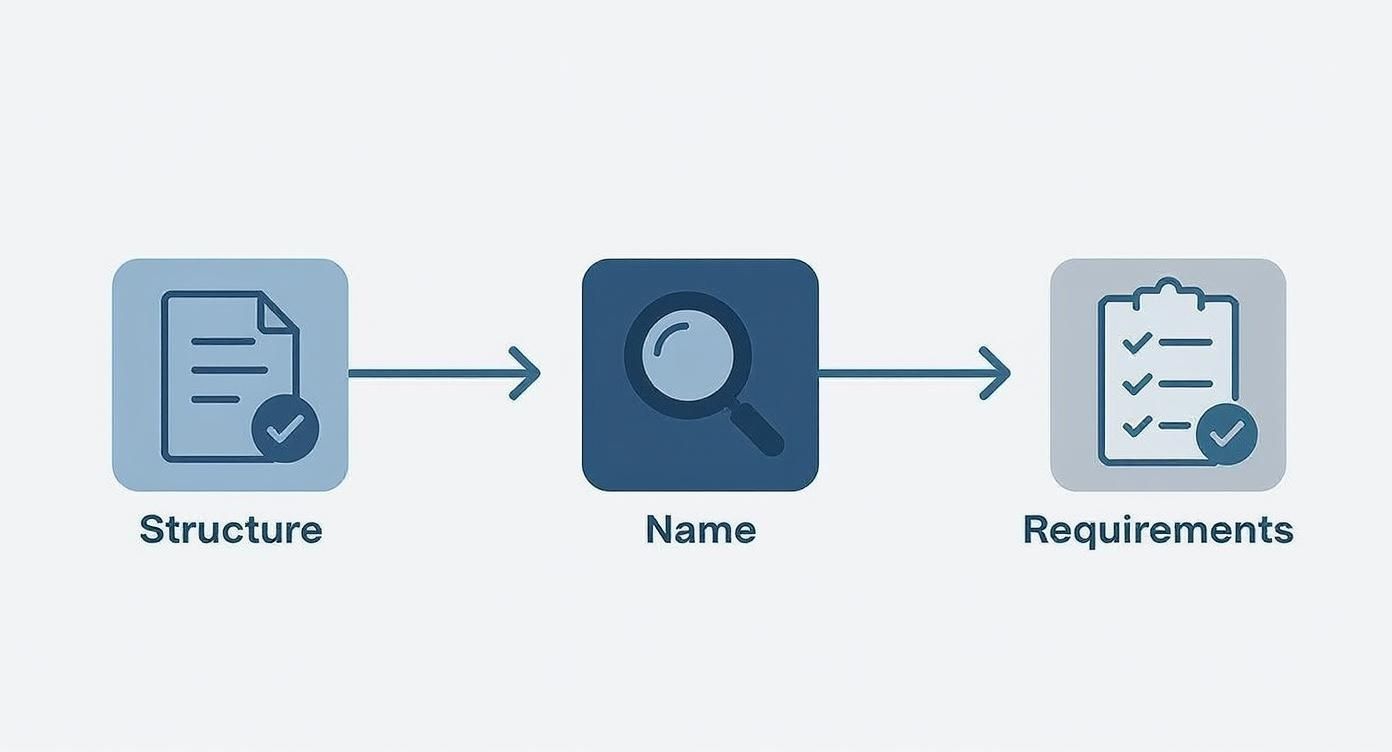
It really highlights that finalising your structure, name, and key appointments isn't just prep work—it's the essential foundation for a smooth submission.
The Final Step: Receiving Your Certificates
Whether you go digital or stick with paper, a successful application ends with the same prize. The government will issue two critical documents that officially mark your company's birth.
- Certificate of Incorporation (CI): This is your company's birth certificate. It’s the official proof that your company is a legal entity under the Hong Kong Companies Ordinance.
- Business Registration Certificate (BRC): Issued by the Inland Revenue Department, this certificate is essential for all tax matters and confirms your business is registered to operate.
For overseas entrepreneurs, this entire process can be completed remotely without ever needing to step foot in Hong Kong. By engaging a professional firm, you can simply email your scanned documents, and they'll handle the entire submission, collection, and delivery of your certificates. It’s a seamless experience built for a globalised business world.
Let’s put that into perspective. Imagine you're a software developer based in Europe. You can finalise your documents on a Monday morning, your service provider files them electronically, and you could realistically have your Certificate of Incorporation in hand by lunchtime that same day. This isn't an exaggeration; it's the standard of efficiency Hong Kong delivers.
Once you have these certificates, your company officially exists. You're now free to open a corporate bank account, sign contracts, and start trading. This is the moment all your planning pays off—the official start of your Hong Kong business journey.
Life After Incorporation: Nailing Compliance and Banking
Holding your new Certificate of Incorporation is a fantastic feeling. It feels like you’ve hit a major milestone, and you have. But from my experience, this is where the real work begins. Getting incorporated is just the first lap; now you have to run the actual business, keep on top of your legal duties, and get your finances sorted.
This is where many entrepreneurs trip up. It's rarely their business idea that fails them, but rather the underestimation of what comes next.
Right after the incorporation of a Hong Kong company, you'll face two immediate and critical hurdles: setting up your ongoing compliance framework and opening a corporate bank account. Let’s walk through what these actually involve and how you can manage them like a seasoned pro.
Understanding Your Annual Compliance Duties
Hong Kong’s pro-business reputation comes from its efficiency, not a lack of rules. The government rightly expects your company to be a good corporate citizen, which means meeting a few key annual obligations. Believe me, ignoring these is not an option—it leads to hefty fines and, in serious cases, legal trouble.
Think of compliance as the regular maintenance for your business. You wouldn't drive a car for a year without checking the oil, right? It's the same principle. You can't run a company without looking after its legal and financial health.
The good news is these tasks are predictable and totally manageable once you know what’s required.
- Annual Return (Form NAR1): This isn't a tax form. It’s an annual snapshot of your company's core details—directors, shareholders, etc.—that you must file with the Companies Registry.
- Business Registration Renewal: Your Business Registration Certificate has to be renewed every year or every three years. It's a simple but absolutely mandatory step.
- Accounting and Auditing: Every single company in Hong Kong must keep proper books. And yes, that includes companies with zero transactions. At the end of your financial year, these records must be audited by a Hong Kong Certified Public Accountant (CPA).
- Profits Tax Return: Using those audited accounts, you'll then prepare and file a Profits Tax Return with the Inland Revenue Department (IRD).
If I can give you one piece of advice, it's this: from day one, keep meticulous records. Every invoice, every receipt, every contract. This simple habit will save you a world of stress and money when it's time to talk to your accountant and auditor.
A Practical Compliance Calendar
To help you get organised, it's useful to see what a typical first year of compliance looks like. Meeting deadlines is everything, so staying ahead of your obligations is crucial for a smooth operation.
To keep things clear, here’s a quick summary of the key deadlines you'll need to manage.
Key Annual Compliance Deadlines for a HK Company
| Compliance Task | Governing Body | Deadline | Key Consideration |
|---|---|---|---|
| Annual Return (NAR1) | Companies Registry | Within 42 days of the company's incorporation anniversary. | This is a hard deadline. Late filing triggers escalating financial penalties automatically. |
| Business Registration Renewal | Inland Revenue Department | Roughly one month before your current certificate expires. | The IRD will post a demand note to your registered address, so make sure it's current. |
| First Board Meeting | Internal Governance | Usually within the first 1-3 months of incorporation. | This is where you formally appoint your company's auditor for the first financial year. |
| Appoint an Auditor | Hong Kong Institute of CPAs | Within 3 months of incorporation. | You can't file a valid tax return without an audited financial statement from a CPA. |
| Profits Tax Return | Inland Revenue Department | Issued around 18 months after incorporation; due within 3 months. | Your very first tax return will cover your company's first accounting period. |
These are the core government filings you can't miss. They form the backbone of your company's good standing.
Beyond government filings, a crucial part of modern compliance is protecting your company's data. It’s a smart move to start thinking about setting up encrypted email for business early on to secure sensitive commercial information and safeguard client privacy.
The Reality of Opening a Hong Kong Bank Account
Now, let's talk about the elephant in the room: banking. A decade ago, opening a corporate bank account in Hong Kong was straightforward. Today, it’s arguably the single most challenging part of the entire process. Because of global anti-money laundering (AML) and Know Your Customer (KYC) rules, banks have become incredibly cautious.
They aren't just opening an account for you; they are starting a relationship and need absolute certainty that your business is legitimate, transparent, and low-risk.
Your success here boils down to one word: preparation. You need to walk into that meeting—whether it’s online or in-person—with a compelling and completely logical story. They will pick it apart.
Here’s what you absolutely must have ready:
- A Crystal-Clear Business Plan: What do you actually do? Who are your customers and suppliers? Most importantly, why do you specifically need a bank account in Hong Kong? Be ready to answer these questions clearly and confidently.
- Proof of Business: Don't just tell them about your business—show them. Bring draft contracts, supplier invoices, a professional website, and up-to-date LinkedIn profiles for the directors. You need to prove this is a real, operating enterprise.
- Substance: Banks are looking for a genuine connection to Hong Kong. If you're trading with Asia or have local partners, make that the focus. A clear reason for being here is non-negotiable.
- Source of Funds: Be prepared to explain exactly where your initial capital came from, and have the documents to back it up.
The banking landscape has become so complex that getting expert advice can be a real game-changer. Our team has deep experience in this area, and you can learn more about how we help clients navigate the challenges of opening a bank account in Hong Kong in our detailed guide. Getting your compliance and banking right isn't just admin; it's the foundation of your company's credibility and long-term success.
Avoiding the Common Traps When Setting Up Your Company
Starting a business in Hong Kong is an exciting time, but the path to getting incorporated is filled with small, easy-to-miss traps. I’ve seen countless entrepreneurs get caught out, not by big, dramatic failures, but by simple oversights that spiral into costly delays and compliance headaches.
Think of it like building a house. You can have a perfect blueprint, but if you use the wrong screws or mis-measure one beam, the entire structure is at risk. These common pitfalls are the faulty screws of company formation.
The Rejected Company Name Saga
One of the first and most frustrating hurdles is getting your company name approved. You've probably spent weeks coming up with the perfect brand, only to have the Companies Registry turn it down flat. Why does this happen? Usually, it's because the name is too similar to one already on the register, contains restricted words like “Bank” or “Trust” without the necessary licences, or is just deemed inappropriate.
A client of mine once tried to register a name that was just a single letter off from a major financial institution. The rejection cost them two weeks of momentum and a last-minute scramble to rebrand. A quick, thorough search on the Cyber Search Centre beforehand would have saved them all that grief.
Underestimating the Bank Account Gauntlet
This is, hands down, the biggest challenge new founders face right after they incorporate. Many people think that once they have their Certificate of Incorporation, opening a bank account is just a formality. The reality is completely different. Banks in Hong Kong face immense regulatory pressure to fight money laundering, so their due diligence process is incredibly stringent.
I’ve watched entrepreneurs walk into bank meetings with just their incorporation papers, expecting to walk out with an account number. They are almost always turned away.
The bank isn't just opening an account for you; they're vetting your entire business. They need to see a solid reason for you to bank in Hong Kong, real proof of business activity (like draft contracts or supplier invoices), and a clear, logical business plan. Not having this ready isn't a small hiccup—it's a showstopper.
The Silent Threat of Neglected Compliance
So, your company is registered, the bank account is finally open, and you're focused on making sales. It's all too easy to let annual compliance deadlines slip to the back of your mind. This is a very expensive mistake. Forgetting to file your Annual Return (NAR1) or renew your Business Registration doesn't just get you a polite reminder.
It triggers automatic, and escalating, financial penalties. Fines for a late NAR1 filing can quickly run into thousands of Hong Kong dollars. Worse, persistent non-compliance can lead to the company being struck off the register and even prosecution of the directors. These aren't just admin tasks; they are legal duties that protect your company's good standing.
When Professional Guidance Is an Investment, Not a Cost
Many founders, especially early on, try to do everything themselves to save a bit of cash. While that DIY spirit is great for many things, it can be a false economy when it comes to company formation. The money you save on a DIY filing can be wiped out instantly by one mistake—a rejected name, a failed bank application, or a missed compliance deadline.
Hiring a specialist firm isn't really a cost; it's an investment in getting things done right and avoiding risk. A good advisor does more than just push paper. They’re your strategic guide, helping you to:
- Navigate the banking maze: They know exactly what each bank is looking for and can help you put together an application that ticks every box.
- Prevent compliance errors: They’ll manage your deadlines and make sure all your filings are correct and on time, saving you from fines and stress.
- Offer strategic advice: They can provide insights on smart tax structures and corporate governance that set you up for success down the road.
Ultimately, getting through the Hong Kong incorporation process smoothly is all about foresight. By knowing what these common pitfalls are, you can sidestep the errors that trip up so many others and make sure your business starts on the strongest foundation possible.
Common Questions About Setting Up in Hong Kong
Even after walking through the entire process, a few practical questions almost always come up. I've heard these time and again from entrepreneurs who are on the verge of making their move. Let's clear up these final, crucial details so you can move forward with confidence.
Think of this as the final checklist before you press 'go' on your Hong Kong venture.
Can a Foreigner Really Own 100% of a Hong Kong Company?
Yes, absolutely. This is one of the biggest draws for international founders and a cornerstone of Hong Kong's appeal. The city’s pro-business framework imposes zero restrictions on foreign ownership.
You, as a non-resident, can be the sole director and the sole shareholder of your private limited company. There's no requirement for a local partner or any mandatory Hong Kong equity stake. This gives you complete control over your business. The only two pieces you need locally are a registered office address in Hong Kong and a Company Secretary who is either a Hong Kong resident or a licensed corporate body.
What's the Real Minimum Share Capital I Need?
Legally speaking, there's no official minimum. You could technically register a company with just HK$1. But in practice, that's not the best look. It can signal a lack of seriousness to banks, suppliers, or potential partners.
The standard, go-to approach that we've seen work best for countless start-ups and SMEs is to issue 10,000 shares at HK$1 each. This sets your total issued share capital at a respectable HK$10,000. The great part? You don't have to deposit this money into a bank account when you incorporate. It simply represents the limit of shareholder liability.
This standard HK$10,000 structure hits the sweet spot. It gives your new company a credible foundation from day one without tying up your cash.
Do I Physically Need to Be in Hong Kong to Register My Company?
No, you don’t need to book a flight just for the paperwork. The entire company registration can be handled remotely from wherever you are in the world—a huge plus for global entrepreneurs.
When you work with a professional services firm, you can securely send your documents (like a copy of your passport and proof of address) electronically. They will then manage all the filings with the Companies Registry for you.
One crucial thing to keep in mind, however, is the bank account. While the company formation is remote, opening the corporate bank account often isn't. Many banks still prefer to meet the company directors in person, though some are becoming more flexible. It’s always smart to check the bank’s specific requirements early in the process.
What Are the Main Taxes I Should Expect?
Hong Kong is famous for its simple and low-tax regime. Getting your head around this is key to understanding why so many businesses choose to set up here.
Here are the main taxes you'll deal with:
- Profits Tax: This is the big one. Hong Kong operates a two-tiered system. The first HK$2 million of your assessable profit is taxed at just 8.25%. Any profit beyond that is taxed at the standard rate of 16.5%.
- The Territorial Principle: This is the magic ingredient. Hong Kong only taxes profits that arise in or are derived from Hong Kong. If your business earns profits from activities conducted entirely overseas, those profits are generally not subject to Hong Kong tax.
- No Hidden Surprises: You won't find any Value Added Tax (VAT) or Goods and Services Tax (GST). There's no capital gains tax, and dividends paid out to shareholders are also tax-free. This simplicity makes financial planning much more straightforward.
Conclusion
At Lion Business Consultancy Limited, we do more than just incorporate your company; we build the secure, compliant, and tax-efficient foundation your global ambitions deserve. If you're ready for a strategic partner who provides 1:1 guidance for your international expansion, let's start the conversation.