

 Hong Kong
 Singapore


 UAE
UAE
 Malaysia
 Turkey

 UK
UK
 EU
EU
 US
US
 Switzerland
 Bahamas Bank Account
 Cayman Islands Bank Account
 Mauritius Bank Account

 BVI
BVI
 Seychelles


Securing your trademark is the official process of locking down the exclusive legal rights to your brand’s name, logo, or slogan. Think of it as the step that transforms your brand identity from a brilliant idea into a tangible, legally defensible asset. In short, it’s what gives you the power to stop anyone else from using it in your field.
Your Brand Is Your Most Valuable Asset

Think about the last time you saw a brand name and instantly felt a sense of quality or trust. That powerful connection didn’t happen by accident. It’s the product of countless hours, investment, consistent quality, and a hard-earned reputation—all wrapped up in a simple name or logo.
Now, imagine someone else slapping that same identity onto a knock-off product, confusing your customers and eroding the trust you’ve painstakingly built. This is precisely where trademark registration proves its worth. It’s not just a bureaucratic formality; it’s the essential shield that protects your entire business reputation.
Many founders I talk to see registration as a complex, expensive distraction from the “real work” of building their business. I get it. But the reality is, it’s one of the smartest, most strategic investments you’ll ever make. It’s the difference between building your business on solid rock versus shifting sand.
A Tale of Two Coffee Shops
Let me share a classic story I’ve seen play out countless times. Imagine a small, independent coffee roaster, “Artisan Beans,” that has built an amazing local following. They’ve poured their heart and soul into creating unique blends and a fantastic customer experience. Their brand is their everything.
Then, a bigger chain spots their success and opens a café called “Artisan Brews” just down the road. Suddenly, customers are confused, and the unique brand identity that Artisan Beans worked so hard to build is being diluted.
Because they never got around to the registration of trademarks, their legal options are now messy, expensive, and far from certain. This scenario highlights a critical lesson: proactive brand protection isn’t an expense—it’s an insurance policy on your future.
Why Registration Is Non-Negotiable
If you don’t register your trademark, you’re leaving your most valuable asset completely exposed. It’s like building a beautiful home but forgetting to put locks on the doors. Official registration establishes clear, legally recognized ownership, which is absolutely crucial for several reasons:
- Deterring Copycats: A registered trademark is a public notice of your ownership. It makes competitors think twice before trying to ride on your coattails.
- Building Asset Value: A protected brand is a tangible asset that adds real, quantifiable value to your company’s balance sheet. This makes you far more attractive to investors or potential buyers down the line.
- Expanding Globally: Registration is the bedrock for protecting your brand as you move into new international markets, whether that’s Hong Kong, Singapore, or the UAE.
This isn’t just theory; the numbers back it up. In a key business hub like Hong Kong, for instance, non-resident trademark filings climbed to over 22,000 in 2023. This shows a clear trend of international businesses prioritising brand protection in Asia’s top markets. You can dig into more detailed statistics from Hong Kong’s Intellectual Property Department.
A trademark is so much more than a name or a logo. It’s the sum of every single interaction a customer has with your business. Protecting it legally ensures that you, and only you, control that narrative and profit from your hard work.
Mastering Your Pre-Filing Strategy
Before you even think about filling out an application, the most critical work has already begun. Rushing this initial stage is like building a house without checking the foundations first—a recipe for costly, frustrating problems down the line. This is where you lay the strategic groundwork that can make or break your entire trademark registration.
The first move isn’t paperwork; it’s a deep, honest look at your own brand. What actually makes it unique? A trademark is meant to be a distinctive signpost for your business, not just a generic label. This is a concept that trips up so many entrepreneurs who fall in love with a name that’s far too descriptive of what they sell.
The All-Important Trademark Strength Spectrum
To get this right, you need to understand where your proposed name sits on a spectrum of strength. A weak, generic term like “The Coffee Shop” is impossible to trademark because it literally describes the business. On the far end, you have strong, fanciful names like “Starbucks”—a word with no inherent link to coffee that became a global powerhouse through smart branding and protection.
Your goal is to land somewhere in the middle or, ideally, towards the stronger end. A strong mark is infinitely easier to register and, crucially, to defend against copycats.
Here’s a breakdown I often share with clients to help them grasp the concept:
Trademark Strength Spectrum From Weakest to Strongest
| Type of Mark | Description | Example | Level of Protection |
|---|---|---|---|
| Generic | Common name for the product/service itself. | “Software” for a software company. | None. Impossible to register. |
| Descriptive | Directly describes a quality, feature, or function. | “Speedy Car Wash” for a fast car wash. | Very Weak. Only registerable after extensive use proves it has a “secondary meaning.” |
| Suggestive | Hints at the nature of the goods/services without explicitly describing them. Requires some imagination from the consumer. | “Netflix” (suggests watching films online). | Good. Protectable without proving secondary meaning. A smart choice. |
| Arbitrary | A real word used in a context completely unrelated to its dictionary meaning. | “Apple” for computers. | Strong. Highly protectable and distinctive. |
| Fanciful | A completely made-up word created solely to function as a trademark. | “Kodak” or “Exxon.” | Strongest. The gold standard for trademark protection. |
Trying to register a descriptive mark is an uphill battle from day one. Aiming for a suggestive, arbitrary, or fanciful name gives you a much stronger legal foundation to build upon.
Conducting Your Initial Search and Clearance
Once you have a strong, distinctive name in mind, the next step is the clearance search. This is where you play detective to see if anyone else is already using a similar mark for similar goods or services. Skipping this can lead to an immediate application rejection, and you’ll have wasted both your time and money.
Start with some simple, informal searches. A quick look on Google, social media platforms, and domain registrars can often reveal obvious conflicts right away.
But for a serious application, that’s not nearly enough. You must check the official trademark databases in the jurisdictions where you plan to operate. Most national intellectual property offices, like Hong Kong’s IPD, offer free online search tools that you need to get familiar with.
A proper search isn’t just about finding exact matches. You’re looking for marks that are “confusingly similar”—a legal concept that trips up many self-filers. This could mean similar spelling (“Kwick Snax” vs. “Quick Snacks”), similar pronunciation, or even a similar overall meaning that could easily confuse a customer.
A common mistake I see is people only searching for their business name. Don’t forget, you need to search for your logo and any taglines you plan to use as well. Each distinct element of your brand identity may need its own protection strategy.
Choosing Your Classes The Right Way
After you’re confident your mark is clear for use, you have to decide what to protect it for. Trademarks are registered in specific categories of goods and services, organised under an international system called the Nice Classification. There are 45 classes in total—34 for goods and 11 for services.
Don’t rush this part. Selecting the wrong classes can leave your brand dangerously exposed, while choosing too many is just a waste of money.
Let’s use a real-world example. Imagine a tech startup launching a new productivity app called “ZenFlow.” They would obviously file in Class 9 (for downloadable software). But that’s just today. What about their five-year plan?
- If they plan to offer online workshops and coaching, they should also file in Class 41 (education and training services).
- If they want to sell branded merchandise like planners and notebooks, they need to add Class 16 (paper goods).
- If they are developing a B2B platform, Class 42 (software as a service) is essential.
Strategically choosing your classes is about protecting not only what your business is today but also what you want it to become tomorrow. This foresight separates a basic filing from a robust, long-term brand protection strategy. Getting this right is especially important in commercially active hubs. The sheer volume of trademarks in Hong Kong, for instance, has it ranked 19th globally in terms of registrations in force, as detailed in WIPO’s country profile for Hong Kong.
Before you file, it’s also wise to ensure all your foundational business details are in order. A mismatch between your trademark application and your official company records can cause unnecessary delays. If you’re unsure, you can check out our guide on how to find your business registration number to make sure everything aligns perfectly.
Where to File: The National vs. International Crossroads
Once you’ve done your homework—the searches, the classification, the strategy—it’s time to actually file the application. This is where the rubber meets the road. The biggest decision you’ll make at this point is where to file. Broadly speaking, you have two paths: a national filing or an international one.
This choice isn’t just about geography; it’s about your business’s immediate reality and future ambitions. A national filing is like a scalpel—precise, direct, and perfect for protecting your brand in a single, critical market. An international filing, usually through the Madrid Protocol, is more like a net—designed to cover a wide area efficiently.
The initial groundwork of searching, classifying, and strategising is the foundation for everything that follows. Get this right, and the application process becomes much smoother.
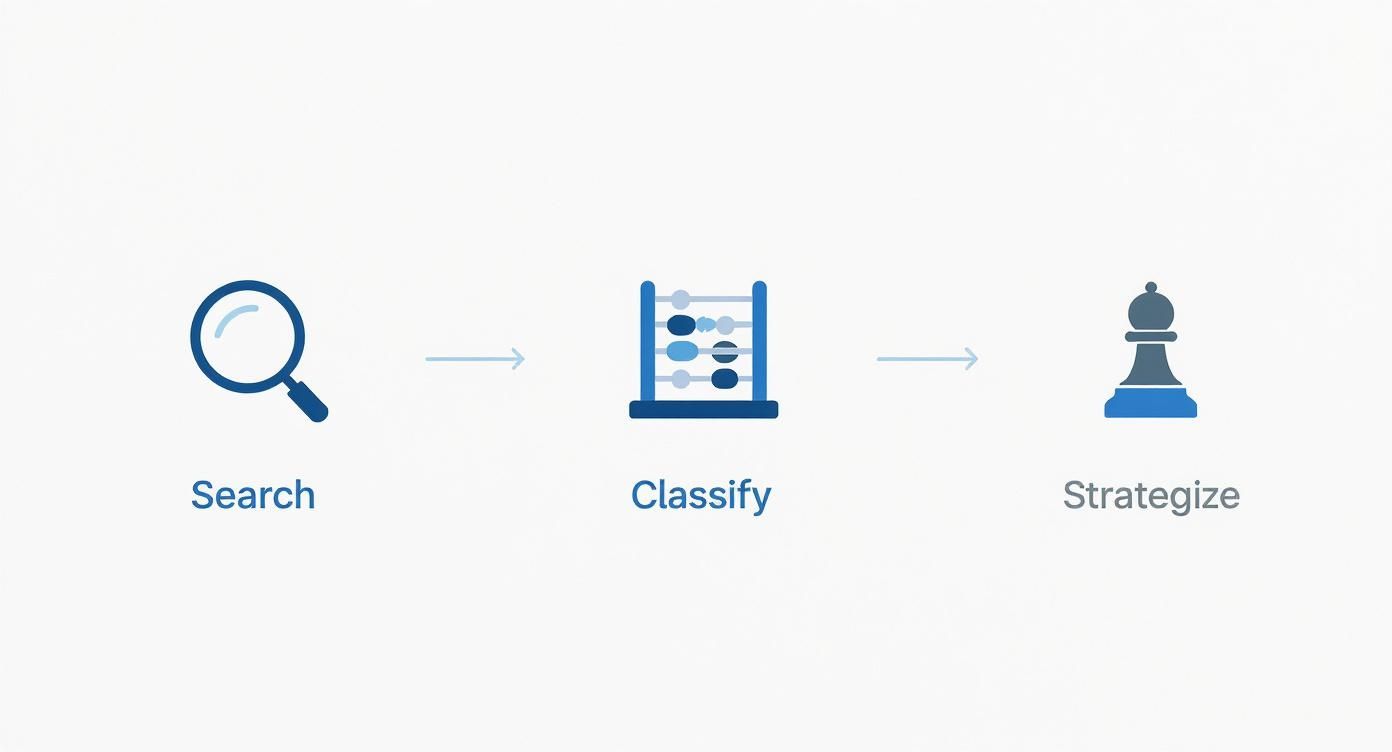
As you can see, the quality of your application is directly tied to the rigour of your prep work. Don’t rush it.
The National Route: A Closer Look at Hong Kong
For most new businesses, a national filing is the smartest place to start. It secures your rights in your home or primary market, giving you a solid base to build from. Let’s use Hong Kong as an example because its system is remarkably efficient and gives a clear picture of the process.
Filing directly with the Hong Kong Intellectual Property Department (IPD) means you’re asking for protection only within Hong Kong. This is the go-to option if Hong Kong is your main operational base or a key target for sales. The application itself is a stickler for detail: who you are (the owner), what your mark is, and a very specific list of the goods or services it covers, all sorted by the Nice Classification system.
From my experience, this is where simple mistakes cause the biggest headaches.
- Vague Goods/Services: Don’t just put “software.” The examiner will reject it. Be specific: “downloadable mobile application for financial management” or “software as a service (SaaS) platform for project collaboration.”
- Mismatched Applicant Details: The owner’s name must be exactly as it appears on your legal business registration. Even a small typo can derail the entire application.
- Poor Mark Representation: If you’re registering a logo, the image you submit must be clean and high-resolution. That image is precisely what gets protected—nothing more, nothing less.
Get it right, and a Hong Kong application can sail through from filing to registration in as little as 4-6 months, assuming no objections pop up. That speed is a huge advantage when you need to lock down your brand identity quickly.
The International Route: Using the Madrid Protocol
But what if your plans are bigger? If you’re eyeing several countries at once—say, Singapore, the UAE, and the EU—filing separate national applications is a slow, painful, and expensive way to do it. That’s precisely the problem the Madrid Protocol was created to solve.
The Madrid system is a game-changer. It allows you to file one application, in one language, and pay one set of fees to seek protection in up to 130 member countries. It’s a fantastic tool for managing the registration of trademarks across borders.
There’s a catch, though. You can’t just jump into the Madrid system from a cold start. You first need a “basic mark”—that is, an existing application or registration in your home country. So, for a Hong Kong-based business, you’d file with the IPD first. That Hong Kong application then becomes the foundation for your international filing, allowing you to extend protection to other member countries.
It’s crucial to understand that the Madrid Protocol doesn’t create a single “global trademark.” What it does is create a bundle of national trademark rights. Each country you designate will still examine your application under its own local laws and can grant or refuse it.
A Quick Look at Costs and Timelines
Budgeting for this is key. Costs and timelines can vary wildly between jurisdictions, so you need a realistic picture. The fees usually consist of official government charges and, if you hire help, professional service fees.
Here’s a rough comparison of some key business hubs to get you started:
| Jurisdiction | Typical Filing-to-Registration Timeline | Estimated Government Filing Fee (per class) | Strategic Consideration |
|---|---|---|---|
| Hong Kong | 4-6 months | ~HKD 2,000 | Fast, efficient, and a strategic gateway to the mainland China market. |
| Singapore | 6-9 months | ~SGD 374 | A key hub for Southeast Asia with a robust and respected IP regime. |
| UAE | 12-18 months | ~AED 7,500 | Higher cost but essential for accessing the booming Middle Eastern market. |
| European Union (EUIPO) | 7-12 months | ~EUR 850 | A single application covers all 27 EU member states, offering immense value. |
Note: These figures are approximate and can change. They don’t include any legal or professional fees.
So, which path is right for you? It’s not about which is “better,” but which fits your business right now. Starting with a national registration in a core market like Hong Kong is often the most pragmatic and cost-effective first move. As your business grows, you can leverage that initial registration as a springboard for a wider international strategy using the Madrid system. It’s all about building your protection block by block.
Where Should Your Trademark Live? Integrating IP into Your Corporate Structure
So you’ve registered your trademarks. Job done, right? Not quite. For founders with an eye on the long game, this is where the real strategy begins. The crucial question isn’t just if your brand is protected, but who—or what—actually owns it.
Putting the trademark in the name of your everyday operating company is the default move, but it’s rarely the smartest one. We’re moving beyond simple legal filings now and into the realm of sophisticated business architecture. By thinking strategically about where you place your trademarks within your corporate group, you can build a powerful fortress around your most valuable assets, shielding them from the inevitable risks of doing business.
Think about it. Your main company is on the front lines every day, dealing with customers, suppliers, and staff. It’s exposed. If that company gets hit with a lawsuit or runs into financial trouble, and it owns your trademarks, your entire brand is at risk. But what if it didn’t?
The IP Holding Company: Your Brand’s Safe House
This is where an Intellectual Property Holding Company (IPHC) comes in. It’s a separate, distinct company created for one reason: to own and manage your IP, including your trademarks. This company doesn’t trade or deal with the public. It simply holds the assets and licenses them out.
The setup is brilliantly simple yet incredibly effective:
- The IPHC: This company holds the legal title to your trademarks. It’s often set up in a stable, tax-neutral jurisdiction.
- The Operating Company: This is your customer-facing business. It pays a royalty fee to the IPHC for the legal right to use the brand name and logos.
This separation creates a bulletproof firewall. If your operating company ever faces a lawsuit, bankruptcy, or any other financial disaster, creditors can’t touch the trademarks. Why? Because they legally belong to a completely different company—the IPHC.
A Real-World Scenario
Let’s take a successful e-commerce brand based in Hong Kong. They sell globally and have been smart enough to register their trademarks in the EU, the US, and key Asian markets.
Instead of keeping these valuable registrations inside the Hong Kong operating company, they establish a separate IPHC. Many founders look at jurisdictions like the British Virgin Islands for this, prized for its robust legal system and corporate flexibility. If you’re exploring this route, getting to grips with a BVI Business Company structure is a non-negotiable first step.
The BVI company now officially owns all the global trademarks. The Hong Kong company, in turn, signs a formal licensing agreement with the BVI entity and pays it a regular royalty to use the “brand.”
Fast forward two years. A nasty dispute with a major supplier spirals into a costly lawsuit against the Hong Kong company. Because the trademarks are safely tucked away in the separate BVI entity, they are completely insulated from the fight. The brand itself—the business’s crown jewel—remains secure.
This strategy effectively transforms your brand from a vulnerable target into a protected asset. It’s a foundational element of sophisticated asset protection for any global-minded business.
It’s Not Just Defence; It’s About Building Value
This structure is about more than just playing defence. It’s about creating tangible financial value. Once your trademarks are registered and housed correctly, they stop being an abstract idea and become a concrete asset on your balance sheet. This fundamentally changes how banks, investors, and potential buyers see your business.
A registered trademark can be professionally valued, insured, and even used as collateral to secure financing. When you walk into a bank for a loan or pitch to venture capitalists, a well-structured IP portfolio screams professionalism and long-term vision. It proves you’ve built something with lasting, defensible value, not just a passing business idea.
This is especially true when building international banking relationships. Lenders want to see stable, well-managed businesses. Showing them you have a dedicated IPHC and a clean licensing agreement proves you’re operating at a high level of sophistication. Your brand becomes a powerful financial tool that can open doors and fuel your next stage of growth.
Protecting Your Trademark After Registration

Getting that official registration certificate feels like crossing the finish line, but really, it’s just the start of the race. The registration of trademarks isn’t a “set it and forget it” deal. Think of your trademark as a living asset—it needs constant care and attention to hold its value and power.
Without a proactive defence strategy, the legal shield you’ve worked so hard to build can quickly develop cracks. The good news is that protecting your brand doesn’t have to be a full-time job, but it does demand a clear plan and consistent effort.
Actively Monitoring for Infringement
The first rule of trademark ownership is that the responsibility to police your mark rests squarely on your shoulders. The trademark office won’t do it for you. You have to be the guardian of your brand, actively looking for others who might be using your mark without permission.
It’s a bit like owning a piece of land. Just having the deed isn’t enough; you still need to make sure no one starts building on your property without asking.
This monitoring can take several forms:
- Marketplace Watch: Routinely search online marketplaces, social media platforms, and app stores for your brand name and any close variations.
- Competitor Analysis: Keep an eye on new players entering your space to ensure their branding doesn’t stray too close to yours.
- Formal Watch Services: For businesses with more at stake, you can hire professional services that automatically monitor new trademark applications and flag any potential conflicts.
For anyone selling online, understanding the platform-specific tools is crucial. A great place to start is learning about the Amazon Brand Registry, which is a powerful tool that puts control back in the hands of brand owners.
The Danger of Genericide
One of the most insidious threats to a trademark is ‘genericide’. This is what happens when a brand name becomes so popular that the public starts using it as the generic term for the product itself. When that happens, the mark can lose its legal protection entirely.
It’s a classic cautionary tale. History is littered with famous brands that became victims of their own success:
- Aspirin was once a registered trademark of Bayer.
- Escalator was a trademark of the Otis Elevator Company.
- Thermos was also a protected brand name.
To avoid this fate, you must always use your trademark as an adjective, not a noun or a verb. For example, you don’t “Google” something; you use the “Google search engine.” It seems subtle, but this disciplined use is vital for your brand’s long-term health. This is a common pitfall, especially in fast-growing Asian markets. Proper brand management is just as critical as the initial company registration in Hong Kong.
Always pair your trademark with the generic name of the product or service it represents. It’s not a Xerox, it’s a Xerox® photocopier. This simple habit reinforces your ownership and prevents your brand from becoming a generic term.
Staying on Top of Renewals
Finally, remember that trademark rights aren’t permanent. They have a lifespan and must be renewed periodically to stay in force. In most jurisdictions, including Hong Kong, a trademark registration is valid for 10 years and can be renewed indefinitely for subsequent 10-year periods.
Missing a renewal deadline is one of the most painful—and easily avoidable—mistakes you can make. If you fail to renew, your mark becomes abandoned and falls into the public domain, free for anyone else to claim. All the hard work and investment you put into building your brand’s reputation could be lost overnight.
Set multiple calendar reminders well ahead of the deadline. Most trademark offices send a courtesy notice, but you should never rely on it. Taking ownership of your renewal timeline is a non-negotiable part of responsible brand management.
Your Top Trademark Questions Answered
Even with a solid plan, the journey to protecting your brand is bound to raise a few questions. Let’s walk through some of the most common ones I hear from entrepreneurs who are new to the world of trademarks.
How Long Does This Actually Take?
This is the classic “it depends” answer, but for good reason. The timeline for getting a trademark registered can vary wildly depending on where you file.
In a really efficient jurisdiction like Hong Kong, you might see your mark registered in as little as 4-6 months if there are no bumps in the road.
But in other popular business hubs, like the EU or the UAE, you need to be more patient. It’s wise to budget for a 9 to 18-month process from start to finish. And remember, if the examiner has questions (an ‘office action’) or a third party opposes your application, that will naturally extend the timeline.
What’s the Real Difference Between ™ and ®?
It’s easy to get these two mixed up, but the distinction is legally very important.
- ™ (The Trademark Symbol): Think of this as an informal heads-up. Anyone can stick a ™ next to their logo or brand name to signal to the public, “Hey, I’m claiming this as my brand!” You can use it even if you haven’t officially registered the mark.
- ® (The Registered Symbol): This one has real legal muscle. You are only allowed to use the ® symbol after your trademark application has been fully examined, approved, and officially placed on the register by the government’s trademark office. Using it before you get that certificate is a big no-no and can get you into legal trouble.
Should I File a Trademark Myself?
Technically, yes, you can. For a very straightforward application in a single country—especially if your brand name is highly unique—many business owners manage the process themselves just fine.
The catch is that the process is full of potential traps for the inexperienced. A simple mistake in your application can lead to a rejection that’s hard to fix. An attorney becomes a huge asset when you need a thorough search to ensure your name is clear, when you get a complex rejection from the examiner, or when you’re trying to map out a protection strategy across several countries. For those who need help with the trickier aspects of brand protection, it’s often worth seeking expert legal guidance on trademark matters.
What If My Application Gets Rejected?
A rejection is not a dead end—it’s usually just the start of a negotiation.
If the trademark office issues a provisional refusal, they have to tell you exactly why. You’ll then have a specific window of time to make your case. This is your opportunity to either tweak the application, perhaps by narrowing down your list of goods and services, or to file a legal argument explaining why you believe the examiner got it wrong. This is another point where having a professional in your corner can dramatically improve your odds of success.
At Lion Business Consultancy Limited, we understand that protecting your brand is just one piece of a larger global strategy. Our expertise lies in integrating your IP with secure banking, low-tax corporate structures, and long-term asset protection. If you’re ready to build a business structure as strong as your brand, let’s talk. Explore our private advisory services.