

 Hong Kong

 Singapore


 UAE
UAE


 Malaysia
 Turkey



 UK
UK
 EU
EU
 US
US
 Switzerland
 Bahamas Bank Account
 Cayman Islands Bank Account
 Mauritius Bank Account

 BVI
BVI
 Seychelles

If you're looking to register a trade mark, you’re taking a crucial first step in legally protecting your brand identity. This process grants you exclusive rights to your name or logo, stopping others from using something confusingly similar. But this is more than just a defensive move; it’s a strategic investment that transforms your brand into a valuable, legally defensible asset—an absolute must for any business with global ambitions.
Why Your Brand Is Your Most Valuable Global Asset

Before you start drafting plans for international expansion, let's get one thing straight. Your most critical business asset isn't your product, your software, or even your brilliant team. It's your brand. The recognition, trust, and reputation you've worked so hard to build are what truly set you apart in a crowded marketplace.
Securing your brand is the bedrock of your company’s future. It's easy to dismiss this as just another administrative task or a line item on a spreadsheet, but that’s a shortsighted mistake. Think of it as a strategic investment in safeguarding your reputation, customer loyalty, and ultimately, your position in the market.
A Cautionary Tale from the Fintech World
I remember working with a promising fintech startup a few years back. They had a fantastic product and a solid plan to break into the European market. Their brand name was sleek, memorable, and had already gained significant traction with their early adopters in Hong Kong.
But they had made a classic—and critical—oversight. They hadn't registered their trade mark in their target EU country. A local competitor, noticing their buzz, swooped in and registered a nearly identical name. The startup was suddenly facing a total nightmare: either rebrand from scratch or get dragged into a messy, expensive legal fight they simply couldn't afford. Their identity in a new market was almost dead on arrival.
This kind of story is far from unique. Far too many ambitious entrepreneurs learn this lesson the hard way, realising the brand they’ve poured years into is completely unprotected right when it matters most.
The Gamble of Relying on Common Law Rights
Now, in some places, you might gain some limited "common law" rights just by using your brand name. But for any business with international ambitions, leaning on this is like betting your entire company on a single roll of the dice.
Common law rights are notoriously flimsy because they are:
- Geographically limited: They typically only protect you in the specific area where you can prove you’ve established a reputation.
- Difficult to prove: You have to pull together mountains of evidence showing continuous use, a process that is both expensive and incredibly time-consuming.
- Weak against registered marks: In a dispute, a registered trade mark owner almost always has the upper hand legally.
This approach leaves your brand dangerously exposed, especially when you step into new countries. A registered trade mark swaps that uncertainty for concrete, legally enforceable ownership.
Key Takeaway: A registered trade mark is a financial shield. It makes your business far more attractive to investors, smooths the path for partnerships, and gives you a clear, powerful way to fight infringement, protecting both your revenue and your brand's value.
For any serious entrepreneur, the registration of trademarks isn't just about defence—it's about offence. It solidifies your market position and gives you the stability you need to grow with confidence. This formal protection sends a clear message to investors and partners that you're serious about building long-term value. Without it, you’re basically building a global empire on quicksand.
Laying the Groundwork: Your Pre-Filing Strategy
Jumping into a trade mark application without a clear plan is one of the most common and costly mistakes I see entrepreneurs make. It’s like setting sail without checking the weather forecast—you might get lucky, but you're far more likely to hit a storm. Think of this as your pre-flight checklist, the essential groundwork that separates a smooth registration from a rejected application.
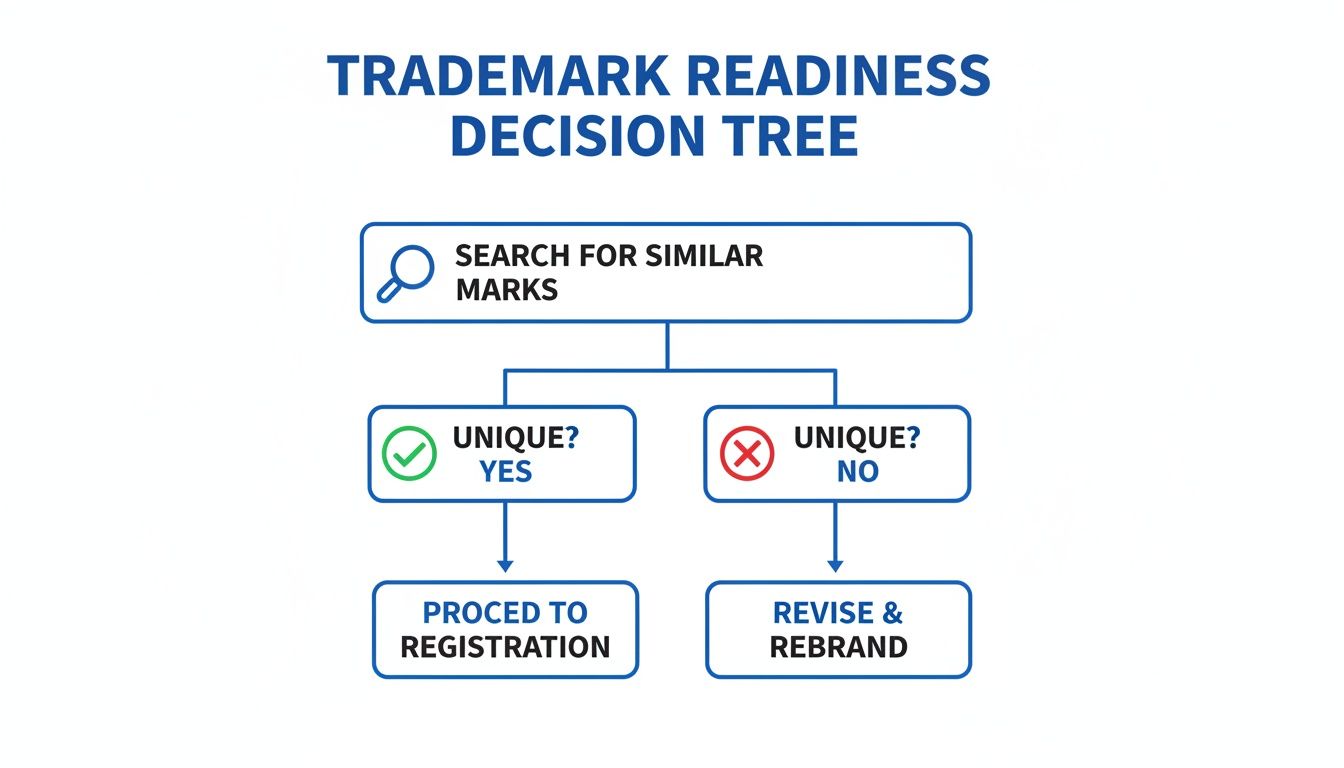
Your very first move must be a thorough clearance search. I’m not talking about a quick Google search for your brand name. This is a deep dive to ensure your proposed mark is genuinely unique and, more importantly, available for you to claim as your own. Honestly, skipping this step is the number one reason applications fail.
Distinguishing Between a Basic and a Comprehensive Search
Many business owners start with a basic search on their local intellectual property office's website. While that’s a decent first step, it's dangerously incomplete. It will only flag identical or very similar marks that are already registered or have a pending application.
What a basic search won't show you are the hidden risks:
- Unregistered "common law" marks: These are brands that have built a reputation through use alone, without formal registration. They can still have legal rights and could block your application.
- Phonetically similar marks: A name that sounds like yours, even if spelt differently, can be a major obstacle. Think "Kwik" vs. "Quick." These can cause market confusion, which is exactly what trade mark law aims to prevent.
- Marks in different but related classes: Another company might own the name for a slightly different product that's still considered commercially related to yours.
A comprehensive search, the kind professionals conduct, digs into all these areas. It scours business directories, domain registrations, and even social media to paint a complete picture of the landscape. It’s this extra diligence that saves you from investing time and money into a mark you can never truly own.
Choosing Your Territory: The Nice Classification System
Once you're confident your mark is unique, the next strategic decision is which classes of goods and services to file under. We use the Nice Classification system for this, an international framework that groups everything into 45 distinct classes. Getting this right is absolutely critical.
Think of these classes as defining the legal territory your brand will own. If you sell branded coffee beans, you'd file in Class 30. Simple enough. But what if you plan to open a café under the same name in two years? That would fall under Class 43 (services for providing food and drink).
I had a client, an e-commerce brand selling artisanal leather goods (Class 18), who had a five-year plan to launch a bespoke bag design service (Class 40). By filing for both classes from the start, they secured their brand for their current products and their future ambitions. When they were finally ready to expand, their brand territory was already protected, saving them from a costly and uncertain new filing process down the road.
This kind of forward-thinking is vital, especially in competitive markets. The business landscape in Hong Kong, for instance, is incredibly active. According to WIPO's latest profile, there were 58,706 classes specified in registrations in a single recent year, an 11% increase year-over-year. This reflects the high volume of business activity and hammers home the importance of securing your brand's territory early. You can explore more data on Hong Kong's IP environment in WIPO's country profile.
Your classes should protect not just the business you have today, but the business you intend to build tomorrow. Be ambitious and strategic with your choices.
When preparing your application, you will also need to provide clear "specimens" showing how you use the mark in commerce. For this, and for certifying other key documents during the process, it's essential to understand the requirements for official verification. Our guide on obtaining a true and certified copy provides helpful context on how these documents are prepared for official use.
This careful groundwork—a comprehensive search and strategic class selection—is the bedrock of a successful application to register a trade mark.
Choosing Your Path: National vs. International Filing Routes
You've done the hard yards—your mark is cleared, and your classes are chosen. Now you're at a critical decision point: how to file your application. This isn't about finding the single "best" way, but rather the smartest route for your specific business ambitions. You're essentially choosing between a focused, country-by-country approach or a broader, more streamlined international system.
Let's put this into a real-world context. If you're launching a new café concept solely in Hong Kong, filing directly with the local Intellectual Property Department (IPD) makes the most sense. It's direct, focused, and tailored to one market.
But what if your five-year plan involves expanding into Singapore, the UK, and three other EU countries? Suddenly, managing five separate applications—in different languages, with different lawyers and renewal dates—becomes a logistical nightmare. This is exactly where an international system can be a lifesaver.
The Direct National Filing Approach
The traditional way to register a trade mark is by filing directly with the intellectual property office of each country where you want protection. Think of it as applying to the Hong Kong IPD for Hong Kong, the United States Patent and Trademark Office (USPTO) for the US, and so on.
This approach is your best bet when:
- You're only targeting one or two specific countries for the foreseeable future.
- A key market for you isn't part of an international agreement like the Madrid Protocol.
- Your application needs to be carefully customised to navigate a particular country's tricky legal landscape.
The biggest upside is direct control. You're in that country's system from day one, which can sometimes speed things up for a single registration. The downside, however, becomes painfully obvious as you grow. The administrative burden and costs multiply with every new country you add to your list.
The International Route: The Madrid Protocol
For businesses with multi-country ambitions, the Madrid Protocol is often the answer. It's an international system run by the World Intellectual Property Organization (WIPO) that lets you file a single application, in one language, to seek protection in up to 130 member countries.
It's a common misconception that this system grants you one "global trade mark." It doesn't. What it does is dramatically simplify the application process. Your single application gets forwarded to the national offices of the countries you've designated, and each one examines it according to its own laws. They still hold the final say.
Key Takeaway: The Madrid system is an efficiency tool. It streamlines the paperwork and centralises management for multi-country filings, but it doesn't override the authority of individual national IP offices.
For many entrepreneurs and SMEs, this is a strategic game-changer. It slashes the upfront complexity and cost of an international launch. Instead of juggling lawyers and deadlines across five different jurisdictions, you can manage your portfolio from a single hub.
Keep in mind that you'll likely need to appoint a local representative. Understanding the formalities for this is crucial; our guide on the Power of Attorney Ordinance offers insight into how legal representation is managed in places like Hong Kong.
Trademark Filing Routes at a Glance
To help you decide which path aligns with your international business strategy, here's a quick comparison of the primary routes for trade mark registration.
| Filing Route | Best For | Key Advantage | Potential Drawback |
|---|---|---|---|
| National Filing | Businesses focusing on 1-2 specific countries. | Direct control and tailored applications. | Becomes costly and complex when scaling internationally. |
| Madrid Protocol | Businesses planning expansion into multiple member countries. | Centralised application and portfolio management. | Dependent on your home application; issues there can affect all designations. |
| EUIPO Filing | Businesses seeking protection across all EU member states. | A single registration covers the entire European Union. | "All or nothing" – a refusal in one country can jeopardise the entire EU mark. |
| UKIPO Filing | Businesses focused exclusively on the UK market. | A straightforward process for UK-only protection. | Offers no protection outside the United Kingdom (post-Brexit). |
Ultimately, the right choice boils down to your expansion plans, budget, and appetite for administrative complexity. A targeted national filing is perfect for a controlled launch, while the Madrid Protocol offers a powerful and efficient springboard for global growth.
From Examination to Registration: The Journey After You File
You’ve filed your trade mark application. It’s a great feeling, but hitting ‘submit’ is really just the starting line for the next leg of the race. This is where the waiting game begins, and your application goes under the microscope.
Once your application is in the system, it doesn’t just get a quick once-over. A government examiner will pick it apart, looking at every detail. They’re checking for technical correctness, ensuring your mark is distinctive, and most critically, running searches to see if it clashes with any existing trade marks on the register. It's a thorough, methodical process designed to protect the integrity of the whole system.
Don't Panic: How to Handle an Office Action
It’s incredibly common to get a letter from the trade mark office called an Office Action. My first piece of advice? Don't panic. This isn't a flat-out rejection. It’s the examiner’s way of saying they have questions or concerns that need to be addressed before they can approve your mark.
Most of the time, these objections fall into a few common categories:
- Descriptiveness: The examiner thinks your mark just describes what you sell. Think "Sweet Apples" for a business that sells, well, apples.
- Likelihood of Confusion: Your mark looks or sounds too much like one that’s already registered, and they believe it could confuse customers.
- Classification Problems: The list of goods or services you submitted isn't quite right—maybe it's too vague or you've put something in the wrong class.
You’ll have a deadline to respond, and a strong, well-argued response is your ticket to getting back on track. This is often where having a professional in your corner really pays off, as they can frame the legal arguments needed to overcome the examiner's points.
For anyone filing in Hong Kong, the Intellectual Property Department's (IPD) official website is your best friend. It’s packed with the forms, search tools, and official guidance you’ll need.
Getting familiar with this portal is a must for navigating the local requirements to register a trade mark.
Surviving Public Scrutiny: The Opposition Period
If the examiner gives your application the green light, it’s not over yet. Next, it gets published in an official journal. This kicks off the opposition period—usually lasting two to three months—where your mark is essentially put on public display.
During this time, anyone can step forward and formally oppose your application. They might claim your mark will damage their business because it's too similar to their own, or maybe they'll argue it’s a generic term the whole industry should be able to use. Oppositions aren't an everyday occurrence, but when they do happen, they’re a serious roadblock that can require careful negotiation or even formal legal proceedings.
I remember a case with a local beverage startup we worked with. They received an Office Action claiming their brand name was just a description of their fruit drinks. We helped them build a case, gathering evidence from their marketing and early sales figures to show the name had already gained its own unique identity. By proving customers linked that specific name to their product, we got the objection withdrawn and the mark was approved.
This just goes to show how important it is to think about the legal defensibility of your brand right from the very beginning.
The sheer number of applications flowing through offices like the Hong Kong IPD is staggering. With 36,980 trade mark applications filed in recent years, it’s clear that entrepreneurs and SMEs are fiercely protective of their brands. This competitive landscape, which you can see reflected in data from sources like Trading Economics, is exactly why a polished, well-prepared application is so crucial for success.
Once you’ve made it past both the examiner and the opposition window, you’re finally there. The trade mark office will issue your certificate of registration, officially granting you the exclusive right to use your brand.
Beyond Registration: How to Maintain and Enforce Your Rights

Getting that registration certificate in the mail feels fantastic, like you've crossed the finish line. In reality, it’s the starting gun. Now the real work of managing and defending your brand begins.
A trade mark isn't a "set it and forget it" asset. It’s a living part of your business that needs constant attention to maintain its value. Without a solid plan for maintenance and enforcement, the protection you fought so hard for can weaken or even disappear. This is what separates a brand that's just on paper from one that's genuinely protected in the real world.
Keeping Your Trade Mark Alive: Maintenance and Renewals
Your trade mark registration has an expiry date. In most places, including Hong Kong, that initial term is 10 years. To keep your rights, you must file for renewal before that deadline hits. Missing it can be a disaster, potentially forcing you to restart the application process and lose your original priority date.
Think of it just like renewing your business licence—it's a critical administrative task that proves you're still actively using the mark.
On top of the ten-year renewal, some countries have mid-term requirements. The United States, for example, demands a "Declaration of Use" between the fifth and sixth years. It’s basically a check-in to confirm your mark is still out there in the marketplace.
My Two Cents: As soon as you get your registration number, put your renewal deadline in your calendar. Then, set a few reminders for the year leading up to it. Losing your rights over a missed deadline is a rookie mistake you can’t afford to make.
These filings aren't just bureaucratic hoops. They're a clear signal to everyone that your brand is active, valuable, and you're prepared to defend it.
The Watchful Guardian: Monitoring for Infringement
Here's a hard truth: a registered trade mark is only as strong as your will to defend it. The registration gives you the right to stop others from using a confusingly similar mark, but finding those infringers is entirely up to you. The trade mark office won’t be policing the market for you.
This means you have to be proactive. You should be regularly scanning for potential infringements across different channels:
- Online Marketplaces: Search sites like Amazon, Alibaba, and eBay for anyone using your brand name or a slight variation.
- Social Media: Look for accounts, pages, or hashtags trying to mimic your identity and confuse your customers.
- Domain Names: Keep an eye out for "typosquatters" who register domains similar to yours to steal your web traffic.
- New Trade Mark Applications: Watch newly published applications to spot conflicts early, while you can still oppose them.
Making this a regular part of your business routine is non-negotiable. If you catch an infringement early, it’s much easier to shut it down before the other party builds a real presence.
From a Gentle Nudge to a Firm Stand: Enforcing Your Rights
So, you've found someone sailing a little too close to your brand's wind. What's the next move? Your response should always be measured and strategic.
The first step is almost always a cease and desist letter. This is a formal, but not yet legal, warning shot. It clearly outlines your registered rights, points out their infringing activity, and demands they stop. A well-written letter from a legal professional often gets the job done without any more fuss.
If they ignore you or carry on, it's time to escalate. This could mean launching formal opposition proceedings if they've applied for their own mark, or it could lead to court. Litigation is the last resort—it’s expensive and slow—but it's the ultimate tool for protecting your brand's integrity when nothing else works.
To keep your brand safe, you need to know how to avoid trademark infringement and build a solid foundation from day one. This ongoing cycle of maintenance and enforcement is what ensures your trade mark remains a powerful, valuable, and legally defensible asset for years to come.
Your Top Trademark Registration Questions Answered
Even the sharpest entrepreneurs have questions when it comes time to register a trade mark. It’s a legal minefield of specific rules, deadlines, and jargon that can feel pretty daunting. Let’s tackle some of the most common queries I hear, so you can move forward with confidence.
How Long Will It Take to Get My Trade Mark Registered?
This is usually the first question on everyone's mind, and the honest answer is: it really depends on where you’re filing. The timeline can swing dramatically from one country to another.
In a streamlined system like Hong Kong, a smooth, unopposed application can sail through in about 6 to 8 months. That’s about as fast as it gets.
But if you're looking at a larger jurisdiction, like the United States, be prepared to wait. It's not unusual for the process to stretch out to 12 months or even longer, especially if the examiner has questions or raises an objection. International filings under the Madrid Protocol add another layer, as each country you’ve designated will review your application on its own schedule. You absolutely have to bake these timelines into your business launch or expansion plans.
Can I Just Register a Trade Mark Myself, or Do I Need a Lawyer?
Technically, yes, you can file a trade mark application on your own. But for any business with serious growth ambitions, it’s a path I rarely recommend. This isn't just paperwork; it’s a legal process where small mistakes can have huge, costly consequences down the line.
A simple oversight, like picking the wrong classification of goods or services, can get your application thrown out, wasting months of your time and money. It's not about just filling in a form; it's about strategically building a defensible legal asset for your business.
For any kind of international filing, working with a specialist trade mark attorney or an advisory firm isn't a cost—it's an investment. They'll make sure your application is solid, aligns with your long-term vision, and can handle the complicated back-and-forth with government examiners for you.
I always tell clients to think of it like this: you could probably build your own bookshelf, but a master carpenter will ensure it’s sturdy, perfectly fitted, and will last a lifetime. The same idea applies here. Professional guidance helps you build a much stronger, more valuable brand.
What Happens If My Trade Mark Application Gets Rejected?
Don't panic. An initial rejection—often called an Office Action—isn't necessarily the end of the road. In fact, it's more like an invitation to argue your case.
The examiner will send you a formal letter explaining exactly why they've refused the mark. From there, you have a fixed period to submit a response, complete with legal arguments and evidence to overcome their objections. The most common hurdles are:
- The mark is too descriptive: The examiner thinks your name just describes what your product or service is (e.g., "Sweet Apples" for selling apples).
- Likelihood of confusion: Your mark is considered too similar to one that's already registered.
This is another moment where having an expert in your corner is invaluable. An experienced advisor can give you a frank assessment of your chances, help you craft a persuasive legal argument, and navigate the appeals process.
What's the Real Difference Between the TM, SM, and R Symbols?
Those little symbols pack a big punch, and using them correctly is crucial. Each one signals a different level of legal right.
The ™ (Trademark) and ℠ (Service Mark) symbols are what you use to claim your "common law" rights. You can pop these next to your logo or name even before it's registered. They act as a public notice, telling the world, "Hey, I consider this my brand." They don't offer the ironclad protection of a registered mark, but they're a good first step.
The ® symbol, however, is the real deal. It carries serious legal weight and can only be used once your trade mark has been officially registered by a national trade mark office. Using the ® before your registration is granted is actually illegal in many countries. It’s the ultimate signal that your brand is fully protected by the force of law.
At Lion Business Consultancy Limited, we know that navigating trade mark complexities is just one piece of your global expansion puzzle. We offer the personalised, 1:1 advice you need to ensure your brand, banking, and corporate structures are secure and primed for growth. Let's build a protected and profitable international presence for your business together.