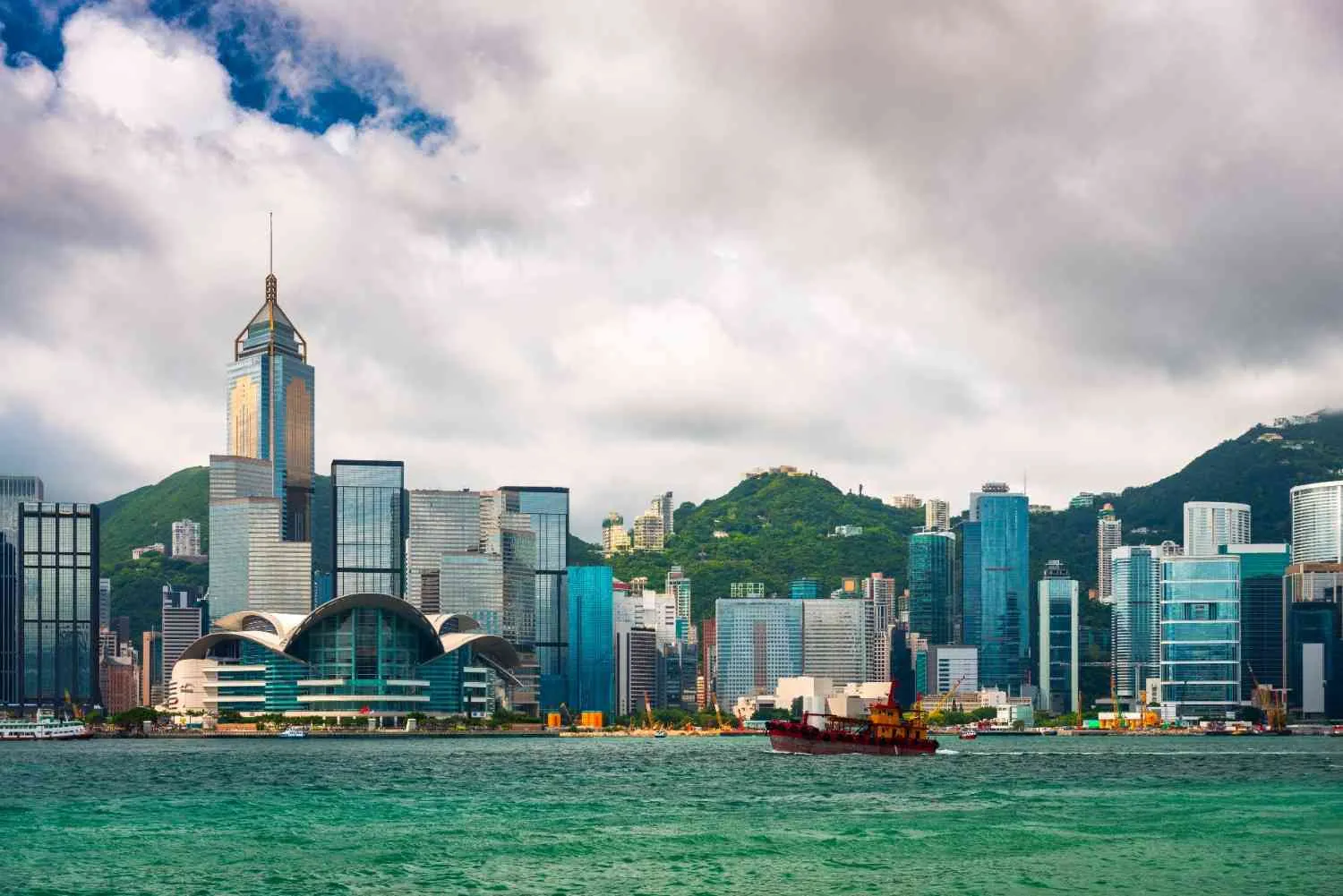

 Hong Kong


 Singapore



 UAE
UAE



 Malaysia


 Turkey

 UK
UK
 EU
EU
 US
US
 Switzerland
 Bahamas Bank Account
 Cayman Islands Bank Account
 Mauritius Bank Account
 BVI
BVI
 Seychelles
Launching a business in Hong Kong is a massive achievement. But turning this vibrant city into a true home? That happens the moment your family joins you. The Hong Kong dependent visa is your bridge to making that happen, allowing your spouse, children, and sometimes parents to share in your entrepreneurial journey. It’s what transforms a solo venture into a shared family adventure.
A Founder's Guide to Bringing Your Family to Hong Kong
For any entrepreneur, relocating isn't just a business move—it's a life-altering event that impacts your entire family. The dependent visa isn't merely a piece of administrative paper; it’s the key to establishing a stable, supportive home base while you're laser-focused on getting your company off the ground. Think of it as a crucial line item in your business plan, one that’s essential for your long-term success and personal well-being.
Your power to bring your family over is directly tied to your own visa status. Whether you're in Hong Kong as an investor, under a general employment visa, or through a talent scheme, you become the "sponsor," and their entire application rests on your standing. I’ve written this guide from a founder’s perspective, cutting through the usual jargon to provide the practical, real-world advice you need.
Why This Matters for Entrepreneurs
Imagine this: instead of worrying about your family's well-being from halfway across the world, you're building your dream with them right by your side. Getting them settled smoothly is a game-changer. It’s not just about emotional comfort; it’s a strategic advantage that gives you the headspace to tackle the countless demands of your new business.
A successful dependent visa application unlocks:
- Stability: The emotional foundation of a united family is your strongest shield against the immense pressure of launching and scaling a business.
- Flexibility: A spouse on a dependent visa generally has the right to work without needing a separate employment visa. This opens up possibilities for a second income or allows your partner to pursue their own career or business goals.
- A Clear Path Forward: The time your family spends in Hong Kong on dependent visas counts towards the crucial seven-year requirement for permanent residency, putting everyone on the same track to a shared future.
The Government's Focus on Family-Centric Talent
Hong Kong understands the modern entrepreneur. To attract and retain top-tier talent, they know family-friendly immigration policies are non-negotiable. The city's leadership gets that founders and professionals are far more likely to plant deep roots if their families can join them without an endless bureaucratic struggle.
Hong Kong has made a clear effort to welcome families alongside talented individuals. Between 2022 and early 2025, the government approved entry for roughly 132,000 unmarried dependent children under 18 under various talent schemes. This statistic speaks volumes about their commitment to family unity.
This big-picture approach means that while you’re busy setting up a business in Hong Kong, your family can start building their new life, enrolling in schools, and becoming part of the community. Understanding this supportive mindset is the first step toward making your family's move as successful as your business launch.
Who Can I Bring to Hong Kong on a Dependant Visa?
Getting the eligibility right is the bedrock of a successful Hong Kong dependant visa application. This isn't just about filling out forms; it's about telling a clear, credible story to the Immigration Department. The entire process revolves around two key players: the sponsor (that's you, the entrepreneur) and the dependant (your family member).
Before anything else, your ability to sponsor someone hinges entirely on your own valid visa status. Whether you hold an employment visa, an investment visa as a business owner, or are here through a talent scheme, you must be legitimately established in Hong Kong before you can bring your family over.
The Straightforward Cases: Spouses and Young Children
For most founders, the most common scenario involves sponsoring a legally married spouse and any unmarried children under the age of 18. These applications are generally the most direct, but that doesn't mean you can be complacent.
The name of the game is providing undeniable proof of your relationship. Treat it like a due diligence exercise for an investor—every claim must be backed by solid evidence.
- For Your Spouse: A legally recognized marriage certificate is the cornerstone. But don't stop there. Immigration officers want to see proof of a genuine, ongoing partnership. Think joint bank statements, photos of you together over the years, or a shared tenancy agreement. These details make your case human and believable.
- For Children Under 18: A birth certificate clearly listing you as a parent is the primary requirement. If you've adopted, you'll need the official adoption documents.
While these cases tend to move more smoothly, the financial requirements are just as rigorous. You must still prove you can support them without issue.
The More Complex Scenarios: Older Children and Parents
What about children over 18 or your elderly parents? This is where the process becomes more challenging, and the burden of proof is significantly higher. The Immigration Department's primary concern here is genuine dependency.
Sponsoring parents aged 60 or over is generally only possible if you are a Hong Kong permanent resident. Even then, it’s not a given. You must prove they are almost entirely dependent on you financially and have no other means of support.
For unmarried children between 18 and 25, you need to demonstrate that they are still reliant on you, perhaps due to a disability or because they are enrolled in full-time education. Each case is judged individually, so your evidence must be compelling. For a wider perspective on general visa eligibility questions, seeing how other countries handle these nuances can be insightful.
A Critical Note for Founders: Your financial stability will be under a microscope. The Immigration Department must be completely convinced that you can support your entire family without any of them needing to access public funds. This is a non-negotiable safeguard for Hong Kong's social welfare system.
Proving Financial Stability When You're an Entrepreneur
This is often the biggest hurdle for business owners. Your income isn't a neat, predictable monthly salary; it fluctuates with client payments, project cycles, and the inherent ups and downs of running a business.
So, how do you prove you have the financial muscle to support your family? You need to paint a complete and convincing picture. Think of it like pitching an investor—you're not seeking funding, but demonstrating stability. A multi-layered approach is always best:
- Business Bank Statements: Show healthy and consistent cash flow over the last 6-12 months.
- Personal Bank Statements: Demonstrate a solid savings buffer. A good rule of thumb is having enough to cover at least six months of living expenses for your entire family.
- Audited Financial Reports: If your company is more than a year old, these provide a credible, third-party assessment of its financial health.
- Proof of Accommodation: A signed tenancy agreement for a home large enough for your family is powerful evidence. It proves you've made concrete plans for their arrival.
A single payslip is just one data point. As a founder, you need to show a trend line of financial capability. By layering different forms of proof, you build a compelling narrative that your business is a stable enterprise, fully capable of supporting your loved ones in Hong Kong.
Putting Together Your Document Checklist
Securing a Hong Kong dependent visa is less about hope and more about meticulous, organized preparation. Think of it as assembling a pitch deck for your family—every document is a piece of hard evidence that strengthens your case. The Immigration Department doesn't need a story; they need to see clear, undeniable proof. This checklist is your blueprint for an application that leaves nothing to chance.
The process boils down to gathering documents for two parties: you, the sponsor, and your family member, the dependent. It’s easy to get tunnel vision on the dependent's paperwork, but I’ve seen applications stall because the sponsor's own records weren't in order. Your documentation is just as vital.
Core Documents for You, The Sponsor
As the anchor of this application, your paperwork needs to establish three key things: your legal status in Hong Kong, your financial stability, and the authenticity of your relationship. This isn't just about showing your visa; it’s about proving you have a solid foundation for your family to build upon.
Here’s what you need on hand:
- Your Hong Kong Visa and HKID Card: Simple, yet essential. Provide clean copies of your current visa label and your Hong Kong Identity Card. This is the baseline proof that you have the right to sponsor anyone.
- A Valid Passport: A copy of your passport’s personal details page is a must. Ensure it has at least six months of validity remaining.
- Proof of Financial Standing: This is where immigration officers dig deep, especially for entrepreneurs. Compile at least 6-12 months of both personal and business bank statements. If your income isn't a steady salary, you need to paint a broader picture. I always advise clients to supplement this with proof of a healthy savings balance, audited company financials, and even major client contracts to demonstrate consistent cash flow.
- Proof of Accommodation: A signed tenancy agreement for a home that's large enough for your entire family is non-negotiable. This shows you have a suitable place for them to live from day one.
Essential Paperwork for Your Dependent Family Member
For your spouse or child, the documentation is all about proving two things: who they are, and how they are connected to you. Every document should create an unbroken chain back to you, the sponsor.
Here’s what they will need:
- Their Valid Passport: Just like you, their passport must be current, with ample time before its expiration.
- A Completed Application Form (ID 997): This is the official form for the dependent visa application. Fill it out with extreme care—even small inconsistencies can raise red flags.
- Proof of Relationship: This is the heart of the application.
- For a spouse, this is your marriage certificate.
- For a child, it’s a birth certificate clearly showing your name as a parent.
To really solidify your case, I recommend including supplementary evidence. Think family photos from different holidays over the years, or statements from a joint bank account. It all helps build a compelling story of a genuine relationship.
To make this crystal clear, let's break down who provides what in a simple table.
Essential Documents for Sponsor and Dependent
This side-by-side view helps you organize the core documents required from both you and your family member, ensuring nothing gets missed.
| Document Category | Required from Sponsor | Required from Dependent |
|---|---|---|
| Identity & Status | Copy of Hong Kong Identity (HKID) Card | Copy of valid passport |
| Travel Document | Copy of valid passport | Completed Dependent Visa Application Form (ID 997) |
| Legal Standing in HK | Copy of current Hong Kong visa label | Not applicable |
| Proof of Relationship | Marriage or birth certificate | Marriage or birth certificate |
| Financial Support | 6-12 months of bank statements, employment contract, company financials | Not applicable (unless adding to evidence of relationship, e.g., joint account) |
| Accommodation | Signed tenancy agreement for a suitable residence | Not applicable |
Remember, this is about presenting a complete, coherent package. The clearer the link between your stability as the sponsor and the dependent's identity, the smoother the process will be.
Insider Tip: If any of your key documents, like a marriage or birth certificate, are not in English or Chinese, you must get them officially translated by a certified professional. I’ve seen applications get stuck for weeks over this simple oversight. Don't try to cut corners here—it's a small investment for a much smoother journey.
The number of families relocating to Hong Kong is growing. In 2023 alone, the city approved nearly 48,700 dependent visas. A significant portion of these, around 22,800, were linked to talent schemes, signaling a strong trend of skilled professionals and entrepreneurs bringing their families with them.
This data confirms the government's support for family unity, but it also means their process is well-defined and strict. You can explore these trends and get a feel for the bigger picture by reviewing the latest migration policy research.
With this volume of applications, your goal is to make the immigration officer’s job as easy as possible. A clean, well-organized, and complete file is your best strategy. Treat this checklist not as a to-do list, but as your roadmap to getting your family’s application across the finish line without any unnecessary delays.
Submitting the Application and Seeing It Through
You’ve gathered the documents, checked everything twice, and now it's time for the final push: lodging the application. This is where your careful preparation pays off. It's not just about sending a file; it’s about navigating the Hong Kong Immigration Department's process with confidence.
The central document for your family member is Form ID 997. Be meticulous. I’ve seen applications delayed for weeks over a simple typo or a date that doesn't match a supporting document. That small inconsistency can be enough to trigger questions from a case officer, causing frustrating delays.
To put it simply, the process breaks down into a few logical phases.
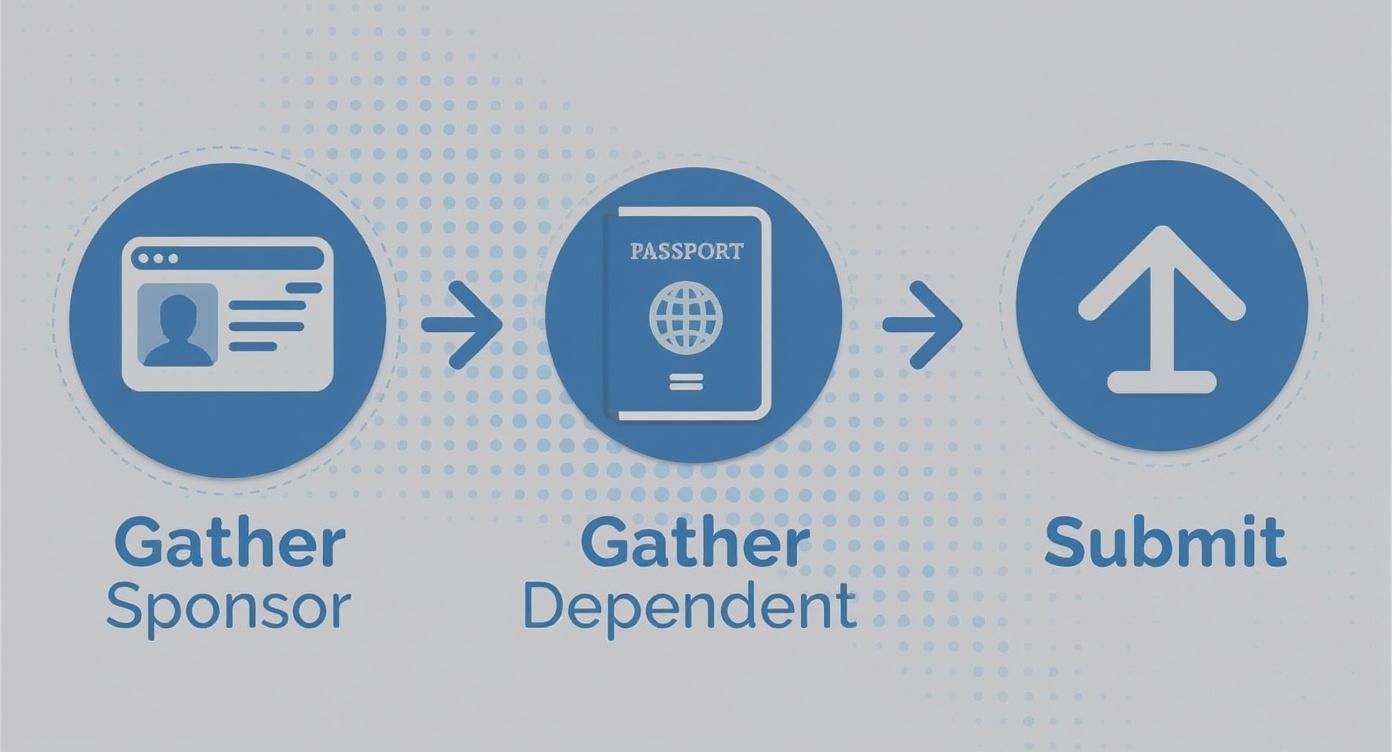
As you can see, it follows a natural sequence. First, you get your own house in order as the sponsor. Then, you gather all the proof of your dependent's identity and your relationship. Only then are you ready to submit.
How to Lodge Your Application
You have a few options for submitting the application, and the best route often depends on your location and preference.
- Online Submission: This is my go-to recommendation for most clients. It's fast, efficient, and the Immigration Department’s online portal is user-friendly. You can upload digital files and receive an acknowledgement almost instantly.
- By Post: If you prefer a paper trail, this is a solid choice. Just be sure to use a tracked postal service to have proof of delivery.
- In Person: For those already in Hong Kong, you or an authorized representative can drop the application off at the Immigration Department headquarters. This provides immediate confirmation of receipt.
The Waiting Game: What to Expect After Submission
Once submitted, the official processing time for a Hong Kong dependent visa is approximately six weeks. However, treat this as a guideline. In reality, if you're an entrepreneur with a complex income history or if your relationship proof isn't perfectly straightforward, it can take longer. Patience is a virtue here.
Don't be surprised if the Immigration Department requests more information. This is very common, so don't panic. In my experience, it’s usually a routine check to clarify a specific point, often related to your financial ability to support your family without accessing public funds.
A request for more documents isn't a red flag; it's an invitation to strengthen your case. Respond quickly and precisely, providing exactly what they’ve asked for. It’s your chance to clear up any lingering doubts the case officer might have.
For example, they might ask for your latest bank statements to see your current cash flow. Or, if there's a question about your living situation, you could send photos of your apartment along with the tenancy agreement. A swift, comprehensive reply demonstrates that you're organized and serious.
Approval, Payment, and Getting Started in Hong Kong
When that approval email lands in your inbox, you're on the home stretch. The Immigration Department will send a notification to pay the visa fee. Once paid, they'll issue a visa label.
This visa label must be affixed to your dependent's passport before they travel. They will need to present it at the immigration counter upon their first arrival in Hong Kong.
Once they're here, the very next step is to book an appointment to register for a Hong Kong Identity (HKID) card. This is non-negotiable and essential for nearly everything—opening a bank account, signing up for a mobile plan, you name it. Securing that HKID is the final piece of the puzzle, officially marking the start of your family’s new life in Hong Kong.
What a Dependant Visa Actually Means for Your Family's Life in Hong Kong

Securing a Hong Kong dependant visa for your family is a huge milestone, but what does it actually mean for their day-to-day life? It’s vital to understand what this visa empowers them to do, because that’s the difference between merely residing in the city and truly building a life here.
Unlike many other jurisdictions where dependents face frustrating limitations, Hong Kong’s approach is remarkably practical and flexible. This visa isn't just a pass to stay; it's a key that unlocks genuine personal and professional opportunities for your loved ones. For entrepreneurial families, this flexibility is a massive advantage, opening the door to dual-income households and shared ambitions.
Unrestricted Work Rights: A Game-Changer
One of the most powerful benefits of the dependant visa is the freedom it grants your spouse to work. There’s no need to find a separate employer for sponsorship, and they don’t have to navigate a complex process to secure a different work permit. This is a game-changer.
Your spouse can:
- Take up a job with any company in any industry.
- Start their own business and become an entrepreneur right alongside you.
- Work as a freelancer or consultant without any additional red tape.
This freedom offers incredible financial and personal flexibility. It can alleviate the pressure on you as the primary business owner and, just as importantly, allow your partner to pursue their own career aspirations—a critical part of feeling fulfilled and settled in a new country.
Full Access to Education and Study
For your children, the dependant visa provides seamless access to Hong Kong’s excellent education system. They have the right to enroll in either local or international schools without needing a separate student visa, which removes a significant layer of stress from the relocation process.
And this isn't just for children. A spouse holding a dependant visa is also free to pursue further education, whether it's a university degree, a professional certification, or language classes to help them integrate more fully.
Key Takeaway: The Hong Kong dependant visa is designed for integration. It empowers family members to work, study, and build their own lives, turning the move to Hong Kong into a shared, enriching experience rather than a one-sided relocation.
The Clear Path to Permanent Residency
Perhaps the most valuable long-term benefit is that time spent in Hong Kong on a dependant visa counts toward the seven-year requirement for permanent residency, also known as the "Right of Abode." This means your entire family is on the same timeline to securing your future in the city.
After living in Hong Kong continuously for seven years, both you and your dependants can apply for permanent resident status. This grants the right to live and work in Hong Kong indefinitely, without any visa restrictions. It's the final step in making Hong Kong your family's long-term home.
It’s worth noting that Hong Kong is a major hub for high-income individuals and their families. Immigration Department data shows that of the 41,057 approved Category A applicants (which includes dependants), a significant portion were high earners, with 1,296 individuals reporting incomes of HKD 10 million or more. You can dive deeper into visa control statistics on the official site.
With the ability to work and build a life, your spouse will naturally need to manage their own finances, starting with a local bank account. Our guide on Hong Kong bank account requirements for non-residents walks you through the practical steps to get that sorted.
Common Application Mistakes and How to Avoid Them
Navigating the Hong Kong dependent visa process can sometimes feel like walking through a minefield. From my experience helping founders bring their families over, it's rarely one major issue that derails an application. Instead, it’s usually a handful of small, avoidable oversights that cause the biggest headaches and delays.
The most common trap, especially for entrepreneurs, is presenting insufficient financial proof. A single strong month of company revenue simply won't suffice. Immigration officers are looking for a stable, consistent financial history that proves you can comfortably support your family in Hong Kong without any reliance on public assistance.
Inadequate Proof of Relationship
Another frequent hurdle is providing flimsy evidence of your relationship. This is particularly true for unmarried partners, but even a marriage certificate alone might not be enough to satisfy the authorities. The case officer needs to see clear proof that your relationship is both genuine and ongoing.
Think of it like building a case file. You need to layer your evidence to paint a compelling picture.
- Joint Tenancy Agreements: This is powerful proof that you share a home.
- Shared Financials: Statements from a joint bank account are excellent for demonstrating financial interdependence.
- Travel Itineraries & Photos: Create a visual timeline. Photos from trips, family gatherings, and everyday life tell a story that documents alone cannot.
The objective is to leave no doubt in the immigration officer's mind. The more comprehensive your "relationship portfolio," the stronger your application will be.
A Note on Documentation Integrity: It is absolutely critical that every document submitted is genuine. Any misrepresentation, even a seemingly small white lie, can lead to immediate refusal and could even result in a ban from future applications. Understanding the serious consequences of avoiding visa application misrepresentation is non-negotiable.
Simple but Costly Form Errors
Finally, don't let simple paperwork mistakes sink your application. A typo in a name, a date that doesn't match a passport, or a single missed field on Form ID 997 can bring everything to a halt. These may seem like trivial details, but to a case officer, they are red flags that demand extra scrutiny.
Before you submit, triple-check everything. Go through every line of the form and compare it against your supporting documents—passports, birth certificates, and everything in between. Better yet, have a fresh pair of eyes review it all. Treating your visa paperwork with the same diligence as a critical business contract is the best way to avoid these unforced errors and keep the process moving forward.
Common Questions We Get About Dependent Visas
We get a lot of questions from entrepreneurs and their families trying to make sense of the Hong Kong dependent visa process. Let's tackle some of the most common ones we hear in our practice.
Sponsoring Parents and Job Changes
"Can I sponsor my parents?" This is probably the number one question we're asked. The short answer is, it's tough. You generally need to be a Hong Kong permanent resident yourself, and your parents must be aged 60 or over. Crucially, you'll have to prove they genuinely depend on you, not just financially but emotionally too. It's a high bar.
Another frequent worry is about changing your own visa status, say, from being an employee to launching your own company. Remember, your family’s dependent visas are tethered to your own. If your sponsorship status changes, you must notify the Immigration Department immediately. This usually means your dependents will need to update their visas to stay legally in Hong Kong.
Rights and Immediate Next Steps
One of the best things about the dependent visa is the freedom it gives your spouse. They can work for any employer or even start their own business without needing a separate employment visa. This is a game-changer for entrepreneurial couples, offering real flexibility.
A practical tip we always give clients: as soon as your family member lands in Hong Kong with their new visa, get them an appointment to register for a Hong Kong Identity Card (HKID). You can't do much without it—from opening a bank account to getting a mobile phone plan, the HKID is essential.
It's also smart to think about the long game. The time your family spends here on dependent visas counts towards the seven years needed to qualify for permanent residency, or "Right of Abode." If you want to dive deeper into what that means, check out our guide comparing permanent resident vs citizen status.
Conclusion
Getting your family’s dependent visas sorted is a critical piece of the puzzle when you're building a life and a business in Hong Kong. At Lion Business Consultancy Limited, we specialize in creating seamless global structures for entrepreneurs like you. Let us handle the complexities—from your family’s visas to your banking and company formation—so you can focus on what you do best: growing your venture.