

 Hong Kong



 Singapore



 UAE
UAE



 Malaysia

 Turkey


 UK
UK
 EU
EU
 US
US
 Switzerland
 Bahamas Bank Account
 Cayman Islands Bank Account
 Mauritius Bank Account

 BVI
BVI
 Seychelles

Navigating the world of stamp duty on share transfers can feel like deciphering a complex legal puzzle. But for any entrepreneur or SME owner, getting this right isn't just about compliance—it's about smart financial strategy. Let's break down what it is, why it matters, and how you can manage it without the headaches.
Your Guide to Share Transfer Stamp Duty
So, what exactly is stamp duty on a share transfer?
Think of it as a government tax on the legal paperwork that makes a change in your company's ownership official. When shares move from one person to another—whether you're bringing on a partner or selling a stake—the document that records that shift, known as an "instrument of transfer," gets a literal stamp of approval, and that stamp comes with a fee. It’s similar to paying a land registry fee when you buy a house; it’s the government's charge for formally recognising the transaction.
For an entrepreneur, understanding this tax is foundational. It’s a real cost that can impact your bottom line during pivotal moments like taking on investment, restructuring ownership, or planning your exit. My goal here is to demystify it, so you can build your business on a rock-solid financial footing.
Before we dive deeper, let’s get a quick overview of the key concepts.
Key Stamp Duty Concepts at a Glance
| Concept | Simple Explanation for Business Owners |
|---|---|
| What is it? | A tax on the legal documents that transfer company shares. |
| Who pays? | Usually the buyer, but this is often a point of negotiation in the deal. |
| When is it triggered? | Whenever the ownership of shares officially changes hands. |
| What is taxed? | The 'consideration' (the price paid) or the shares' market value, whichever is higher. |
| Why does it matter? | It’s a tangible cost that directly affects the final value of your transaction. |
This table gives you a bird's-eye view, but as any founder knows, the devil is in the details. Let's explore the specific moments in your business journey when this tax is likely to make an appearance.
Common Triggers for Stamp Duty
This isn't some obscure rule that only applies to giant corporations. Stamp duty often pops up during the most common and exciting milestones a growing business faces. Knowing these triggers helps you anticipate costs and avoid unpleasant surprises.
Here are a few scenarios where it comes into play:
- Bringing on a new partner or co-founder: When you issue shares to a key person joining your leadership team, that transfer document is typically liable for stamp duty.
- Securing investment: An angel investor or venture capital fund buying a stake in your company is a classic transaction that triggers a duty payment.
- Restructuring company ownership: Sometimes you need to reorganise things, maybe by moving shares between founders or into a holding company. This is also considered a taxable event.
- Executing an exit strategy: When you sell your business, that significant share transfer makes stamp duty a major line item in the deal's finances.
A Historical Pillar of Government Revenue
Why do governments care so much about this tax? In short: it’s a massive and reliable source of income. The practice of stamping documents to collect revenue is centuries old and remains a core part of the financial system in many jurisdictions.
In Hong Kong, for example, stamp duty is a cornerstone of public finance. The modern rules for share transfers have evolved from 19th-century legislation, but the core principle hasn't changed.
Stamp duty on stock transfers and property transactions forms a substantial component of government revenue. Historical records show that over the decade leading up to 2021, stamp duty from stock transfers consistently contributed approximately HK$20 billion annually to Hong Kong's financial resources.
This long history explains why the rules are enforced so strictly. Having a clear legal framework for your company, including essentials like a shareholders agreement, gives you the control and clarity needed to manage these duties effectively and stay compliant.
When Does a Share Transfer Actually Trigger Stamp Duty?
It’s a common misconception that stamp duty only matters when you sell your entire company. The reality is much broader. Many routine business decisions—the kind of strategic moves entrepreneurs make every day—can create a tax liability, often when you least expect it.
The core trigger is the transfer of beneficial ownership. Think of this as the real, underlying right to enjoy the financial perks of owning shares, like receiving dividends or profiting from a future sale. The moment that right officially changes hands, the government wants its cut.
The Obvious Triggers You’ll See in Business
Let’s start with the classic scenarios. These are the major milestones where stamp duty should always be on your radar.
Imagine you’ve been building your startup for a few years and finally find the perfect CTO to bring on as a co-founder. You agree to give her a 10% stake. The moment you sign the legal paperwork—the instrument of transfer—to move those shares into her name? That's a taxable event.
It’s the same for other common situations:
- Landing an Angel Investor: An experienced investor loves your vision and injects $500,000 for a 20% equity stake. This transfer of shares is a clear trigger for stamp duty.
- A Co-Founder Exits: Your original partner decides to move on. Whether you or another shareholder buys them out, that purchase is a straightforward share transfer that needs to be stamped.
- Passing Shares to Family: As part of a succession plan, you might transfer shares to your children. Even if it’s a gift with no money exchanged, stamp duty is still calculated on the shares' fair market value.
A crucial point to remember: stamp duty is almost always charged on the higher of two figures—the price paid for the shares or their fair market value. This prevents anyone from selling valuable shares for a nominal sum just to dodge the tax bill.
The Sneaky Scenarios That Can Catch You Out
This is where things get more nuanced. Beyond simple sales, certain corporate manoeuvres can land you with an unexpected stamp duty bill. These are the moments when getting advice early on really pays off.
Properly structuring your business from the beginning can save you countless headaches, which is why a well-managed incorporation of a company in Hong Kong is more than just a formality.
Here are a few less obvious triggers to watch for:
- Company Restructuring: You decide to set up a holding company to protect your assets. Shifting shares from your main operating business to this new entity is still a transfer. While you might qualify for relief, you still have to go through the formal process.
- Mergers & Acquisitions: When two companies join forces, shareholders often swap their old shares for new ones in the merged entity. This "share-for-share" exchange is considered a transfer and, you guessed it, triggers stamp duty.
- In-Specie Distributions: This is just a technical term for paying out an asset in its original form instead of cash. For example, a parent company might distribute shares it owns in a subsidiary to its own shareholders. That’s a direct transfer of ownership, and it’s dutiable.
- Share Buybacks: Sometimes a company buys its own shares back from an investor. Depending on how this is structured, it can be treated as a transfer and attract stamp duty.
By getting a handle on these triggers—both the obvious and the subtle—you can stop seeing stamp duty as a random financial hit. Instead, it becomes a predictable cost to factor into your planning. This foresight helps you structure deals smarter, budget accurately, and avoid the stress of a surprise tax bill.
How to Calculate Stamp Duty in Hong Kong
Alright, let's get into the mechanics. While the idea of a government tax can feel intimidating, the actual calculation for Hong Kong’s stamp duty on share transfers is surprisingly straightforward. It’s less about complex financial modeling and more about applying a simple formula to the right numbers.
The process boils down to one core principle: the tax is calculated on the value of the shares changing hands. Sounds simple enough, but there’s a crucial detail here that often catches people out.
Determining the Value of Your Shares
The Inland Revenue Department (IRD) is very specific about this. Stamp duty isn't just based on the price you agree on. It’s calculated on whichever of these two figures is higher:
- The Consideration: This is simply the price paid for the shares. If someone pays you HK$1,000,000 for a slice of your company, that’s the consideration.
- The Net Asset Value (NAV): This is the fair market value of those shares, typically determined from the company’s latest audited financial statements.
So, why this "whichever is higher" rule? It’s a practical anti-avoidance measure. Without it, you could "sell" shares worth HK$500,000 to a family member for a token HK$100 to dodge the tax bill. This rule ensures the government gets its fair share based on the transaction’s true economic worth.
The rule of using the higher of consideration or market value is non-negotiable. It protects the integrity of the tax system and ensures all share transfers are valued fairly for stamp duty purposes.
The Current Stamp Duty Rate
Once you know the correct value, applying the tax rate is simple. Hong Kong's approach to the transfer of shares stamp duty has shifted over the years as the government balances raising revenue with keeping the market competitive.
The most recent significant change occurred on 17 November 2023. Under the current rules, the duty on the contract notes is 0.1% for the buyer and 0.1% for the seller, for a total of 0.2% of the transaction value. On top of that, a fixed duty of HK$5 is charged on the legal instrument of transfer itself. For official details, you can always check the IRD's guidance on stamp duty on stock transfers.
A Worked Example Step-by-Step
Let's walk through a real-world scenario. Imagine "Innovate HK Ltd.," a local SME. The founder, Alex, is selling a 20% stake in his business to a new investor, Chloe.
Here are the key figures:
- Agreed Sale Price (Consideration): HK$1,200,000
- Total Net Asset Value of Innovate HK Ltd.: HK$7,000,000
- Value of 20% Stake (NAV): 20% of HK$7,000,000 = HK$1,400,000
Step 1: Identify the Dutiable Amount
First, we compare the sale price (HK$1.2M) with the market value (HK$1.4M). Because the market value is higher, the stamp duty must be based on HK$1,400,000.
Step 2: Calculate the Duty Payable
- Buyer's Duty (Chloe): HK$1,400,000 x 0.1% = HK$1,400
- Seller's Duty (Alex): HK$1,400,000 x 0.1% = HK$1,400
- Total Stamp Duty on Contract Notes: HK$1,400 + HK$1,400 = HK$2,800
Step 3: Add the Fixed Duty
Finally, we add the small, fixed duty for the legal Instrument of Transfer document.
- Instrument of Transfer Duty: HK$5
Total Duty Payable: HK$2,800 + HK$5 = HK$2,805
This simple breakdown shows how a process that sounds complex is actually just a few manageable steps. Getting these figures right is absolutely critical, and maintaining clean, accurate records is your best defense. For many SMEs, having this calculation handled as part of their regular financial management is a huge relief, which is where professional accounting services in Hong Kong can provide immense value.
By understanding this formula, you can confidently forecast the cost of any planned share transfer, turning a potential tax headache into a predictable business expense.
Getting the Paperwork Right: Stamping Deadlines and Penalties
Figuring out how much transfer of shares stamp duty you owe is just the first step. The real challenge often lies in navigating the paperwork and meeting the tax authority's strict deadlines. It’s a bit like filing your annual tax return—your numbers can be perfect, but if you file late, you’re still facing a penalty.
The stamping process is a clear, step-by-step affair. It starts with gathering your documents and ends when you receive that official stamp, proving the duty has been paid. Miss a step or a deadline, and you're not just looking at frustrating delays; you're facing financial penalties that can really sting.
This infographic breaks down the basic logic behind the stamp duty calculation, which is the starting point for the whole process.
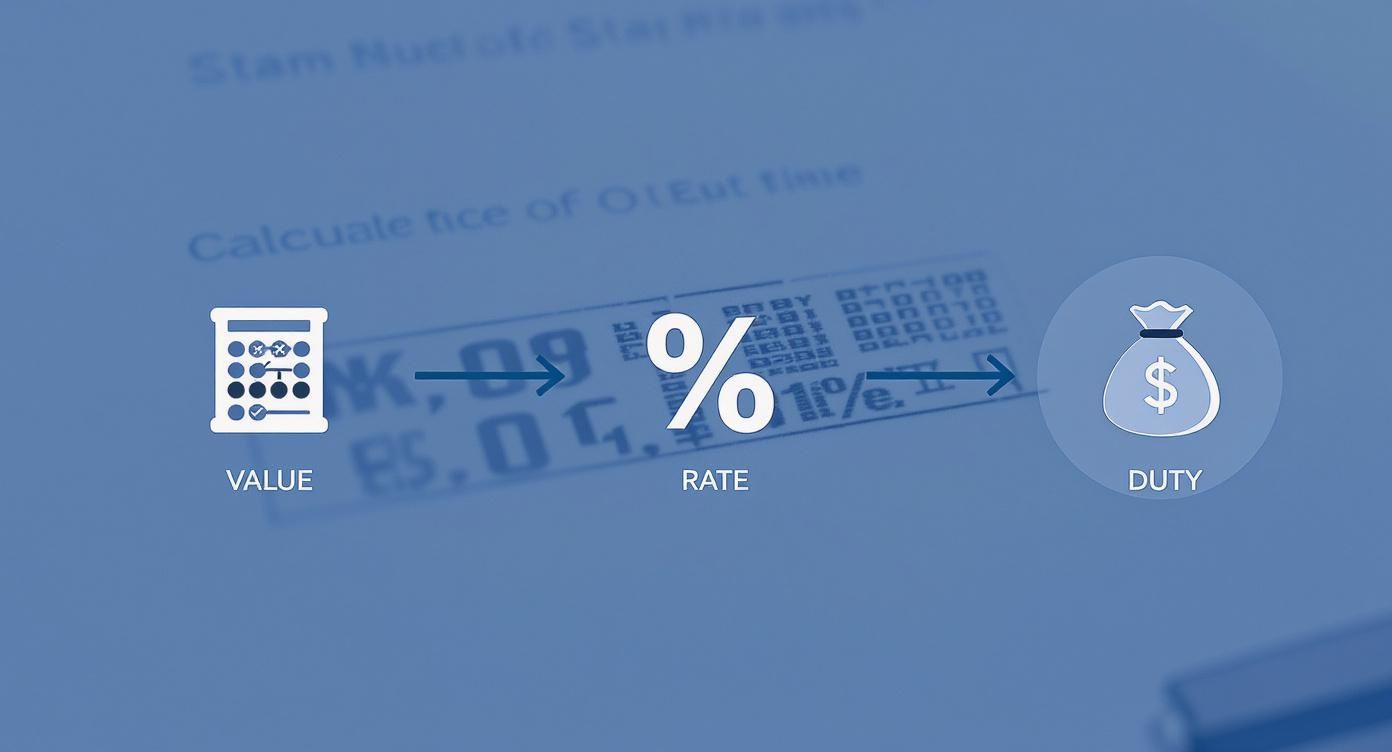
As you can see, the final duty hinges entirely on the share value and the current rate. That’s why getting the valuation right from the start is so important.
Your Stamping Process Checklist
To make it easier, let’s walk through the process with a simple checklist. Following these steps will help you stay on the right side of the law and avoid any last-minute panic.
- Gather Your Documents: First, you'll need two critical items: the signed Instrument of Transfer and the company’s most recent audited financial statements. The financials are non-negotiable, as they’re used to confirm the market value of the shares.
- Complete the Application: You’ll need to fill out the official application forms from the Inland Revenue Department (IRD). Double-check every detail for accuracy.
- Submit for Adjudication: Hand everything over to the Stamp Office. Their job is to review your valuation and check your calculations to ensure everything aligns.
- Await the Assessment: The Stamp Office will issue a payment notice that confirms the final amount of duty you need to pay.
- Pay the Duty: Once you have the notice, pay the amount owed by the due date.
- Receive the Official Stamp: After your payment is processed, the Instrument of Transfer gets its official stamp. This is the final step that makes the legal transfer complete and official.
Critical Deadlines You Cannot Afford to Miss
When it comes to stamp duty, timing is everything. Hong Kong’s rules are crystal clear about when your documents need to be stamped, and the deadline depends entirely on where the transfer agreement was signed.
- Signed in Hong Kong: The Instrument of Transfer must be stamped within 2 days of being executed. Yes, just two days.
- Signed Outside Hong Kong: You get a bit more breathing room. The document must be stamped within 30 days of its execution.
These aren't just guidelines; they are hard-and-fast rules. Miss them by even a single day, and penalties kick in automatically. The authorities see timely payment as a fundamental part of the process.
The Heavy Price of Being Late
So, what happens if you miss the cut-off? The penalties for late stamping are tiered and they escalate quickly. They are specifically designed to discourage anyone from delaying payment.
Here’s how the penalty structure works:
- Up to 1 Month Late: The penalty is 2 times the original stamp duty.
- Between 1 and 2 Months Late: It jumps sharply to 4 times the original duty.
- Over 2 Months Late: The penalty maxes out at a painful 10 times the original duty.
Let's put that into perspective. If your stamp duty was calculated at HK$5,000 and you’re just over two months late, you could be hit with a HK$50,000 penalty on top of the original HK$5,000 you still owe. It's a hugely expensive mistake, but one that’s completely avoidable with proper planning.
Common Exemptions and Reliefs for Your Business
Not every share transfer automatically comes with a tax bill. For savvy entrepreneurs, understanding the available stamp duty exemptions isn't about tax avoidance; it's about smart financial planning. Think of these reliefs as specific pathways the government has created to avoid taxing transactions where the ultimate ownership doesn't really change.
Getting this right can save your company a substantial amount, especially during internal reorganisations. It’s often the key difference between a costly paper exercise and a smooth, tax-efficient corporate manoeuvre.

Intra-Group Reorganisation Relief
This is perhaps the most valuable relief for any business with a group structure. Let's say you have a holding company and an operating subsidiary. If you move the subsidiary's shares from one of your companies to another, have you really "sold" anything in a commercial sense?
Of course not. You're just shifting an asset from one pocket to another. The ultimate beneficial owner—your group—remains the same. This is the simple logic behind intra-group relief.
To leverage this powerful exemption, you need to meet some strict conditions:
- Associated Bodies Corporate: The company transferring the shares and the company receiving them must be "associated." In Hong Kong, this generally means one company beneficially owns at least 90% of the other, or a third company beneficially owns at least 90% of both.
- No Disassociation Planned: Crucially, at the time of the transfer, there can be no intention for the companies to break this association. This is a classic anti-avoidance rule, preventing businesses from creating a temporary group just to dodge the duty.
Intra-group relief is not automatic. You have to formally apply for it and provide evidence to the Stamp Office that your transaction meets all the requirements. Assuming it applies without formal adjudication could lead to a very nasty surprise.
Other Important Exemptions
While group reorganisations are the most common scenario for SMEs, a few other specific situations can also offer a path to relief. These are often linked to financial market activities but can sometimes apply to other business structures.
For example, certain transfers involved in stock borrowing and lending are exempt. This is mainly to keep financial markets liquid and isn't something most SMEs will encounter. Similarly, some transfers to registered charities may also qualify for relief under specific rules.
It’s also vital to stay aware of changes in the tax landscape. For instance, in August 2021, Hong Kong introduced a significant 30% increase in the stamp duty on stock trades, pushing the combined rate from 0.2% to 0.26%. This move was expected to generate an extra HK$12 billion a year. You can read more about this significant tax policy shift on scmp.com.
To help you navigate these options, here is a quick overview of some common reliefs.
Stamp Duty Reliefs at a Glance
| Type of Relief | Typical Business Scenario | Primary Condition |
|---|---|---|
| Intra-Group Relief | Transferring assets (like shares in a subsidiary) between two companies within the same corporate group. | The transferor and transferee companies must be at least 90% associated. |
| Charitable Relief | Gifting shares or property to a registered charity recognised under section 88 of the Inland Revenue Ordinance. | The transfer must be a genuine gift to a qualifying charity for no consideration. |
| Stock Borrowing Relief | A financial institution borrowing and then returning shares as part of a market-making or lending arrangement. | The transaction must be a recognised stock borrowing and lending agreement. |
This table provides a high-level summary, but the devil is always in the detail. Each relief has its own set of rules and application procedures that you must follow precisely.
Why Relief Planning Matters
Simply knowing these reliefs exist is only half the battle. What really sets successful businesses apart is actively planning for them. Whenever you're considering a merger, an acquisition, or even just a simple internal tidy-up of your corporate structure, the first question should be: "Can we structure this to qualify for relief?"
Getting professional advice before you sign on the dotted line is non-negotiable. A tax advisor can help you map out the transaction step-by-step, ensuring you meet the strict criteria for an exemption. This proactive approach turns stamp duty from an unavoidable cost into a manageable—and sometimes completely avoidable—expense.
When Should You Bring in a Professional?
For a simple share transfer, you might be able to handle the basics yourself. But as your business grows and your deals become more complex, the financial and legal stakes get much higher. Knowing when to call in a specialist isn’t a sign of weakness; it’s a sign of a smart business owner protecting their assets.
Think of an expert advisor as a strategic partner. They help you see around corners and structure deals in the most favourable way, not just tick a compliance box. The reality is, the cost of good advice upfront is almost always a fraction of the price you'll pay to clean up a mess later on.
Red Flags: Time to Call an Expert
Some situations are inherently trickier and carry a much higher risk of error. If your share transfer involves any of the following, it’s a clear signal to get professional guidance.
-
Cross-Border Transactions: When a deal involves parties in different countries, you're suddenly juggling more than just Hong Kong's rules. You could easily trigger tax obligations in multiple jurisdictions. An expert is crucial for navigating this complexity.
-
Complex Company Valuations: What is your company truly worth? If the answer isn't obvious from the balance sheet—which is common for tech startups with valuable IP or businesses with intangible assets—you need a formal valuation. Getting this wrong means paying the wrong amount of duty, a surefire way to attract unwanted attention from tax authorities.
-
Unique Share Classes: Does your company have different types of shares, like preference shares with special voting or dividend rights? Valuing these for stamp duty purposes is far more complicated than a simple calculation based on net assets.
Navigating Anti-Avoidance Rules and Tricky Structures
Tax authorities are always on the lookout for transactions that seem designed purely to sidestep tax. These are caught by what are known as anti-avoidance provisions.
An advisor’s real value shines here. They ensure your legitimate business restructuring isn't mistaken for tax evasion, helping you document the solid commercial reasons behind your decisions to create a clear, defensible record.
This becomes absolutely critical during major events like mergers, acquisitions, or setting up a holding company. Likewise, getting the basics right is non-negotiable. Simple clerical errors can cause huge headaches. For instance, using the correct Hong Kong Business Registration Number on all official forms is vital, as a small mistake can lead to significant delays. An advisor ensures these foundational details are perfect from day one.
At Lion Business Consultancy Limited, we know that navigating global finance is about smart strategy, not just ticking boxes. We act as your private financial manager, building the secure banking, tax, and corporate structures that let you expand without hesitation. If you’re looking for a partner to protect your assets and set you up for what’s next, explore our services at https://lionbusinessco.com.