
 Hong Kong
 Singapore
 UAE
UAE


 Malaysia
 Turkey
 UK
UK
 EU
EU
 US
US
 Switzerland
 Bahamas Bank Account
 Cayman Islands Bank Account
 Mauritius Bank Account
 BVI
BVI
 Seychelles
Getting an HSBC account open in Hong Kong is more than just a task on your to-do list; for many entrepreneurs, it’s the strategic first step into one of the world’s most dynamic financial hubs. You’ll need the right documents and a clear understanding of the process, but think of it less as a hurdle and more as laying the foundation for your business’s future.
Your Gateway to Banking in Hong Kong
For ambitious entrepreneurs and small-to-medium enterprises (SMEs), opening a bank account with HSBC here isn’t just a box-ticking exercise. It’s a foundational move for anyone serious about tapping into Asia’s vibrant market. This isn’t just about finding a place to park your capital; it’s about unlocking real opportunities for international trade, investment, and smarter wealth management.
This guide is designed to give you a real-world perspective, moving beyond the usual checklists to offer the practical, actionable advice that I share with my own clients.
The infographic below really captures how opening an account in Hong Kong can be a springboard for growth.
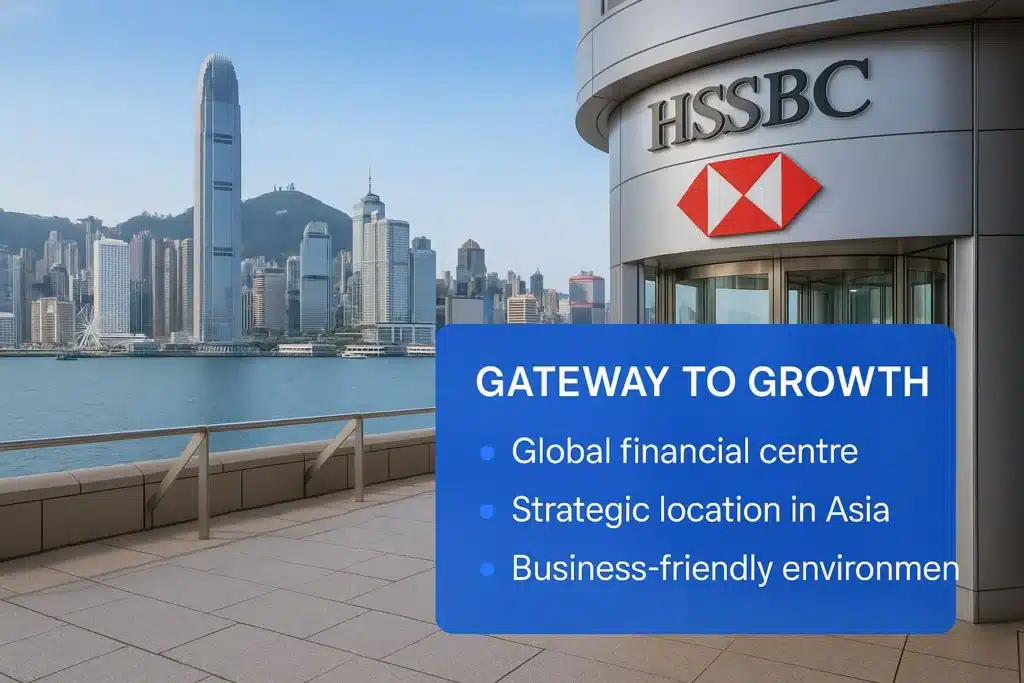
As you can see, a Hong Kong bank account is much more than a utility; it’s a strategic tool for expansion.
Why HSBC Remains a Top Choice
With its deep-rooted history and commanding presence in the city, HSBC is the logical first port of call for many. The bank is renowned for its stability, and its digital platforms are built for the realities of both local and international business—a massive advantage in today’s global economy.
Imagine you’re an entrepreneur juggling a supply chain that stretches across multiple continents. HSBC’s global network makes cross-border payments feel seamless. For an investor, it opens the door to a huge range of financial products.
The bank’s sheer scale speaks volumes about its reliability. Just look at the numbers: as of mid-2025, HSBC’s customer accounts in Hong Kong held a staggering HKD 6.24 billion, with loans to customers hitting around HKD 3.54 billion. These aren’t just abstract figures; they represent the immense trust that individuals and businesses place in the institution.
As you establish your financial footprint in Hong Kong, it’s worth exploring some comprehensive expat financial planning tips to see the bigger picture of managing your wealth internationally.
Ultimately, choosing to open an HSBC account is about setting your venture up for success. It provides the solid financial infrastructure you need to operate confidently in a fast-paced, competitive environment.
Finding the Right HSBC Account for You
Picking a bank account can feel like a chore, but getting it right from the start saves you a world of headaches—and money—down the line. It’s about matching the account’s features to how your business actually operates. The needs of a freelance designer juggling international payments are worlds apart from a growing retail business managing local payroll.
Let’s break down HSBC’s main accounts in Hong Kong, so you can see which one truly fits your situation.

For Everyday Personal Banking
For most people, the HSBC One account is the go-to choice. It’s the workhorse of their personal banking lineup, designed for daily life without unnecessary complications.
Picture this: you’ve just landed a job in Hong Kong. You need a straightforward account to receive your salary, handle rent transfers, and top up your Octopus card. HSBC One is perfect for this. It’s built for simple, digital-first banking, and best of all, there are typically no monthly service fees or minimum balance requirements to worry about.
For Ambitious SMEs and Start-ups
Once you’re running a business, your needs evolve dramatically. This is where the Business Integrated Account comes in. It’s less of a simple account and more of a financial control panel for your company.
This is the account you’ll use for everything from managing payroll and paying suppliers to receiving payments from clients. It’s designed to support the unique rhythm of a business, giving you access to essential tools and credit facilities as you grow.
A savvy move for any account holder in Hong Kong is to keep an eye on deposit rates. HSBC works hard to offer competitive savings rates. For instance, as of September 2025, the bank held its HKD savings interest rate at 0.25% per annum for balances over HKD 5,000, even while adjusting its USD rates. You can find more on their rate strategy on the official HSBC news site.
For High-Net-Worth Individuals and Investors
If you’re managing more significant assets, then HSBC Premier is in a different league. This isn’t just about transactions; it’s a full-service wealth management relationship.
This tier is really for individuals with a Total Relationship Balance of HKD 1,000,000 or more. The real value here is the personalized service—you get a dedicated Relationship Manager, better rates on mortgages and loans, and seamless global banking support. For an entrepreneur who has just sold their company, Premier provides the expert advice and global access needed to manage and grow that capital effectively.
To help you see everything at a glance, here’s a quick comparison of the most popular HSBC accounts in Hong Kong.
HSBC Account Comparison for Individuals and SMEs
This table helps you quickly compare the features and requirements of HSBC’s most popular accounts in Hong Kong to find the perfect fit.
| Account Type | Ideal For | Key Features | Minimum Balance/Fees |
|---|---|---|---|
| HSBC One | Individuals, expats, students | Digital-first banking, multi-currency support, no monthly fees | Typically no minimum balance or service fees. |
| Business Integrated Account | Start-ups, SMEs, sole proprietors | Payroll, trade services, business credit cards, online banking | Varies by account tier; fees may be waived with minimum balance. |
| HSBC Premier | High-net-worth individuals, global investors | Dedicated Relationship Manager, global account access, preferential rates | Requires a Total Relationship Balance of HKD 1,000,000 or more. |
Choosing the right account from day one means you have a banking partner that actually supports your goals, whether you’re just starting out or managing a global portfolio.
Getting Your Paperwork in Order
Think of your HSBC application like building a house—if the foundation isn’t solid, the whole thing falls apart. In this case, your documents are the foundation. A single missing or incorrect piece of paper is the number one reason applications get held up or flat-out rejected, turning what should be a simple task into a major headache.
Getting your documents right from the start isn’t just about being organized; it’s a strategic move. It can save you weeks of frustrating back-and-forth with the bank. The crucial thing to grasp is that the bank looks at personal and business applications through two very different lenses.
The Essentials for Personal Accounts
When you’re opening a personal account, HSBC really just wants to confirm two basic things: who you are and where you live. Sounds simple, but the devil is in the details.
For your identity, it’s pretty straightforward. If you’re a resident, you’ll need your Hong Kong Identity Card (HKID). For non-residents, your passport is the key.
Where people usually get tripped up is the proof of address. HSBC is very particular about this. You’ll need something recent—like a utility bill or a statement from another bank that’s less than three months old. The most important part? The name and address on this document must perfectly match what you’ve put on your application. Even a tiny difference can cause a delay.
The Corporate Dossier for Business Accounts
This is where the real legwork begins. For a business, HSBC isn’t just verifying one person; they’re doing their due diligence on an entire commercial entity, and the paperwork reflects that.
Before you even think about booking an appointment, you’ll need a complete file of your company’s documents. Having everything in order shows the bank you’re serious and makes their job easier, which always works in your favor.
Here’s a clear checklist of what you’ll typically need to prepare.
Required Documents for HSBC Account Opening
| Document Type | Personal Account | Business Account |
|---|---|---|
| Proof of Identity | ✓ (HKID or Passport) | ✓ (For all directors/shareholders) |
| Proof of Address | ✓ (Recent utility bill/bank statement) | ✓ (For all directors/shareholders) |
| Business Registration Certificate | ✓ | |
| Certificate of Incorporation | ✓ | |
| Articles of Association | ✓ | |
| Director & Shareholder Register | ✓ |
As you can see, the list for a business is far more extensive. You’re not just providing your own details but also identification and address proof for every director, major shareholder (typically anyone with 10% or more), and the ultimate beneficial owners.
Insider Tip: Don’t wait for the bank to ask for certified true copies of your corporate documents. Be proactive and get them certified by a solicitor or a certified public accountant (CPA) beforehand. This one step can genuinely speed up the whole process.
If you’re not from Hong Kong, the requirements can feel a bit more intense. Banks often apply extra scrutiny to non-resident applications. To get fully prepared, it’s worth reading our in-depth guide on Hong Kong bank account requirements for non-residents.
Walking into the bank (or submitting online) with every document perfectly organized and correctly certified changes the entire dynamic. You’re no longer just another applicant; you’re a professional who has done their homework, making it easy for the bank to say yes.
Choosing Your Application Path: Online vs In-Branch
You’ve picked the right HSBC account and have your documents lined up. Now comes a crucial decision: how do you actually apply? Do you handle it all online from your desk, or is it better to book a meeting and speak to someone face-to-face?
There’s no single right answer here. Deciding whether to open your HSBC account online or in-person is about more than just convenience; it’s about matching the application method to your specific circumstances. Each route offers its own set of benefits.
The Digital Route: A Smooth Online Experience
For most Hong Kong residents with straightforward banking needs, applying online is a no-brainer. The digital process is slick, fast, and designed for opening standard personal accounts like the HSBC One.
Think of a local professional who just needs an account for their salary to be paid into. They can get the whole thing done on their phone in less than 30 minutes, upload a photo of their HKID, and that’s it. It’s incredibly efficient, you can do it anytime, and there’s no need to travel to a branch.
To make sure your online application goes off without a hitch, keep these tips in mind:
- Stable Internet is Key: Nothing is more frustrating than losing your connection halfway through. Make sure you have a reliable signal.
- Get Your Digital Docs Ready: Have clear, high-resolution scans or photos of your ID and proof of address. A blurry document is one of the most common reasons for an application to get held up.
- Check Every Detail: Autocomplete can be a real pain. A tiny mismatch between what you enter and what’s on your documents will almost certainly flag your application for a manual review.
When an In-Branch Visit Makes Sense
While the digital option is tempting, it’s not for everyone. For more complex cases, especially for non-residents or businesses with complicated ownership, an in-branch appointment is practically a must.
Take the example of a European founder setting up a new trading company in Hong Kong. Her business involves two directors living overseas and a corporate shareholder based in Singapore. A standard online form just isn’t built to handle that kind of complexity.
By meeting a relationship manager in person, she can walk them through the business model, explain the international fund flows, and get personalized advice on setting up multi-currency payment solutions. This human interaction is invaluable for building trust and clarifying any potential red flags from the outset.
I generally advise clients to book an in-branch meeting if they:
- Are a non-resident opening their first bank account in Hong Kong.
- Are establishing a business account with foreign directors or a complex shareholding structure.
- Need to discuss specialized products like trade finance or wealth management.
- Simply prefer having a direct point of contact at the bank.
For many international business owners, the real hurdle isn’t just the application but managing it all from another country. The good news is that things are getting easier. It’s worth exploring your options for remote bank account opening services in Hong Kong, which can help bridge the gap when you need that personal touch but can’t be there in person.
Ultimately, the best path forward comes down to your own situation. If your needs are simple and you value speed, go digital. But if there’s any complexity involved, investing the time for an in-branch meeting is a wise strategic move that will dramatically improve your chances of getting the account open quickly and smoothly.
What Happens After You Apply?
You’ve hit “submit” on your HSBC application. So, what now? This is where the waiting game begins, and it can feel a little like sending a message into the void. But there’s a clear process happening on the bank’s end, even if it’s not always visible to you.
The timeline really hinges on what kind of account you’re setting up. If you’re a Hong Kong resident opening a simple personal account, you could get the green light in just a few business days. It’s a different story for business accounts, though. If your company has international directors or a more complicated ownership structure, you’ll need to be patient. These applications involve a much deeper dive into due diligence, so expect the process to take several weeks.
Dealing with Requests for More Information
Don’t be alarmed if you get an email from HSBC asking for more documents or clarification. This is completely normal and, frankly, a good sign—it means a real person is actively reviewing your file.
This is all part of the bank’s Know Your Customer (KYC) obligation. They need to tick every box to meet regulatory requirements. Think of it as a conversation; they just need a bit more detail to get comfortable. They might ask for things like:
- A clearer breakdown of your business activities or revenue streams.
- Proof showing the source of your initial funding.
- More details on the ultimate beneficial owners if your company has a layered structure.
How you handle these requests can make a huge difference. My advice? Be quick, be clear, and only send exactly what they’ve asked for. Flooding them with extra, unrequested paperwork just muddies the waters. A clean, direct response shows you’re organized and transparent—qualities that help you build a solid banking relationship and avoid issues down the road.
Pro Tip: Being transparent from the start is the best way to prevent your account from being flagged or frozen later. For a deeper dive, check out our Hong Kong banking checklist on how SMEs avoid freezes.
Getting Your Account Up and Running
Once that coveted approval email lands in your inbox, you’re in the final stretch. HSBC will mail out your account details, a welcome pack, and your physical cards. The last piece of the puzzle is activating your online and mobile banking, which is usually a straightforward process that puts you in full control.
You’re banking with a financial powerhouse. In the first half of 2025 alone, HSBC’s Hong Kong operations brought in around HKD 7.85 billion in revenue and held a steady best lending rate of 5.25%. This isn’t just a random number; it’s a clear indicator of the bank’s stability in the local market, offering real peace of mind. You can read more about HSBC’s robust financial performance and risk management in Hong Kong.
Got Questions? Let’s Clear Things Up
Going through the motions of opening an HSBC account can feel a bit like a maze, especially when your situation isn’t cookie-cutter. I’ve seen countless entrepreneurs and individuals get tripped up by the same few hurdles, so let’s tackle them head-on.
Getting these details right from the start is non-negotiable. A rejected application isn’t just a minor hiccup. For a new business, it can mean weeks of delays, putting everything from signing a lease to paying your first employees on hold. Knowing the common pitfalls is what separates a smooth approval from a frustrating back-and-forth with the bank.
Can I Open an Account if I’m Not a Hong Kong Resident?
Yes, you absolutely can, but you’ll need to do your homework. HSBC Hong Kong is open to non-resident applicants, but they’ll understandably take a closer look at your application. The most important thing is to clearly justify why you need a bank account here.
Are you managing local investments? Running a Hong Kong-registered company? Or perhaps you have close family ties in the city? These are all solid reasons. Simply wanting an account for convenience is unlikely to fly. Also, be prepared for a mandatory in-person visit to a branch and a longer wait for approval as they conduct their due diligence.
What’s the Most Common Reason Applications Get Rejected?
Nine times out of ten, it’s the simple stuff that sinks an application. The biggest culprit by far is inconsistent or incomplete paperwork. Think of a slight name mismatch between your passport and a utility bill, or a proof of address that’s a few weeks out of date. It seems small, but it matters.
For business accounts, the red flags are a bit more serious:
- A confusing ownership structure. If your company’s ownership is a web of entities and you don’t have clear, certified documents showing who the ultimate beneficial owners are, your application will almost certainly grind to a halt.
- A vague business plan. You need to be able to explain, simply and clearly, what your company does, who its customers are, and how it makes money. If the bank can’t understand your business, they won’t want to bank it.
- An unverified source of funds. Be ready to prove where your initial capital is coming from with proper documentation.
I once worked with a tech start-up whose shareholders were spread across three different countries. Their application was nearly denied because their shareholder agreement hadn’t been properly certified. A quick trip to a notary solved it, but it was a perfect example of how one small oversight can cause a massive headache.
So, How Long Does This All Actually Take?
This is the million-dollar question, and the honest answer is: it depends. The timeline can vary wildly based on how complex your situation is.
If you’re a Hong Kong resident applying for a personal HSBC One account online, you could be approved in just a couple of business days. But if you’re setting up a business account with overseas directors, you need to be patient. These applications often take anywhere from two to eight weeks, and sometimes even longer if the bank comes back with questions. Remember, every time they ask for more information, the clock effectively resets. Your best bet for a faster turnaround is to submit a perfectly organized application right from the start.
What About Initial Deposits and Monthly Fees?
This is a crucial detail, and you need to pay close attention to the specific account you’re choosing. The fee structure can have a real impact on your cash flow.
The standard HSBC One personal account is a great option for many because it generally has no minimum balance requirement or monthly service fee. It’s a flexible, low-maintenance choice for day-to-day banking.
Premium accounts, however, play by different rules. HSBC Premier, for example, requires you to maintain a pretty hefty ‘total relationship balance’—usually around HKD 1,000,000—across all your accounts, from savings to investments. If you drop below that, you’ll get hit with a significant monthly fee. The same logic often applies to business accounts, where monthly fees might be waived if you keep a certain average balance. Always, always ask for the latest ‘Schedule of Services and Tariffs’ so you know exactly what you’re signing up for.
Conclusion
Getting through these complexities is precisely where having an expert in your corner makes all the difference. At Lion Business Consultancy Limited, our specialty is making sure your banking setup is not just approved, but is secure and perfectly aligned with your business goals. We turn a stressful process into a straightforward one.