

 Hong Kong


 Singapore
 UAE
UAE


 Malaysia
 Turkey

 UK
UK
 EU
EU
 US
US
 Switzerland
 Bahamas Bank Account
 Cayman Islands Bank Account
 Mauritius Bank Account
 BVI
BVI
 Seychelles

Yes, you absolutely can open an offshore bank account online. In today’s digital world, you can often complete the entire process without ever leaving your office. Think of it as a three-step journey: choosing the right country for your business, preparing your personal and company documents with precision, and navigating an online application with a bank that welcomes global clients.
With a bit of strategic preparation, it’s a surprisingly accessible way to unlock significant financial agility for your business.
Your Digital Gateway to Global Banking

When you hear “offshore banking,” what comes to mind? For many, it’s an outdated image from a spy movie—secretive, complex, and reserved for the ultra-wealthy. Let’s set the record straight: that’s a picture from a bygone era.
For today’s entrepreneurs and small to medium-sized enterprises (SMEs), opening a bank account in another country is a smart, strategic move. This guide is your practical roadmap, designed to cut through the noise and demystify the process. This isn’t about hiding money; it’s about managing your capital intelligently on a global stage.
The Real-World Strategic Edge
The advantages for a growing business aren’t just abstract concepts—they’re immediate and tangible. Let me share a story I see all the time: a European e-commerce founder wants to expand into the booming Asian market.
By opening a corporate account in a financial hub like Hong Kong, they suddenly unlock several game-changing benefits:
- Currency Diversification: They can hold funds in multiple currencies—like USD, EUR, and RMB—creating a natural hedge against volatility in their home currency.
- Simplified Payments: Paying suppliers in Asia becomes seamless. They can transact in local currencies, sidestepping hefty conversion fees and the frustrating delays of traditional international wires.
- Asset Protection: Placing capital in a stable, well-regulated jurisdiction adds a crucial layer of security against economic or political instability back home.
This isn’t about finding loopholes; it’s about operational excellence. That same e-commerce store could boost its profit margin by 2-3% just by optimizing how it handles currency conversions. For any SME, that’s a significant win.
The true goal here is to build a more resilient and agile business that can thrive in our interconnected world. Think of offshore banking as giving your company a financial toolkit that finally matches your international ambitions.
As you embark on this journey, remember that digital security is paramount. Taking a moment to review essential cybersecurity tips for securing your digital footprint is a vital first step. With the right strategy and a clear map, this powerful financial tool is well within your reach. Let’s explore how you can make it happen.
Choosing the Right Offshore Jurisdiction
Selecting the right jurisdiction is, without a doubt, the most critical decision you’ll make. A common rookie mistake is to chase the lowest tax rate, but that’s like buying a car based only on its color. True, long-term stability and security are found in a country’s political climate, its legal framework, and its international reputation.
Imagine you’re choosing a long-term business partner. You need a jurisdiction that’s dependable, transparent, and respects global compliance standards. The goal is to find a premier financial center that offers security and efficiency, not a questionable hideout that will immediately raise red flags with your clients and partners.
Key Factors Beyond Taxation
When you set out to open an offshore bank account online, your focus should be on the foundational pillars that define a world-class jurisdiction. These are the non-negotiables that will protect your assets and keep your operations running smoothly.
- Political and Economic Stability: A proven track record of stability is paramount. Jurisdictions like Switzerland and Singapore are perennial favorites for a reason—their economies are resilient, and their political systems are incredibly predictable.
- A Robust Legal Framework: Look for countries with an ironclad rule of law, a deep respect for privacy, and modern banking regulations. This ensures your assets are protected by a predictable and fair legal system.
- International Reputation: How a jurisdiction is perceived on the world stage matters more than you might think. Avoid countries on international blacklists. Banking in one of those locations can create massive operational headaches, especially with correspondent banks in major economies like the US and UK.
For a deeper dive into locations that might be a good fit, take a look at our comprehensive guide on the best countries to open an offshore bank account.
Comparing Leading Financial Hubs
Each major offshore hub offers its own unique flavor and strategic advantages. Hong Kong, for example, is more than just a banking center; it’s the undisputed gateway for any business trading with Mainland China. Its status as the world’s number one offshore renminbi (RMB) hub makes it a magnet for companies that transact in that currency.
As of early 2025, Hong Kong’s RMB deposits hit an incredible RMB1,164.1 billion, the largest pool outside of the mainland. On an average day, the turnover in its RMB settlement system can exceed RMB3.1 trillion, a clear indicator of its unmatched liquidity and crucial role in global trade.
This visual gives a quick snapshot of corporate tax rates across several popular spots.
The data shows that while tax is a factor, the rates among top-tier jurisdictions like Hong Kong and Singapore are quite competitive.
To help you see the bigger picture, here’s a side-by-side comparison of some popular offshore banking locations. This should help you weigh the options based on what’s most important for your business.
Comparing Top Offshore Banking Jurisdictions
| Jurisdiction | Key Strengths | Best For | Typical Minimum Deposit |
|---|---|---|---|
| Switzerland | Unmatched reputation for privacy, stability, and wealth management expertise. | High-net-worth individuals, asset protection, long-term wealth preservation. | Varies widely, but often $500,000+ for private banking. |
| Singapore | Premier Asian financial hub, politically stable, strong rule of law. | Businesses operating in Asia, tech companies, wealth management. | $200,000 – $300,000 for priority banking. |
| Hong Kong | Gateway to China, world’s largest offshore RMB hub, excellent for trade finance. | E-commerce, import/export businesses, companies trading with Mainland China. | $10,000 – $50,000 for business accounts. |
| Cayman Islands | Politically stable, sophisticated financial services, no direct taxation. | Hedge funds, investment funds, international corporations. | Often $100,000+, varies by institution. |
This table is just a starting point. The “best” choice is always the one that aligns with your operational and financial goals.
Your choice of jurisdiction is a strategic decision that should support your business’s long-term vision. Don’t just think about where your business is today, but where it will be in five years. Will you need access to Asian markets, European investment opportunities, or stable US dollar banking? The answer will point you to the right financial home.
Gathering Your Documents for a Smooth Application
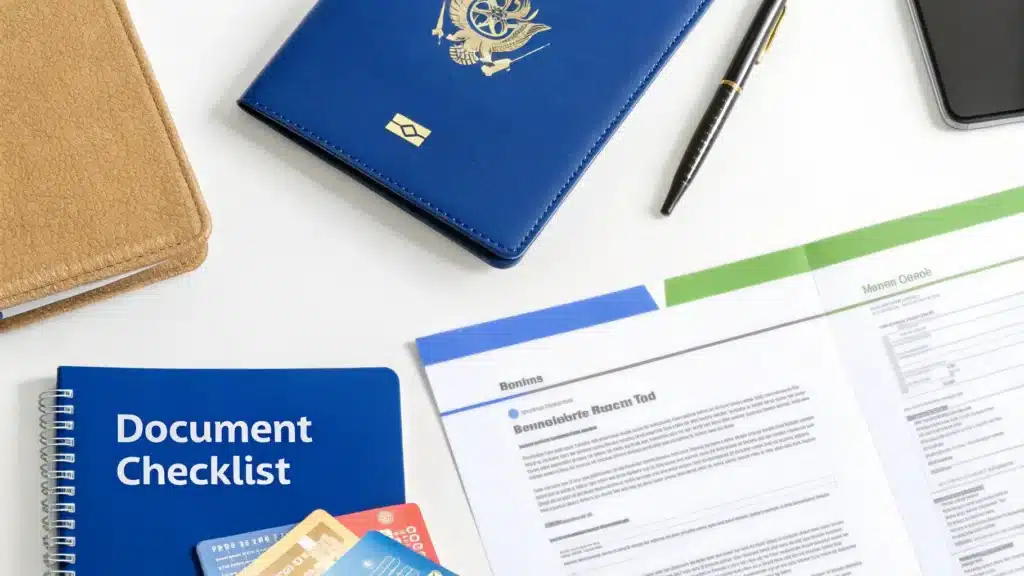
This is the make-or-break stage of the process. Your success is often determined right here, before you even fill out a single online form. Meticulous preparation isn’t just a good idea—it’s the only way to ensure a smooth journey.
Offshore banks operate under intense regulatory scrutiny. They are legally mandated to conduct thorough Know Your Customer (KYC) checks to prevent financial crime, and they don’t take shortcuts. Think of this phase less as a chore and more like building a trust portfolio for your new banking partner. You’re proactively demonstrating your legitimacy, which dramatically speeds things up and signals that you’re a serious, credible client. A single missing or unclear document can bring your application to a grinding halt.
The Essential Document Checklist
While the exact list varies slightly between banks and jurisdictions, the core requirements are universal. Getting these in order will put you miles ahead.
For a personal account, you’ll almost always need:
- Certified Copy of Passport: This must be a high-quality, clear copy. Depending on the bank, it may need to be notarized or apostilled.
- Proof of Residential Address: A recent utility bill or bank statement is standard. It must be less than three months old and clearly show your name and current address.
- Bank Reference Letter: A simple letter from your current bank confirming you are a client in good standing.
Opening a corporate account is a more complex undertaking with a longer checklist. The bank needs to understand your business inside and out. This is where many entrepreneurs get stuck, but you can find a detailed breakdown of the Hong Kong bank account requirements for non-residents to get a clearer picture.
Expect to provide a full corporate package, including:
- Certificate of Incorporation
- Memorandum and Articles of Association
- Register of Directors and Shareholders
- Certificate of Good Standing (if the company is over a year old)
- Personal KYC documents (passport, proof of address) for every director, shareholder, and ultimate beneficial owner (UBO).
- A solid business plan detailing your company’s activities, target markets, and expected transaction patterns.
Pro Tips for Flawless Documentation
Gathering the documents is one thing; presenting them correctly is another. I’ve seen countless applications delayed over simple, avoidable mistakes.
First, ensure all certified copies are crystal clear. A blurry passport photo or an unreadable address on a utility bill is an instant red flag for a compliance officer. They won’t squint; they’ll just reject it.
Second, if any of your documents are not in English, you will need professional, certified translations. Don’t try to use Google Translate for official paperwork—it won’t be accepted.
Put yourself in the shoes of a compliance officer. Their entire job is to eliminate risk. Every document you provide should be so clear and well-organized that it answers their questions before they even have to ask. A messy, incomplete file creates doubt; a professional package builds confidence.
Finally, understand the scale of the financial environment you’re entering. Hong Kong’s external financial assets, for instance, reached a staggering HK$57,244.3 billion in mid-2025, about 17.7 times its GDP. This reflects the immense volume of cross-border finance flowing through the city, which is precisely why its regulations are so strict—and why your documentation must be perfect. You can read more about these global financial flows handled by Hong Kong on censtatd.gov.hk.
Navigating the Online Application Process

You’ve gathered your paperwork and organized it perfectly. Now it’s time for the main event: the application itself. This is where all that preparation pays off, transforming a potentially daunting task into a manageable one.
Fortunately, most modern offshore banks have invested heavily in their online portals. The days of endless paper forms and mandatory in-person meetings are largely behind us. Today, the journey to open an offshore bank account online is surprisingly intuitive, guiding you through digital forms that cover your personal details, business operations, and financial history.
Articulating Your Business and Funds
This is where many applications stumble. The section asking for your business activities and source of funds is scrutinized more than any other. I’ve seen countless applications delayed or rejected because of vague, generic answers. Remember, the compliance officer’s job is to build a clear, legitimate picture of your business, and they view ambiguity as a massive red flag.
You need to be precise and transparent. Don’t just write “international consulting” or “e-commerce.” That tells them nothing.
Instead, paint a vivid picture:
- Be Specific: Instead of “consulting,” try “Providing strategic marketing consultancy for B2B software companies based in the European Union.”
- Explain Your Model: Rather than “e-commerce,” describe your business as, “Selling handcrafted leather goods sourced from Italy to customers in North America via a Shopify storefront.”
- Clarify Fund Sources: Be explicit about where the money is coming from. For example, “The initial deposit of $50,000 is from personal savings accumulated over 10 years of employment as a software engineer. Future deposits will consist of client payments for services rendered.”
This level of detail does more than just tick a box. It immediately builds trust and establishes your credibility as a serious professional who respects international financial regulations.
Think of your application as your business’s first formal introduction to the bank. A clear, confident, and detailed narrative removes all doubt and makes the compliance officer’s decision to approve you much, much easier. Anything less just invites more questions and slows everything down.
The Final Step: Digital Verification
Once you’ve submitted the forms and uploaded your documents, you’re on the home stretch. The last piece of the puzzle is usually digital identity verification. Banks have become quite sophisticated, using modern technology to confirm you are who you say you are.
This crucial step typically takes one of two forms:
- A Brief Video Call: You’ll have a short video chat with a bank representative. They will ask you to hold your passport up next to your face for a real-time match. It’s a simple, personal touch in an otherwise digital process.
- A Secure Mobile App: Some tech-forward banks use a dedicated app. It will guide you through taking a selfie and a photo of your passport. The app’s biometric software then verifies the match, providing a highly secure confirmation without needing a scheduled call.
This final check is the modern equivalent of a firm handshake with your new banker. It solidifies the trust you’ve built throughout the process, clearing the final hurdle to getting your account approved.
Dodging the Common Pitfalls: A Smoother Path to Account Opening
The journey to opening an offshore account is usually straightforward, but a few common, preventable mistakes can lead to frustrating delays or an outright rejection. I’ve seen countless entrepreneurs stumble over the same hurdles. Once you know what they are, you can easily sidestep them.
Think of it this way: the bank’s compliance officer has a stack of applications to review. Yours needs to be the one that’s easy to say “yes” to.
The Devil’s in the Details: Documentation and Descriptions
One of the fastest ways to get your application sent to the back of the line is by submitting incomplete or sloppy paperwork. A compliance officer isn’t going to chase you for a missing signature or a blurry passport scan. They’ll simply move on to the next file.
Treat your document package like a pitch to an investor—it must be flawless, organized, and professional.
Another classic error is being too vague about what your business does or where your funds originated. A one-liner like “business consulting” is a huge red flag for any bank. They are legally required to know precisely what you do and where your money comes from. Be specific. Build trust from the very first page by being transparent and detailed.
Underestimating the Bank’s Scrutiny
Many founders mistakenly assume opening an offshore account will be as quick as opening a personal account at their local bank. It’s a different world entirely.
Offshore banks conduct deep due diligence, and this rigorous process can easily take several weeks, not days. Don’t expect an approval email tomorrow.
Patience is key. So is responsiveness. If the bank comes back with questions, view it as a positive sign—they’re engaged with your application. Your job is to provide prompt, clear, and comprehensive answers. Every day you delay your response is another day added to the timeline.
It’s easy to think the bank’s compliance team exists to block you, but that’s not their goal. Their job is to protect the bank from risk. When you submit a professional, transparent, and well-documented application, you make their job simple and show them you’re the low-risk, ideal client they’re looking for.
Finding the Right Fit Isn’t Just a ‘Nice-to-Have’
Finally, a surprisingly common mistake is applying to the wrong bank. If you’re an e-commerce startup, there’s no sense in applying to a private bank that caters to high-net-worth individuals and requires a $500,000 minimum deposit. It’s a complete mismatch.
Do your homework. Research their typical clients, the services they specialize in, and their fee structures. Applying to a bank that doesn’t align with your profile is a guaranteed waste of everyone’s time.
For business owners, getting the account open is only half the battle. You also need to know how to keep it in good standing. For SMEs, our guide on a Hong Kong banking checklist to avoid account freezes is packed with practical advice. Choosing a banking partner that genuinely understands your business model is the bedrock of your international success.
Answering Your Questions About Offshore Banking
When you first start researching how to open an offshore bank account online, a lot of questions come up. The world of international finance can seem complex, but the core concepts are often simpler than they appear. Let’s tackle the most common questions we hear from entrepreneurs every day.
Is Opening an Offshore Bank Account Actually Legal?
Yes, absolutely. For both individuals and businesses, opening and holding an offshore bank account is 100% legal. The key isn’t where you bank, but how you report it.
Legality boils down to transparency. You are required to declare the account and report any income it generates to the tax authorities in your home country, just as you would with a local account. The negative stigma comes from illegal activities like tax evasion or money laundering, not from the simple act of banking overseas. In fact, all reputable financial centers adhere to strict international protocols like the Common Reporting Standard (CRS), which facilitates the automatic exchange of tax information between countries to ensure compliance.
How Long Does It Take to Open an Account Online?
This varies significantly. The timeline depends on the country, the specific bank, and the complexity of your personal or business structure. A straightforward personal account, with all documents perfectly prepared, could be approved in as little as one to two weeks.
Corporate accounts, however, require a much deeper due diligence process into the company’s structure, beneficial owners, and business model. For these, it’s realistic to expect a timeframe of four to eight weeks, though it can sometimes take longer. My best advice? The fastest way to speed things up is to have your paperwork prepared flawlessly and to reply to any bank inquiries immediately.
A Quick Insight: Don’t get frustrated by the bank’s detailed checks. Their thoroughness is actually a good sign. It shows you’re dealing with a well-regulated institution, which is exactly what you want for the long-term security of your assets.
What’s the Minimum Deposit I Should Expect?
This is probably the most frequent question I get, and the answer is always: it truly depends. The required initial deposit can range dramatically.
- Digital Banks & Fintechs: Many newer, online-first platforms are very accessible, some with no minimum deposit at all, while others might ask for $1,000 to $5,000.
- Major Commercial Banks: For a business account with an established bank in a hub like Hong Kong or Singapore, you’ll likely see minimums in the $10,000 to $50,000 range.
- Exclusive Private Banks: For high-net-worth services in premier wealth centers like Switzerland, you’re in a different league. Initial deposits here often start around $250,000 and can easily exceed $1 million.
The key is to find a bank whose requirements match your financial situation and your business’s stage of growth.
Do I Physically Have to Go There to Open the Account?
In many cases, no. This is one of the biggest transformations in modern banking. Many progressive banks, especially in hubs like Hong Kong, the Cayman Islands, and Singapore, have invested in fully remote onboarding processes. You can securely upload all your documents and verify your identity over a scheduled video call, all without leaving your home or office.
However, this isn’t a universal rule. Some traditional, old-school banks might still insist on a face-to-face meeting, particularly if an application is considered higher risk. Always double-check a bank’s policy on remote account opening before you get too deep into the process.
Navigating the complexities of international banking requires a partner who understands the nuances of global finance. At Lion Business Consultancy Limited, we specialise in creating secure, compliant, and efficient banking structures for entrepreneurs and SMEs. We don’t just open accounts; we build long-term financial frameworks that protect your business and support your expansion. Learn how our private advisory can secure your global banking future.