

 Hong Kong
 Singapore
 UAE
UAE

 Malaysia
 Turkey

 UK
UK
 EU
EU
 US
US
 Switzerland
 Bahamas Bank Account
 Cayman Islands Bank Account
 Mauritius Bank Account
 BVI
BVI
 Seychelles

When you’re launching a business, two documents inevitably land on your desk: the memorandum of association and the articles of association. Let's cut through the jargon. Think of the memorandum as your company's birth certificate—it’s the official declaration by the founders that they want to form a business. The articles, on the other hand, are the user manual, the nitty-gritty rulebook for how your company will actually run day-to-day.
Your Company's DNA: Unpacking The Foundational Documents

Imagine trying to build a global business without a clear set of rules. It would be pure chaos. Yet, that's exactly what you risk if you don't fully grasp your company's memorandum and articles of association. These aren't just tick-box legal documents; they are the fundamental DNA of your corporate structure, the very blueprint for your success.
For any entrepreneur with international ambitions, especially when eyeing a powerhouse hub like Hong Kong, getting to grips with these documents is non-negotiable. They define everything about your company—its purpose, its legal existence, and the internal machinery that dictates every decision, from appointing a director to defining shareholder rights.
The Birth Certificate vs. The User Manual
Let’s translate the legalese into plain English. The best way to understand the difference is with a simple analogy that sticks.
- The Memorandum of Association: This is your company's official birth certificate. It’s a straightforward, formal statement from the founding members declaring their intention to form a company. It states the company's name and confirms its legal creation. Simple as that.
- The Articles of Association: This is the detailed user manual, the internal rulebook for your business. It dives into the specifics of how the company is run, covering everything from the directors' powers and responsibilities to how meetings are conducted and what rights are attached to different share classes.
So, while the memorandum effectively says, "We've created a company," the articles lay out, "And here's how we're going to run it." Grasping this core difference is the first, crucial step to building a sound international business.
To give you a clearer picture at a glance, here’s a quick comparison:
Quick Guide to Your Company's Core Documents
| Document | Core Purpose (The 'What & Why') | Key Function (The 'How') | Analogy |
|---|---|---|---|
| Memorandum of Association | To declare the founders' intention to form a company and establish its legal existence. | States the company's name and lists the initial subscribers (founding members). | The Birth Certificate |
| Articles of Association | To set the internal rules and regulations for the company's day-to-day operations. | Governs director powers, shareholder rights, meeting procedures, and share transfers. | The User Manual |
These two documents work together to create a complete constitutional framework for your company, providing both its identity and its operational blueprint.
For a real-world look at where these documents fit in, understanding the company registration process shows exactly how they are used right from day one to bring a business to life.
Why This Matters for Your Global Ambitions
Getting these foundational documents right from the very beginning has a huge impact on your company's future. A carefully drafted set of articles can be the difference between a smooth investment round and a deal bogged down in endless due diligence.
Think about opening a corporate bank account. Banks will scrutinise these documents to understand your company's governance structure before they even consider your application. If the articles are vague or poorly defined, it’s an immediate red flag that can stall, or even kill, your ability to operate internationally.
Because the stakes are so high, drafting and maintaining these documents properly often requires specialist expertise. This is where professional corporate secretarial services can be an absolute game-changer.
Ultimately, your memorandum and articles of association are the bedrock of a bankable, protected, and scalable business. They provide the clarity and stability you need to navigate the complexities of global expansion, ensuring your venture is built on solid ground.
The Hong Kong Evolution: From Two Documents to One
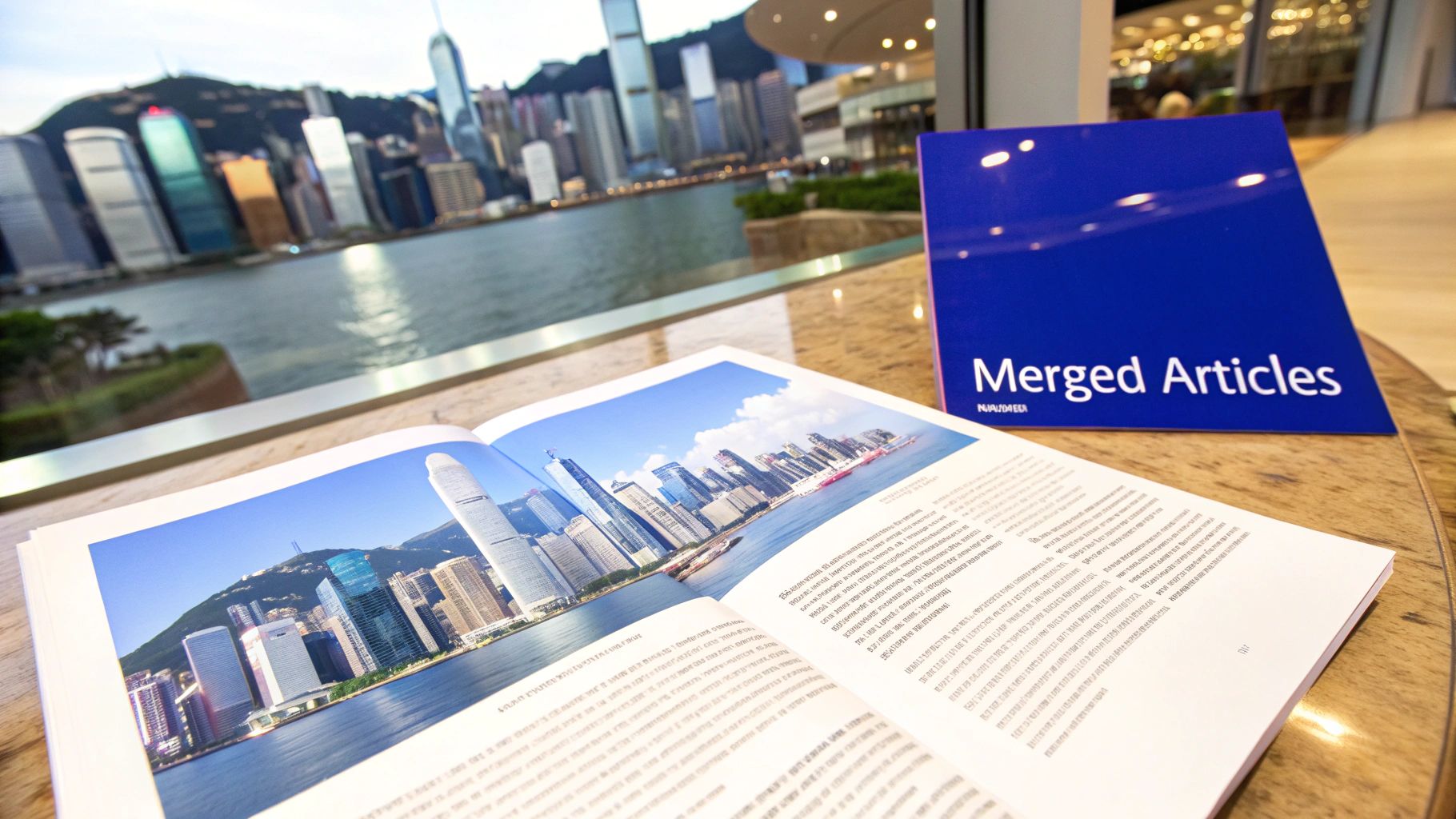
For any entrepreneur with an eye on Hong Kong, getting a grip on its corporate law history isn't just an academic exercise—it’s a real strategic advantage. The city’s reputation for efficiency is legendary, and how it handles company formation documents is a perfect showcase of that spirit in action.
In the past, setting up a business in Hong Kong required you to draft two separate documents: the memorandum and articles of association. This dual-document system was the norm for a long time, mirroring the approach in the UK and other Commonwealth jurisdictions. Think of the memorandum as the company’s public face and the articles as its internal rulebook.
But let's be honest, it was a bit clunky. The two documents often had overlapping information, creating unnecessary complexity and administrative headaches for business owners and investors. Hong Kong knew that to stay competitive as a world-class business hub, it had to streamline the process.
A New Era: The 2014 Companies Ordinance
The pivotal moment came on March 3, 2014, when the new Companies Ordinance (Chapter 622) came into force. This wasn't just a minor update; it was a complete overhaul of Hong Kong’s corporate governance framework. In a smart, decisive move, the ordinance did away with the need for a separate Memorandum of Association for all new companies.
This was a fundamental shift. The new law effectively merged the key parts of the old memorandum into a single, comprehensive document: the Articles of Association. All the essential details that used to live in the memorandum—like the company name, liability of members, and initial share capital—are now simply part of the articles. For any company formed after that date, only the Articles of Association are needed, drastically cutting down on paperwork.
This change brought Hong Kong in line with global best practices, making the entire process of setting up a company faster, clearer, and much more intuitive for entrepreneurs from all over the world.
What about companies that were around before 2014? Their original memorandum is still valid and is now legally treated as part of their Articles. That said, many of these older companies have since chosen to adopt a new, consolidated set of articles to modernise their governance structure.
Practical Perks for Today’s Entrepreneurs
So, what does all this legal history mean for you as a business owner? The benefits are direct and make a real difference.
- Simplified Compliance: With just one core constitutional document to manage, keeping your company compliant is far more straightforward. There's less chance of tripping over inconsistencies between two different rulebooks.
- Less Red Tape: The process to incorporate a company in Hong Kong is now quicker and requires less paperwork, which means you can get your business up and running much faster.
- Crystal-Clear Rules: A single, consolidated document gives directors, shareholders, and outside parties like banks or investors a clear and unambiguous set of rules to follow.
- More Flexibility: The modern Articles of Association are designed as a complete and adaptable framework. This makes it much easier to amend the rules as your business grows, evolves, and pivots.
This streamlined approach cements Hong Kong’s status as a top-tier destination for international business. By ditching outdated complexities, the city has fostered a corporate environment that prizes efficiency, clarity, and stability—exactly what ambitious founders need to thrive on the world stage.
Drafting Articles For Bankability And Asset Protection

Your Articles of Association are so much more than a box-ticking exercise. Think of them as the constitution for your company—a strategic blueprint that can either open doors with banks and investors or slam them shut. Now that we've covered the basics, let's get practical and talk about how to draft articles that do the heavy lifting for you.
A generic, off-the-shelf set of articles is like using 'password123' for your entire business. Sure, it gets the job done at first, but it leaves you wide open to risk. A well-drafted, bespoke set of articles, on the other hand, is your company's unique encryption key, custom-built to protect its future.
This is never more true than when you're dealing with international banks. Their compliance teams pore over your memorandum and articles of association to figure out one thing: risk. They want to know who calls the shots, how big decisions get made, and exactly what the company has the power to do. Any vagueness is a red flag.
The Dangers Of Generic Templates
I've seen it countless times: entrepreneurs grab a standard template to save a bit of time and money, only to find it costs them dearly down the road. These templates are made for a non-existent "average" company, and they often bake in risks you won't spot until it's too late.
For example, a standard template might give directors sweeping powers to make major decisions without ever consulting the shareholders. This could mean one director can take out a massive loan or sell off a crucial company asset, leaving everyone else powerless to stop them.
The flip side is just as bad. Some templates are so restrictive they can grind the business to a halt. Imagine needing a unanimous vote for every minor operational expense. In a fast-moving market, that kind of deadlock can be a death sentence.
Crafting Clauses That Protect And Empower
To build a corporate structure that is both strong and bank-friendly, your articles need to be tailored to your specific business. This means getting forensic about a few key areas to create total clarity and protect everyone involved.
Here are the clauses you absolutely must get right:
- Director's Powers and Limitations: Get specific. Clearly state what directors can and cannot do on their own. Set hard financial limits for contracts, loans, or asset sales that require shareholder approval.
- Shareholder Rights and Voting: Spell out the rights for each share class. Define the voting thresholds needed for different types of decisions—a simple majority might be fine for day-to-day matters, but a 75% supermajority should be required for something huge, like selling the company.
- Dispute Resolution Mechanisms: Don't wait for a falling out to decide how you'll handle it. Build in a clear, step-by-step process. Maybe you start with mediation before escalating things to binding arbitration.
- Share Transfer Provisions: Control who can own a piece of your company. A "right of first refusal" clause is a must-have, giving existing shareholders the first chance to buy any shares being sold before they're offered to outsiders.
Your articles are your company's first line of defence. The specific wording can be the difference between a seamless international transaction and a frozen bank account while the compliance team investigates your vague corporate governance rules.
When you're preparing documents for things like opening a bank account or for legal matters, you'll almost always need certified copies. Getting your head around the requirements for a true and certified copy from the start ensures your paperwork is accepted without frustrating delays, keeping your business moving forward.
At the end of the day, spending the time to draft thoughtful, customised articles is one of the smartest investments an entrepreneur can make. It elevates a simple compliance document into a genuine strategic asset that boosts your bankability, protects your vision, and lays a rock-solid foundation for growth.
Keeping Your Company's Rulebook Fit for Growth
Think of your business as a living thing. The game plan that got you off the ground won’t be the same one that takes you global. As you eye new markets, court new partners, or chase down fresh opportunities, your strategy has to evolve. So why would you let your company’s internal rulebook—the Articles of Association—gather dust?
Sticking with outdated articles is like trying to navigate Hong Kong’s MTR with a map from the 90s. It’s more than just a bit clumsy; it’s a real threat to your growth. You could find yourself legally blocked from holding a virtual board meeting or creating a new class of shares for a key investor, all because of rules that no longer make sense.
This is exactly why the ability to amend your articles of association isn't just some boring legal procedure. For any ambitious business, it's a vital strategic lever you can pull to make sure your company's governance keeps up with your real-world ambitions.
The Special Resolution: Why Change Needs a Big “Yes”
You can't just change your articles on a whim, and that’s a good thing. In most places, Hong Kong included, it takes a special resolution. This means you need a heavy majority of your shareholders—usually 75%—to vote in favour of the update.
That 75% threshold might seem like a high hurdle, but it's actually a clever bit of corporate engineering. It acts as a safety valve, making sure that any fundamental changes to the company’s DNA have the overwhelming support of its owners. It stops a small faction from pushing through radical changes that could damage the interests of everyone else.
In Hong Kong, this robust 75% majority vote became the standard after the 2014 Companies Ordinance overhaul, which streamlined things by focusing all the core governance rules into the Articles. As detailed in Baker McKenzie's 2025 guide, this high bar creates stability without sacrificing flexibility. That balance is essential for the nearly 1.5 million companies registered by mid-2025, a figure that includes over 84,000 new startups. You can dive deeper into Hong Kong's business landscape in their comprehensive guide.
The Three Steps to Making a Change
While getting the votes is the main event, the process itself is thankfully straightforward. It’s a simple, transparent path designed to ensure there are no surprises.
-
Call a General Meeting: The first step is for the directors to formally call a shareholder meeting, making sure to give everyone enough notice as laid out in your current articles.
-
Propose the Resolution: The meeting notice must spell out the proposed changes in plain language. Shareholders need to walk in knowing exactly what’s on the table.
-
File with the Registry: Once the special resolution passes, the job isn't quite done. You have to file the newly updated Articles of Association with the appropriate authority—like the Companies Registry in Hong Kong—to make it official.
Don’t think of reviewing your articles as just a compliance chore. It’s about building agility into your company's bones. A regular check-up ensures your own rulebook never becomes a roadblock to your next big opportunity.
Navigating Governance Rules Beyond Hong Kong
Once you've got your head around the rules in Hong Kong, it's easy to think you've cracked the code. But the moment your business steps into a new market—whether it's Singapore, the UAE, or somewhere in Europe—you'll find that corporate governance is far from a universal language. The core documents that act as your company's DNA can look strikingly different from one country to the next.
This isn't just about terminology. It’s about fundamental differences in legal thinking and business culture. For any entrepreneur with global ambitions, understanding these nuances is a superpower. It allows you to ask the right questions, avoid costly mistakes, and build an international structure that’s both compliant and resilient.
Getting a handle on these variations is your first step to a seamless expansion. Let's take a look at how some of the most popular business hubs approach their foundational documents.
Singapore and the Company Constitution
Just a short flight away, Singapore provides a perfect example of streamlined, business-friendly governance. Like modern Hong Kong, Singapore has moved to a single, consolidated document to run its companies: the Company Constitution.
This document neatly combines the functions of the old memorandum and articles of association into a single, unified rulebook. Singapore used to have the two-document system, but a 2016 update modernised the process, making life much simpler for businesses.
For entrepreneurs, this approach offers a few clear benefits:
- A Single Source of Truth: Every rule, from director's powers to shareholder rights, lives in one place. No more cross-referencing between two documents.
- Built-in Flexibility: You can adopt a standard "Model Constitution" to get started quickly or draft a bespoke version that perfectly fits your business model.
- Designed for Clarity: The entire system is built to be straightforward and accessible, a key reason Singapore remains a magnet for international businesses.
Navigating the UAE Free Zones
The United Arab Emirates is a different beast altogether. The governance rules you'll need to follow can change dramatically depending on where you set up shop—on the mainland or within one of the many specialised free zones, like the Dubai International Financial Centre (DIFC) or Abu Dhabi Global Market (ADGM).
Think of each free zone as its own little legal island, complete with its own registrar and its own unique set of corporate laws. This means that while you'll likely still need a Memorandum and Articles of Association, their exact contents and required format must be tailored to the specific regulations of that zone.
This is where your founding documents have to be dynamic. They need to evolve as your company grows and enters new jurisdictions.
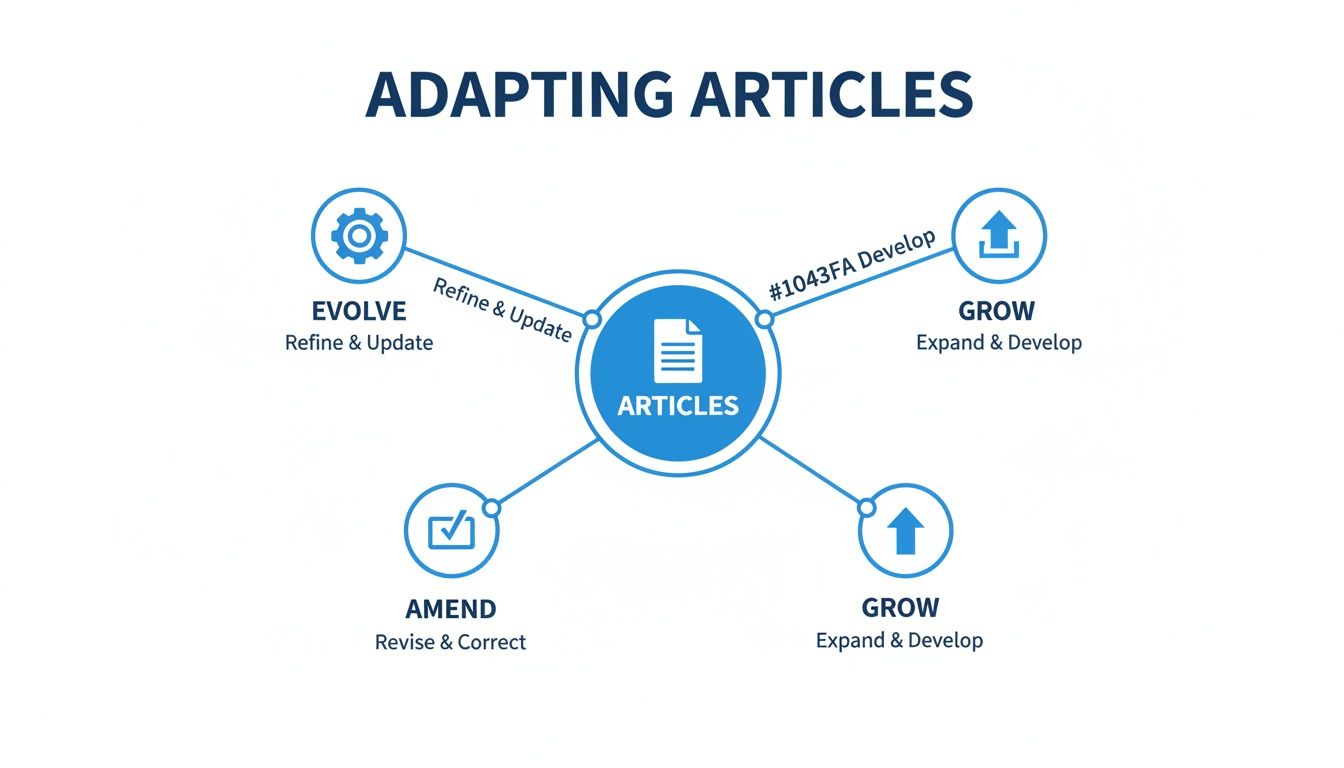
The real lesson here is that your governance documents are not set-in-stone relics. They are living instruments that must adapt as your business footprint expands across diverse regulatory environments.
The crucial takeaway is this: never assume the rules from one country apply in another. When expanding, especially into a complex region like the UAE, getting localised expert advice isn't a luxury—it's an absolute necessity.
European Variations
Travel over to Europe, and you'll find a patchwork of approaches reflecting the continent's diverse legal histories. In the UK, companies still technically use a Memorandum of Association and Articles of Association. However, thanks to the Companies Act 2006, the memorandum has been stripped back to a simple, one-page declaration of intent signed by the founders at incorporation. The Articles of Association now do all the heavy lifting.
Look elsewhere, and the terminology and structures shift again. In Germany, a private limited company (a GmbH) is governed by its Gesellschaftsvertrag (which translates to Articles of Association), a document that must be officially notarised to be valid. The regulatory landscape is always evolving, particularly with new financial technologies coming into play. For a deeper dive into how rules are changing for new financial products, a guide on global stablecoin regulation offers some interesting parallels.
You don't need to become an expert in global corporate law overnight. The key is to develop a global mindset: always assume local differences exist and factor the cost of expert legal advice into your expansion budget from day one. Getting your foundational documents right is the bedrock of any successful international venture.
To help you visualise these differences, here’s a quick comparison of the foundational documents in a few key global hubs.
Foundational Documents In Key Global Hubs
| Jurisdiction | Primary Governance Document(s) | Key Feature or Requirement | Best For Entrepreneurs Who… |
|---|---|---|---|
| Hong Kong | Articles of Association | A single, comprehensive document. The old Memorandum is now a historical artefact for pre-2014 companies. | …want a modern, common law system with strong ties to Mainland China. |
| Singapore | Company Constitution | A unified document combining the old Memorandum and Articles. Companies can adopt a flexible model constitution. | …seek a highly efficient, English-speaking hub for accessing Southeast Asian markets. |
| UAE (DIFC) | Memorandum of Association & Articles of Association | Governed by the specific Free Zone's common law-based regulations, which are distinct from mainland UAE law. | …need a sophisticated financial and legal framework to operate in the Middle East. |
| UK | Articles of Association (primary) & Memorandum of Association (archival) | The Memorandum is a simple statement at incorporation; the Articles contain all the ongoing rules. | …value a prestigious, well-established jurisdiction with a globally respected legal system. |
| Germany | Gesellschaftsvertrag (Articles of Association) | Must be notarised to be legally valid. Stricter formalities than in common law jurisdictions. | …are establishing a significant operational presence within the European Union. |
This table highlights just how varied the landscape is. Each jurisdiction has tailored its corporate governance to reflect its legal traditions and business priorities, creating unique opportunities—and potential pitfalls—for expanding companies.
How Modern Governance Fuels Hong Kong's Corporate Boom
A company's internal rulebook might sound like a dry, legalistic detail, but in Hong Kong, it's the high-performance oil in a thriving economic engine. The city’s shift to a modern, simplified governance framework wasn't just some administrative tweak; it's a direct catalyst for its corporate success story. This streamlined approach, which now centres on a single, powerful Articles of Association, has created an environment where businesses can launch, operate, and scale with incredible efficiency.
This isn’t just theory—the proof is in the numbers. When the rules of the game are clear and predictable, it builds immense confidence among investors. It’s what attracts both global capital and top-tier entrepreneurial talent, who see Hong Kong not just as a gateway to Asia, but as a stable and secure place to build their ventures.
The Numbers Tell the Story
The impact of this entrepreneur-friendly system is impossible to ignore. Hong Kong's corporate registry soared to a record high in 2025, with a staggering 1,494,806 local companies on the books by mid-year. On top of that, 84,293 new businesses were incorporated in the first half of the year alone, highlighting the city's magnetic appeal.
This boom is a powerful testament to how modernising the Articles of Association—which consolidated all essential governance rules after the old memorandum was abolished—has made setting up a business faster and more straightforward. You can dig deeper into these corporate registration statistics and their context. This growth isn't a happy accident; it's the direct result of a legal framework designed for clarity and speed. When founders, investors, and banks can look at one core document and understand exactly how a company operates, it removes friction and gets everyone moving forward.
The core lesson here is one of social proof. A record number of entrepreneurs are choosing Hong Kong precisely because its governance structure is clear, efficient, and built for the pace of modern business. It's a robust system designed for success.
Why Simplicity Breeds Success
So, what does this actually mean for an international entrepreneur? It means you’re building your venture on a foundation that is recognised and trusted across the globe. The streamlined memorandum and articles of association framework in Hong Kong offers tangible benefits that directly fuel growth:
- Faster Setup: Less paperwork and clearer rules mean you can get your company operational and bankable in a fraction of the time it might take elsewhere.
- Reduced Ambiguity: Having a single source of truth for governance minimises the risk of internal disputes and legal confusion, a huge plus for potential investors.
- Enhanced Credibility: Operating within a respected and transparent legal system gives your business instant credibility on the international stage.
Ultimately, Hong Kong’s corporate boom is a powerful case study. It proves that when a jurisdiction makes clear, efficient governance a priority, it doesn’t just simplify legal processes—it creates a dynamic ecosystem where businesses are genuinely empowered to thrive.
Frequently Asked Questions
Stepping into the world of corporate governance always throws up a few practical questions, especially when your main focus is on actually building the business. We get it. Below, we've answered some of the most common queries we hear from entrepreneurs about the memorandum and articles of association.
Do I Need to Update My Pre-2014 Company's Articles?
Legally, no, you don't have to. Your old memorandum and articles are still valid under Hong Kong law. But should you? Absolutely.
Think of it this way: those documents were written for a different business world. They probably don't account for modern realities like virtual board meetings or electronic signatures. Adopting a new, single set of articles brings your company into the present, making things clearer for directors, shareholders, and anyone you do business with. More importantly, it just looks better. A clean, modern set of articles shows banks and investors you're serious and professional. It’s like upgrading your company’s internal software—it runs smoother and is far more secure.
Can I Just Use a Standard Template for My Articles?
You can, but it's one of the biggest gambles you can take with an international business. A generic template is a one-size-fits-all solution, and your business is unique. These documents won't protect your specific interests, account for your shareholder dynamics, or support your vision for the future.
Think of custom-drafted articles as a foundational layer of asset protection. They let you set the ground rules for everything—from the powers of your directors to how you'll handle a disagreement—nipping potential conflicts in the bud. This is precisely the kind of detail that gives banks confidence and attracts serious investors who need to see a solid governance structure in place.
"The most common mistake is the 'set it and forget it' mindset. Many entrepreneurs treat their articles as a one-time task during incorporation. But as your business evolves—you bring in partners, seek funding, or expand—your governance documents must evolve too. Failing to review and amend your articles can lead to shareholder disputes, compliance issues, and major roadblocks when you need to make a strategic move."
How Do the Articles Affect Opening a Bank Account?
Banks read your Articles of Association very carefully. It’s a core part of their due diligence. They want to know exactly who runs the company, what their powers are, and what the business is set up to do. Well-drafted articles that clearly lay all this out send a strong signal of good governance.
On the flip side, articles that are vague, contradictory, or obviously outdated are an immediate red flag for any bank's compliance team. This can trigger long delays, a barrage of questions about your structure, or even a flat-out rejection of your application. Your articles are, in essence, a key part of your company's financial identity, and they have a direct impact on your ability to get banked.
At Lion Business Consultancy Limited, we know that your company's founding documents are more than just paperwork. They're strategic tools for growth and protection. We offer personalised, 1:1 advisory to make sure your corporate structure is secure, bankable, and perfectly aligned with your international ambitions. Let's build a framework that protects your business today and prepares it for tomorrow.
Secure your global expansion with expert guidance