

 Hong Kong

 Singapore

 UAE
UAE



 Malaysia


 Turkey


 UK
UK
 EU
EU
 US
US
 Switzerland
 Bahamas Bank Account
 Cayman Islands Bank Account
 Mauritius Bank Account
 BVI
BVI
 Seychelles

Thinking about launching a company in Hong Kong? It’s a brilliant move, and one that thousands of global entrepreneurs make every year. They don’t just see a city; they see a launchpad. At its heart, Hong Kong offers a remarkably friendly business environment, a refreshingly simple tax system, and an infrastructure that’s second to none, making it one of the most efficient places in Asia to get a company off the ground.
Why Hong Kong Is a Top Choice for Your Business

For any ambitious founder, picking a home base is a massive strategic decision, not just a logistical one. Time and again, Hong Kong comes out on top. It acts as a powerful springboard into the massive Asian market while also serving as a trusted bridge to the West.
Let’s put this into perspective. Imagine a European tech startup with a fantastic new app. To crack the Asian market, they need a hub that’s stable, efficient, and well-regarded. Incorporating a company in Hong Kong gives them exactly that. This isn’t just about getting a business licence; it’s about plugging your venture into an entire ecosystem designed for growth.
The city delivers a unique blend of advantages that really hit home for SMEs and startups.
The Strategic Advantages for Founders
So, what makes Hong Kong such a magnet for international business? It really boils down to a few key pillars that directly support a founder’s journey from a great idea to a regional powerhouse.
- Simple and Low Taxation: Hong Kong runs on a territorial tax system, which is a game-changer. It means you’re only taxed on profits earned in Hong Kong. With a corporate profits tax rate capped at 16.5% and zero VAT, sales tax, or capital gains tax, you keep more of your hard-earned money to reinvest in the business.
- World-Class Legal Framework: The legal system here is based on English Common Law. For international businesses, this means familiarity and predictability. It’s a robust framework that gives you solid protection for contracts, intellectual property, and shareholder rights.
- Unmatched Global Connectivity: Sitting right at the heart of Asia, Hong Kong is a natural crossroads for finance and logistics. Its status as a free port and its doorstep access to mainland China give you incredible access to global supply chains and one of the biggest consumer markets on the planet.
This isn’t just talk; the numbers tell the story. In the first half of 2025 alone, 84,293 new local companies were registered in Hong Kong. That’s a powerful vote of confidence from the global business community. On top of that, 761 non-Hong Kong companies established a presence here during that same period. You can dig into more official figures on the Companies Registry website.
For a founder, this ecosystem means less time tangled in red tape and more time actually building the business. Hong Kong’s entire infrastructure is built for efficiency, helping you move faster and scale smarter.
Think of it this way: setting up your company here is like planting a tree in fertile soil. The environment provides the stability, nutrients, and sunlight you need for strong, healthy growth. It’s that powerful mix of resilience and opportunity that makes Hong Kong such a valuable partner for any successful venture.
Choosing the Right Business Structure for Your Venture
Deciding on the right business structure is one of the first, and most critical, calls you’ll make as an entrepreneur. This isn’t just a formality or a box to tick on a form; it’s the very foundation of your company. It dictates how you operate, how you’re taxed, and most importantly, how your personal assets are protected.
Think of it like choosing the right vehicle for a journey. A freelance consultant might just need a nimble scooter—it’s quick, easy to manage, and gets you moving fast. But if you’re building a brand with inventory and employees, you’ll need something more like an armoured truck to protect your valuable assets. Let’s break down the most common options in Hong Kong so you can find the perfect fit.
The Private Limited Company: The Fortress
For most serious entrepreneurs in Hong Kong, the Private Limited Company is the gold standard. Why? Because it establishes your business as a separate legal entity. This creates a solid wall between your personal finances and your business’s liabilities.
Picture Sarah, who is launching a new tech startup. She’s leasing office space, hiring developers, and taking on initial funding. If her business were to hit a rough patch and accumulate debt, the Limited Company structure means that her personal savings, her apartment, and other assets are safely out of reach. The company is responsible, not Sarah personally. That kind of peace of mind is priceless when you’re taking big risks.
The Limited Liability Company is the go-to for entrepreneurs with a vision for growth. It offers the strongest protection and signals to investors, clients, and partners that you’ve built a professional and durable operation from day one.
This structure is the clear choice for any business that plans to scale, raise capital, or simply wants the credibility that comes with a formal corporate identity. It’s the armoured truck of business structures—built for the long haul and designed for maximum protection.
The Sole Proprietorship: The Express Lane
Now, let’s look at a different scenario. Meet David, a freelance copywriter. He works from home, manages a handful of clients, and has very low overheads. For him, the administrative layers and costs of a Limited Company would be overkill.
A Sole Proprietorship is the simplest and quickest way to get a business off the ground. The business is legally tied directly to you as an individual—there’s no separation.
- Upside: The setup is incredibly straightforward and cheap. You’re in complete control, and the ongoing compliance is minimal.
- Downside: The big catch is unlimited liability. If your business runs into debt, creditors can come after your personal assets. This makes it a much riskier option for ventures with any significant financial exposure.
For solo service providers, consultants, and freelancers with low operational risks, the Sole Proprietorship is that scooter—perfect for getting you on the road immediately.
The Partnership: The Tandem Bike
What if you’re not flying solo? Let’s say two friends, Maria and Chen, decide to merge their design portfolios to launch a creative agency. A Partnership seems like a natural fit, allowing them to formally run a business together.
Like a Sole Proprietorship, a general Partnership typically comes with unlimited liability. This means each partner is personally on the hook for the business’s debts, including those racked up by the other partner. It’s worth noting that Hong Kong also offers a Limited Partnership structure, which can shield some partners from this liability.
This structure thrives on collaboration but absolutely requires deep trust and a meticulously drafted partnership agreement. It’s the tandem bike: incredibly efficient when both partners are pedalling in sync, but it can get wobbly and chaotic if you’re not aligned.
To make the choice clearer, it helps to see the key differences side-by-side.
Comparing Hong Kong Business Structures at a Glance
This table breaks down the core features of each entity to help you quickly assess which one aligns with your business goals and risk tolerance.
| Feature | Limited Liability Company | Sole Proprietorship | Partnership |
|---|---|---|---|
| Legal Identity | Separate legal entity from owners | No separation; owner and business are one | No separation; partners and business are one |
| Liability | Limited to the amount invested in shares | Unlimited; personal assets are at risk | Unlimited for general partners |
| Ownership | 1 to 50 shareholders | Single owner (the individual) | 2 to 20 partners |
| Credibility | High; seen as professional and stable | Lower; often viewed as a small-scale operation | Moderate; depends on the partners’ reputation |
| Best For | Startups, SMEs, businesses planning to scale, foreign investors | Freelancers, consultants, solo service providers with low risk | Professional firms (e.g., law, accounting), joint ventures |
| Setup Complexity | More involved; requires formal incorporation | Very simple; register with the Business Registration Office | Simple; requires a partnership agreement and registration |
Ultimately, choosing the right structure is about matching the legal framework to your practical, real-world needs. A Limited Company offers robust protection for growth, while simpler structures offer speed and ease for solo ventures.
Your Step-by-Step Company Incorporation Checklist
Setting up a company in Hong Kong can feel like a maze of legal forms and regulations. But when you break it down, it’s really just a series of logical steps. Think of it less as a legal nightmare and more as a project plan for launching your business.
This checklist will walk you through the entire process, turning a seemingly huge task into a set of clear, manageable actions. We’ll start with the fun part—your brand’s name—and work our way through to the final submission, so you know exactly what to do at every stage.
Step 1: Choose and Secure Your Company Name
Every great business starts with a name. This is your first official move, and it’s a big one. Your company name is more than just a label; it’s the first impression you make and your legal identity in Hong Kong.
First things first: your name has to be unique. It can’t be the same as, or too similar to, a name already on the Companies Registry’s index. Before you get your heart set on a name, do a quick check using the Registry’s free Cyber Search Centre. This simple search can save you a ton of time and the headache of a rejected application.
A few ground rules to keep in mind:
- An English name for a limited company must end with the word “Limited”.
- The name can’t include words that suggest a government connection (like “Bureau”) or regulated activities (like “Bank” or “Trust”) unless you have the right approvals.
- You can register a name in English, Chinese, or both.
Step 2: Assemble Your Company Leadership
With a name picked out, it’s time to build your company’s core team. This means appointing the key people who will legally run the business. For a private limited company in Hong Kong, you’ll need to fill these roles.
Directors: You must have at least one individual director. You can have corporate directors, but you can’t only have a corporate director. The great news for international founders is that there are no residency requirements for directors.
Shareholders: At a minimum, you need one shareholder. This can be a person or another company. For most solo entrepreneurs, the director and shareholder are the same person, which is perfectly fine.
Company Secretary: This is a non-negotiable, mandatory role for every Hong Kong limited company. Think of the company secretary as your chief compliance officer, making sure you’re meeting all your legal obligations. They must be a Hong Kong resident or a corporate body with a registered office in Hong Kong. This is often where a professional firm like Lion Business Co. comes in to provide a qualified secretary.
Step 3: Prepare Your Incorporation Documents
Now for the paperwork. This is where you put your company’s structure and rules down on paper. It’s more straightforward than it sounds. You’ll be preparing two main documents to send to the Companies Registry.
- Incorporation Form (Form NNC1): This is your main application. It captures all the vital details: your chosen name, your registered Hong Kong office address, and the personal details of your directors, shareholders, and company secretary.
- Articles of Association: This is your company’s internal playbook. It sets out the rules for how the company will be run, covering everything from shareholder rights and director duties to how you’ll conduct meetings.
Getting these documents right is critical. They form the legal foundation of your business, and any mistakes here can cause delays.
Step 4: Submit Your Application and Register
Once your documents are in order, you’re ready for the final sprint: submission. Hong Kong has made this part of the process remarkably efficient, especially if you go the digital route.
The speed of incorporation here is a huge advantage. According to the Companies Registry, if you apply online via the e-Registry or the CR eFiling mobile app, your certificate of incorporation is issued almost instantly upon successful submission. If you go the old-school route with a paper application, it typically takes about four working days. For a deeper dive into the legal landscape, Baker McKenzie’s guide to doing business in Hong Kong is an excellent resource.
Once your company is officially registered, you’ll receive two key documents:
- Certificate of Incorporation: This is essentially your company’s birth certificate.
- Business Registration Certificate: Issued by the Inland Revenue Department, this is a must-have for any business operating in Hong Kong. To get the full picture, check out our guide on understanding your Hong Kong Business Registration Number.
This flowchart gives you a simple visual of how the different business structures are set up.
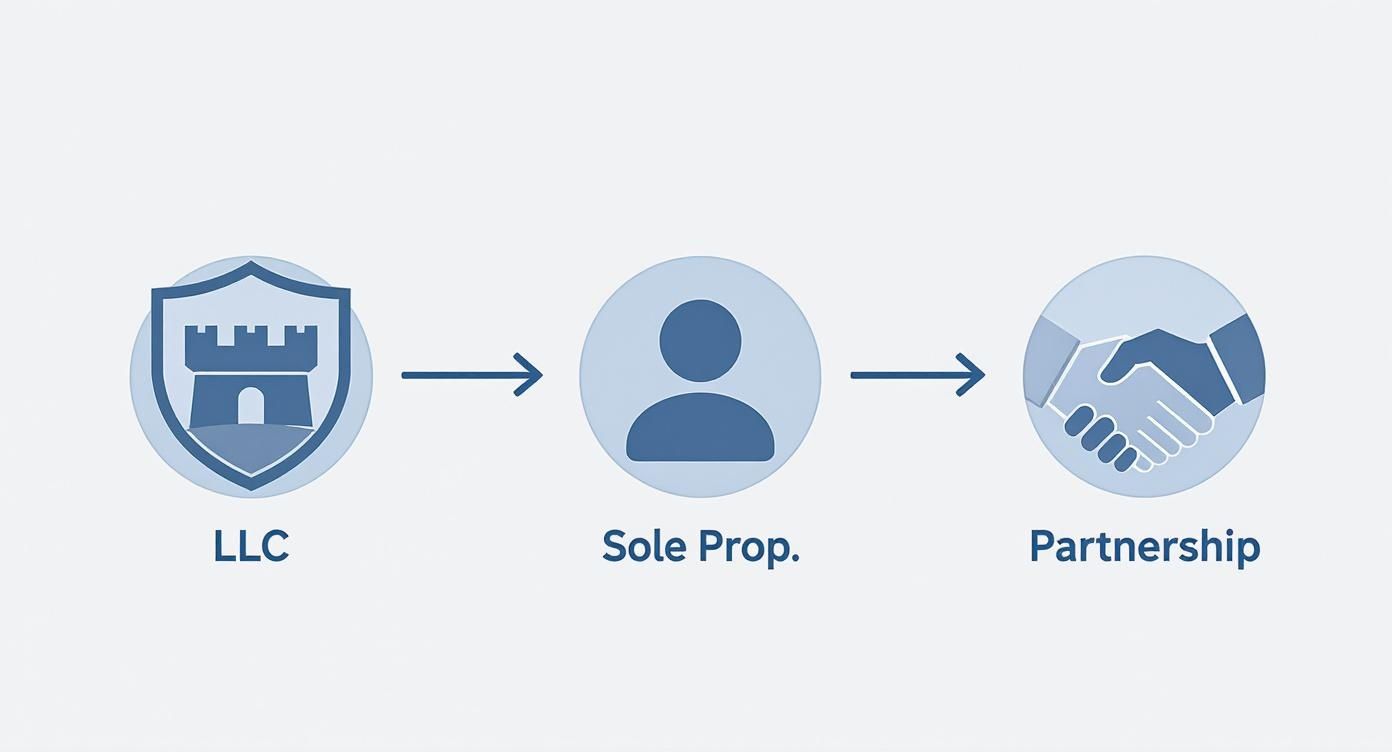
As the diagram shows, while each path is different, the Limited Liability Company provides the strongest protection for its owners, neatly symbolised by the fortress shield.
Navigating Costs, Banking, and Post-Setup Compliance

So, your company is officially registered in Hong Kong. That’s a huge milestone, and you should absolutely celebrate it. But it’s the beginning of the journey, not the finish line. Now, the real work begins—managing the financial and administrative realities of running a legitimate business.
Think of your new incorporation certificate like the keys to a brand-new car. You own the vehicle, which is fantastic, but you still need to pay for fuel, insurance, and regular maintenance to keep it running smoothly on the road. This next part is all about those essential “running costs” and responsibilities for your new Hong Kong company.
Understanding the Full Cost of Operation
Beyond the one-time incorporation fee, you’ll have a few recurring costs that are essential to keeping your company in good standing. Budgeting for these from day one will save you from any nasty surprises down the road.
These aren’t just line-item expenses; they’re investments in your company’s legitimacy and operational health.
- Business Registration Certificate: This is a mandatory annual fee paid to the Inland Revenue Department. It must be renewed every year to keep your business legally recognised. The fee hovers around HK$2,000, though it can fluctuate.
- Company Secretary Services: You’re required by law to have a Hong Kong-based company secretary. Professional firms handle this, managing statutory filings and ensuring you never miss a critical deadline.
- Registered Office Address: Your company must have a physical registered address in Hong Kong. Using a professional service gives you a legitimate address for all official mail and correspondence.
These ongoing costs are predictable and absolutely crucial for maintaining your company’s legal status.
The Corporate Bank Account Hurdle
One of the first—and often most significant—challenges for a new company is opening a corporate bank account. Years ago, this was a simple box-ticking exercise. Not anymore. Thanks to stringent global Anti-Money Laundering (AML) and Know Your Customer (KYC) regulations, banks are incredibly meticulous.
Imagine you’re trying to get into an exclusive club. You can’t just show up at the door. You need the right credentials, a clear reason for being there, and you have to prove you’re trustworthy. Hong Kong banks now view new corporate clients through a similar lens. They need to see a solid business plan, concrete proof of business activity, and comprehensive details on every single director and shareholder.
The bank account opening process is a test of your business’s legitimacy. Being over-prepared is the only way to approach it. A rejected application can cause significant delays, so getting it right the first time is essential.
To give yourself the best shot, you need to assemble a complete application package. This means your business plan, contracts or invoices showing actual business activity, and detailed background information on all key people. To get a handle on these critical regulatory requirements, check out your guide to AML and KYC compliance.
Staying Compliant: Your Annual Obligations
Once your company is up and running with an active bank account, your focus will shift to ongoing compliance. These aren’t just bureaucratic chores; they’re the fundamental practices that prove your company is active, healthy, and transparent.
Meeting these obligations is critical for avoiding hefty fines, penalties, and potential legal trouble. The Hong Kong government takes compliance very seriously, and so should you.
Here are your key annual duties:
- Annual Return (Form NAR1): This is a yearly snapshot of your company’s details—directors, shareholders, registered office, etc.—that must be filed with the Companies Registry.
- Profits Tax Return: You must file a tax return with the Inland Revenue Department every year. Even if your company made zero profit, a “nil” return is still required.
- Annual General Meeting (AGM): While many SMEs can dispense with holding a formal AGM, you still need to follow the proper procedures for financial reporting and passing resolutions.
Thankfully, Hong Kong’s corporate registry has been modernised to make these processes much more efficient. The December 2023 overhaul introduced the Integrated Companies Registry Information System (ICRIS), a new platform designed to improve the efficiency and transparency of company filings, making it easier for businesses to manage their compliance.
Staying on top of these duties is what will ensure the long-term health and success of your venture in Hong Kong.
Common Pitfalls to Avoid During Company Formation
Learning from other people’s mistakes is one of the smartest things you can do in business. The path to incorporating a company in Hong Kong is well-trodden, but it’s also full of common traps that lead to painful delays and surprise costs. We’ve seen founders stumble into these time and again.
Think of this section as a map from an experienced guide, pointing out the hidden potholes along the trail. By knowing where they are ahead of time, you can make your journey a whole lot smoother.
The Misstep of a Non-Compliant Company Name
It all begins with a name, but right away, this is where many people run into trouble. We once worked with a fintech founder who was dead set on a particular brand name. The problem? It was nearly identical to a financial services firm already registered in Hong Kong.
Their application was rejected, and that one issue caused a frustrating delay of several weeks while they went back to the drawing board. It was a classic domino effect, pushing back investor meetings and their product launch. The lesson here is simple: always conduct a thorough name search through the Companies Registry’s Cyber Search Centre before you get too attached to anything.
Overlooking the Local Company Secretary Rule
Another frequent—and critical—mistake is underestimating the mandatory requirement for a local company secretary. Hong Kong law is perfectly clear on this: every limited company must appoint a secretary who is either a Hong Kong resident or a corporate body with a registered office here.
We saw this happen with an overseas e-commerce entrepreneur who thought they could handle every role on their own. They filled out all the paperwork perfectly, only to have their application stopped in its tracks because they hadn’t appointed a qualified secretary. This isn’t just an admin job; this person is your company’s chief compliance officer. Forgetting to appoint one is a non-starter and will bring your incorporation to a halt.
“A common misconception is that the incorporation process is just a series of forms. In reality, it’s a sequence of legal requirements where each step must be completed correctly before the next can begin. Missing one, like the local secretary rule, breaks the entire chain.”
Underestimating the Bank Account Opening Timeline
This might be the biggest pitfall of them all. So many founders assume that opening a corporate bank account is the quick, final step. It’s not. In today’s regulatory climate, it’s a detailed and often lengthy process that can easily take weeks, if not months.
Take the story of a small trading company that had just landed its first big contract. With their shiny new Certificate of Incorporation in hand, they figured they could open an account and get paid within a week. But the bank’s due diligence was far more intense than they ever imagined, demanding extensive documentation on their business model and source of funds. The delay almost cost them their first crucial deal.
This is a scenario where preparation is everything. Banks are under huge pressure to prevent financial crime, so they scrutinise every new application. Having your business plan, contracts, and shareholder information perfectly organised isn’t just helpful—it’s essential. To get ready for this critical stage, our Bank Onboarding Risk Playbook 2025 gives you an inside look at what banks are really looking for. When you understand things from their perspective, you can navigate the process without those costly delays.
Your Partner for a Seamless Hong Kong Launch
We’ve covered a lot of ground together in this guide, from understanding why Hong Kong is such a strategic hub to untangling the finer points of staying compliant. You’ve got the map, but now it’s time to actually make the journey. The next step—and the most important one—is putting that plan into action and bringing your Hong Kong company to life.
This is where the rubber meets the road, and honestly, where having a seasoned partner can make or break your launch. Hong Kong’s company setup process is known for its efficiency, but it’s also incredibly precise. It doesn’t leave much room for error. One small mistake on a form, a slight misunderstanding of a local rule, or a bank application that isn’t perfectly prepared can easily trigger major delays and unexpected costs.
At Lion Business Co., we’re more than just paper-pushers. We manage your entire launch from the initial idea to the final sign-off. Think of us as your on-the-ground advisory team, making sure every single detail is handled correctly the first time.
End-to-End Support for Your Peace of Mind
You can see us as the architects and project managers for your new venture. We take all the individual pieces you’ve learned about—from picking the right business structure to satisfying a bank’s due diligence checks—and assemble them into a solid, successful business launch.
Our job is to give you total confidence so you can focus on what you do best: building your business. We’ll handle the heavy lifting at every stage.
- Strategic Entity Selection: We’ll sit down with you to figure out the best company structure for your specific business model, ensuring your assets are well-protected.
- Flawless Documentation: Our team meticulously prepares and double-checks every incorporation document to make sure it sails through the Companies Registry’s review.
- Efficient Submission Management: We take charge of the entire submission process. Our experience means we know how to keep things moving for a quick and smooth registration.
- Expert Banking Assistance: Opening a corporate bank account can be a real headache. We’ll guide you through it, helping you build a strong application that ticks all the boxes for the bank’s KYC and AML requirements.
- Ongoing Compliance Support: Once you’re up and running, we stick around. We offer essential company secretarial and accounting services to keep your business in good standing with the authorities.
Our promise is simple: we save you a ton of time and shield you from expensive mistakes. By managing the whole process, we make sure you start on the right foot, laying a rock-solid foundation for your success in Asia.
Setting up your business in Hong Kong is an exciting prospect. Let us handle the complexities so you can pour all your energy into the opportunity ahead.
Got Questions? We’ve Got Answers
Even with the best roadmap, you’re bound to have some questions pop up along the way. It’s completely normal. Let’s tackle a few of the most common ones we hear from entrepreneurs setting up shop in Hong Kong.
Do I Really Need a Physical Office to Register My Company?
You absolutely don’t need a dedicated physical office. However, Hong Kong law is firm on one thing: every company must have a registered office address located within the city. This isn’t where you have to work; it’s the official address where the government will send all legal notices and correspondence.
For founders based overseas or running a lean digital business, this is where a virtual office or a professional company secretarial service comes in handy. It’s a smart, cost-effective solution that gives you a legitimate address and keeps you compliant without the expense of a physical lease.
Is a Company Secretary Really Mandatory?
Yes, this one is non-negotiable. Every private limited company in Hong Kong is required by law to appoint a company secretary. Think of this role as more than just an admin—they are your company’s chief compliance officer, legally responsible for making sure you meet all your statutory duties, like filing the Annual Return and keeping company records in order.
Your company secretary is the official link between your business and the government’s regulatory bodies. The role must be filled by a Hong Kong resident or a local corporate body, which is why most international entrepreneurs partner with a professional firm to handle this.
Realistically, How Long Does It Take to Open a Business Bank Account?
This is the million-dollar question, and the answer varies quite a bit. Honestly, opening a corporate bank account in Hong Kong can take anywhere from a few weeks to several months. The timeline really depends on the bank you choose, how complex your business is, and how buttoned-up your application is.
These days, banks are incredibly strict with their background checks to meet global anti-money laundering regulations. A well-prepared application—complete with a solid business plan, proof of business, and clear details on all directors and shareholders—makes a world of difference. A common mistake is underestimating this step, so our best advice is to get the ball rolling as soon as you can.
Ready to make your Hong Kong business a reality without getting tangled in the details? At Lion Business Consultancy Limited, we provide the expert, one-on-one guidance to make your incorporation and banking setup a smooth and successful process. Let’s build your foundation together.