

 Hong Kong

 Singapore
 UAE
UAE

 Malaysia
 Turkey


 UK
UK
 EU
EU
 US
US
 Switzerland
 Bahamas Bank Account
 Cayman Islands Bank Account
 Mauritius Bank Account
 BVI
BVI
 Seychelles

So, you're exploring the idea of setting up a company in Hong Kong. It's a smart move, one that thousands of international entrepreneurs make every year. They're drawn to the city’s incredibly pro-business culture and its standing as a powerhouse in global finance. This isn't just about paperwork; it's about giving your business a strategic launchpad to scale globally.
Why Hong Kong Is a Top Choice for Global Founders

When people think of Hong Kong, the first thing that usually comes to mind is its simple, low-tax system. And while that’s a huge plus, fixating only on taxes means you miss the full picture. The real power of a Hong Kong company comes from a whole host of strategic advantages that, when combined, create an exceptional base for international business.
Let me paint a picture. Imagine you're running a successful e-commerce brand out of Europe. Your suppliers are in mainland China, and you're seeing explosive sales growth across Southeast Asia. Setting up shop in Hong Kong gives you a central command post. Suddenly, you can take payments from customers worldwide in various currencies, pay your Chinese suppliers seamlessly, and streamline regional logistics—all from one stable, legally sound jurisdiction.
A Bridge Between East and West
Hong Kong’s legal system is based on English common law, a legacy of its British past. This is a huge comfort for Western businesses because it’s a framework they know and trust. It offers robust protection for contracts, intellectual property, and shareholder rights. At the same time, its deep-rooted economic and cultural links to mainland China make it the undeniable gateway for any business aiming to tap into that enormous market.
This unique position makes Hong Kong the perfect middle ground. For a consulting firm based in the UK, having a Hong Kong entity on their letterhead adds a ton of credibility when pitching to clients in Asia. It signals you’re serious about the region and makes cross-border agreements and payments far simpler.
The Ideal Launchpad for Growth
Beyond its legal and geographical muscle, Hong Kong is a world-class financial centre. For a tech startup, that means access to a massive pool of venture capital and private equity investors who understand the global landscape. Raising your seed round or Series A can often be much smoother through a Hong Kong company because of its transparent corporate governance rules.
Hong Kong's re-domiciliation regime, which kicked off in 2025, has only strengthened its appeal as a top business hub. It lets foreign companies move their registration to Hong Kong seamlessly, without the headache of liquidating and starting over. This means you get to keep your company’s history and identity intact.
For an international founder, the decision to incorporate a company in Hong Kong unlocks a whole toolkit of benefits:
- Financial Stability: The Hong Kong dollar (HKD) is pegged to the US dollar, providing a stable currency for international trade and reducing foreign exchange risks.
- Ease of Business: The entire process of setting up and managing a business is remarkably efficient, with far less red tape than you'll find in many other jurisdictions.
- Global Connectivity: With a world-class airport and logistics network, it's a powerhouse for any import-export business or anyone managing a global supply chain.
When you add it all up, the case is pretty compelling. We dive even deeper into the strategic advantages in our guide on why Hong Kong company incorporation is a great option for business expansion. Ultimately, this isn't about finding a tax loophole; it's about building a resilient, world-ready foundation for your business.
Choosing the Right Business Structure in Hong Kong
Getting your business structure right is like pouring the foundation for a house. A solid foundation means you can build a stable, lasting enterprise. A weak one? You'll be dealing with cracks and problems for years. When you decide to incorporate a company in Hong Kong, this is your first critical decision.
For most entrepreneurs setting up shop from overseas, the choice is actually quite straightforward. While you could technically set up as a sole proprietorship or a general partnership, they come with one massive, deal-breaking flaw: unlimited liability.
This means if the business gets into financial trouble, your personal assets—your home, car, and savings—are fair game for creditors. It’s a gamble few founders are willing to take, and for good reason.
That's precisely why the vast majority of international business owners choose to set up a Private Company Limited by Shares.
The Power of the Private Limited Company
Think of a limited company as a completely separate legal person. It can own property, enter into contracts, and take on debt, all entirely independent of you, the founder.
This legal separation creates a protective shield between your business finances and your personal wealth. If the worst happens and the company fails, creditors can only go after the company's assets, not yours. This single concept—limited liability—is the most compelling reason it’s the default choice for anyone serious about business.
Beyond just protecting your assets, this structure signals credibility. It shows potential investors, banks, and major clients that you're building a real, scalable company, not just a side hustle. It's a framework built for growth, giving you the flexibility to issue shares to bring on partners or raise capital down the line.
The official numbers from Hong Kong's Companies Registry back this up. After a predictable dip during the pandemic, new company formations bounced back, hitting 132,246 in 2023. If you dig into the data, you'll see that private limited companies consistently represent over 95% of all new incorporations each month. You can check out the full yearly and monthly statistics on their website to see the trend for yourself.
Comparing Hong Kong Business Structures for Foreign Entrepreneurs
To really put it in perspective, let's look at a quick, practical comparison of how the main business structures stack up for an international founder.
| Feature | Private Limited Company | Sole Proprietorship | Partnership |
|---|---|---|---|
| Liability | Limited to your investment. Your personal assets are safe. | Unlimited. You are personally responsible for all business debts. | Unlimited. Both partners are personally liable for all debts. |
| Legal Status | A separate legal entity from its owners (shareholders). | Not a separate legal entity. You and the business are one. | Not a separate legal entity. The partners are the business. |
| Credibility | High. Seen as a professional and stable business structure. | Lower. Often perceived as a small, one-person operation. | Moderate. Can be complex and less formal than a company. |
| Fundraising | Easy to raise capital by selling shares to investors. | Difficult. Cannot issue shares; relies on loans or personal funds. | Difficult. Bringing in new partners can be complicated. |
| Continuity | The business continues to exist even if ownership changes. | The business ends if the owner stops working or passes away. | The partnership may dissolve if a partner leaves or dies. |
As you can see, the choice is pretty clear for anyone looking to build something bigger than a small local service.
Founder's Tip: When you incorporate a company in Hong Kong as a limited company, you're not just registering a name. You are creating a distinct legal vehicle that can outlive its founders, attract serious investment, and operate on the global stage with confidence.
In the end, going with a Private Company Limited by Shares isn't just the safe option; it's the smart, strategic one. It provides the protection you need today and the flexibility you'll be grateful for as your business grows.
The Hong Kong Incorporation Process: A Step-by-Step Guide
So, you’ve settled on forming a Private Limited Company. Excellent choice. Now for the part that often feels daunting—the actual incorporation process. But let's be clear: it doesn’t have to be a nightmare of legal jargon and endless forms.
Think of it less like filing paperwork and more like assembling the critical parts of your new business engine. We'll walk through this together, focusing on the practical steps and insights that make the whole thing manageable. It all comes down to being prepared.
This diagram neatly captures the journey from that initial spark of an idea to a fully-formed, legally protected company.
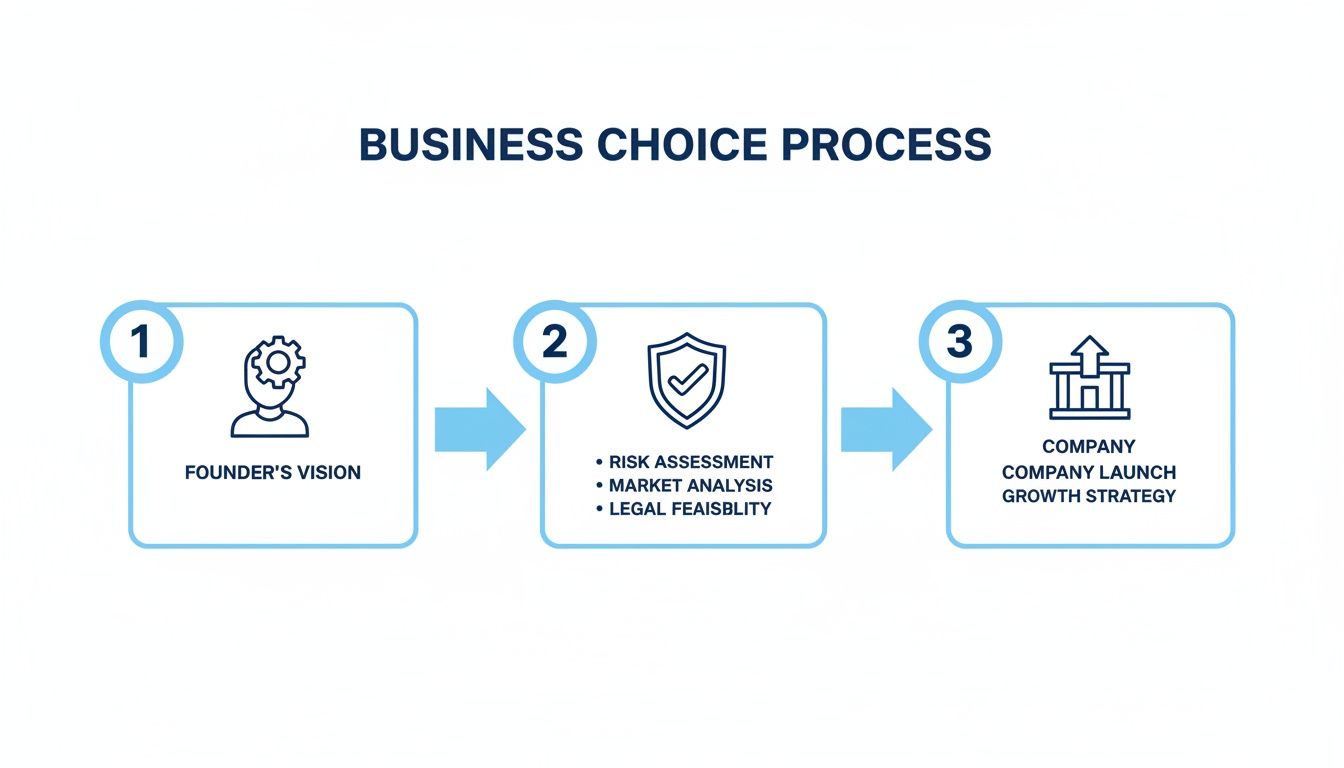
The key takeaway here is that 'shield' phase. Choosing a limited liability structure is the single most important thing you can do to protect your personal assets from your business operations.
Choosing Your Company Name
First things first, your company needs a unique name. This isn't just about branding; the Hong Kong Companies Registry has firm rules. Your proposed name can’t be too similar to one already registered, and it certainly can’t be misleading or offensive.
A common pitfall is picking something too generic. I’ve seen countless applications for names like "Global Trading Limited" get rejected because, unsurprisingly, they’re already taken. Be creative and specific.
Before you get your heart set on a name, do a quick search on the Companies Registry's Cyber Search Centre. This five-minute check can save you from the headache of a rejected application and having to start over.
Pro Tip: You can register an English name, a traditional Chinese name, or both. If you have any plans to do business in mainland China or with Chinese-speaking partners down the line, getting a Chinese name registered from day one is a smart, forward-thinking move.
Assembling Your Key Documents
Once you've secured a name, it's time to get the core legal documents in order. This is where attention to detail is non-negotiable. The two most critical documents are the Incorporation Form (NNC1) and your company's Articles of Association.
- Incorporation Form (NNC1): This is the main application. It lays out all the essential details: your company name, registered address, share capital, and the initial directors, shareholders, and Company Secretary.
- Articles of Association: Think of this as the internal rulebook for your company. It governs how decisions are made, how shares can be transferred, and the powers of the directors. While a standard template is available, you can customise it—for instance, by adding different share classes to prepare for future investors.
The secret to a smooth process? Gather all the necessary information for these forms before you start filling them out. You'll need copies of passports, proof of residential addresses, and other personal details for every director and shareholder. Having this all in one file prevents frustrating delays.
The entire process is increasingly digital, and the Companies Registry’s online portal is the central hub for most electronic submissions.
This shift to e-services is one of the reasons why Hong Kong sees such a high volume of new company formations. The numbers speak for themselves: in the first half of a recent fiscal year alone, a staggering 84,293 new local companies were registered. This pushed the total number to a record high of nearly 1.5 million.
The Essential Roles: Director, Shareholder, and Secretary
It’s crucial to understand who does what. While one person can often hold multiple roles in a small company, each has distinct legal responsibilities you need to be aware of.
- Director: The director (or directors) manages the day-to-day business. They’re responsible for making strategic decisions and ensuring the company complies with the law. You must have at least one director who is a real person (not another company).
- Shareholder: The shareholder is the owner of the company. They contribute capital in exchange for shares and have the ultimate power to appoint or remove directors. For most startups, the founder is both the sole director and the sole shareholder.
- Company Secretary: This is a mandatory role for every Hong Kong limited company, and it’s a critical one. The Company Secretary is your chief compliance officer, responsible for maintaining statutory books, filing annual returns, and ensuring the company meets all its legal obligations.
For non-residents, this last role is particularly important. A Hong Kong company must have a Company Secretary who is either a Hong Kong resident or a licensed Hong Kong corporate body. This isn't just a box to tick; it's a strict legal requirement. This is why engaging a professional corporate services provider isn't really an option for foreigners—it's a necessity. They will typically serve as your named Company Secretary, ensuring you never miss a critical filing deadline.
While we're focused on Hong Kong here, it can be useful to see how the process compares in other global hubs. For a different perspective, take a look at a comprehensive founder's guide to company registration in Dubai.
By getting a handle on these three components—the name, the documents, and the key roles—you demystify the incorporation process. It becomes a series of logical, actionable steps rather than a bureaucratic mountain to climb.
Getting Your Hong Kong Business Bank Account Open

You’ve navigated the incorporation process and the Certificate of Incorporation is in your hands. It’s a great feeling, but now comes what many founders consider the real challenge of setting up in Hong Kong: opening a corporate bank account.
Let’s be honest—it’s not the straightforward affair it was a decade ago.
For many entrepreneurs who decide to incorporate a company in Hong Kong, this hurdle is often the most frustrating. Why the hassle? It all comes down to global regulations. Banks are under immense pressure to prevent money laundering, leading to incredibly strict Know Your Customer (KYC) and Customer Due Diligence (CDD) checks. From their perspective, a non-resident director with no local ties can look like a higher risk.
But that’s not a reason to be discouraged. It's a reason to be prepared. When you approach the bank account opening process with a clear strategy and a complete set of documents, you transform yourself from a potential risk into a credible, desirable client.
Traditional Banks vs. Digital Platforms
Your first big decision is where to apply. The landscape has changed significantly, giving you far more options than just the big high-street names like HSBC or Standard Chartered.
Traditional Banks:
- The Good: They offer a full suite of services—trade finance, loans, corporate credit cards—backed by global brand recognition and a sense of deep-rooted stability.
- The Challenge: The application process is often slow, bureaucratic, and may require an in-person visit to Hong Kong. Their risk appetite for start-ups owned by non-residents can be quite low.
Modern Digital Banks & Fintech Platforms:
- The Good: Their onboarding is much faster and often fully remote. They are generally more welcoming to international online businesses, start-ups, and SMEs. Multi-currency accounts are usually standard.
- The Challenge: Services might be more limited compared to traditional banks (e.g., complex trade finance). Some old-school clients or suppliers may still prefer dealing with a traditional bank.
If you’re running an e-commerce business selling globally, a digital platform might be the perfect fit, offering a quick setup and easy international payments. However, a trading company needing letters of credit will almost certainly need the heavy-duty services of a traditional bank. Your business model is the key to making the right choice.
Preparing Your Application for Success
Walking into a bank meeting unprepared is the fastest way to get a "no." The bank’s compliance officer needs to understand three things: who you are, what your business does, and why it's legitimate. Your job is to tell this story clearly and professionally.
Think of your bank application not as a form-filling exercise, but as a pitch to a crucial business partner. You are selling them on the legitimacy and potential of your company. A well-prepared business plan and supporting documents are your pitch deck.
Here's a practical checklist of what you'll need to get ready. Having these documents in order will dramatically increase your chances of success.
- A Solid Business Plan: This is non-negotiable. It should clearly outline your business model, target market, revenue projections, and the experience of key personnel. It doesn’t need to be 100 pages, but it must be professional and convincing.
- Proof of Business Activity: This is your evidence. Show them signed contracts with suppliers, invoices to clients, your live business website, or even a detailed LinkedIn profile for the directors. Anything that proves you’re running a real, active business is gold.
- Director & Shareholder Information: Get certified true copies of passports, proof of residential address (like a recent utility bill or bank statement), and a CV or professional biography for each director and key shareholder.
- Company Documents: You'll need all the incorporation documents you just received, including the Certificate of Incorporation, Business Registration Certificate, and Articles of Association.
Presenting a complete, well-organised package demonstrates professionalism and makes the compliance officer's job easier. For a deeper dive, our comprehensive guide offers more insider tips on navigating the Hong Kong bank account opening process.
Ultimately, the bank is assessing risk. By providing a clear, transparent, and well-documented application, you lower their perceived risk and position your business as a trustworthy partner they want to work with. Taking the time to get this right is one of the most important investments you can make after you incorporate a company in Hong Kong.
Keeping Your Hong Kong Company in Good Standing
Getting your company registered is a huge milestone, but it's just the beginning. Once you’ve successfully incorporated in Hong Kong, the game shifts from setup to ongoing maintenance. It's a bit like buying a new car; the real work isn't the purchase, but the regular servicing that keeps it running perfectly and legally.
This is a classic tripwire for new founders. You breathe a sigh of relief thinking the hard part is done, only to get hit with unexpected deadlines and paperwork later. Staying compliant in Hong Kong isn't complex, but it absolutely demands a proactive approach and a sharp eye for detail. Let these duties slide, and you could be looking at steep fines or even legal headaches for the company and its directors.
The good news? With the right partners in your corner, managing compliance just becomes a standard, predictable part of your yearly business routine.
Your Core Annual Obligations
Every year, you have three main tasks to check off to keep your company in good standing with the Hong Kong government. These are non-negotiable and form the foundation of your corporate compliance.
- Annual Return (Form NAR1): Think of this as an annual snapshot of your company’s vital statistics. It confirms details like your registered office, directors, shareholders, and company secretary. You have a strict 42-day window after your company's incorporation anniversary to get this filed with the Companies Registry.
- Business Registration Certificate (BRC) Renewal: This is your official licence to operate, issued by the Inland Revenue Department (IRD). It needs to be renewed every year (though you can opt for a three-year certificate). You'll typically receive the renewal notice about a month before your current one expires.
- Profits Tax Return (PTR): This is your main corporate tax filing. The IRD sends you the PTR, and you'll need to complete it, get your books audited by a Hong Kong CPA, and file it before the deadline. For a new company, the first PTR usually arrives about 18 months after your incorporation date.
A Real-World Scenario: Let's say you run a small e-commerce business selling handcrafted goods through your Hong Kong company. Your compliance reality would involve diligently tracking every sale and every payment to suppliers. This data is the lifeblood for your accountant, who uses it to prepare the financial statements needed for your audit and eventual Profits Tax Return submission.
The Team That Keeps You Compliant
As a founder living outside Hong Kong, you simply can't handle all of this alone—in fact, the law requires you to have local help. Your two most crucial allies here are your Company Secretary and your accountant.
Your Company Secretary acts as your chief compliance officer. They are legally responsible for ensuring you hit statutory deadlines, like filing the Annual Return. They'll also maintain your company's official records, notify the government of any changes (like a new director), and serve as the main liaison with the authorities. You can get a deeper look at what this involves in our guide to Hong Kong company secretary services.
Your accountant, on the other hand, is all about financial compliance. They’ll get your books in order, prepare the year-end financial statements, and coordinate with an independent auditor to get everything signed off before you file your tax return. Getting a handle on your finances right after you incorporate is crucial. To get started on the right foot, it’s worth brushing up on some small business bookkeeping basics.
Keeping Your Records Straight
One of the most vital—and often forgotten—compliance tasks is simply keeping meticulous records. This goes beyond just financial transactions; it also covers who ultimately owns and controls your company.
Every company in Hong Kong is required to maintain a Significant Controllers Register (SCR). This is a private document that lists any person or entity with significant control over your business (for example, anyone holding more than 25% of the shares or voting rights). While it's not for public viewing, it must be kept at your registered office and be ready for inspection by law enforcement if they ask for it.
Keeping the SCR and your financial records in perfect order isn't just about avoiding penalties. It builds a solid foundation of trust and transparency, which makes everything from dealing with banks to attracting investors that much smoother.
Common Questions About Setting Up a Hong Kong Company
Even with a solid plan, you're bound to have some specific questions as you get closer to incorporating. Here are the most common ones we hear from entrepreneurs, answered directly.
Do I physically need to be in Hong Kong to set up my company?
No, you don't. The entire incorporation process can be handled from anywhere in the world. Your corporate service provider will manage all the paperwork and submissions with the Companies Registry on your behalf.
The one part that can sometimes require a visit is opening the business bank account. Many of Hong Kong's traditional banks still prefer a face-to-face meeting with at least one director. However, this is changing. A growing number of modern digital banks and fintechs now offer fully remote account opening, which has been a game-changer for international founders.
What's the difference between the Companies Registry and the IRD?
This is a great question, and it's important to understand who does what.
Think of the Companies Registry (CR) as the birthplace of your company. They are the ones who officially register your business, give it legal life, and issue your Certificate of Incorporation. They handle the legal structure and records.
The Inland Revenue Department (IRD), on the other hand, is all about taxes. They issue your Business Registration Certificate (a separate document you need to operate) and will be your main point of contact for everything tax-related, like filing your annual Profits Tax Return. To operate legally, you need to be in good standing with both.
Can I be the only director and shareholder?
Yes, absolutely. Hong Kong's company law is very flexible and founder-friendly. You can set up a private limited company where you are the 100% owner (shareholder) and the sole person in charge (director).
This is an incredibly popular structure for solo entrepreneurs, consultants, and freelancers. It gives you all the benefits of a limited liability company—like legal protection and a professional image—without needing to bring on partners right away.
What happens if I miss an annual filing deadline?
This is something you want to avoid. Missing deadlines for your Annual Return (the NAR1 form) or your Business Registration renewal will trigger automatic government penalties. These fines start small but escalate the longer you wait, and they can add up quickly.
In worst-case scenarios, ongoing non-compliance can lead to legal action against the company and its directors. Eventually, the company could even be struck off the register by the government. This is precisely why a good Company Secretary is non-negotiable for non-resident founders—they're your safeguard against these kinds of oversights.
The key is to be proactive. Your service provider should have a system to track these dates and alert you well in advance. Getting things filed on time is a simple administrative task that saves you a ton of money and stress down the line.
At Lion Business Consultancy Limited, we know that getting these details right is just as important as the big strategic moves. We act as your private financial manager, ensuring your Hong Kong company is set up properly and stays compliant and bankable for years to come. If you're looking for a partner who provides personalised, 1:1 guidance for your global expansion, we’re here to help. Plan your next move with us today.