
 Hong Kong
 Singapore

 UAE
UAE


 Malaysia
 Turkey
 UK
UK
 EU
EU
 US
US
 Switzerland
 Bahamas Bank Account
 Cayman Islands Bank Account
 Mauritius Bank Account
 BVI
BVI
 Seychelles

When you're launching a business in Hong Kong, you'll quickly come across something called the Hong Kong Standard Industrial Classification (HSIC) Code. Think of it as your company's official business ID—a simple code that tells the government, banks, and potential partners exactly what you do.
Getting this right from the very beginning is more important than most entrepreneurs realise. It’s a small detail that can make a huge difference in how smoothly your business gets off the ground and operates down the line.
What Exactly is the HSIC Code?
Imagine setting up a new stall in a massive, perfectly organised market. To help customers find you, the market manager gives you a specific section, aisle, and shelf number based on what you sell. The HSIC code works in precisely the same way for your business within Hong Kong’s economy. It’s not just a bureaucratic formality; it’s a critical piece of your company’s identity.
This code is a mandatory part of your company registration, acting as the official label for your primary business activity. It tells everyone, from the Inland Revenue Department to a potential investor, the nature of your operations at a glance.
Why This Code is a Critical First Step
For entrepreneurs and small businesses, understanding the HSIC code is crucial from day one. Choosing the right code means a much smoother setup process, while a mismatch can create some surprisingly big headaches.
Here’s why it deserves your full attention:
- Company Registration: You literally cannot complete your company incorporation without selecting a primary HSIC code. It's a foundational requirement.
- Banking Relationships: When you go to open a business bank account, the bank uses this code for their initial risk assessment and "Know Your Customer" (KYC) checks. A clear, accurate code can speed things up considerably.
- Regulatory Compliance: Many industries in Hong Kong are regulated. Your HSIC code signals to government authorities which rules might apply to your business, helping you avoid compliance missteps.
- Access to Opportunities: Government grants, funding schemes, and industry-specific support programmes are often targeted at businesses with specific HSIC codes. The right one can unlock valuable resources.
Essentially, your HSIC code is the starting point that connects your business to Hong Kong’s entire economic framework. It’s less like a simple label and more like a passport that grants you access to the right services, regulations, and opportunities.
To give you a clearer picture, let's break down the key areas where your HSIC code plays a role.
Why Your HSIC Code Matters at a Glance
This table provides a quick summary of the key areas where your Hong Kong Standard Industrial Classification Code is critical for your business.
| Area of Impact | Why It's Important | Example Consequence of a Mismatch |
|---|---|---|
| Company Registration | It's a mandatory field on your incorporation forms with the Companies Registry. | Your application could be delayed or rejected if the code doesn't align with your stated business nature. |
| Bank Account Opening | Banks use it for due diligence and to understand your business model and risk profile. | A vague or mismatched code might trigger extra scrutiny, slowing down or even jeopardising your account opening. |
| Licensing & Permits | The code helps government bodies identify if you need special licences (e.g., for finance, food, or travel). | You might operate without a required licence, leading to fines or forced closure if your code masks your true activity. |
| Taxation | The Inland Revenue Department (IRD) may use the code for statistical analysis and to benchmark your company's performance. | An incorrect code could lead to the IRD questioning your tax filings if your profits seem unusual for that industry. |
| Government Statistics | The Census and Statistics Department uses the data to track economic trends and inform policy. | While not a direct penalty, inaccurate data can skew industry reports and economic planning. |
As you can see, this isn't just a number you pick at random. It has real-world consequences for your company’s journey.
It's also important not to confuse your HSIC code with your company’s unique identifier. They serve different purposes. You can learn more about the differences in our guide to the Hong Kong Business Registration Number.
Making a deliberate choice for your HSIC code lays a solid foundation, ensuring your new venture is correctly positioned for long-term success in this dynamic market.
How the HSIC V2.0 System Actually Works
Think of Hong Kong’s entire economy as a massive, perfectly organised library. To find the right book—your specific business activity—you need a precise cataloguing system. This is exactly what the Hong Kong Standard Industrial Classification (HSIC) V2.0 provides. It's a clear, hierarchical framework designed to pinpoint every company's unique place in the market.
This system isn’t just a random collection of numbers. It’s a logical, five-level structure that moves from the general to the highly specific. Getting your head around this flow is key to selecting the right code and making sure your business is correctly identified by government bodies, banks, and potential partners.
The Five Levels of Classification
The HSIC V2.0 system is built on a simple principle: start broad, then get specific. Each level adds another layer of detail, like zooming in on a map until you find your exact street address.
The structure is organised as follows:
- Level 1: Industry Section (Letter Code): This is the highest level, like the main floor of the library. There are 21 sections (coded A-U) covering broad economic areas, such as 'Manufacturing' (Section C) or 'Financial and Insurance Activities' (Section K).
- Level 2: Industry Division (2-digit code): This is the aisle on that floor. It breaks down the section into more specific groups. For example, within Section G ('Import/export, wholesale and retail trades'), Division 47 covers 'Retail trade'.
- Level 3: Industry Group (3-digit code): Now you're at a specific bookshelf in that aisle, narrowing the focus even further.
- Level 4: Industry Class (4-digit code): We're looking at a single book on the shelf now, defining the business activity more clearly.
- Level 5: Industry Sub-class (6-digit code): This is the most detailed level—the specific chapter within the book. It provides the ultimate precision needed for official registration.
Let's see this in action with a real-world example.
From Coffee Shop to Code
Imagine you're opening a speciality café in Central. You're not just in "business"; you're in a very specific niche. Here’s how the HSIC system would classify your new venture, step by step:
- Industry Section: Your café falls under Section I for 'Accommodation and food service activities'.
- Industry Division: Within that, you belong to Division 56, which covers 'Food and beverage service activities'.
- Industry Group: More specifically, you're in Group 561, 'Restaurants, food and beverage service places'.
- Industry Class: You're not a full-service restaurant, so you fit into Class 5610, which covers a range of food service places.
- Industry Sub-class: Finally, your specific code is 561004, for 'Coffee shops'.
This 6-digit code tells the Companies Registry, your bank, and the Inland Revenue Department exactly what you do. It distinguishes you from a fine-dining restaurant (561001) or a fast-food outlet (561002), ensuring you are benchmarked and regulated correctly.
The HSIC system provides a granular lens into Hong Kong's economic makeup, with its 21 top-level Industry Sections forming the backbone of official statistics. The system's depth really shines in how it captures the dominance of the services sector. For instance, sections like G (Import/export, wholesale, retail) underpin Hong Kong's lifeblood of trade, which saw exports hit HK$4.8 trillion in 2022. You can discover more about these economic statistics on the C&SD website.
This flowchart illustrates how your chosen HSIC code directly influences your interactions with key institutions.
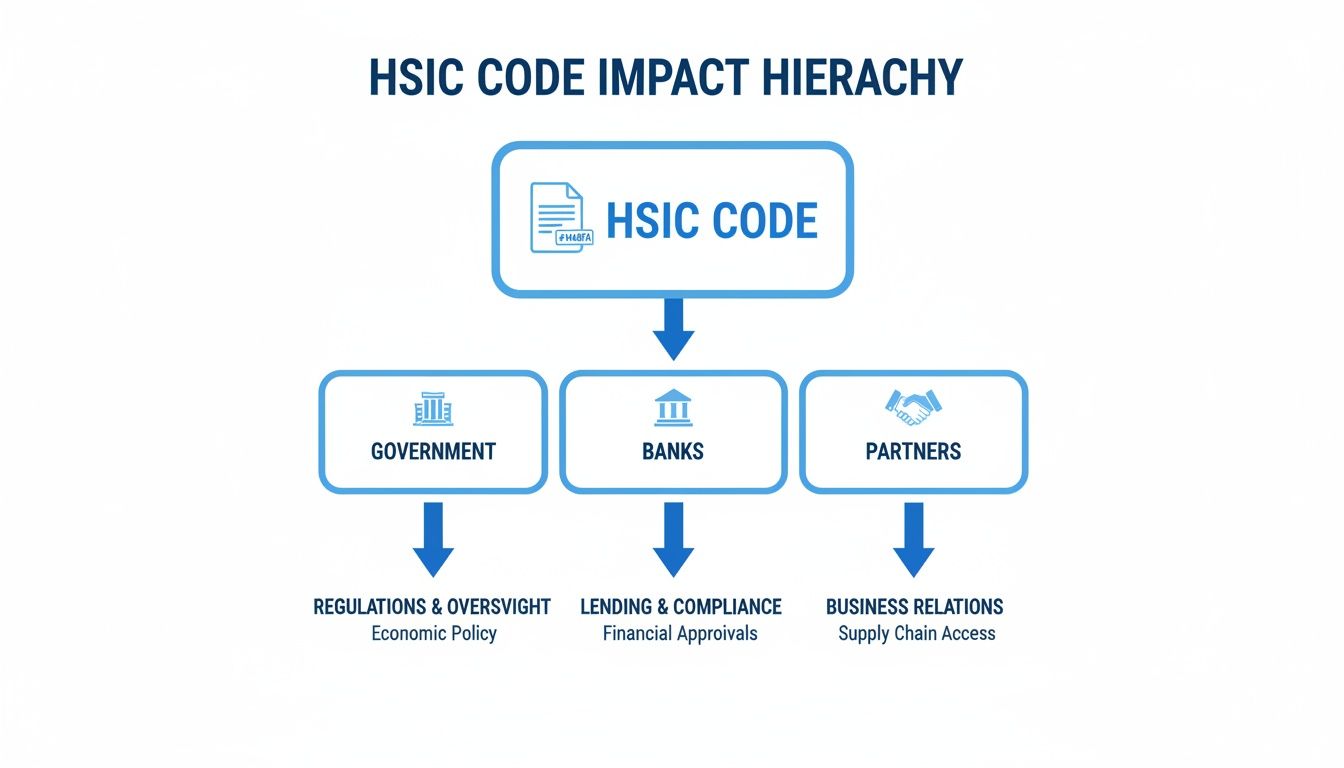
As the diagram shows, a single code creates a ripple effect, shaping how government agencies, financial institutions, and business partners perceive and categorise your company. Getting it right from day one ensures a much smoother journey through Hong Kong’s regulatory, financial, and commercial landscapes.
The Story Behind Hong Kong's Business Codes
The Hong Kong Standard Industrial Classification (HSIC) system didn't just appear out of thin air. Its history is a mirror, reflecting Hong Kong’s own incredible economic journey from a manufacturing powerhouse to the dynamic global financial and services hub we know today. To get why the system is structured the way it is, it helps to look back at where it came from.
The first version, launched back in 1990, was a product of its time. It was designed for an economy humming with the sounds of factories and the bustle of traditional trade. Think textiles, electronics, and shipping—the very bedrock of Hong Kong's post-war boom. It worked well for that era, but as the city’s economy began to sprint in a new direction, the system started to lag behind.
Rebuilding the System for a New Economy
By the early 2000s, Hong Kong was in the middle of a massive transformation. The services sector was booming, with new and exciting industries like fintech, specialised consulting, and digital media popping up everywhere. The old classification system just couldn't keep pace. It was like trying to use a map of 1990s Hong Kong to navigate the city today—the key landmarks were all different. A major overhaul wasn't just needed; it was essential.
This led to the most important update in the system's history. The Hong Kong Standard Industrial Classification Code was completely reimagined to reflect these economic shifts. The original HSIC V1.0 from 1990 was based on the UN's international standards of that period. The real game-changer, however, arrived in 2008 with HSIC V2.0, which was rolled out fully from 2009.
This new version was a massive leap forward. It expanded the structure to the five-level system we use today, bumping up the top-level industry groups from just nine to a far more detailed 21. This upgrade was crucial, especially for properly classifying the services sector, which by then employed a staggering 88.8% of the workforce. You can read more about how this evolution reflects Hong Kong's economic structure on Sleek.com.
Why This History Matters to Your Business
Understanding this isn't just a history lesson; it has very real implications for your business today. The shift to HSIC V2.0 was about much more than just adding a few new categories. It was a fundamental change that brought greater precision and put Hong Kong in step with global standards.
Here’s what that evolution means for you:
- Pinpoint Accuracy: The system now has the detail to correctly identify highly specialised businesses, whether you’re a mobile app developer or an environmental consultant.
- Speaking a Global Language: By aligning with the latest UN standards (ISIC Revision 4), HSIC V2.0 makes it much easier for international investors, banks, and partners to immediately grasp what your business does.
- Smarter Government Policy: The detailed data collected through this modern system helps the government design better policies and support schemes that are actually targeted at specific, growing industries.
The journey from a manufacturing-focused framework to one built for the services economy tells the story of Hong Kong itself—a story of resilience and adaptation. Your HSIC code connects your business directly to that narrative, positioning it firmly within today’s diverse and globally-linked economy.
Choosing the right Hong Kong Standard Industrial Classification Code means you’re using a system that was intentionally redesigned to understand and support the realities of modern business. It ensures your venture is seen for what it is, not lost under an outdated label from a bygone era.
How to Choose the Right HSIC Code for Your Business
Picking the right Hong Kong Standard Industrial Classification Code isn't just about ticking a box when you register your company. It’s a foundational step that defines your business in the eyes of the government, banks, and other institutions. Getting it right from the start saves a lot of headaches later.
The golden rule is simple: focus on your principal business activity. This is the single operation that brings in the most money.
Many businesses today, especially new ventures, have several things going on at once. Maybe you’re a software company that also does a bit of consulting on the side. Or perhaps you run an e-commerce shop that sells to customers directly but also has a wholesale arm. In these situations, you have to pinpoint what your primary revenue driver is.
This isn’t about listing every possible thing your business might do one day. It’s about declaring what your business is right now.
Start With Your Core Revenue Source
Before you even glance at the official HSIC list, ask yourself one simple question: "Where does most of our money actually come from?" The answer will point you in the right direction.
Think of it this way: a local coffee shop might sell some branded mugs and bags of beans, but its main business is making and serving coffee. Its HSIC code should fall under 'Food and beverage service activities' (Section I), not 'Retail trade' (Section G). The merchandise is a bonus, not the main event.
The key is to avoid choosing a code based on a minor or future part of your business. Your HSIC code must reflect your current, primary economic activity. A mismatch can flag your application for compliance checks and cause unnecessary delays.
A Practical Step-by-Step Guide
Once you've zeroed in on your main activity, finding the actual code is a straightforward process. The Census and Statistics Department (C&SD) has some great online resources to help you nail down the right classification.
Here’s a simple framework to follow:
- Use Keyword Searches: Head to the C&SD website and use its search tool. Start with broad terms that describe your business, like "software," "consulting," "design," or "e-commerce."
- Drill Down Through the Hierarchy: Your search will likely return a few potential matches. Use these as your starting point to navigate the five-level HSIC structure. Find the right broad Industry Section first, then the Division, and keep going until you land on the most specific 6-digit Sub-class that fits.
- Read the Descriptions Carefully: This is crucial. Don't just pick a code because the title sounds right. Each classification in the HSIC V2.0 Manual has detailed notes, including examples of what activities are included and, just as importantly, what’s excluded.
The official C&SD page is your go-to resource for this entire process.
Using this official portal ensures you’re working with the most current and accurate codes for your business.
Real-World Scenario Analysis
Let's walk through a common example. Imagine you’re launching a fintech startup. You've developed a budgeting app (software development) but you also plan to offer paid financial planning workshops (consulting).
- Primary Revenue: Your projections show that a solid 80% of your income will come from subscriptions to the app.
- Keyword Search: A search for "software development" will quickly point you towards Section J: Information and communications.
- Drilling Down: From there, you'd navigate to Division 62: Computer programming, consultancy and related activities, and then into Class 6201: Software development.
- Final Code: The most precise fit would almost certainly be 620101: Development of application software.
Even though you're running workshops, your main game is software. Choosing a consulting code would be a misrepresentation of your business's core function. This kind of clarity is vital when you start the process of incorporating your Hong Kong company, as it sets a clear and accurate foundation for everyone you'll be dealing with.
Common HSIC Code Mistakes and How to Avoid Them
Choosing your Hong Kong Standard Industrial Classification Code can feel like just another box to tick on a form, but don't be fooled. Getting this detail wrong can cause very real headaches for your business down the line. A small slip-up here can lead to frustrating delays with banks, compliance issues with the Companies Registry, or even missing out on government grants specifically for your industry.
Many entrepreneurs trip up at this stage, usually by making one of a few common mistakes. Knowing what these pitfalls are is the best way to sidestep them and build your company on a solid foundation from the very beginning.
The Problem with Being Too Vague (or Too Ambitious)
One of the most frequent errors is picking a code that sounds impressive but doesn't actually describe how your business makes most of its money. Another common trap is defaulting to a generic "other business activities" code when you're not sure which one to pick. This kind of vagueness is a major red flag for banks during their Know Your Customer (KYC) compliance checks.
A specific, accurate HSIC code tells banks and regulators you have a clear, focused business plan. A vague one hints at a lack of direction or, worse, looks like an attempt to hide what you're really doing. This almost always leads to extra questions and delays in getting your bank account opened.
The legal side of this is serious, too. Since the government adopted the HSIC V2.0 system, it has become the standard for industry statistics that shape economic policy. All of Hong Kong’s 1.4+ million registered companies have to play by these rules. Providing inaccurate information can lead to penalties under the Business Registration Ordinance, including fines up to HK$50,000. If you want to dive deeper into why this data is so vital for Hong Kong's economy, you can discover more insights about HSIC compliance and its impact on Yau & Wong's website.
Real-World Examples: Getting the Code Right
Let's make this practical. Here’s a look at how you'd choose a code for a few common types of businesses in Hong Kong. The key in every case is to focus on your primary source of revenue.
-
Case Study 1: The E-commerce Store
You sell beautiful, artisanal leather bags online. While your business relies on a website and technology, your core activity is selling physical goods to customers.- Wrong Code:
631200(Web portals). This code is for businesses that run the platform, not for those who sell on it. - Right Code:
479100(Retail sale via mail order houses or via Internet). This hits the nail on the head—it describes your main revenue stream perfectly.
- Wrong Code:
-
Case Study 2: The Management Consultancy
You provide strategic business advice to corporate clients. As part of a project, you might occasionally develop a small software tool for a client, but that's not your main service.- Wrong Code:
620101(Development of application software). This only applies if software development is your primary business. - Right Code:
702200(Management and management consultancy services). This accurately reflects what you do day-in, day-out to earn income.
- Wrong Code:
Thinking through your operations this way helps you land on the right code. Just be honest about where the majority of your revenue comes from today, not where you hope it will come from in five years. And remember, if your business model changes significantly, you're required to update your registration details to reflect your new direction.
How Your HSIC Code Impacts Your Business Long-Term
Picking your Hong Kong Standard Industrial Classification Code is far more than a simple box-ticking exercise during company registration. It’s a foundational decision that sticks with your business for life, quietly shaping everything from banking relationships to your eligibility for government grants.
Think about it from a bank’s perspective. When you apply for a corporate account or a business loan, they run Know Your Customer (KYC) checks. Your HSIC code is one of the first things they look at to understand what your company actually does. If your stated business activities don’t line up with your code, it raises a red flag. That can mean extra scrutiny, frustrating delays, or even a flat-out rejection.

Unlocking Government Grants and Support
Beyond banking, the right HSIC code can be your key to unlocking valuable government support. Many funding schemes are targeted at specific industries, and your code is what determines if you get a seat at the table.
Here are a couple of major programmes where this comes into play:
- Technology Voucher Programme (TVP): This popular scheme is designed to help companies adopt technology to boost productivity. Eligibility often depends on having a code related to technology, consulting, or modern services.
- SME Export Marketing Fund (EMF): If you're looking to expand overseas, this fund can be a huge help. It’s primarily aimed at small and medium-sized businesses with codes in trade, manufacturing, and export.
Choosing the right code can open the door to thousands of dollars in funding. The wrong one could mean you’re locked out of opportunities you never even knew existed.
Your HSIC code is more than just a label; it’s a strategic asset. It positions your business within Hong Kong’s economic landscape, directly influencing the financial and governmental support you can receive.
Adapting to Business Growth and Pivots
Businesses rarely stand still. What happens when your company evolves? A startup that began as a software developer (code 620101) might later pivot into a data analytics consultancy (code 702200).
When your main source of revenue changes that significantly, your HSIC code needs to change with it. It’s not just about updating your business cards.
Failing to update your code is a compliance oversight that can cause headaches down the line. It can create discrepancies in your financial reports and even affect your tax profile. The Inland Revenue Department (IRD), for example, uses industry data to benchmark company performance. If your profits look unusual for your registered industry, it could trigger an audit. You can explore more about how business activities impact Hong Kong profits tax in our detailed guide.
Keeping your HSIC code current is just good business hygiene. It ensures your official identity matches your real-world operations, keeping you compliant and ready to seize the next opportunity.
Your Top Questions About HSIC Codes Answered
When you're setting up a business in Hong Kong, the HSIC code system can seem a bit confusing. It's totally normal to have questions. We've helped countless founders through this, so here are some of the most common queries we hear – and the practical answers you need.
Can My Company Have More Than One HSIC Code?
This is a classic question. The short answer is no; you can only select one official Hong Kong Standard Industrial Classification Code when you register your company.
The key is to choose the code that reflects your main business activity – the one that brings in the most income. Your company’s internal documents, like the articles of association, can absolutely cover a wider range of activities. But for the Companies Registry, you have to nail it down to just one.
Of course, businesses evolve. If your primary source of revenue shifts significantly later on, you'll need to update your business registration to reflect that new reality. This keeps everything above board and ensures your company is properly categorised.
What Happens If I Pick the Wrong HSIC Code?
Choosing the wrong code might seem like a small mistake, but it can cause some surprisingly big headaches. Think of it as giving the wrong address; mail and opportunities just won't find you.
-
Banking Roadblocks: A mismatch between your business description and your HSIC code is a red flag for banks. It can seriously delay or even derail your application for a corporate bank account as they use this for their risk and know-your-customer (KYC) checks.
-
Missed Opportunities: Many government grants, funding programmes, and even essential operating licenses are tied to specific industries. The wrong code could make you ineligible, cutting you off from valuable support.
-
Compliance Trouble: At the end of the day, providing incorrect information on official documents is a breach of the Business Registration Ordinance. While rare, this could lead to fines.
Getting it right from the beginning just makes sense. It saves you time, money, and a lot of potential frustration.
The definitive resource for all things HSIC is the official list maintained by the Census and Statistics Department (C&SD) of the Hong Kong government. Their website provides the full classification, search tools, and detailed notes to help you find the most accurate and up-to-date code for your business.
Ultimately, taking a few extra minutes to select the correct code is a foundational step in building a solid business in Hong Kong. It ensures you're correctly positioned within the city’s economic and regulatory landscape from the get-go.
Conclusion
Navigating company formation, banking, and tax compliance in Hong Kong is a lot to handle on your own. At Lion Business Consultancy Limited, we provide the personalised, one-on-one advice you need to build a secure and efficient international business structure. We don't just set up your company; we protect it for the long run.