
 Hong Kong


 Singapore


 UAE
UAE



 Malaysia


 Turkey


 UK
UK
 EU
EU
 US
US
 Switzerland
 Bahamas Bank Account
 Cayman Islands Bank Account
 Mauritius Bank Account

 BVI
BVI
 Seychelles

If you're an entrepreneur dreaming of global expansion, understanding Hong Kong's tax system isn't just a box to tick—it's your first strategic advantage. The hk corporate tax rate is famous for being incredibly low and refreshingly simple, especially with its two-tiered system that gives startups and SMEs a powerful head start.
So, what does this mean for your bottom line? In short, your first HK$2 million in profit is taxed at a gentle 8.25%. Only the profit you earn above that threshold is taxed at the standard rate of 16.5%. It’s a system designed to help you grow.
Your Guide to Hong Kong’s Favourable Tax System
Welcome to the essential rundown on one of the most business-friendly tax frameworks on the planet. For entrepreneurs and small business owners, Hong Kong's system is far more than a set of rules—it’s a launchpad for growth. Forget the tangled tax codes you see elsewhere; Hong Kong’s approach is built on clarity and consistency.
At the heart of it all is the two-tiered profits tax. This wasn't just a random policy decision; it was specifically designed to give smaller companies a financial leg up. By halving the tax rate on your initial profits, the government helps you keep more cash in the bank right when you need it most. Think of it as a built-in advantage, fueling your journey from a fledgling startup to a market leader.
To make this crystal clear, here's a simple breakdown of the rates.
Hong Kong's Two-Tiered Profits Tax Rates At a Glance
This table shows exactly how the two-tiered system works for corporations, highlighting the clear benefit for businesses in their early growth stages.
| Assessable Profits Bracket | Applicable Tax Rate |
|---|---|
| First HK$2 million | 8.25% |
| Portion above HK$2 million | 16.5% |
As you can see, the structure is refreshingly straightforward—no complex calculations or hidden clauses. It’s all about rewarding your ambition.
Why This Matters for Your Business
For years, Hong Kong has held its spot as one of the world's most competitive tax jurisdictions. The standard profits tax rate of 16.5% has been consistent since the 2008/09 assessment year, putting it far below the global average. You can see the official rates and historical trends for yourself by reviewing Hong Kong's tax rate history on gov.hk.
This stability, combined with low rates, makes financial planning so much easier. Here's what that translates to in practical terms for your business:
- More Cash to Reinvest: A lower tax bill means more capital stays where it belongs—in your business. You can use it to hire key talent, accelerate your marketing, or develop your next game-changing product.
- A Sharper Competitive Edge: With a lower cost base, you have more flexibility to price your services or products competitively on the global stage.
- Stress-Free Planning: The clear, two-tiered structure removes the guesswork from financial forecasting, letting you plan for the future with confidence.
In this guide, we’ll walk you through exactly how these rates work in practice, so you can make smart decisions right from day one.
The Territorial Principle: Hong Kong's Tax Superpower

Before we dive deeper into the numbers, let's talk about the single most important rule in Hong Kong’s financial playbook: the territorial principle of taxation. This isn't just a piece of jargon; it's the secret ingredient that makes the hk corporate tax rate so compelling for international entrepreneurs.
Most countries tax a company's worldwide income, meaning every dollar earned, no matter where, is fair game for the taxman. Hong Kong flips that script. It only taxes profits that are "arising in or derived from" Hong Kong itself.
In simple terms, if your profit comes from business activities happening outside Hong Kong, it generally isn't taxed here—even if your company is registered in Hong Kong. This is a genuine game-changer for any business with a global footprint.
Onshore vs. Offshore Profits Explained
The heart of the territorial principle lies in figuring out what counts as onshore versus offshore profit. This is where many entrepreneurs get tripped up. It’s not just about where your customers are; it’s about where the actual work that generated the income took place.
The Inland Revenue Department (IRD) wants to know: what did you do to earn the money, and where did you do it?
Let's illustrate this with an example. Imagine you run a digital marketing agency from a Hong Kong office.
-
Onshore Profit Example: You land a contract with a local café in Tsim Sha Tsui. Your team in your Quarry Bay office designs the marketing campaigns and runs their social media. The income from this client is clearly earned in Hong Kong, making it fully taxable.
-
Offshore Profit Example: You sign a deal with a client in Australia to build their new e-commerce website. All meetings are held over Zoom, and the design and coding work is handled by your remote team in the Philippines. In this scenario, the profit-generating activities happened outside Hong Kong, so the income may be considered offshore and not subject to tax here.
Getting this distinction right is everything. It's the foundation of legitimate tax planning and a core reason why so many international businesses use Hong Kong as their home base. Structuring your operations correctly from the start can dramatically lower your effective tax rate.
The key question isn't where the profits ultimately land in your bank account, but where the operations that created those profits actually took place. This is fundamental to navigating Hong Kong's tax system.
Proving Your Offshore Claim
Of course, you can't just declare your profits as "offshore" and call it a day. The burden of proof is on you. You have to be able to show the IRD, with clear evidence, that your income-generating activities truly happened outside of Hong Kong.
This means meticulous record-keeping isn't just good practice; it's non-negotiable.
To successfully support an offshore claim, you’ll need a solid paper trail. Be prepared to provide things like:
- Detailed service agreements that specify the scope and location of the work.
- Travel records, like flight tickets and hotel receipts, to prove where meetings were held.
- Correspondence with clients and suppliers (emails, meeting minutes) that show where key decisions were made.
- Invoices and payment records that directly link to the offshore work performed.
Understanding how to classify and document your income sources is a vital skill. For a deeper look into the nitty-gritty, you can learn more about how Hong Kong profits tax is applied to different income sources in our detailed guide. With the right documentation, your business can stay compliant while taking full advantage of Hong Kong's unique tax framework.
How the Two-Tiered Profits Tax System Works
So, what’s the secret sauce that makes Hong Kong so attractive for startups and SMEs? A huge part of it is the two-tiered profits tax system. This isn't some minor discount; it's a deliberate policy designed to give smaller businesses a real boost. The whole idea is to leave more cash in your pocket during those crucial early years when you're just getting off the ground.
Think of it as a financial launchpad. The government gives you a substantial tax break on your first taste of success, helping your business gain some serious momentum before the standard tax rate kicks in. It’s one of the key reasons the Hong Kong corporate tax rate is seen as so competitive.
The Nuts and Bolts of the System
Alright, let's get into how this actually works on a practical level. The system essentially splits your company's assessable profits into two brackets, each with its own tax rate. This structure is specifically designed to help businesses when they're most vulnerable.
Introduced in the 2018/19 assessment year, this wasn't an accidental change. It was a strategic move to make Hong Kong’s tax regime even more appealing. Here’s the breakdown: your first HK$2 million in assessable profits are taxed at just 8.25%. Anything you earn above that is taxed at the standard rate of 16.5%. For a deeper dive, the Inland Revenue Department's official site has all the official details.
A Startup's Journey: A Real-World Example
To really see the difference this makes, let’s imagine a fictional tech startup, "InnovateHK Ltd."
After a great first year, InnovateHK has an assessable profit of HK$2.5 million. If Hong Kong had a simple, flat tax rate, their entire profit would be taxed at 16.5%.
But with the two-tiered system, the calculation is much friendlier:
- First Bracket: The first HK$2 million of their profit is taxed at the reduced 8.25% rate.
- Tax Payable: HK$2,000,000 x 8.25% = HK$165,000
- Second Bracket: The remaining HK$500,000 is taxed at the standard 16.5% rate.
- Tax Payable: HK$500,000 x 16.5% = HK$82,500
Their total tax bill comes to HK$247,500. Under a flat 16.5% system, they would have paid HK$412,500. That’s an immediate saving of HK$165,000. That’s cash they can pour straight back into the business—maybe to hire another developer or fund a new marketing campaign.
This isn't just about saving tax. It's a genuine strategic advantage. For a young company, that extra HK$165,000 can be the difference between stagnating and scaling up.
The Rule for Connected Businesses
Naturally, the government needed to ensure this generous benefit wasn't exploited. To prevent this, they put a clear rule in place for connected entities. If you have a stake in or control over several companies, only one of those companies can choose to use the two-tiered rates in any given tax year.
This rule is smart. It stops larger corporations from simply slicing up their business into multiple smaller entities just to claim the lower tax rate over and over. A group of connected companies has to nominate just one business to get the benefit, which keeps the system fair and ensures the policy helps who it was designed to help: independent small and medium-sized businesses.
Calculating Your Assessable Profits Correctly
Knowing Hong Kong's corporate tax rates is just the first step. The real art is applying those rates to the right number—your assessable profit. Think of this as your company’s true financial result after you've accounted for all the costs of doing business. It’s not about your total sales; it’s about what’s left in the pot after everything is said and done.
To figure this out, you’ll start with your gross profit and begin subtracting every legitimate business expense you incurred to earn that income. This isn't about finding creative loopholes; it’s a straightforward process of reflecting your genuine profitability as defined by Hong Kong's tax rules.
Once you have your assessable profit, the two-tiered system comes into play, as shown below.
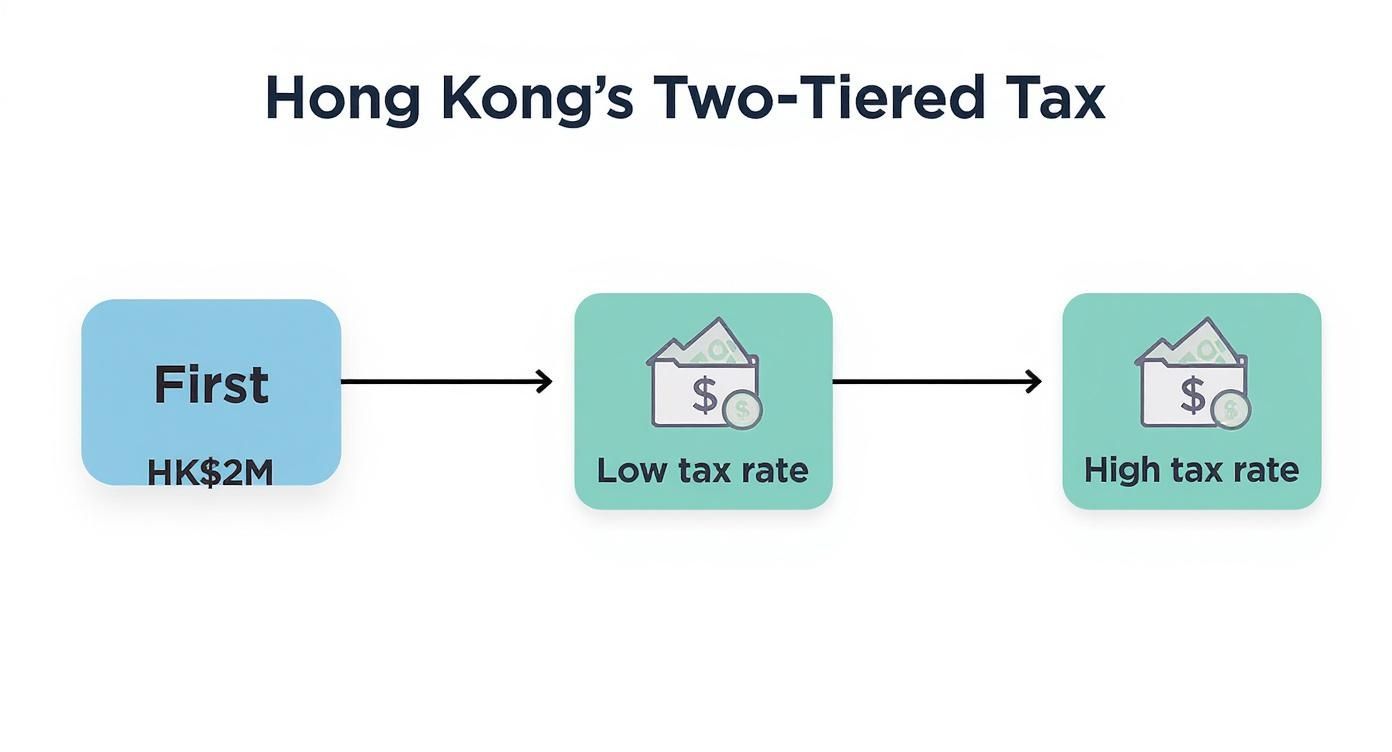
This visual really drives home the benefit for smaller businesses and startups. That first slice of profit gets a much gentler tax treatment, which is a massive help for preserving cash flow when you need it most.
Identifying Deductible Expenses
So, what kind of costs can you actually deduct? The Inland Revenue Department (IRD) keeps it simple: as a general rule, any expense you incur specifically to produce assessable profits is fair game. For a typical SME, this covers a lot of ground.
Here are some of the most common expenses you can write off:
- Salaries and Employee Benefits: This covers everything from wages and bonuses to your Mandatory Provident Fund (MPF) contributions.
- Rent for Office Space: The cost of your workshop, office, or storefront is a classic business expense.
- Marketing and Advertising Costs: Whether you’re running Google Ads, social media campaigns, or have hired a marketing agency, those costs are deductible.
- Professional Fees: Payments to your accountant, lawyer, or a business consultant all count.
- Software Subscriptions: All those monthly fees for project management tools, your CRM, or cloud storage add up, and they're all legitimate deductions.
It’s this combination of clear deductions and low statutory rates that cements Hong Kong's reputation as a pro-business hub. In fact, profits tax has often been a bigger contributor to government revenue than salaries tax, which shows just how foundational this framework is to the local economy. You can find more background on Hong Kong's tax structure on Wikipedia.
Case Study: A Local E-Commerce Brand
Let’s walk through a story to see how it all fits together. We’ll use a fictional Hong Kong e-commerce brand called "Artisan Collective" that sells handcrafted goods.
Their financial year has just wrapped up. Here's how they calculate their assessable profit:
-
Start with Gross Profit: Artisan Collective brought in HK$3,500,000 in total sales. The direct cost to create their products (cost of goods sold) was HK$1,500,000.
- Gross Profit: HK$3,500,000 – HK$1,500,000 = HK$2,000,000
-
Subtract Allowable Expenses: Next, they add up all their operational costs for the year.
- Salaries and MPF: HK$600,000
- Office Rent: HK$240,000
- Marketing Spend: HK$150,000
- Software & Subscriptions: HK$50,000
- Professional Fees: HK$60,000
- Total Expenses: HK$1,100,000
-
Arrive at Assessable Profit: Finally, they subtract their total expenses from the gross profit to find the magic number.
- Assessable Profit: HK$2,000,000 – HK$1,100,000 = HK$900,000
Artisan Collective's assessable profit is HK$900,000. This is the final figure their corporate tax bill will be based on—a far cry from their initial revenue of HK$3.5 million.
This example highlights why good bookkeeping is non-negotiable. Every receipt and invoice for a legitimate business cost directly lowers your tax burden, making sure you only pay tax on the profit you’ve truly made.
Key Filing Dates and Compliance Obligations

A brilliant tax strategy is only as good as its execution. In Hong Kong, the system is efficient but expects precision. Missing a deadline can attract unnecessary penalties, so let’s map out your compliance journey to keep you organised, penalty-free, and focused on growth.
It all starts when the Inland Revenue Department (IRD) issues your company’s first Profits Tax Return (PTR). This usually happens about 18 months after your business incorporation date, giving you plenty of time to get your first set of audited accounts in order.
After that initial return, the process becomes an annual affair. The IRD typically sends out PTRs on the first working day of April each year. From there, your specific filing deadline hinges on your company's financial year-end.
Navigating Key Tax Deadlines
While the standard deadline is one month from the date the PTR is issued, most businesses take advantage of a block extension scheme, which provides a lot more breathing room.
Here’s a general timeline based on your accounting year-end:
- Year-End from 1st April to 30th November: Your filing deadline is typically 2nd May of the following year.
- Year-End from 1st December to 31st December ("N" Code): This deadline is usually extended to 15th August of the following year.
- Year-End from 1st January to 31st March ("M" Code): This is the most common choice, with a filing deadline of 15th November.
Figuring out which category your business falls into is crucial. You can dive deeper into the specifics of the Hong Kong tax year to make sure your calendar is perfectly aligned with the IRD's expectations.
Think of these dates not as threats, but as predictable checkpoints. Knowing them in advance transforms tax compliance from a stressful scramble into a routine part of your business operations.
Understanding Provisional Profits Tax
One concept that often catches new entrepreneurs by surprise is provisional tax. Hong Kong's system works by having you prepay an estimated amount of tax for the upcoming year, which is calculated based on the profits of the year you just finished.
When you get your tax assessment, you'll see two figures: the final tax for the year just completed and the provisional tax for the current year. This system helps the government maintain a steady revenue stream and helps you avoid a single, massive tax bill later on.
Don't worry—if your actual profits for the year end up being lower than estimated, any overpayment is credited back to you or applied to your next tax bill. It’s also worth noting that beyond tax rules, other industry standards like understanding SOC compliance can also shape your company's broader reporting and internal control obligations.
Actionable Tax Planning Strategies for SMEs
Knowing the rules of Hong Kong's tax system is the first step. The real art lies in using that knowledge to make smart, strategic decisions for your business. This isn't about finding obscure loopholes; it’s about structuring your business and its finances in a way that’s both compliant and intelligent.
Let's dive into a few practical strategies that can make a real difference to your bottom line.
How You Pay Yourself Matters
For many SMEs, one of the most fundamental tax decisions starts with your own compensation. Should you take a director's salary or pay yourself in dividends? This isn't just a payroll question—it has direct tax implications.
A director's salary is treated as a business expense. This means it's deducted from your company's revenue before calculating your assessable profit, lowering your overall corporate tax bill. Dividends, however, are paid out from profits that have already been taxed. Thinking through this structure can significantly impact both your personal and company tax liabilities.
Maximising Legitimate Deductions
This might sound obvious, but you’d be surprised how many businesses leave money on the table by not claiming all their legitimate expenses. Every missed deduction is a missed opportunity to lower your taxable profit.
Go beyond just rent and staff costs. Are you properly accounting for all your software subscriptions? What about professional development courses for your team, or the travel costs for that crucial client meeting?
The key is meticulous record-keeping. A clean, organised accounting system is your best friend here, ensuring you capture every allowable expense. This directly shrinks the final figure that your hk corporate tax rate is applied to.
The goal isn't to spend more, but to accurately account for every dollar spent to generate profit. This simple discipline ensures you pay tax on your true profitability, not a penny more.
Leveraging the Territorial Principle
For businesses with an international footprint, Hong Kong's territorial principle is perhaps the most powerful tax planning tool available. Remember, Hong Kong only taxes profits that arise in or are derived from the city. If you can clearly prove that your core, profit-generating activities happened outside of Hong Kong, that income may not be subject to profits tax at all.
This goes much deeper than just having overseas customers. It's about where key decisions are made, where contracts are negotiated and signed, and where your services are actually delivered. For a detailed breakdown of how this works and what documentation you'll need, our guide on understanding Hong Kong’s offshore profits exemption claim is an essential read.
Exploring Special Tax Deductions
Finally, don't forget that the government actively encourages certain types of business activities with enhanced tax deductions. If your company is involved in innovation, the deduction for Research and Development (R&D) expenditure is incredibly valuable.
Qualifying R&D spending can earn you a super-deduction of up to 300% on the first HK$2 million and 200% on any amount beyond that. This is a massive incentive designed to support innovation. If you're creating new products, improving processes, or developing unique services, looking into this could unlock significant tax savings and free up cash to reinvest in your growth.
Answering Your Top Questions About Hong Kong Corporate Tax
To round things off, let's tackle some of the questions we hear all the time from business owners trying to get their heads around the hk corporate tax rate. These are the common sticking points, and getting clear on them will help you move forward with confidence.
Is Hong Kong Really a Tax Haven?
This is a big one. The short answer is no; Hong Kong is a low-tax jurisdiction, and that's a very different thing from a tax haven.
The distinction is important. Tax havens are often about secrecy and helping individuals or corporations hide money. Hong Kong, on the other hand, operates a transparent and fully compliant tax system. It adheres to international standards like the Common Reporting Standard (CRS) and only taxes profits that are actually generated within its borders. Its business-friendly tax regime is a core part of its economic strategy, not a backdoor for tax evasion.
What if My Company Made a Loss? Do I Still Pay Tax?
If your business is in the red for the year, you won't have any profits tax to pay. It gets better, though. Those losses can be carried forward indefinitely to offset taxable profits you make in future years.
This is a massive advantage because it helps you lower your tax bills down the road. Just remember, you absolutely must still file your Profits Tax Return to report the loss to the Inland Revenue Department (IRD). Filing is what locks in your ability to use those losses later.
Think of a reported loss not as a failure, but as a future tax credit. It’s a financial tool that helps your business recover and thrive in the years to come.
How Does Tax Differ for a Corporation vs. a Sole Proprietorship?
The way you're taxed really depends on how your business is set up. The rules are quite different.
-
Corporations (Limited Companies): These businesses get to use the two-tiered profits tax system. That means they pay a lower rate of 8.25% on their first HK$2 million of profit. Anything above that is taxed at the standard 16.5%.
-
Unincorporated Businesses: This covers sole proprietorships and partnerships. They don't get the two-tiered system and are instead taxed at a flat rate of 15% on their assessable profits. The one wrinkle is that owners can choose to be assessed under Personal Assessment, which sometimes results in a lower tax bill depending on their personal financial situation.
At Lion Business Consultancy Limited, we know these details are what make or break a business strategy. We don't just register companies; we build tax-efficient structures designed to protect your assets and fuel your growth. If you're looking for personalised, 1:1 guidance for your expansion, let's design your strategy together.