
 Hong Kong

 Singapore
 UAE
UAE
 Malaysia
 Turkey
 UK
UK
 EU
EU
 US
US
 Switzerland
 Bahamas Bank Account
 Cayman Islands Bank Account
 Mauritius Bank Account
 BVI
BVI
 Seychelles

That small, manageable figure on your credit card statement often feels like a safety net, especially when your business's cash flow is tight. But is it helping you stay afloat or slowly pulling your business under? For many entrepreneurs, the credit card minimum payment is a tempting short-term fix that masks a dangerous long-term problem.
Think of it as the emergency brake for your finances. It stops an immediate crash—late fees and a hit to your credit report—but it was never designed for regular use. Relying on it month after month is like driving with the brake partially engaged; you’re creating immense friction and burning through valuable resources just to move forward.
Why This Small Payment Creates Big Problems
Imagine you’ve just used your corporate card to cover a critical HK$50,000 equipment purchase. Paying just the minimum might seem prudent, a smart way to preserve cash for other operational needs. However, this decision is often the first step onto a financial treadmill you can't easily get off.
The reality is that this small payment barely covers the interest accrued during the month, with only a tiny fraction going towards the actual principal balance. This creates a cycle where your debt shrinks at a glacial pace, while the interest compounds relentlessly.
The minimum payment is mathematically engineered to maximize the lender's profit, not to help you clear your debt efficiently. It keeps you as a paying customer for as long as possible.
This seemingly harmless habit has significant consequences for any ambitious SME:
- Capital Drain: Every dollar paid in interest is a dollar not invested in marketing, inventory, or talent.
- Stifled Growth: High-interest debt limits your ability to seize new opportunities or weather unexpected downturns.
- Reduced Borrowing Power: Consistently carrying high balances can negatively impact your business credit score, making future financing more expensive and harder to secure.
Ultimately, the minimum payment transforms a useful financial tool into a liability. It’s a lifeline that, if held onto for too long, will inevitably sink the business it was meant to save. We'll cut through the confusion and explain why this option is one of the costliest forms of financing you can use.
How Banks Figure Out Your Minimum Payment
Ever squinted at your credit card statement, trying to figure out how the bank landed on that exact minimum payment amount? It’s not just a number they pull out of thin air. It’s a very specific formula, and it’s one that’s built from the ground up to benefit the lender.
Getting your head around this calculation is the first big step toward understanding why sticking to the credit card minimum payment can be such a costly trap for your business.
The Two Main Ways It's Calculated
While the exact maths can differ slightly from one bank to another, they almost always use one of two core models—or sometimes a blend of both. The end goal for the bank is always the same: make sure the payment covers the new interest and any fees, while you pay down the actual debt as slowly as legally possible.
Here’s a look at the two main approaches:
- Percentage of the Balance: This is the one you’ll see most often. The bank takes a small slice of your total outstanding balance—usually somewhere between 1% and 3%. Then, they tack on all the interest that’s built up over the month, plus any late fees or other charges.
- A Flat Fee: For smaller balances, some banks just set a fixed minimum amount. This ensures they get a payment that's worth their while, even if the percentage calculation would result in a tiny figure.
Most of the time, your minimum payment will be the higher of these two results. This setup guarantees the bank a baseline return every single month, no matter how much or how little you owe. If you want a deeper dive into how your total debt is tracked, check out our guide on the meaning of an outstanding balance.
Think of the minimum payment as trying to bail out a leaky boat with a teacup. You're scooping out water (your payment), but more is constantly seeping in through the holes (interest and fees). The bank's formula makes sure the teacup is just big enough to keep you afloat, but never lets you get dry.
A Real-World Hong Kong Example
In Hong Kong, the rules for minimum payments are set by each bank, so you'll see some variation. A very common structure is requiring a percentage of the balance plus any fees and interest, or a fixed minimum like HK$350—whichever is greater. You can usually find this laid out in the Key Facts Statement provided by any major bank. To see this in the wild, have a look at the terms and conditions on the DBS Bank website.
Let’s run the numbers. Say your business put a HK$20,000 supplier invoice on a corporate credit card. The card has a 35% Annual Percentage Rate (APR), which breaks down to about 2.92% per month.
Here’s how a typical bank would calculate your minimum payment:
- Outstanding Balance: HK$20,000
- Monthly Interest: HK$20,000 * 0.0292 = HK$584
- Percentage of Balance (using 1%): HK$20,000 * 0.01 = HK$200
- Calculated Minimum Payment: HK$200 (1% of balance) + HK$584 (interest) = HK$784
So, your minimum payment is HK$784. But here’s the critical part: only HK$200 of that payment actually goes toward chipping away at the original HK$20,000 debt. The other HK$584 is pure profit for the bank.
This is exactly how a simple business expense can quickly morph into a long-term financial headache, bleeding cash that you should be using to grow your company.
To make this even clearer, let's look at a few different ways banks might approach this.
Minimum Payment Calculation Examples
The table below shows how three different bank policies would affect the minimum payment on the same HK$20,000 balance.
| Bank Policy Example | Calculation Breakdown | Resulting Minimum Payment |
|---|---|---|
| Bank A (Percentage + Interest) | 1% of balance (HK$200) + Interest (HK$584) | HK$784 |
| Bank B (Higher of % or Flat Fee) | 2.5% of balance (HK$500) OR a HK$350 flat fee. Bank takes the higher amount. | HK$500 |
| Bank C (Total Percentage) | 5% of the total balance, which includes principal and new interest. (HK$20,584 * 0.05) | HK$1,029.20 |
As you can see, the final number can vary significantly. This is why it's so important to read the fine print on your card agreement to understand exactly how much of your payment is actually working for you.
The True Long-Term Cost of Paying the Minimum
Making that small minimum payment feels like a relief when cash is tight, but it’s a trap. For any business owner, it’s absolutely critical to understand the staggering long-term financial hit. Consistently paying just the minimum isn't a strategy; it’s a slow-motion financial drain that siphons precious capital straight from your business into the bank's coffers.
Let's walk through a realistic scenario. Picture a startup founder in Hong Kong—we'll call her Chloe. She's just launched her e-commerce business and uses her corporate card to buy HK$50,000 worth of essential equipment. To preserve working capital, she decides to only make the credit card minimum payment each month.
On the surface, it seems like a smart cash-flow move. In reality, it's the first step into a very expensive cycle of debt.
The Amortization Trap in Action
Chloe's card has a 35% Annual Percentage Rate (APR), a fairly standard rate for business cards in Hong Kong. Her bank sets the minimum payment at 1% of the outstanding balance, plus all the interest tacked on that month.
So, in the first month, her minimum payment comes to about HK$1,958. Here's the kicker: roughly HK$1,458 of that is pure interest. Only a measly HK$500 actually goes towards paying down her original HK$50,000 debt. The next month, her balance is a hair lower, the interest is a fraction less, and a tiny bit more of her payment chips away at the principal.
This is the heart of the problem—the debt barely budges. It’s like trying to fill a bucket with a big hole in it; most of your effort just goes to replacing what’s leaking out. If you want to run these numbers yourself, spreadsheet tools are your friend. For a practical walkthrough of how these calculations work, check out an in-depth guide on the PMT function in Excel.
This infographic breaks down exactly how your balance, interest, and fees all come together to determine your payment.
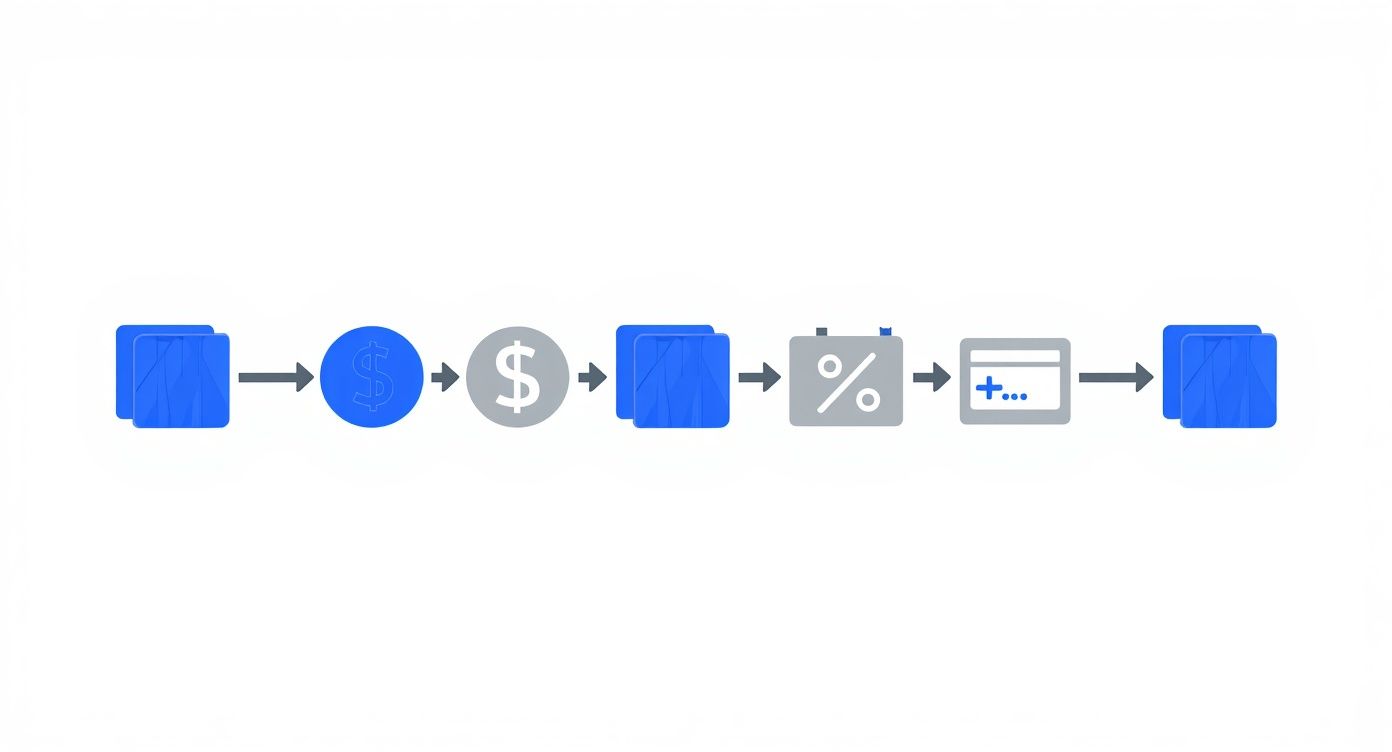
As you can see, your payment has to cover all the new interest and fees before it even starts to make a dent in the original amount you spent.
A Tale of Two Payment Strategies
Let's compare the devastating long-term effect of Chloe's choice against a more disciplined approach. What if, instead of the bare minimum, she committed to paying a fixed HK$2,500 each month? It’s more than the minimum, for sure, but still a manageable figure for a new business.
The difference isn't just significant; it's business-altering.
Repayment Scenario: HK$50,000 Debt at 35% APR
This table lays out the shocking difference between the two approaches.
| Payment Strategy | Monthly Payment | Time to Repay | Total Interest Paid |
|---|---|---|---|
| Minimum Payment Only | Starts at ~HK$1,958 (decreases over time) | Over 28 Years | ~HK$135,000 |
| Fixed HK$2,500 Payment | Fixed HK$2,500 | 2 Years and 5 Months | ~HK$22,000 |
The numbers don't lie. By sticking with the minimum payment, Chloe would pay almost three times the original cost of her equipment in interest alone. That HK$50,000 debt would take nearly three decades to clear. This isn't just a financial burden; it's a multi-decade handicap on her business's future.
Paying the minimum on a significant balance is like agreeing to a business partnership where your partner (the bank) contributes nothing but takes the majority of your profits for years to come.
The Opportunity Cost for Your Business
The most damaging part of this cycle isn't just the interest paid; it's the lost opportunity. Think about what Chloe’s business could have done with the extra HK$113,000 that went to the bank as interest.
That capital could have been a game-changer, funding things like:
- A major digital marketing campaign to bring in thousands of new customers.
- Hiring a key employee to manage operations, freeing her up to focus on growth.
- Expanding her product line or tripling her initial inventory.
- Building a cash reserve to handle unexpected market shifts or pounce on a sudden opportunity.
Instead, that capital simply vanished into the bank’s revenue stream, generating zero return for her business. The minimum payment didn't just cost her money; it cost her growth, resilience, and years of her professional life. It’s a powerful lesson in how a seemingly small financial habit can anchor an enterprise for decades.
How Minimum Payments Impact Your Business Credit
A strong business credit profile is your passport to better financing. It opens doors to bigger loans, better supplier terms, and healthier lines of credit. So, where does the habit of only making the credit card minimum payment fit into this picture? It’s a bit more complicated than most business owners think.
On the surface, consistently paying the minimum on time does one crucial thing: it keeps you out of default. You sidestep late fees and avoid the immediate, nasty hit a missed payment leaves on your credit report. From that narrow angle, it seems fine. You are, after all, meeting your end of the bargain.
But lenders and credit bureaus are reading a much bigger story. They aren't just asking, "Did they pay?" They're asking, "How are they managing their debt?" And this is where the minimum payment habit starts to do some serious, often hidden, damage to your business's financial reputation.
The Real Damage Is Your Credit Utilisation Ratio
The most significant harm comes from a metric called the credit utilisation ratio (CUR). This is simply the percentage of credit you're using compared to your total available credit limit, and it’s one of the most important factors in your credit score.
Think of your business credit line as a delivery van. If you're constantly running it at 95% capacity, it tells lenders your operations are stretched thin. Even if you never miss a maintenance check (your minimum payment), that high, sustained load suggests you have no room to breathe—no buffer for emergencies. A business operating that close to its financial edge is seen as a higher risk.
To a lender, a high credit utilisation ratio is a major red flag. It suggests a business might be overly reliant on debt just to keep the lights on, which increases the odds of hitting financial trouble down the road.
This single number can drag down your business credit score, even with a perfect payment history. A lower score means you'll be looking at higher interest rates on future loans, and some lenders might just say "no" altogether.
The Hong Kong Context
This is a particularly big issue right here at home. A 2022 report from TransUnion found a startling knowledge gap. Roughly 41% of Hong Kong credit card holders weren't sure why it was important to pay more than the minimum balance each month. That figure is nearly double the global average, which shows just how widespread the misunderstanding is. If you want to see the details, you can explore the full TransUnion research on consumer payment trends.
The bottom line is this: while paying the minimum keeps your account in good standing, it actively works against your goal of building strong credit. Your balance stays stubbornly high, keeping your utilisation ratio in a danger zone that makes your business look less stable to potential financial partners. That can make it much harder—and more expensive—to get the funding you need when your next big opportunity comes along.
Smarter Repayment Strategies for Entrepreneurs
It's one thing to understand how damaging a credit card minimum payment can be, but it’s another thing entirely to break free from its grip. For any entrepreneur, this means moving past the simple advice of "just pay more." You need a disciplined, tactical approach that works with the often-unpredictable cash flow of a growing business.
It’s time to switch from defence to offence. This isn't just about clearing debt; it's about reclaiming your capital so you can put it back into growing your company. The following methods offer a clear playbook for taking back control of your business's financial health, one payment at a time.
The Debt Avalanche Method
The Debt Avalanche is a strategy grounded in pure financial logic. It's designed to save you the most money on interest payments over the long haul. This method is perfect for the data-driven business owner who wants the most mathematically efficient path out of debt.
Here’s the three-step breakdown:
- List Your Debts: Write down all your business credit card balances, ordering them from the highest Annual Percentage Rate (APR) down to the lowest.
- Focus Your Firepower: Make the minimum payment on all your cards to keep the accounts in good standing. Then, pour every extra dollar you have into the card with the highest interest rate.
- Rinse and Repeat: As soon as that high-interest card is paid off, roll the entire amount you were paying (the minimum plus all the extra) over to the card with the next-highest APR.
Let's say your business has two cards: Card A with a HK$70,000 balance at 35% APR and Card B with a HK$30,000 balance at 22% APR. Using the Avalanche method, you’d throw all your extra repayment funds at Card A first. By wiping out your most expensive debt, you’ll save a significant amount in long-term interest.
The Debt Snowball Method
While the Avalanche method makes the most sense on paper, the Debt Snowball is all about human psychology. It’s built to create momentum and keep you motivated by delivering quick, satisfying wins. This is a great choice if you’re feeling overwhelmed by your debt and need to see real progress fast to stay in the fight.
The process is almost the same, but with one crucial twist:
- List by Balance: Instead of ordering your cards by interest rate, you list them from the smallest balance to the largest.
- Target the Smallest: You continue making minimum payments on everything, but you aggressively attack the smallest debt with all your extra cash.
- Build Momentum: Once that first small balance is gone, you get a powerful sense of accomplishment. You then roll that entire payment over to the next-smallest debt, creating a "snowball" that grows bigger and moves faster as you knock out each balance.
The Debt Snowball gives you the psychological boost of clearing an entire account off your books. That victory can be the exact motivation you need to tackle the larger, more intimidating balances next.
Proactive Cash Flow Management
Both of these strategies hinge on one critical thing: having extra cash to throw at your creditors in the first place. For any SME, that can be the biggest challenge. This is where mastering your business's financial rhythm becomes absolutely essential.
Proactive cash flow management means you stop just reacting to bills as they come in and start anticipating them. By building a reliable cash flow forecast, you can spot leaner months well in advance and plan to make larger credit card payments during your high-revenue periods. This is how you break the minimum payment cycle for good.
For some practical guidance on this, our article on proven strategies for positive cash flow is a fantastic place to start.
Ultimately, choosing a strategy is less about which one is technically "best" and more about which one your business will actually stick with. Whether you prefer the cold logic of the Avalanche or the motivational rush of the Snowball, the goal is the same: to stop letting the minimum payment dictate your financial future and start building a more resilient, profitable business.
Turning Debt Management into a Growth Strategy
Getting a handle on your debt is about so much more than just saving on interest. It's about freeing up your capital so you can pour it back into what really matters: growing your business. If there’s one thing to take away from this guide, it’s that the credit card minimum payment is a classic trap. It looks like an easy way out, but it's a costly illusion of affordability.
When you understand how these payments are calculated, you gain control. It’s like pulling back the curtain on a system that’s designed to keep you on the hook for as long as humanly possible. A smart repayment plan isn't just a nice-to-have; it's your ticket to building real financial strength for your business.
This shift in thinking moves you from being reactive—just paying bills as they land on your desk—to being proactive. You get in the driver's seat of your company's financial future, making choices that fuel sustainable growth instead of letting debt call the shots.
Beyond Paying Bills: Optimising Your Entire Financial Operation
For any serious entrepreneur, getting out of the minimum payment cycle is really just the starting line. The bigger prize is optimising your entire financial operation, and that’s where having an expert in your corner becomes absolutely critical for scaling up.
True financial freedom for a business isn't about having zero debt. It's about having strategic control over your capital, giving you the power to fund your next big move without being held back by your last one.
This is where you start asking the bigger, more strategic questions:
- Is my corporate structure really set up for the best tax efficiency?
- Are my banking relationships solid enough to support my international ambitions?
- What am I doing to protect my assets as we expand into new territories?
Answering these questions properly requires a strategic partner, not just another vendor. At Lion Business Co., we step into that role, acting as a dedicated financial manager for our clients. We don't just put out fires; we build sturdy financial frameworks designed to support long-term success. It’s all about creating systems that protect your business right now while paving the way for tomorrow’s growth.
Ready to move beyond the minimum in every part of your business? Once you're committed to building a truly resilient financial foundation, bringing in professional guidance is the natural next step. If you need support with this, our dedicated accounting services in Hong Kong can show you what’s possible when you have an efficient financial backbone.
Let's start building your path to financial freedom. Schedule a private consultation with us, and we'll map out a clear strategy that tackles your unique challenges and sets you on a course to hit your most ambitious goals.