

 Hong Kong

 Singapore


 UAE
UAE



 Malaysia
 Turkey

 UK
UK
 EU
EU
 US
US
 Switzerland
 Bahamas Bank Account
 Cayman Islands Bank Account
 Mauritius Bank Account

 BVI
BVI
 Seychelles
Thinking about doing business with a company in the British Virgin Islands? Your first move, before any contracts are signed or money changes hands, should always be a BVI corporation search. Think of it as your foundational due diligence—the essential first check to confirm you're dealing with a legitimate, active company.
Why a BVI Corporation Search is Your First Line of Defence
Imagine this scenario: you're about to bring on a new business partner, vet a critical supplier, or move forward with a major deal. You need to know exactly who is on the other side of the table. A company search isn't just a box-ticking exercise; in a jurisdiction known for its corporate privacy, it’s one of the most important risk management tools you have.
I've seen it happen countless times: an entrepreneur gets deep into negotiations, ready to partner with a BVI entity, only to discover at the last minute it isn't in good standing. A quick, upfront search would have revealed that instantly. This isn't a rare occurrence. Proper vetting is what separates a smart business deal from a potential legal and financial nightmare. The search gives you a clear snapshot of a company’s official status, so you don't waste time or money on a business that's already defunct or non-compliant.
When is a BVI Search Non-Negotiable?
While it's always a good idea, there are a few situations where a thorough check is absolutely essential:
- Vetting Partners and Suppliers: You must confirm that a potential partner is legally registered and actually has the authority to sign a binding agreement.
- Mergers and Acquisitions (M&A): Any M&A deal relies heavily on due diligence. Verifying the target company’s corporate health, its incorporation date, and any registered charges is ground zero.
- Compliance and KYC: If you're in a regulated industry, a corporation search is a mandatory part of your Know Your Customer (KYC) and Anti-Money Laundering (AML) obligations.
The definitive source for this information is the BVI's Registry of Corporate Affairs, which operates under the BVI Financial Services Commission (FSC).
It’s important to realize this isn't like a simple Google search. Accessing these official records involves a formal process, which highlights the structured and confidential nature of BVI corporate data.
How it Protects Your Bottom Line
A BVI corporation search is about gathering the core intelligence needed to protect your interests. It tells you if a company is meeting its most basic legal duties, like paying its annual government fees—a simple but powerful indicator of its operational health.
A proactive search is the difference between making an informed decision and walking into a partnership blind. It establishes a baseline of trust and legitimacy before you commit any capital.
This search is a key piece of your overall risk evaluation puzzle. To get a better sense of how this fits into a wider strategy, this guide to fraud risk assessment offers some great context. While BVI's strict privacy laws mean a public search won't give you the full story, it delivers the foundational facts you need to proceed with confidence.
Getting to Grips with the BVI Registry of Corporate Affairs
When you need the real story on a BVI company, there's only one place to go: the Registry of Corporate Affairs. This isn't just some online database; it’s the official keeper of corporate records in the British Virgin Islands, meticulously managed by the BVI Financial Services Commission (FSC).
Think of the Registry as the definitive library for corporate information. But here's the catch—you can't just wander in and pull files off the shelf. Performing a british virgin islands corporation search is a formal affair, and it almost always involves an intermediary. This is where you'll first encounter the crucial role of a BVI Registered Agent. Every single BVI company must have one by law, and they are the gatekeepers for much of the detailed corporate data you might be after.
VIRRGIN: Your Window into Official Records
The engine behind all official searches is a system called VIRRGIN (Virtual Integrated Registry and Regulatory General Information Network). It's a robust platform, but direct public access for comprehensive searches isn't really a thing.
Instead, you’ll typically work with a local BVI corporate services firm or the company's own Registered Agent. These are the professionals with authorized access to pull the official records on your behalf. This system is a deliberate feature of BVI's corporate framework, designed to balance transparency with a high degree of privacy. It’s a critical point to understand from the outset—you won't find a simple public search bar that reveals everything.
Getting a feel for the BVI system is easier when you understand the general principles of navigating the world of public records. It provides context for why certain information is readily available while other data is kept under lock and key.
Ultimately, any due diligence process follows a logical path to protect your interests. It starts with vetting your potential partner, moves to formalizing the relationship, and ends with safeguarding your assets.
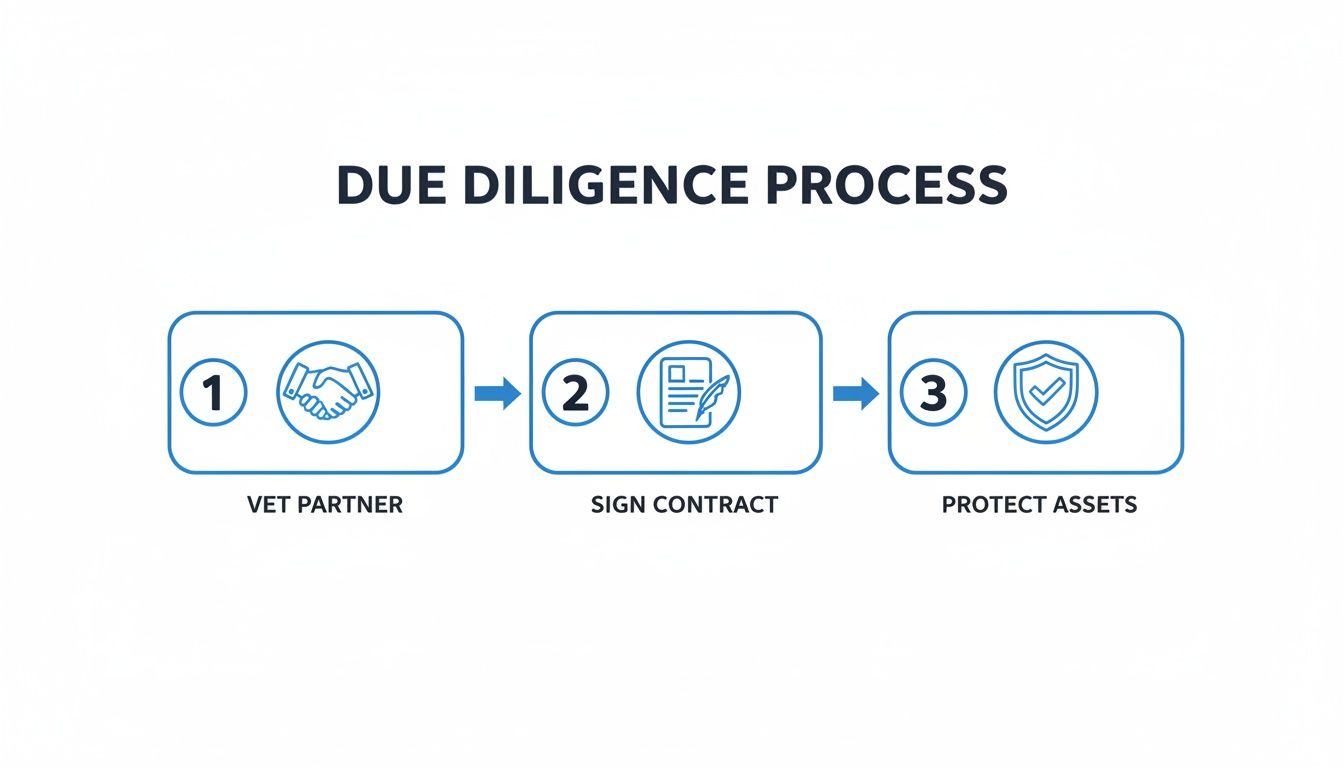
This process highlights why a BVI corporation search is such a foundational first step in any business engagement. You have to verify who you're dealing with.
What’s Public vs. What’s Private
So, what information can you actually get your hands on? A standard search will confirm the basics, which is often enough for initial validation. But the juicy details—who owns the company and who runs it—are a different story.
This is the central challenge of a BVI search: separating what the Registry makes public from what the Registered Agent holds privately.
Public vs Private Information in a BVI Search
| Information Type | Publicly Available via Registry | Held Privately by Registered Agent |
|---|---|---|
| Company Name & Number | ✔️ Yes | ✔️ Yes |
| Incorporation Date | ✔️ Yes | ✔️ Yes |
| Company Status | ✔️ Yes (Active, Struck-Off, etc.) | ✔️ Yes |
| Registered Office Address | ✔️ Yes | ✔️ Yes |
| Registered Agent Name | ✔️ Yes | N/A |
| Memorandum & Articles | ✔️ Yes | ✔️ Yes |
| Register of Directors | ❕ Optional (Only if filed publicly) | ✔️ Yes (Mandatory) |
| Register of Shareholders | ❌ No | ✔️ Yes |
| Beneficial Ownership Info | ❌ No | ✔️ Yes (Reported via BOSSs system) |
| Register of Mortgages/Charges | ✔️ Yes (If filed) | ✔️ Yes |
As you can see, the publicly available data confirms a company’s existence and good standing but offers little insight into its management or ownership. For a more detailed breakdown of what to expect, our guide on the BVI company registry is a great resource.
The key takeaway is this: The BVI system prioritizes verified, official data over open-access convenience. Public searches confirm legitimacy, but private records held by the Registered Agent tell the full story.
Digging deeper often comes with a price tag. For example, obtaining a Certificate of Good Standing will set you back $100. If a company has voluntarily filed its list of directors, getting a copy of that record costs $75. These fees are a standard part of conducting thorough due diligence in the BVI.
Making Sense of Your BVI Company Search Results
Getting the search report back from the BVI Registry is only half the battle. The real work begins now: turning that raw data into a clear picture of the company you’re investigating. Without the right context, it's just a jumble of dates and legal jargon. But when you know what to look for, you can piece together the company's story.
The very first thing to check is the company’s status. It’s the single most important detail on the report. If it says 'Active', you can breathe a little easier. This confirms the company is in good standing and has kept up with its annual government fees. Anything else is a cause for concern.
What the Company Status Really Means
A status of 'Struck-Off' should immediately set off alarm bells. This means the Registrar has kicked the company off the official register, almost always because it failed to pay its annual fees or keep a Registered Agent on record. A struck-off company is a ghost—it's legally unable to trade, move assets, or even show up in court.
Sure, a company can be restored from this state, but you have to question why it happened in the first place. Was it a simple oversight? Or was it a deliberate move to mothball the company, perhaps to duck liabilities or hide assets? This one word from your british virgin islands corporation search can speak volumes.
A company’s status is its corporate pulse. 'Active' means it's alive and well. 'Struck-Off' points to a serious, and often deliberate, failure to meet its most basic legal obligations.
The Gatekeepers: Registered Office and Agent
Every BVI company report will name the Registered Agent and list its Registered Office. This isn’t just a mailing address; it’s the company’s official legal home and its required local point of contact. This agent holds the keys to the kingdom, including the company’s most vital private documents like the registers of directors and shareholders.
Pinpointing the Registered Agent is a crucial piece of the puzzle. They are the gatekeepers to any deeper information. While they're bound by confidentiality and won't just hand over private files, knowing who they are is the necessary first step for any formal legal request or more advanced due diligence.
Following the Money: Financial Encumbrances
Your next stop should be the Register of Charges. Think of a 'charge' as something similar to a mortgage—it’s a security interest a lender takes over a company's assets. If a company has registered charges, it has used some of its assets as collateral for a loan.
Seeing charges isn't automatically a bad sign; successful companies take on debt to fuel growth all the time. But the pattern of these charges tells a story. A flurry of recent charges might hint at financial trouble. On the other hand, a single, long-held charge with a major international bank could be a sign of a stable, well-financed operation.
Finally, the report will give you a glimpse into the share capital. This figure represents the maximum number of shares the company is allowed to issue. It won't tell you who owns those shares, but it does give you a sense of the company’s scale and structure. For instance, a common setup for a standard BVI business company is an authorised capital of 50,000 shares.
Understanding Beneficial Ownership and Search Limits
Let's get straight to the point. The main reason a British Virgin Islands corporation search can feel like hitting a brick wall is the jurisdiction's deep-rooted commitment to corporate privacy. For decades, the identities of the ultimate beneficial owners (UBOs)—the real people pulling the strings—were kept under lock and key.
This is the single biggest limitation you’re going to face, and wrapping your head around it is crucial for setting realistic expectations for your due diligence.
The BVI isn't frozen in time, though. Under pressure from international bodies like the Financial Action Task Force (FATF), things are slowly starting to open up. But don't mistake evolution for a revolution; it doesn't mean all the records have suddenly been thrown open to the public.
The Myth of a Public UBO Register
There’s a common misconception floating around that recent legal changes have created some kind of publicly searchable database of BVI company owners. That's simply not true.
While BVI companies are now legally required to identify their beneficial owners and report this to their Registered Agent, that data goes into a private, secure system. It's not for public consumption.
This system, known as BOSS (Beneficial Ownership Secure Search system), is a tool for law enforcement. It’s only accessible to competent authorities, like the BVI's Financial Investigation Agency, for legitimate investigations. For your standard due diligence search, this goldmine of information remains firmly out of reach.
Here's the key takeaway: BVI companies must know and report who their beneficial owners are, but this information is not public. Your search will confirm a company's existence and good standing, not who ultimately owns it.
What Recent Changes Mean for You
The regulatory ground is constantly shifting. The most important development for you to be aware of comes from amendments to the BVI Business Companies Act, which are tightening up reporting requirements across the board. These updates signal the BVI's serious move towards greater compliance, even if public access isn't on the table yet.
For a closer look at the legislative details, you can read our guide on the BVI Business Companies Act.
New rules are set to take effect from early 2025, forcing BVI companies to file their registers of directors, members, and beneficial owners directly with the Registrar. What's really significant is that the threshold for a "beneficial owner" is dropping from 25% to just 10% ownership. This will compel much more detailed disclosures into the government's private system.
While you can't see this data, it means more comprehensive information is being collected behind the scenes. You can find out more about how these regulations are evolving by reading the full analysis on JD Supra.
So, even if the front door for public searches remains guarded, the internal record-keeping is becoming far more robust.
Navigating the Opacity
So, where does this leave you and your due diligence work? It’s all about adjusting your strategy.
-
Acknowledge the Limits: First, accept that a standard online search won't unmask the owners. Focus your energy on what you can verify: the company's legal status, any registered charges, and director information (if it has been filed).
-
Request Information Directly: The simplest path forward is often the most direct. Ask the company you're investigating to provide a certified copy of its Register of Members or Directors, sourced from its official Registered Agent.
-
Look for Red Flags: If a company balks at providing these basic verification documents, that refusal speaks volumes. In the world of due diligence, that’s a massive red flag in itself.
Understanding these limitations from the outset helps you frame the right questions. It also tells you when a simple registry check isn't going to cut it, pushing you toward more advanced verification methods when the stakes are high.
When to Use Professional Corporate Investigation Services

A standard British Virgin Islands corporation search is a fantastic starting point. It gives you a crucial snapshot of a company’s status and basic filings. But sometimes, what you find in that initial report is just enough to make you realize you have a lot more questions than answers.
Certain discoveries should be immediate red flags, signaling it's time to call in the experts.
For instance, finding a company has been ‘Struck-Off’ is a major trigger. On the surface, it could be a simple administrative oversight. Or, it could be a deliberate tactic to put the company on ice, shielding its assets from creditors. Likewise, uncovering multiple registered charges against a company's assets requires a much closer look. Are these a sign of healthy investment and growth, or is the company dangerously overleveraged?
A basic registry search just can't give you that context. When the stakes are high and the initial findings are vague or worrying, professional corporate investigation services are no longer a luxury—they’re a necessity.
Scenarios Demanding Expert Intervention
Think of a professional firm as your due diligence special forces. You bring them in when the terrain gets too complex for standard methods. In my experience, these are the most common situations where their expertise is absolutely non-negotiable:
- Confirming Beneficial Ownership: Knowing who truly pulls the strings is often critical for compliance or a deal, especially if the other party is being less than forthcoming. Professionals have ways of finding out.
- Investigating Complex Structures: If a BVI company is owned by a Cayman entity, which is in turn owned by a trust in Singapore… you’re dealing with a corporate web deliberately designed to obscure ownership. Untangling that requires specialized skills.
- High-Value Transactions: For any significant investment, merger, or acquisition, the cost of a deep-dive investigation is pocket change compared to the potential loss from a bad deal.
A professional investigation isn’t an admission of failure; it’s a strategic decision to escalate your due diligence when faced with complexity and risk. It’s about seeking clarity, not just information.
A Real-World Example
I once worked with a client looking to acquire a BVI-based tech company. The initial search through VIRRGIN came back clean—the company was active and in good standing. But something didn’t feel right. We advised them to engage a specialist firm to dig deeper.
What they uncovered was that the BVI entity was just the tip of the iceberg.
It was actually owned by a complex trust structure involving entities in two other offshore jurisdictions. The investigation revealed that one of the undisclosed beneficial owners was embroiled in a massive litigation case—a deal-breaking piece of information that a standard search could never have found. This intelligence saved our client from walking straight into a legal minefield.
Choosing a reputable investigator is key. You need a firm with genuine, on-the-ground BVI experience and a global network to trace complex ownership trails across borders. They can pull enhanced reports, source documents through official channels, and give you the comprehensive intelligence needed to move forward with confidence. For particularly complex corporate structures, getting support from a firm that provides an expert company secretary service can also be invaluable for navigating these murky waters.
Got Questions About BVI Company Searches? We’ve Got Answers.
Even with a clear guide, a few questions always seem to pop up when people dive into their first British Virgin Islands corporation search. Let's tackle some of the most common sticking points so you can move forward with confidence.
Can I Actually Find Out Who Owns a BVI Company?
This is probably the number one question I get, and the short answer is no, not from a public search. The BVI’s reputation for privacy is well-earned.
While companies are required to know and report their ultimate beneficial owners (UBOs) to their Registered Agent, this information is held securely and isn't available to the public. What you will see in a standard search is the company’s name, its official number, its current status, and who its Registered Agent is. The names behind the shares remain confidential.
What’s the Big Deal If a Company Is “Struck-Off”?
Seeing a company's status listed as 'Struck-Off' is a serious red flag. It means the company has been kicked off the official Register of Companies, almost always for failing to pay its annual government fees.
For all practical purposes, a struck-off company is a ghost. It can't legally do business, enter contracts, or even defend itself in court.
You need to treat this discovery with caution. While it's sometimes possible for a company to be restored, a struck-off status tells you it’s not in good standing right now. The key question is why it was allowed to lapse—was it just a simple oversight, or was it a deliberate move to dodge creditors?
What Should I Expect to Pay for a BVI Company Search?
The cost really depends on how deep you need to go. A quick, informal name check on a third-party site might not cost you anything. But for official, reliable documents, you’ll be paying fees directly to the BVI Registry.
As a ballpark, getting an official Certificate of Good Standing will set you back about US$100. If you're lucky and the company has chosen to file its Register of Directors publicly (which is not mandatory), pulling a copy of that might cost another US$75.
Of course, if you engage a professional firm for a full due diligence report, the price will be higher. You're not just paying for documents then; you're paying for the expertise to analyze them.
Conclusion
At Lion Business Consultancy Limited, we specialise in navigating these complexities for you. We don't just pull reports; we provide the strategic insight you need to understand what the data means for your business, ensuring your global expansion is built on a foundation of clarity and security.