

 Hong Kong

 Singapore
 UAE
UAE

 Malaysia
 Turkey
 UK
UK
 EU
EU
 US
US
 Switzerland
 Bahamas Bank Account
 Cayman Islands Bank Account
 Mauritius Bank Account
 BVI
BVI
 Seychelles

For entrepreneurs and SMEs looking to scale globally, opening an international business bank account has morphed from a simple task into a strategic mission. Gone are the days of a friendly chat and a few paper forms. In 2025, you're stepping into a high-stakes arena of digital verification, relentless anti-money laundering (AML) checks, and a labyrinth of international regulations. One wrong move can lead to delays, outright rejections, or—worst of all—a frozen account right when you need it most. These are costly mistakes a growing business can't afford.
This isn't just about ticking boxes; it's about architecting a durable financial backbone for your international vision. I've seen countless founders get bogged down by vague requirements and soulless application portals that offer zero guidance. This guide is built differently. I'm giving you a practical, consultative walkthrough—your definitive bank onboarding checklist for 2025—designed to pull back the curtain on this process and ensure you get it right on the first try.
You'll learn the specific plays, from fortifying your digital security with multi-factor authentication to preparing for the deep dive of KYC verification and understanding the long game of ongoing due diligence. Consider this your roadmap to not just opening an account, but securing a banking partner who can keep pace with your global ambitions.
1. Fortify Your Digital Fortress: Multi-Factor Authentication (MFA) Implementation
The first gate in your bank onboarding checklist for 2025 isn't a physical one; it's digital. Multi-Factor Authentication (MFA) has graduated from a "nice-to-have" to the absolute baseline for secure international business banking. Regulations like Europe's PSD2 now legally mandate Strong Customer Authentication (SCA), making MFA a non-negotiable step. This security protocol requires you to prove your identity using at least two different methods.
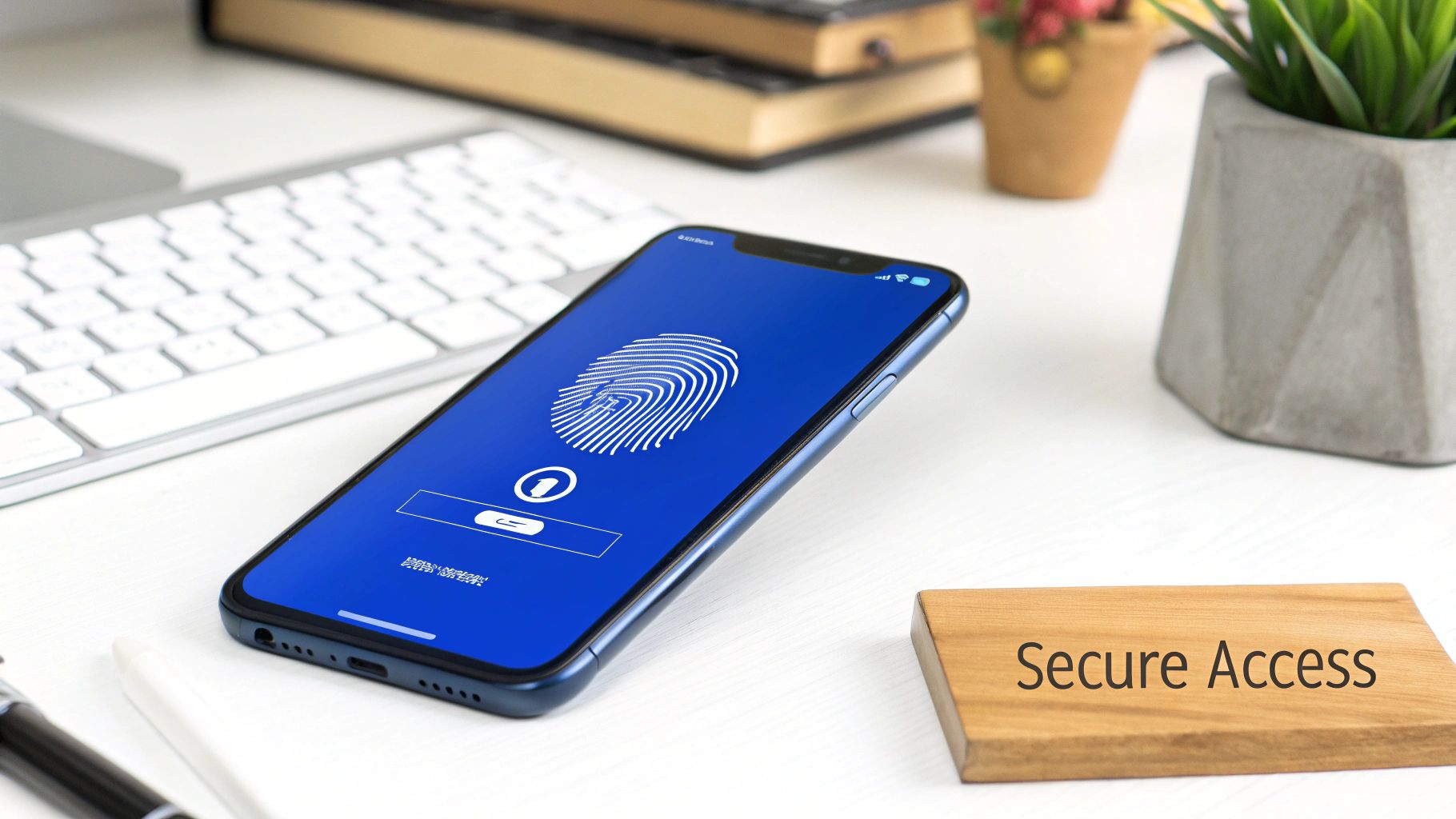
Think of it as a digital double-lock on your vault. It combines something you know (a password), something you have (your phone), and something you are (a fingerprint). For your company, this is your primary defense to ensure only authorized people can access funds and approve payments. To truly secure your operations, it's vital to understand and defend against threats like MFA fatigue attacks, a clever tactic criminals use to bypass even strong security.
Actionable MFA Implementation Tips:
- Offer Diverse Methods: Provide multiple MFA options such as SMS codes, authenticator apps (like Google Authenticator), hardware keys, and biometrics. This accommodates varying user preferences and technical capabilities.
- Implement Risk-Based Authentication: Configure your system to require stronger authentication for higher-risk activities, such as large fund transfers or changing account details, while allowing simpler verification for low-risk actions like checking a balance.
- Prioritise User Education: Clearly communicate the importance of MFA to your team. Explain why it’s being used and how to correctly respond to authentication prompts, which is your primary defence against social engineering tactics.
2. Ace the Deep Dive: Know Your Customer (KYC) Verification
The next crucial milestone in your bank onboarding checklist for 2025 is navigating the comprehensive identity checks known as Know Your Customer (KYC). This is the bank's mandatory deep dive to verify who you are and assess any potential risks. For an international business, especially one with a more complex or offshore structure, passing KYC is the make-or-break moment. It's the cornerstone of global anti-money laundering (AML) regulations and a pivotal hurdle in the account opening journey.

The process means collecting and validating a trove of information—personal IDs, corporate documents, and the details of every ultimate beneficial owner (UBO). Modern banks like Revolut and Wise have streamlined this with AI that recognizes documents and verifies identities in real-time. This isn't just red tape; it's how the system protects itself and your business from illicit actors. Getting this stage right is everything.
Actionable KYC Implementation Tips:
- Implement Risk-Based Tiers: Organise your approach based on customer risk profiles. A low-risk client might only need basic document verification, whereas a high-risk client, such as a Politically Exposed Person (PEP), will require Enhanced Due Diligence (EDD) with deeper background checks.
- Use Multiple Data Sources: Do not rely on a single document. Cross-verify information using independent and reliable sources, such as government databases, credit bureaus, and commercial registries, to build a robust and accurate customer profile.
- Maintain Clear Audit Trails: Meticulously document every step of the KYC process for each client. This includes all submitted documents, verification checks, communications, and risk assessments. This trail is essential for compliance audits and regulatory reviews.
3. Implement Robust Anti-Money Laundering (AML) Screening
A central pillar of any modern bank onboarding checklist for 2025 is a powerful Anti-Money Laundering (AML) screening process. This is the bank's automated front-line defense against financial crime. It works by checking new customers against global sanctions lists, databases of Politically Exposed Persons (PEPs), and negative news sources. For any business operating across borders, proving you meet these standards isn't just good practice—it's a legal requirement to keep illicit funds out of the financial system.
Think of it like an airport security scanner for your business's identity. Top-tier financial institutions and fintechs like Monzo integrate sophisticated tools like ComplyAdvantage to automate this screening, using AI to analyze vast datasets in real-time and flag potential risks. A small discrepancy in your records or a piece of negative press can trigger red flags, leading to delays or freezes. For a real-world look at how this plays out, exploring a Hong Kong banking checklist and how to avoid account issues can offer invaluable insights.
Actionable AML Screening Tips:
- Prepare for Tiered Screening: Understand that banks apply different levels of scrutiny based on your business's perceived risk. A high-risk industry or complex ownership structure will trigger more intensive checks. Have all shareholder and director information ready.
- Maintain a Clear Public Profile: Ensure your company’s online presence and official records are consistent and transparent. Banks scrutinise adverse media, so a clean and professional digital footprint can significantly smooth the onboarding process.
- Establish Internal Protocols: Keep meticulous records of all transactions, ownership changes, and business activities. This creates a clear audit trail that can be provided to the bank if they have questions during a review, proving your commitment to compliance.
4. Implement a Robust Document Management and Verification System
The fourth critical step in your bank onboarding checklist 2025 involves graduating from manual paperwork to a secure digital system for document handling. An automated Document Management and Verification System is essential for efficiently collecting, storing, and validating critical documents like IDs, proofs of address, and corporate registrations. This technology serves as the backbone for meeting strict KYC and AML rules, ensuring both compliance and operational speed.
Such systems use advanced tech to confirm the authenticity of submitted documents, dramatically cutting down the risk of fraud. For a global business, this provides a streamlined and secure way to manage sensitive information while adhering to data protection standards like GDPR. Modern platforms like Onfido (used by N26) and AU10TIX automate the entire flow, from initial capture to secure, encrypted storage with clear audit trails. This digital shift transforms a traditionally painful process into a smooth and secure part of your onboarding experience.
Actionable Document System Implementation Tips:
- Integrate Automated Quality Checks: Configure your system to automatically assess document quality (e.g., checking for blurriness or glare) upon upload. This prevents manual processing of unusable files and prompts customers for a better version immediately.
- Support Diverse Document Formats: Ensure your platform can accept and process a wide range of document types and file formats (PDF, JPG, PNG) from different countries, accommodating a global client base.
- Maintain Clear Retention Policies: Establish and automate document retention and deletion schedules based on specific regulatory requirements for different jurisdictions. This ensures you remain compliant without storing data longer than necessary.
5. Adverse Media and Reputational Risk Check
Beyond formal documents, a vital step in your bank onboarding checklist for 2025 involves a deep look at an applicant's public reputation. Adverse Media Screening is the process of scanning news, court records, and other public sources to uncover potential reputational or financial crime risks. This isn't about office gossip; it's a key part of a modern risk management framework, helping banks spot links to illicit activities like bribery or corruption that formal checks might otherwise miss.
This proactive diligence protects the bank from being associated with individuals or entities that could damage its reputation or attract massive regulatory fines. Leading institutions now weave sophisticated screening platforms, such as ComplyAdvantage or LexisNexis Risk Solutions, directly into their onboarding process. These tools use AI to scan global sources in real-time, painting a much more complete risk picture than traditional background checks alone ever could.
Actionable Adverse Media Screening Tips:
- Establish Clear Flagging Criteria: Define precisely what constitutes "adverse media" for your organisation. Create specific keywords, risk categories (e.g., financial crime, sanctions risk), and severity levels to ensure consistent and objective screening.
- Implement a Tiered Review Process: Not all negative news carries the same weight. Develop a tiered system where low-risk alerts are handled efficiently, while high-risk findings, such as credible accusations of fraud, are escalated to senior compliance officers for in-depth investigation.
- Prioritise Context and Credibility: Train your review teams to assess the context of the information and the credibility of its source. A single negative article from an unreliable blog is very different from multiple reports in reputable international financial journals. Document every review decision and the rationale behind it for a clear audit trail.
6. Biometric Authentication and Liveness Detection
Moving beyond what you know (passwords) and what you have (your phone), the next critical layer in your 2025 bank onboarding checklist is verifying who you are. Biometric authentication uses unique physical traits like your fingerprint or face to offer a highly secure method of identity verification. The real game-changer, however, is pairing it with liveness detection. This crucial technology ensures the person providing the biometric data is real and physically present, stopping fraudsters from using photos, videos, or even masks to fool the system.
This isn't science fiction; it's the current standard for leading financial institutions. Digital banks like N26 use sophisticated facial recognition for lightning-fast and secure account opening. By integrating these advanced checks, banks dramatically reduce the risk of identity fraud from day one, building a foundation of trust from the very first interaction. It’s a powerful signal that they take security seriously.
Actionable Biometric Implementation Tips:
- Insist on Certified Liveness Detection: Ensure your banking partner uses technology compliant with recognised standards, such as those from NIST. This guarantees a high level of anti-spoofing capability, protecting your business from sophisticated fraud attempts.
- Confirm Fallback Authentication Methods: Technology can sometimes fail. A robust onboarding process must include secure and accessible fallback options, like a video call with an agent or knowledge-based questions, if a biometric scan is unsuccessful.
- Understand Data Privacy and Consent: Biometric data is highly sensitive. Verify that the bank has a transparent policy for obtaining explicit user consent and securely managing this data in compliance with privacy regulations like GDPR, ensuring your company's information is protected.
7. Risk Assessment and Segmentation
Beyond just checking an ID, a modern bank onboarding checklist for 2025 requires a sophisticated approach to risk. Automated risk assessment and customer segmentation are how banks meet tough Anti-Money Laundering (AML) regulations efficiently. The process involves evaluating a customer’s risk profile based on factors like their industry, geography, and expected transaction patterns to assign the right level of scrutiny.
This isn't about creating barriers; it's about building a smarter, more efficient compliance system. By sorting customers into low, medium, and high-risk tiers from the start, banks can focus their resources where they're needed most, applying enhanced due diligence only to the highest-risk cases. Systems like FICO's Actimize and SAS Risk Management automate this complex evaluation, ensuring both compliance and agility. As an entrepreneur, understanding how advanced risk assessment tools work across the financial world gives you a strategic edge.
Actionable Risk Assessment Tips:
- Build on Representative Data: Develop your risk models using historical data that accurately reflects your customer base and known financial crime patterns to ensure the models are relevant and effective.
- Implement Regular Bias Audits: Schedule frequent fairness testing and bias audits of your automated systems to prevent unintentional discrimination against certain demographics or geographic regions.
- Create Clear Escalation Paths: Establish and document a transparent protocol for handling high-risk customers, ensuring a smooth and consistent escalation to a compliance officer or specialised team. For a deeper dive into this, you can learn more about developing your strategy from our bank onboarding risk playbook.
8. User Experience (UX) Optimization and Mobile-First Design
In the fast-paced world of international business, a clunky and slow onboarding process is a deal-breaker. That's why User Experience (UX) optimization, built on a mobile-first design, has become a key battleground in the competitive banking landscape. This philosophy is all about creating an intuitive, seamless, and fast onboarding journey on the device where most of us start things: our phones. It’s not about flashy graphics; it's about eliminating friction to boost completion rates and start the relationship on a high note.

This approach turns onboarding from a painful chore into a positive first impression. Fintechs like Revolut and N26 have mastered this, letting you open an account in minutes from your smartphone. That slick experience is now the standard expected by entrepreneurs, making it a vital part of any effective bank onboarding checklist 2025. For your business, it means a much higher chance of getting your account open without the frustration of giving up halfway through.
Actionable UX Optimisation Tips:
- Implement Progressive Disclosure: Avoid overwhelming users with long forms. Instead, collect information in small, logical chunks across multiple steps. Use clear progress indicators to show users where they are in the process.
- Minimise Data Entry: Auto-fill information wherever possible and only ask for absolutely essential data upfront. For instance, allow document scanning via the phone's camera rather than requiring manual input of details.
- Provide Clear Feedback: Use concise error messages that explain exactly what is wrong and how to fix it. Implement real-time validation to inform users of mistakes as they happen, not after they submit the form.
9. Secure Data Transmission and Encryption Protocols
As you work through your bank onboarding checklist 2025, protecting your data in transit is just as critical as securing it when it's stored. Secure data transmission and encryption protocols are the invisible armor that shields your sensitive financial information as it travels from your computer to the bank's servers. This means using technologies like Transport Layer Security (TLS) to make data unreadable to anyone who might intercept it—a foundational requirement for compliance with regulations like GDPR.
This digital fortress ensures that every piece of information, from your company's incorporation documents to your personal ID, is scrambled during submission. Leading fintechs like Wise and Revolut build their entire platforms on this principle, using the same bank-grade encryption as the world's largest financial institutions. Submitting data without this protection is like sending your company's deepest secrets on a postcard.
Actionable Encryption Implementation Tips:
- Verify Bank-Grade Protocols: Before submitting any documents, confirm the bank or financial platform uses current TLS protocols (TLS 1.2 or higher) and NIST-approved encryption algorithms like AES-256. This information is often available in their security policy documents.
- Utilise Hardware Security Modules (HSMs): For businesses handling extremely sensitive data, partnering with banks that use HSMs for storing encryption keys provides an added layer of physical and logical security, making key compromise nearly impossible.
- Establish Certificate Management: Ensure your own systems have a rigorous process for managing digital certificates. Regularly check for expired or vulnerable certificates on your side to maintain a secure connection to the bank’s portal during onboarding and beyond.
10. Establish an Ongoing Customer Due Diligence (CDD) and Monitoring Programme
Completing the initial bank onboarding checklist for 2025 isn't the finish line; it’s the starting gun. Maintaining compliance is a continuous process. Ongoing Customer Due Diligence (CDD) extends those initial checks throughout your entire relationship with the bank. It's a mandatory requirement under global AML laws, ensuring your business's financial activities remain transparent and legitimate over time.
This involves periodic reviews of your information and real-time monitoring of your transactions to spot unusual patterns. Banks use sophisticated AI systems, like FICO Falcon X, to automate this. For your business, this means being ready to provide updated documents or answer questions from your bank as part of their monitoring. Ignoring these requests can lead to account restrictions or even closure, which can be devastating for your operations.
Actionable CDD and Monitoring Tips:
- Implement Risk-Based Reviews: Not all clients require the same level of scrutiny. Work with your bank to understand your risk categorisation. High-risk accounts may undergo quarterly reviews, while low-risk accounts might only be reviewed annually.
- Automate Internal Alerts: While the bank does its monitoring, it's wise to set up internal alerts for significant transactions within your own accounting systems. This helps you proactively identify and document the business rationale for large payments or unusual activity.
- Maintain Meticulous Records: Keep all documentation related to major transactions, changes in company structure, or shifts in your business model organised and accessible. When the bank requests information for a periodic review, having everything ready demonstrates good governance and speeds up the process.
2025 Bank Onboarding Checklist — 10-Point Comparison
| Item | Complexity 🔄 | Resources ⚡ | Expected outcomes 📊⭐ | Ideal use cases | Key advantages & tips 💡 |
|---|---|---|---|---|---|
| Multi-Factor Authentication (MFA) Implementation | 🔄 Medium–High: integration across channels, device support | ⚡ Moderate–High: auth servers, tokens, support staff | 📊 ⭐⭐⭐⭐ — Major fraud reduction (up to 99.9%); regulatory SCA compliance | Consumer banking logins, high‑value transactions, PSD2 SCA | 💡 Reduces credential fraud; offer progressive MFA and multiple fallback methods |
| Know Your Customer (KYC) Verification | 🔄 High: ID capture, OCR, liveness, DB checks | ⚡ High: data providers, RegTech, legal/compliance teams | 📊 ⭐⭐⭐⭐ — Prevents AML; faster onboarding (minutes vs days) | New account opening, corporate onboarding, high‑risk customers | 💡 Risk‑based tiers and multiple data sources; maintain audit trails |
| Anti-Money Laundering (AML) Screening | 🔄 High: continuous list updates, fuzzy matching, workflows | ⚡ High: sanctions databases, screening engines, case teams | 📊 ⭐⭐⭐⭐ — Prevents sanctions breaches and fines; reduces crime exposure | Sanctions/PEP checks, cross‑border payments, high‑risk portfolios | 💡 Tiered screening and clear case protocols; use multiple vendors for coverage |
| Document Management and Verification System | 🔄 Medium: OCR, storage, lifecycle, integrations | ⚡ Moderate: encrypted storage, OCR engines, retention tooling | 📊 ⭐⭐⭐ — Faster onboarding; reduced document fraud; audit readiness | Document‑heavy onboarding, proof‑of‑address/income verification | 💡 Automate quality checks; support multiple formats and clear retention policies |
| Adverse Media & Reputational Risk Check | 🔄 Medium–High: multilingual monitoring + manual review | ⚡ Moderate–High: news feeds, NLP, analyst time | 📊 ⭐⭐⭐ — Early detection of reputational issues; informed decisions | Corporate clients, politically exposed persons, ongoing monitoring | 💡 Define flagging criteria and tiered review; document decisions for audits |
| Biometric Authentication & Liveness Detection | 🔄 High: sensor integration, anti‑spoofing, accessibility | ⚡ High: ML models, testing, hardware and compliance resources | 📊 ⭐⭐⭐⭐⭐ — Very high security (95%+ fraud reduction); frictionless UX | Mobile onboarding, passwordless login, session continuous auth | 💡 Use certified liveness tech, provide fallbacks, run bias/accessibility audits |
| Risk Assessment & Segmentation | 🔄 High: ML models, feature engineering, ongoing validation | ⚡ High: data science team, compute, data feeds | 📊 ⭐⭐⭐⭐ — Better resource allocation; reduced false positives | Tiered onboarding, monitoring prioritization, AML risk scoring | 💡 Build on representative data; perform regular bias audits and model updates |
| UX Optimization & Mobile‑First Design | 🔄 Medium: cross‑device testing, accessibility compliance | ⚡ Moderate: designers, front‑end devs, UX research | 📊 ⭐⭐⭐⭐ — Higher completion (≥75%); improved NPS and conversions | Retail/mobile banking onboarding, consumer apps | 💡 Conduct user testing, minimize fields, progressive disclosure, A/B test |
| Secure Data Transmission & Encryption Protocols | 🔄 Medium–High: key management, certs, legacy integration | ⚡ Moderate: HSMs, TLS, monitoring, audits | 📊 ⭐⭐⭐⭐ — Protects data in transit/rest; meets PCI‑DSS/GDPR | Any sensitive data transfer, payment APIs, inter‑service comms | 💡 Use NIST‑approved algorithms, HSMs, cert management and regular audits |
| Ongoing Customer Due Diligence (CDD) & Monitoring | 🔄 High: periodic reviews, alerts, escalation workflows | ⚡ High: monitoring platforms, analysts, integration with AML tools | 📊 ⭐⭐⭐⭐ — Early detection of laundering/fraud; audit‑ready compliance | Lifetime customer monitoring, high‑risk portfolios, regulatory programs | 💡 Automate alerts, set risk‑based review frequency, document review decisions |
Your Next Move: From Checklist to Confidence
Successfully navigating a bank onboarding checklist in 2025 is more than an administrative chore; it's the foundational act of building a resilient financial future for your global company. As we've walked through, the process is a complex dance of advanced technology, strict regulatory compliance, and strategic foresight. From implementing robust MFA to establishing a program for ongoing due diligence, each step is a critical piece of a larger security puzzle. Successfully navigating this proves to banks that your business is not just legitimate but a low-risk, high-value partner worth banking on.
The real lesson here is that preparation is everything. The era of just submitting a few documents is long gone. Today's banks demand a proactive approach to security and compliance. Mastering your KYC and AML story, organizing your documents digitally, and understanding the nuances of risk are no longer optional—they are the price of admission to the international banking system. This detailed bank onboarding checklist 2025 is your strategic playbook, designed to turn a potentially overwhelming process into a series of clear, manageable actions.
Think of each item not as a hurdle, but as a chance to strengthen your business. A slick, UX-optimized application process reflects a modern, customer-focused company. A well-documented AML protocol shows you're a responsible global player. By embracing these requirements, you aren't just opening an account; you're building a reputation for diligence and integrity that will pay dividends as you scale.
The goal is to move from uncertainty to absolute confidence in your financial operations. That confidence comes from knowing you've anticipated every requirement, secured every data point, and presented your business in the most professional light possible. The journey from this checklist to a fully functional, secure international bank account is your first major step towards sustained global success. With this guide, you are now equipped to make that move with clarity and purpose.
Conclusion
Navigating the complexities of international bank account opening can be daunting, but you don't have to do it alone. Lion Business Consultancy Limited specialises in transforming this intricate process into a streamlined success, acting as your dedicated partner to ensure every detail of the bank onboarding checklist 2025 is met with expert precision. Schedule your confidential consultation today and let us secure the financial foundation your global business deserves.