

 Hong Kong


 Singapore



 UAE
UAE


 Malaysia

 Turkey
 UK
UK
 EU
EU
 US
US
 Switzerland
 Bahamas Bank Account
 Cayman Islands Bank Account
 Mauritius Bank Account

 BVI
BVI
 Seychelles

When you're launching a business, especially in a dynamic financial hub like Hong Kong, you’ll quickly encounter the term "true and certified copy". So, what is it, really? Imagine it as a high-quality photocopy of an original document that an authorized professional has personally stamped and signed to confirm it's a genuine, unaltered replica.
This isn't just a bureaucratic hoop to jump through. Think of it as a formal guarantee. For an entrepreneur, this stamp of approval transforms a simple copy into a legally acceptable document for critical steps like opening a corporate bank account, where authenticity is non-negotiable.
Your Guide to Document Certification in Hong Kong
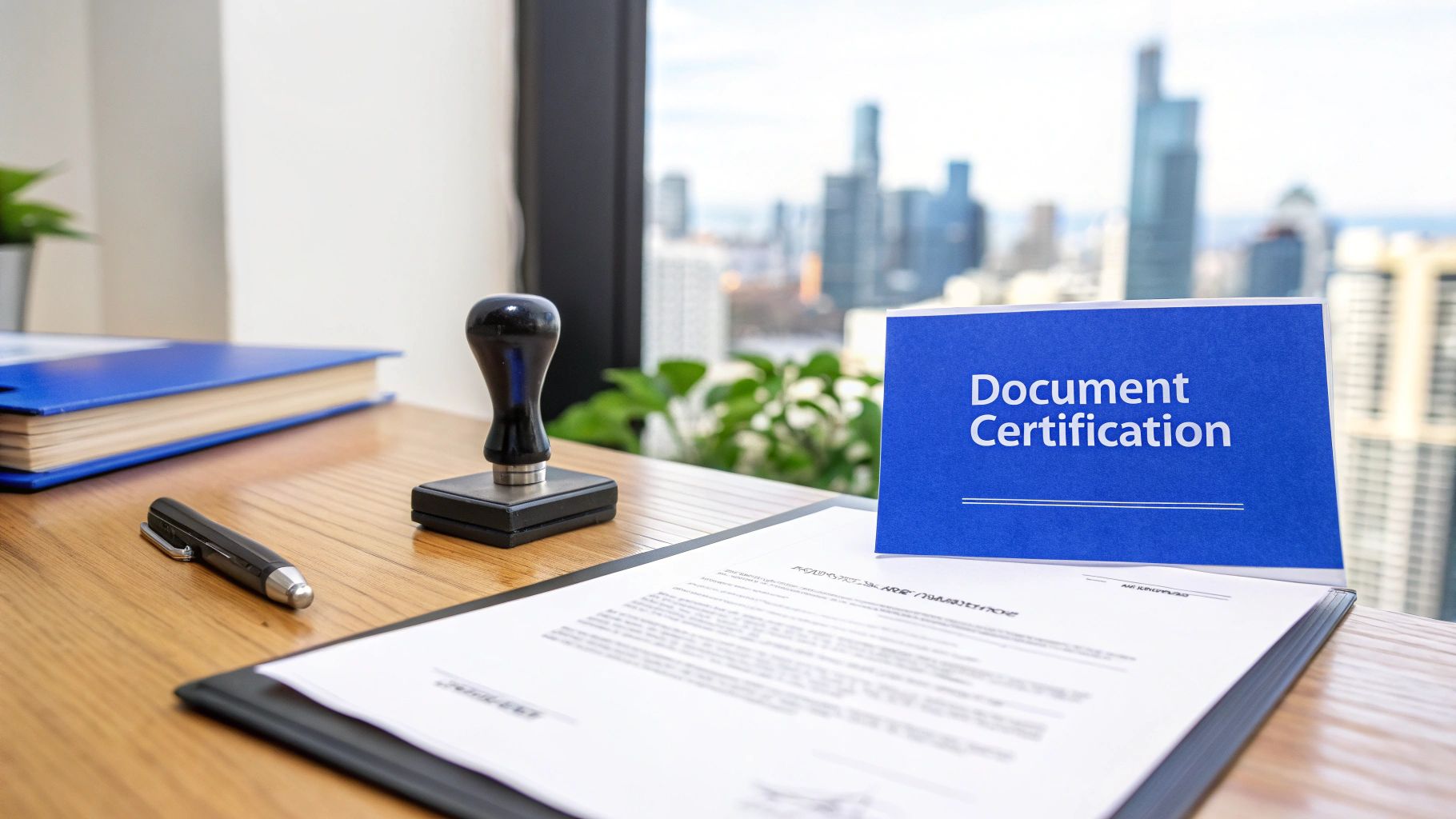
Welcome to the world of official paperwork—a crucial part of getting your SME off the ground in Hong Kong. If you've been asked for a "true and certified copy," you've hit one of the most fundamental requirements in corporate and financial compliance. But what does it mean in practice, and why is it so vital?
Let's tell a quick story. You're sitting in a bank, ready to open your new corporate account. You hand over your passport. The bank manager can't keep your original, of course, but they can't just take a quick photocopy either. How can they be certain the copy is legitimate and hasn't been cleverly doctored?
This is precisely where the power of certification comes into play.
The Foundation of Trust in Business
A certified true copy acts as a bridge of trust between you and institutions like banks, government bodies, and potential business partners. It’s a way of vouching for a document's authenticity without surrendering the original. In Hong Kong's tightly regulated business environment, this process is essential for a few key reasons:
- Fraud Prevention: It serves as a frontline defense against forged documents, protecting financial institutions and government agencies from being entangled in potential criminal activity.
- Regulatory Compliance: Banks and corporate service providers in Hong Kong must follow strict Anti-Money Laundering (AML) and Know Your Customer (KYC) regulations, which demand verifiable proof of identity and other key details.
- Legal Validity: For many official processes—from company registration to signing major contracts—certified copies are required to make the transaction legally binding.
A true and certified copy is more than just a piece of paper; it's a declaration of integrity. It tells the receiving party, "You can trust this document because a licensed professional has staked their reputation on its authenticity."
Understanding this process isn't just about ticking another box. For an entrepreneur, getting this right from the start means a smoother bank account opening, faster company incorporation, and fewer frustrating delays. It's one of the first, most important steps to building a credible, compliant business in a global financial center.
True Copy vs. Certified Copy: What's the Real Difference?
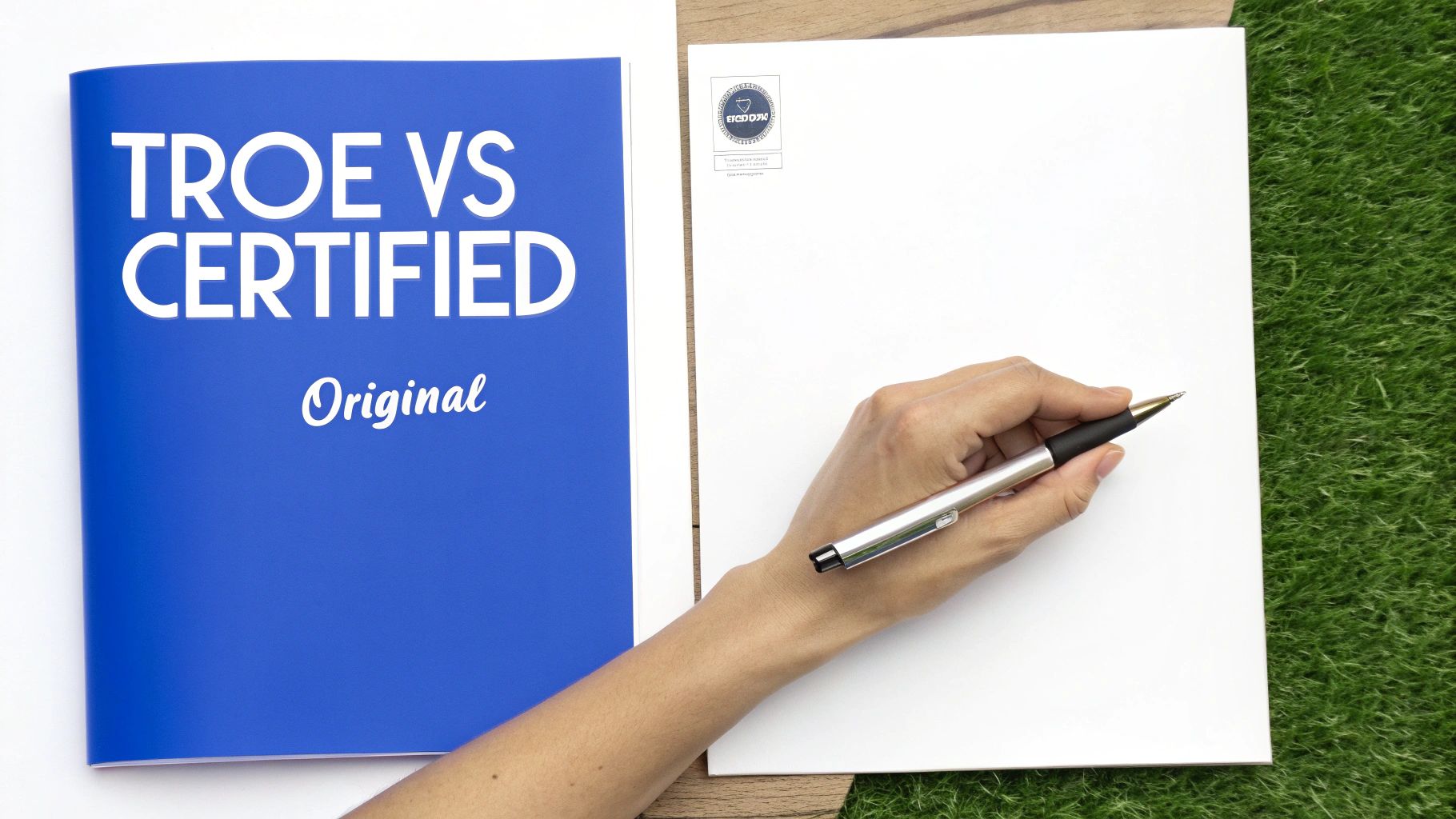
As a business owner, you've probably heard the terms “true copy” and “certified copy” used interchangeably. It’s a common mix-up that can be surprisingly costly. Getting this distinction right is absolutely crucial for keeping your operations moving forward, especially when dealing with banks and official bodies here in Hong Kong.
Think of a true copy as just a high-quality photocopy. It’s a perfect visual replica of your original document, but it has zero legal weight on its own. It’s like a photo of your driver's license—it shows what the license looks like, but you can’t use it to rent a car. You can make one on any office printer, but it’s just a duplicate without any official backing.
A certified copy, on the other hand, is the real deal. This is where a simple photocopy gains its power. A certified copy is a true copy that has been officially verified by an authorized professional—someone like a solicitor, notary public, or CPA. They meticulously compare the photocopy against the original document, page by page. Once they're satisfied it's an exact, unaltered match, they add their stamp, signature, and specific wording to "certify" its authenticity.
From Simple Photocopy to Legal Proof
That simple act of certification transforms the document from a mere duplicate into something legally recognized. The certifier is essentially putting their professional reputation on the line, vouching that your copy is a faithful and unaltered reproduction. It’s a critical safeguard that underpins the entire compliance system.
For any SME founder, this distinction is everything. If a bank asks for a certified true copy and you submit a simple photocopy, it will be rejected instantly. This isn't just a minor hiccup; it can halt your bank account opening, delay your company registration, or even jeopardize a critical business deal.
A true copy shows what the original document looks like. A certified copy proves it. That certification is the official seal of approval that institutions need to meet their compliance obligations.
What Does Certification Actually Add?
So, what transforms that piece of paper from your printer into a document with legal weight? The certifier adds several key elements:
- Specific Wording: A clear statement, often from a rubber stamp, saying something like, "I certify this to be a true and correct copy of the original document sighted by me."
- Signature: The personal, handwritten signature of the authorized professional.
- Date: The date of certification is vital. Most institutions will only accept documents certified within the last 3-6 months.
- Professional Details: The certifier must clearly state their full name, professional title (e.g., Solicitor, Notary Public), and sometimes their official registration number or firm name.
Grasping this is the first and most important step to avoiding frustrating delays. When a Hong Kong bank or government agency asks for a certified true copy, they need the complete package: the photocopy plus the professional verification. Anything less simply won't work.
Who Can Legally Certify Documents in Hong Kong
When you need a document certified in Hong Kong, you can’t just ask any professional you know. The list of individuals with the legal authority to provide a true and certified copy is quite specific. Getting it wrong is a guaranteed way to have your documents rejected, leading to frustrating and expensive delays for your business.
Think of these authorized individuals as the official gatekeepers of authenticity. They have been entrusted by law to verify that a photocopy is a perfect, unaltered match of an original document. Nailing this first step is key to a smooth compliance journey.
The Main Professionals Who Can Certify
In Hong Kong, the authority to certify documents rests with a select group of licensed professionals. Each has a slightly different scope, so knowing who to turn to can save you a lot of time and effort.
The primary certifiers you'll be working with are:
- Solicitors: A Hong Kong-qualified lawyer is often the most common and reliable choice for domestic business matters, like certifying documents for a local bank account opening or company registration.
- Notaries Public: While all Notaries Public are solicitors, they hold extra qualifications that allow them to handle documents intended for international use. If you’re sending paperwork overseas, a Notary Public is usually the right choice—their official seal is recognized globally under The Hague Convention.
- Certified Public Accountants (CPAs): A practicing CPA in Hong Kong is also authorized to certify documents, particularly those related to financial or corporate records. This can be a very practical option if a CPA is already managing your company's accounting or audit.
Choosing the right professional is crucial. A solicitor might be perfect for your local banking needs, but if you're setting up an overseas subsidiary, a Notary Public is the safer, and often mandatory, choice.
Considering the Cost and Context
The price for obtaining a true and certified copy can vary significantly. You can expect to pay anywhere from a few hundred to several thousand Hong Kong dollars, depending on the professional you choose and the number of documents. A single-page certification by a solicitor will be on the lower end, while a complex, multi-page document needing notarization for international use will naturally cost more.
This process is a cornerstone of the city's fast-paced corporate world. To give you some perspective, in the first half of 2025 alone, the Hong Kong Companies Registry processed a staggering 1,678,809 documents. That figure highlights the sheer volume of official paperwork that keeps the city's economy moving.
With 84,293 new local companies registered in that same period, the demand for properly certified true copies is more critical than ever to maintain trust and order.
Your company secretary service can usually point you in the right direction, connecting you with the appropriate professional to get your documents certified correctly the first time. Taking this step helps you sidestep the common pitfall of using someone who isn't authorized to certify.
A Step-by-Step Guide to Getting Your Documents Certified
Knowing the theory is one thing, but as an entrepreneur, you need a clear, practical plan. Let's walk through the entire process of getting a true and certified copy. We'll break it down into a simple, actionable checklist to turn a potentially confusing task into a straightforward one.
Following these steps will help ensure your documents are accepted on the first try, saving you from the headache of frustrating delays.
Step 1: First, Confirm the Exact Requirements
Before you even think about finding a certifier, you need to know the rules of the game. Get in touch with the institution that needs your documents—be it a bank, a government agency, or a business partner—and find out precisely what they require. A bank in Hong Kong will have different standards than a government agency in another country.
You'll want to ask some very specific questions:
- Who can certify? Do they require a Notary Public, or will a solicitor or CPA suffice?
- How recent does it need to be? Most institutions won't accept a certification that's older than three to six months.
- Are there any special instructions? Some banks have specific wording they prefer, or they might require multi-page documents to be bound together in a particular way.
Getting this information upfront is the most critical part of the process. It prevents you from wasting time and money on a certification that will be rejected. This is especially true when you prepare compliance documents for a bank account.
Step 2: Get Your Documents in Order
Once you have the rulebook, it’s time to gather your materials. You’ll need to bring two key items to your appointment with the certifier.
First, the original document. This is non-negotiable. The entire point is for a professional to see the genuine article with their own eyes. Second, a clean, high-quality photocopy. Ensure it's perfect—no smudges, no blurry text, and nothing cut off at the edges. A poor copy is an immediate red flag and will almost certainly be rejected.
This infographic shows the typical workflow you'll encounter with different certifiers here in Hong Kong.
As you can see, each professional—be it a solicitor, notary, or CPA—has a distinct role, whether it’s a legal review or a financial check.
Step 3: The Certification Appointment Itself
This is the moment of truth. During the meeting, the certifier will carefully compare your original document against the photocopy, side by side. They’re looking for any discrepancies, no matter how tiny.
Once they are satisfied that the copy is a perfect match, they’ll add their official stamp and signature. This is what breathes legal life into the photocopy.
The stamp will usually contain wording similar to this:
"I hereby certify that this is a true and correct copy of the original document, which I have sighted."
This statement, combined with their name, professional title, and the date, is what gives the copy its official standing. It’s a process you’ll frequently encounter with personal identity documents. To give you an idea of the scale, in 2023 alone, Hong Kong's Immigration Department issued 1,090,294 identity cards and related travel documents, certified copies of which are constantly needed for business and banking.
Common Certification Mistakes and How to Avoid Them
For a busy entrepreneur, getting documents certified can feel like navigating a minefield. One small mistake can lead to rejections, delays, and a mountain of frustration. Let's walk through the most common pitfalls people encounter when getting a true and certified copy and, more importantly, how you can sidestep them.
Imagine this scenario: you've finally secured the appointment to open your corporate bank account. You hand over your documents, feeling prepared, only to be told the certification is six months and one day old—making it useless. It's a tiny detail, but it can derail your plans for weeks. This is just one of many frequent, yet easily avoidable, mistakes.
Using an Unauthorised or Incorrect Certifier
This is perhaps the fastest route to rejection. A friend who happens to be a lawyer in your home country or a retired accountant simply won't cut it in a jurisdiction like Hong Kong. The list of who can certify documents is specific, and financial institutions adhere to it strictly.
- The Mistake: Asking someone who isn't a practicing Hong Kong solicitor, Notary Public, or CPA to sign your documents.
- The Solution: Always double-check the certifier's credentials. Confirm they are currently licensed and practicing in Hong Kong. If you're ever in doubt, ask your bank or corporate services provider for a referral. They’ll point you to a trusted professional.
Submitting an Outdated Certification
A certified copy has a shelf life. Banks and government agencies need assurance that the document is recent and accurately reflects your current situation. A certification from last year is essentially worthless.
- The Mistake: Submitting a true and certified copy that was signed and dated more than three to six months ago.
- The Solution: Make certification one of the last items on your to-do list before submitting your application. Get into the habit of checking the date on the stamp before you send anything. This simple check not only saves you from delays but also shows the bank you're detail-oriented—a key part of their initial risk assessment. You can learn more about how banks assess risk during the onboarding process in our detailed guide.
Failing to Certify Every Page
For any multi-page document, like your passport or a detailed contract, only certifying the first page is a classic error. The reasoning is straightforward: if a page isn't certified, it could theoretically be swapped out or altered.
Think of it like a security chain for your document. Each page needs to be linked to the others with a signature or stamp. If even one link is missing, the entire chain is broken, and the document's integrity is compromised.
- The Mistake: Only getting the cover page of a multi-page document certified.
- The Solution: Insist that the certifier signs or stamps every single page. For longer documents, they are sometimes bound together with a ribbon, with the professional's seal placed over the knot. This makes it impossible to add or remove pages without breaking the seal, proving it's a complete and unaltered copy.
Navigating Certified Documents in a Digital World
As business increasingly moves online, the traditional paper-and-stamp method of certifying documents is slowly evolving. We're seeing electronic certifications and digital signatures become more common, promising to streamline verification. For SMEs in Hong Kong, this presents both a massive opportunity and a new set of challenges.
Fortunately, local bodies like the Hong Kong Companies Registry are embracing digital submissions. This is a huge step forward, reducing paperwork and speeding up corporate filings. The challenge, however, is that this digital-first approach isn't universally accepted, creating a real headache for businesses operating internationally.
The Global Divide in Digital Acceptance
Let’s imagine a scenario. You receive a digitally certified copy of your company's incorporation documents, which is perfectly valid for the Hong Kong authorities. But when you email that same file to a bank in Europe, they might reject it, insisting on a physical document with a "wet ink" signature and an embossed stamp.
This is a classic hurdle for modern SMEs. Every country has its own rules and, frankly, its own comfort level with technology. While one jurisdiction might fully embrace electronic verification, another might still cling to traditional paper for their compliance checks.
A key challenge for today's entrepreneur is bridging this gap. The validity of your true and certified copy can change the moment it crosses a digital border, depending entirely on the recipient's local regulations and technological readiness.
In this landscape, it’s vital to understand the security and legal standing of tools like a digital signature, which helps prove a document's authenticity. As the rules evolve, the smartest move is to stay informed about which countries accept digital certifications and which still demand paper. The golden rule? Always check with the recipient before you get anything certified.
Got Questions? We've Got Answers
Navigating the world of document certification can feel complex, and it’s natural for questions to arise. To help you avoid any last-minute roadblocks, here are some quick, practical answers to the questions we hear most often from entrepreneurs setting up in Hong Kong.
How Long Is a Certified Copy Good For?
This is a big one. While there isn't a single universal expiry date, most banks and government agencies in Hong Kong will question a certification that's more than three to six months old.
Think of it as a "best before" date. The institution receiving the document needs confidence that it's still current and hasn't been superseded. Best practice is to get your documents certified as close as possible to the date you plan to submit them.
Is a Colour Photocopy Okay to Use?
Absolutely, and in many cases, it's the preferred option. A high-quality colour copy makes it much easier for the certifier to confirm it's a perfect match to the original, especially for documents like passports with photo IDs and security features.
The critical factor is the quality of the copy itself. Whether you choose colour or black and white, ensure it’s a sharp, clean reproduction. No smudges, no blurs, and definitely no cut-off text or edges.
What If My Original Document Is an Electronic File?
This is becoming increasingly common. If your original document is digital—like a PDF bank statement or an e-copy of your company's incorporation certificate—you can't simply print it and have it certified in the traditional way.
The process for digital-native documents is different. It usually involves a professional who can verify the authenticity of the digital source itself before certifying a printed version. Not all certifiers are equipped to handle this, and you’ll need to confirm with the receiving institution that they will accept this form of certification. It's still an evolving area, so always double-check first.
Feeling tangled in the red tape? This is exactly where we come in. At Lion Business Consultancy Limited, we provide the hands-on, private advisory you need to ensure every part of your international expansion is smooth and compliant. Let us handle the details so you can focus on growth.