

 Hong Kong
 Singapore
 UAE
UAE

 Malaysia
 Turkey
 UK
UK
 EU
EU
 US
US
 Switzerland
 Bahamas Bank Account
 Cayman Islands Bank Account
 Mauritius Bank Account
 BVI
BVI
 Seychelles

"We regret to inform you…"
It’s the polite but soul-crushing email that lands like a punch to the gut. You've poured weeks into this bank application. Gathered every document imaginable, answered intensely personal questions, and explained your business model until you were blue in the face. All for a cold, digital dead end.
This isn't a minor hiccup; it's a full-stop roadblock. I've seen this exact situation derail more promising startups than almost any other early-stage hurdle. It freezes operations, sinks deals, and adds a mountain of stress to the already wild ride of building a business.
Why the 'no'? What did you mess up? Was it the offshore company? My business partners?
Most founders treat opening a bank account like a simple chore—just another box to tick. Honestly, that's the single biggest mistake you can make in 2025. A bank isn't just giving you an account number; they're taking you on as a new risk partner. In their heavily regulated world, every new client is a potential liability. They're not focused on your brilliant idea; they're trying to figure out if you fit their risk model without giving them a multi-million-dollar compliance headache.
Why You Need a Playbook
To get approved, you have to stop thinking like an applicant and start thinking like a risk manager. This guide comes from years of sitting on both sides of the table, helping entrepreneurs get that "approved" email instead of the one we all dread.
We’re going to reframe the entire compliance onboarding process from a painful obstacle into a strategic mission. It’s about crafting a compelling story, backed by solid proof, that makes the compliance officer’s job a breeze.
Founder-to-Founder Insight: The number one rule of bank onboarding is simple: Don’t make the compliance officer think. Give them a story so clear and a file so complete that saying ‘yes’ is the easiest and safest option for them.
This is your playbook for getting inside the heads of the financial gatekeepers. We'll break down how banks score your business for risk and what you need to do to pass their hidden audits. The goal is to turn your application from a red flag into a client they’re confident to bring on board.
Let’s turn that rejection risk into an approval.
How Banks Secretly Score Your Business Risk
Ever wondered what happens behind the scenes after you hit ‘submit’ on a business bank account application? It’s not just a person shuffling papers. Your business is immediately put through a sophisticated—and often secret—risk-scoring model.
Think of it as a financial background check where the goal is to get the lowest score possible. This isn't about your personal credit history; it's about predicting whether your business profile could turn into a compliance nightmare for the bank. They're not sizing up your profitability. They're sizing up your potential for trouble.
This is exactly why so many perfectly good businesses get turned down. They unknowingly fail a test they never even knew they were taking. Let's pull back the curtain.
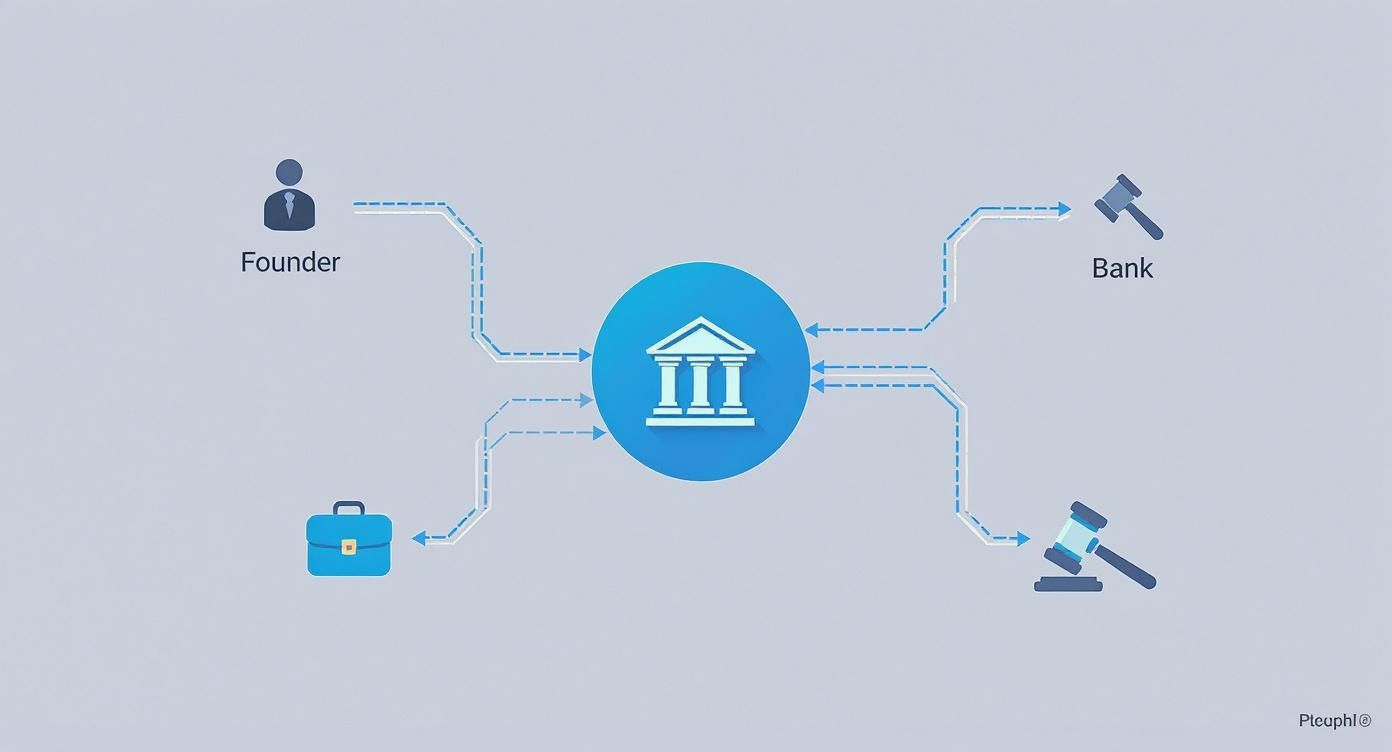
This infographic helps you visualize how the bank sees you—and your company—as two linked but separate entities. Each has its own risk profile that needs to be assessed.
Why Banks Reject Offshore Structures
Where is your company registered? And just as importantly, where do you, the owner, actually live? These are the first questions a bank’s algorithm asks.
A company in Germany with a German founder is straightforward. But a British Virgin Islands company where the founder lives in Dubai and wants to bank in Singapore? That’s instantly seen as complex, and in banking, complexity equals risk until you can prove otherwise.
- Low-Risk: Onshore jurisdictions with stellar regulatory reputations (think UK, Germany, Singapore, Hong Kong).
- High-Risk: Jurisdictions on financial watchlists or those known for banking secrecy.
Most founders don’t realize that offshore company banking isn't impossible. It just demands a much stronger, clearer narrative to justify why the structure exists.
Industry Risk Scoring
Your line of business is a huge factor. Banks bucket industries into risk tiers based on years of data related to money laundering, fraud, and regulatory headaches.
An eCommerce store selling handmade soaps? Low-risk. A crypto OTC desk or a global precious metals trader? That’s an immediate red flag, pushing your application into the high-risk pile. I've seen great businesses struggle simply because their industry code lands them on a bank's internal "caution" list. To learn more about navigating these challenges, our guide on high-risk banking offers specialized insights.
Key Takeaway: Banks aren't judging the legitimacy of your business; they are judging the risk profile of your industry. A perfectly legal business in a high-risk sector needs an absolutely exceptional application to get a foot in the door.
Here's a quick breakdown of common red and green flags.
| Risk Factor | High-Risk Indicator (Red Flag) | Low-Risk Indicator (Green Flag) |
|---|---|---|
| Industry | Crypto, gambling, adult entertainment, money services, arms dealing | SaaS, consulting, local retail, manufacturing, marketing agencies |
| Jurisdiction | Offshore tax havens, countries on FATF grey/black lists | Major onshore financial centres (e.g., UK, USA, Singapore, EU) |
| Transactions | Large, irregular cash deposits; wires from high-risk countries | Predictable, recurring payments from known sources; B2B invoices |
| Structure | Complex multi-layered ownership, nominee directors, bearer shares | Simple, transparent ownership by one or a few individuals |
| Online Presence | No website or a poorly constructed, unprofessional site | A clear, professional website detailing products/services and team |
Understanding these is the first step toward building an application that sails through compliance.
The Transaction Profile
This is all about the money. Where is it coming from, and where is it going? A compliance officer needs to understand your projected cash flow in 30 seconds or less.
Clear, predictable patterns are a massive green flag. For instance, a UK SaaS company receiving recurring monthly subscription payments from clients in the EU and US is simple to understand.
On the other hand, a trading company getting large, sporadic wires from a dozen different countries with no obvious connection screams risk. I once worked with a Turkish exporter whose legitimate payments from EU buyers were constantly being flagged. We solved it by proactively mapping out their exact trade corridors and providing sample contracts and invoices upfront. This turned a high-risk profile into one the bank could comfortably accept.
The Corporate Structure
Finally, the bank puts your ownership structure under a microscope. Who really owns and controls the company? A simple LLC owned by one or two founders is transparent and low-risk.
A convoluted structure involving multiple layers of offshore corporations, trusts, and nominee directors is a compliance officer’s worst nightmare. It sends a signal that you might be trying to hide something, even if your intentions are legitimate.
The internal pressure at banks is immense. Your goal is to anticipate these four pillars and build a profile that scores low on their internal risk audit. To get deeper into the bank's mindset, looking at a comprehensive third-party risk assessment guide can give you a powerful edge.
Building Your Pre-Compliance Onboarding Package
Let's switch from defense to offense. Too many founders treat bank onboarding as a reactive process. They fill out the forms, attach the usual documents, and just hope. Frankly, that’s where you lose all control.
Instead of just submitting an application, you need to build what I call a 'Pre-Compliance Onboarding Package.' This isn't just a folder with your passport and incorporation certificate. It’s a complete, strategic dossier designed to make approval the path of least resistance for the compliance officer reviewing your file.
The goal is to get ahead of every single question they might have. You want to present them with overwhelming clarity. Think of it less as an application and more as a detailed business proposal pitched directly to the bank's risk department.
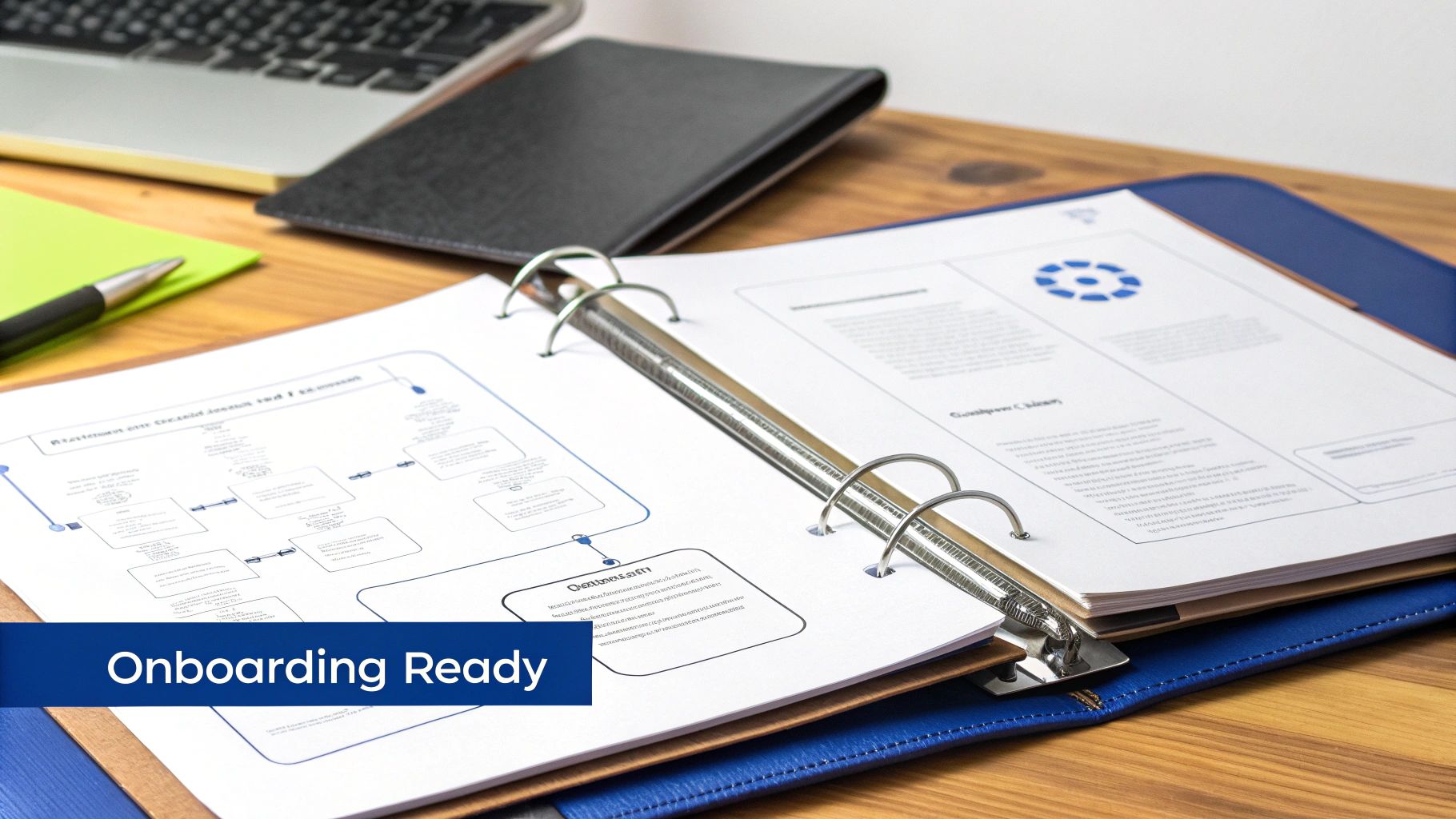
When you do this right, your application stops being a potential liability and becomes an organized, low-risk asset for the bank.
The Business Rationale Memo
This memo is the heart of your package. It’s a punchy, one-to-two-page document that tells the story of your business. But this isn't a marketing pitch; it's a logical breakdown for a risk analyst.
Here's what it needs to nail:
- Your Business Model, Simplified: How do you make money? Who are your customers? Ditch the jargon. A compliance officer should grasp your business in 60 seconds.
- The 'Why' Behind Your Structure: This is critical for offshore company banking. Why did you set up a company in the UAE but need a bank in Singapore? Explain the commercial logic—access to Asian markets, proximity to suppliers, or customer location. A clear economic reason neutralizes the "tax haven" red flag.
- Projected Transaction Flows: Get specific. For example: "We anticipate receiving 10-15 monthly payments from USD 5k-20k from corporate clients in the EU for software subscription fees. We will then make monthly payouts to 3-5 software developers in Eastern Europe and two marketing contractors in the UK." This level of detail builds serious confidence.
I once worked with a SaaS founder with a UAE entity who was getting rejected by every Singaporean bank. The game-changer was his Pre-Compliance Package. The secret weapon? A simple one-page diagram showing his customer acquisition funnel, payment processor flow, and how revenue would land in the Singapore bank account. It made his entire international setup look completely logical.
Source of Funds vs. Source of Wealth
People mix these up all the time, but for a bank, they are critically different.
Source of Funds (SOF) is the initial money used to start the business. Was it from personal savings? A loan? The proceeds from a previous exit? You need a clean paper trail—bank statements, a formal gift deed, or sale documents.
Source of Wealth (SOW) is the bigger picture. It explains how you, the owner, built your personal net worth. This becomes vital during Enhanced Due Diligence (EDD), as banks need to be certain you aren't funding your business with illicit money.
Key Takeaway: A well-documented Source of Wealth statement is non-negotiable. Don’t just write, “I made money in real estate.” Provide the documents: property sale contracts, dividend statements, or a letter from an accountant verifying your income history. The more proof you provide upfront, the fewer invasive questions you'll face later.
Corporate Structure Chart and Sample Documents
Never make a compliance officer guess who owns what. Create a clean visual chart—even a basic one—that maps out all entities, trusts, and the ultimate beneficial owners (UBOs) with their ownership percentages.
Next, bring your business to life with sample documents:
- Sample Invoices: Mock up a realistic invoice for your product or service.
- Sample Client/Supplier Contracts: Have a draft agreement ready that outlines your business relationships.
- A Professional Website: This is often the first thing a compliance officer checks. It has to look professional, be clear, and match the business description in your application.
I’ve seen banks completely reverse their decision after reviewing a single, well-structured invoice trail. It takes your business from an abstract concept to a tangible, verifiable operation. Learning how to prepare comprehensive financial statements can also make your package far more credible.
This proactive approach is the core of the bank onboarding risk playbook (2025).
Navigating Enhanced Due Diligence Without Panic
You’ve submitted everything. Then, the email lands: “We just need a few more details.” This is Enhanced Due Diligence (EDD), and it’s where most entrepreneurs get that sinking feeling.
Take a breath. This isn't a rejection.
An EDD request means a senior compliance officer is taking a personal look. They're intrigued, not dismissive. It's your chance to provide the clarity they need.

Honestly, this is where most applications fall apart. Founders often react with panic, firing back rushed or incomplete emails. The ones who get approved treat it as an opportunity, responding with calm, overwhelming, and perfectly organized evidence.
What Happens During EDD?
When your file gets flagged for EDD, something in your profile has tripped a risk threshold, kicking it out of the automated queue for a manual review. A real person is now trying to resolve lingering questions about your business model, funds, or structure.
Their job is to build a clear, evidence-backed story that justifies approving you. Your only job is to make it easy for them to say "yes".
Common EDD Document Requests
The questions almost always revolve around the same core areas. Be ready to provide deeper proof for things like:
- Source of Wealth (SOW): They might want more than your initial declaration. Get ready to pull out old tax returns, dividend statements, or the sale agreement from a previous business.
- Business Model Verification: The bank needs to see your business isn’t just a concept. This could mean providing signed client contracts (with sensitive data redacted), project proposals, or a live demo of your software.
- Transaction Justification: If you work with clients or suppliers in high-risk countries, they’ll want to know exactly why. Provide supplier agreements, shipping contracts, or letters of intent.
- UBO Verification: For layered corporate structures, they may need more direct proof of the Ultimate Beneficial Owners, sometimes requiring a notarized affidavit.
I recently helped an offshore shipping company whose web of international registrations triggered an EDD review. Instead of scrambling, we calmly submitted the vessel ownership records, key charter agreements, and a one-page memo explaining their primary trade routes. The account was approved in under a week.
Founder-to-Founder Insight: The single biggest mistake I see during EDD is sending bits and pieces of information. Respond with a neatly organized .zip file where every document is clearly labeled. Add a brief cover note that lists each item you’ve provided. That level of professionalism makes a huge difference.
The entire compliance onboarding process is evolving. Building a clear narrative isn't just about opening the account; it’s about keeping it, as we discuss in our guide on how to maintain compliance with a Hong Kong bank account. Pass the EDD test, and you'll build a strong foundation of trust with your new bank.
The Future of Bank Onboarding and How to Prepare
The rulebook for the compliance onboarding process is being rewritten by technology. As we look towards 2025, a few key trends are becoming the new reality. Understanding what’s coming is a real strategic advantage.
AI-assisted KYC, reusable digital identity "passports," and real-time sanctions monitoring are becoming standard. For founders, this is a double-edged sword. It promises a faster process, but it also means automated systems can flag the smallest inconsistency with ruthless efficiency.
Rise of Virtual Banks and Digital-First Compliance
One of the biggest shifts is the rise of specialized virtual banks, especially in hubs like Hong Kong. They offer quicker onboarding, better multi-currency support, and lower fees—a huge draw for global SMEs.
But this points to a deeper change. Virtual banks are built on modern tech, letting them bake in automated risk-scoring and continuous monitoring from the start. This makes having a clean, verifiable, and digitally native corporate history more critical than ever.
Key Takeaway: Think of compliance less as a one-off hurdle and more as a continuous, tech-driven process. The work you put in today to organize your business digitally will be your most valuable asset in tomorrow's automated banking world.
How to Reduce Onboarding Risk Score?
So, how do you prepare for this automated future? Start by building your business as if it’s already here.
Your future-proofing checklist:
- A Professional Web Presence: An automated KYC system will check your website. It must clearly explain what your business does and match your application.
- Digitally Verifiable Documents: Ensure all corporate documents are scanned in high resolution and are easily readable by OCR software.
- Consistent UBO Information: The names and details of your Ultimate Beneficial Owners must be identical across every single document. AI is incredibly good at spotting tiny discrepancies.
The future of banking in Hong Kong is a perfect example of these trends in action.
Ultimately, the bank onboarding risk playbook for 2025 is about preparing for a world where technology is the main gatekeeper. If you anticipate these shifts, you’re setting yourself up not just to get your account approved, but to thrive.
Your Action Plan to Become Bank-Ready
Let’s get practical. Stop thinking like you're asking for a favor. Start acting like a strategic partner who makes the bank’s life easy. Control your story from the beginning.
Getting a business bank account isn't about luck; it's about meticulous preparation. You need to present your business with the clarity and professionalism that compliance officers expect. The aim is to hand them a file so complete that saying "yes" is the most logical choice.
The "Am I Ready?" Checklist
Before you fill out an application, be brutally honest with yourself. If you answer "no" to any of these, you have more homework to do.
- Is my ownership structure crystal clear? Have I drawn a simple chart showing who owns what?
- Can I justify my company's location? If you're using an offshore jurisdiction, you need a solid business reason—and "tax savings" isn't a good enough answer on its own.
- Is my Source of Wealth fully documented? Can I pull out the paperwork to show exactly where my initial capital came from?
- Does my website look the part? A compliance officer will Google you. Your site needs to look professional and match what you say your business does.
- Have I got sample invoices and contracts ready? These prove your business model isn't just an idea; it’s a real, operating entity.
Your Secret Weapon: The Onboarding Package
Your Pre-Compliance Onboarding Package is designed to answer every question a banker could have before they ask. This package is non-negotiable and should contain your Business Rationale Memo, corporate structure chart, Source of Wealth documents, and sample operational paperwork.
This is the heart of the bank onboarding risk playbook (2025). You’re not just applying for an account. You're demonstrating that you are a low-risk, high-quality client that any bank would be smart to work with.
If you’ve got this package organized and can tick off every item on that checklist, you’re in a great position.
However, if you're dealing with complex international structures or operate in a "high-risk" industry, expert guidance isn't just an expense—it's a critical investment.
At Lion Business Co., we build these bank-ready strategies day in and day out. If you're ready to lay the proper financial groundwork, it might be time to book a professional consultation.
Answering Your Toughest Bank Onboarding Questions
I get asked these questions all the time by founders. Here are some straight-talking answers, based on years of getting clients through this exact process.
"Why Do Banks Seem to Hate Offshore Companies?"
They don't hate offshore companies; they're allergic to anything that looks opaque. Certain offshore jurisdictions have a reputation for secrecy, which puts compliance officers on high alert.
Bearer shares, nominee directors that obscure who's in charge, or a structure that doesn't make commercial sense are almost guaranteed rejections. They assume the worst.
Your job is to shatter that assumption by demonstrating real economic substance. Show them a clear ownership chart and give them a rock-solid business reason for your setup—serving a specific market, proximity to a supply chain, etc. It's about providing facts so they don't have to fill in the blanks with suspicion.
"How Can I Lower My Company's Risk Score?"
You can simplify your corporate structure or choose a well-regarded jurisdiction. But the single best thing you can do is prepare a comprehensive pre-compliance package.
I’m not exaggerating when I say I've seen success rates jump to 85–95% when a proper package is submitted. You're anticipating every tough question and answering it for them in advance. When you clearly document your business model, source of funds, and transaction flows, you remove the guesswork. You go from being a potential risk to an easy "yes."
"What's a Realistic Timeline for Getting Approved?"
This is the classic "how long is a piece of string?" question, but I can give you some reliable goalposts. A straightforward domestic company at a neobank could be approved in days.
For more complex, international structures dealing with traditional banks, a realistic timeframe is anywhere from 3 to 6 months. This is especially true if you trigger Enhanced Due Diligence (EDD).
The one thing that puts you back in control of the timeline is preparation. Every missing document or vague answer adds weeks of painful back-and-forth. The secret to faster approval isn't a secret—it's getting everything perfect the first time.
Trying to untangle these knots on your own can be a frustrating, time-consuming ordeal. At Lion Business Co., we specialize in building robust, bankable strategies for complex international businesses.
If you’re ready to secure the financial foundation your business deserves, let's talk. Book a private consultation with our advisory team and we can get started.